Category Archives: Media and politics
Three Important Studies in Digital Media and Politics
Below are summaries of 3 studies that represent trends and progress in digital media and politics. They are of particular interest and represent highlights from 2013. More details are available from the Shorenstein Center.
The first study demonstrates empirically that the global village is increasingly a reality. Most twitter contributions are beyond the local geography and represent a new pattern of interaction.
“Mapping the Global Twitter Heartbeat: The Geography of Twitter” Study from the University of Illinois Graduate School of Library and Information Science, University of Illinois at Urbana-Champaign, published in First Monday. By Kalev Leetaru, Shaowen Wang, Guofeng Cao, Anand Padmanabhan, and Eric Shook.
One of the most comprehensive assessments to date about the effect of new technologies on human communications worldwide, this study examined patterns among more than 1.5 billion tweets from 70 million users over a one-month period in late 2012. It provides empirical evidence that the world is indeed shrinking: “There appears to be only weak geographic affinity in communicative link formation in that users retweet and reference users far away nearly as often as they do those physically proximate to them.” Further, on average people tweet news that happens locally and news about far-away events with about equal frequency. Twitter is “not simply a mirror of mainstream media” and has its own distinct conversational dynamics. The data also show that significant portions of the “world’s most influential Twitter users” were in places such as Indonesia, Western Europe, Africa and Central America. The overall takeaway is that where we live is beginning to matter less in terms of our knowledge, interests and social networks: “Geographic proximity is found to play a minimal role both in who users communicate with and what they communicate about, providing evidence that social media is shifting the communicative landscape.” – See more at: http://journalistsresource.org/studies/society/news-media/digital-media-scholarship-dozen-highlights-2013#sthash.AtZXGfyh.dpuf
The study below demonstrates that incivility online damages expert credibility and distorts the communication process. The study was responsible for a magazine shutting down its comments section.
“The ‘Nasty Effect’: Online Incivility and Risk Perceptions of Emerging Technologies” From George Mason University and University of Wisconsin-Madison, published in the Journal of Computer-Mediated Communication. By Ashley A. Anderson, Dominique Brossard, Dietram A. Scheufele, Michael A. Xenos, and Peter Ladwig.
The study, published in February, has the distinction of being one of the few to actually help change editorial policy this year at a publication. Popular Science cited the study in its announcement that it was shutting down its comments section to push back against a perceived “war on expertise.” There remained some controversy, however, about whether the study’s conclusions were broad enough to justify that editorial decision. The researchers used online surveys with embedded experiments to test how people responded to articles about nanotechnology; some were accompanied by nasty comments, others not. The study’s findings suggest that “impolite and incensed blog comments can polarize online users based on value predispositions utilized as heuristics when processing the blog’s information.” Further, the researchers note, “The effects of online, user-to-user incivility on perceptions towards emerging technologies may prove especially troublesome for science experts and communicators that rely on public acceptance of their information. The effects of online incivility may be even stronger for more well-known and contentious science issues such as the evolution vs. intelligent design debate or climate change.” – See more at: http://journalistsresource.org/studies/society/news-media/digital-media-scholarship-dozen-highlights-2013#sthash.AtZXGfyh.dpuf
The third study is an interesting and important summary of the role of the Internet and political campaigns
“The Internet and American Political Campaigns” From George Washington University, published in The Forum. By David Karpf. (Pre-print open version here.)
Part of a growing cohort of academics pioneering the subfield of online politics, Karpf provides a short, useful summary of the state of research in this area. For journalists, the works cited page alone is a valuable who’s who — fill up that contact list for campaigns 2014 and 2016 — but the narrative also underscores some basic truths: The web has not changed many forms of participatory inequality; polarizing candidates frequently win the small donations race; the “culture of testing” and analytics are changing how campaigns allocate resources; liberals and conservatives typically use technology differently for campaigns. One striking insight: “We are potentially moving from swing states to swing individuals, employing savvy marketing professionals to attract these persuadables and mobilize these supporters with little semblance of the slow, messy deliberative practices enshrined in our democratic theories.” But definitive answers remain elusive on many other fronts. “There is still, frankly, a lot that we do not know,” Karpf writes. For more insights in this area, see Kathleen Hall Jamieson’s response, “Messaging, Micro-Targeting and New Media Technologies.” – See more at: http://journalistsresource.org/studies/society/news-media/digital-media-scholarship-dozen-highlights-2013#sthash.AtZXGfyh.dpuf
End the Year with Top Biased Photos
Let’s return to the issue of biased images. Click on the link below and check out some of the most biased and obviously manipulated images – not necessarily from the previous year – and think a little bit more about how to protect yourself from such manipulation.
You can see that there are essentially four strategies to manipulating images. The first is termed deliberate staging. This is pretty self-explanatory and refers to using objects to increase the emotional intensity of the message or stimulate a particular conclusion that might not be warranted otherwise. It represents a blatant lie and the crude manipulation of an image by placing objects in the image that were not there in the first lace. The second strategy is called fauxtography. This is making something look like a photograph that really is not. So you can see in the one image how a fired missile was captured on the computer and reproduced to make it look like another missile was fired and increase the impression of military might and competence. This is particularly simple in the era of computer photography and Photoshop. The third way to manipulate images is through perspective and angles. Close-up shots of a few hands make it look like there are more people present then in actuality. Wide-angle shots give a different perspective than narrow angle shots. Finally, visual images can be recycled or reused. Pictures of injured or dead soldiers can be simply reused in order to make the scene appear more emotional or communicative of violence than actually occurred.
The ethics of digital manipulation of the news in particular are clear – it is unacceptable. There are debates about photo manipulation with respect to aesthetics or beauty. I have encountered the argument that enhancing beauty or engaging in numerous manipulations for the purpose of aesthetic enhancement only is acceptable. I can accept that. It is not very troubling that a movie star on the front of a magazine has blemishes removed and positive highlights. But a “news” story that is supposed to be telling some semblance of the truth is a different matter.
I have encountered the argument that enhancing a photograph through any of the four methods described above, for the purpose of what the perpetrator considers increased clarity and specificity, is acceptable. So, if a building is blown up and some children are killed then placing a baby’s toy in the center of the image enhances the significant emotional truth of the story. This is, of course, a weak argument that is dangerous since its acceptance justifies any sort of manipulation. Moreover, even if children were killed in an explosion there are numerous emotional and political issues that would be forced to the background because of an individual’s doctoring of the image. And although such an argument has been made is accepted by no reliable or trustworthy news organization.
Deliberation and Exposure to Differences: The Importance of “Hearing the Other Side”
The below is adapted from my book on deliberative communication. A full citation appears on the “deliberation issues” page.
One of the key issues for the news media, either print or broadcast, with respect to its contribution to deliberation is its ability to expose people to the other side of a conflict. This is an essential component of any conflict-resolving endeavor on the part of the media. Ethnopolitical conflicts face the problem of cognitive and moral differences that emerge from different conceptual frameworks used by different cultural groups. These differences can undermine the possibility of finding common ground. It is true that different conceptual frameworks surface from a lack of common ground and the different moral and cognitive grounds are greatest between groups with the greatest cultural and political differences. But the first requirement for invigorating the discourse of opposing views is exposure to the other side, or exposure to disagreement. The media in a conflict can play a particularly important role in exposing one party to the arguments, perspectives, and emotions of the other side.
Exposure to conflicting groups with different political and conceptual moral domains is the essence of the media’s role in the deliberative and democratic process. It is the media’s most fundamental contribution to conflict resolution. Peace and conflict resolution does not depend on similarity among conflicting parties because such a condition will never be met. Rather, the ability to create meaningful discourse between divergent groups is most important. The psychological tendency to balkanize and polarize ourselves is powerful and has become a concern to conflict specialists as a result of increasing tendencies toward emphasizing differences and distinctions. The press has been increasingly remiss at stimulating significant discussion across differences and people retreat into media enclaves and are exposed to different political discourse. In general, as Mutz (2006) reports, exposure to divergent opinions is a positive quality of democratic values because it helps people understand the arguments and rationales for those who think differently. And democratic values are even more encouraged when people actually reach across differences and try to engage others. True, that engaging those who are different than us can be dangerous and risk termination of the relationship, but the rewards are considerable if the risk is overcome. The elite press in particular must confront the effects of fewer opportunities to learn about others by making conflicting discourses available to its audience.
Hearing the other side, which makes one aware of legitimate and defensible arguments from the other side, also improves tolerance for differences. The ability to see more than one side of an issue translates into tolerance because recognition of a defensible argument makes it easier to accept the argument or lend it credence. I may not accept the opposing argument in the full sense of the word, but I can tolerate it. I will be more willing to compromise my own position and extend recognition to the other. This tolerance for differences is invigorated should the differing parties to a conflict have any sort of personal relationship. Typically during protracted ethnopolitical conflicts, where peace processes are often started and stopped, the participants to the conflict have contact with one another which results in trust improvement and some sense of a personal relationship. This development of even an imperfect personal relationship between “enemies” can weaken the identity-based differences between the two and lessen the probability of conflict erupting because of differences. Even a small personal tie will contribute to tolerance.
By demanding that the media expose publics to disagreement and different opinions, I am not suggesting that the media fail if they do not meet an idealized standard of perfect balance. Such balance is probably impossible to define, let alone attain. And it is impossible to impose such a requirement on any one news outlet. It is probably true, however, that the marketplace of ideas works well enough as long as there is sufficient diversity and competition in the information environment. Competition for news and information is effective and clear ideas will find their way into both conflicting communities. The crucial factors for a deliberative media are competition and diversity. When opposing viewpoints contend shared values are more likely to emerge. The online environment poses an interesting example because as Wojcieszak and Mutz (2009) discovered, exposure to the others who disagree occurs more with nonpolitical groups. They studied chat rooms and message boards and discovered that politically oriented networks tended to agree with one another in the first place. Thus, one is more likely to be exposed to political disagreement in casual networks not devoted to politics.
The War and the Digital War
I suppose it was inevitable that the union of war and new media would spawn some strange offspring that looked like a combination of hip media and varieties of war. Terrorists, revolutionaries, and disenfranchised citizens are carrying laptops, hand-held cameras, and phones into battle and posting real-time and unedited messages on Twitter and Facebook.
In 2003 we saw the early effects of new media when telephones were able to capture images such as Abu Ghraib and turn the site into an international symbol of torture. You can watch YouTube videos of Syrian rebels fighting government forces in real-time. The video takers are now part of the battle and have specific assignments and training. You can hear the video takers cry “Allahu akbar” when he successfully captures a photographic moment. We could call this the “YouTube war” because of the union of cell phones and social media that make it possible to furnish the world with real-time war. And YouTube does not delete very many videos; thus, there are some graphic pictures and raw scenes that even amount to crimes. You can see an example here but be forewarned .
The rebel videos in Syria are accompanied by English translations and commentary which touts the successes of the Syrian rebels. According to one article in the Wall Street Journal in September 2013 the rebels have hired accomplished graphic designers with stylized script to enhance the effects. It is not uncommon to leave cell phones and cameras on dead bodies so their content will be picked up. Some videos are designed for religious audiences and contain religious messages. A good reading on the use of social media in revolutionary movements appears in the online publication Small Wars Journal. It is free and easily available.
Some Ways New Media Has Changed Revolutionary Movements
Authoritarian regimes have always tried to control traditional media (radio and television) and have usually had the upper hand. But now the rebels have increased information and can gather intelligence more skillfully. Sophisticated American intelligence tries to understand the battlefield but revolutionaries now do it with amateur videos uploaded from handheld devices. Moreover amateur video legitimizes the narrative of partisans and insurgents. It is the first real countermove in the effort to weaponize information against authoritarian regimes. Propaganda is now a tool everyone has access to.
Secondly, the public sphere aspect of new media allows for mobilization. In Egypt in 2011 the phrase “We are all Khaled Said” on Facebook was a significant aid to youth mobilization during the 18 days in Tahrir Square. In one interesting development rebel fighters have Twitter and Facebook accounts in which they reveal their identity and answer questions “on the field.” They do not divulge locations but other than that the fighters use these social media to disseminate information and establish an online identity. They are completely comfortable with exposing themselves probably because they are simply used to sharing one’s identity online.
But third, social media cannot put weapons on the battlefield so it has its limitations. And state regimes have their resources and instruments of oppression that can easily overwhelm social media. Moreover, social media are particularly good at forming weak ties that are not accompanied by energized activism. Those who are members of Facebook networks make few real sacrifices and are “weakly tied” to the cause.
Finally, it is a little frightening to imagine the worst of all possible outcomes. Although new media in the form of videos uploaded on YouTube were instrumental in prompting debate about Western intervention in Syria and use of chemical weapons, there were also thousands of recorded atrocities before that and nobody paid attention. We might end up being increasingly entertained and narcoticized by images of war, and at the same time feeling just fine about doing nothing.
Are You Offended by This Picture?
Are you offended by the picture below? Perhaps not but many people are. It violates a variety of moral foundations with respect to the interpretation of political messages (see a review here).

The photo is of an American soldier hugging a Muslim woman in a niqab. It is an actual ad inspired by a real couple. At first glance it looks like a political statement with respect to American forces and their concern for local citizens in Iraq or Afghanistan. But the billboard is an ad for a throat spray that is supposed to help people stop snoring and thus keep them “together.” The ad does successfully pass the first rule of advertising which is to capture attention. But for some people this togetherness is too soon after 9/11, and for others it is shoving political correctness down our throats. Others find the ad endearing.
Some research did reveal that the soldier is real and one question that can be asked is why is an American soldier in uniform doing an ad for a commercial company? Well, that’s a good question but not what I’m interested in. It’s more interesting to examine the various responses to the ad and why some find it loving and inclusive and others distasteful and offensive. How you respond seems to be a matter of what sort of moral issues you are concerned with.
Jonathan Haidt of course in his book Moral Foundations Theory (http://righteousmind.com) has explained how liberals and conservatives differ with respect to which moral systems they respond to. Haidt identifies six moral foundations and they are briefly: care/harm, liberty/suppression, fairness/cheating, loyalty/betrayal, authority/subversion, and sanctity/degradation. I won’t elaborate on them all for space considerations but a few insights are worthy.
The care/harm distinction evolved from the need to care for children and is now stimulated by messages about suffering in distress. Compassion is a strong emotion here. For conservatives, however, that compassion is more associated with members of your own group than an outgroup. Conservatives are more likely to help members of an ingroup rather than an outgroup. For liberals, care and compassion are more universal and might be triggered by anyone suffering. There is a subtle element of this in the photograph as the soldier seems to be caring for the woman. Liberals who are more responsive to universal care are more likely to accept the photograph and find it less troublesome.
The sanctity/degradation continuum is also particularly important to those with a conservative ideology. Early in our evolutionary history there was a survival advantage to avoiding human waste, decaying food, and health threats of all types. Haidt argues that many objects as a consequence became sacred and we wanted to protect them against desecration, thus setting into motion “sacred” images, flags, and words. American conservatives tend to bestow sanctity quite easily on objects such as flags, ideologies such as capitalism, and desecration on the other things such as homosexuality and foreign objects. The image of the Muslim has become contaminated and clearly by many with strong conservative ideologies seen as a threat and something to be avoided. The most conservative viewers of the photograph are the most “put off” because they see the sanctity of the American soldier being degraded by contact with an impure other.
We respond to things not only according to our economic interests our moral ones. The argument that we have evolved these moral standards over time and as a result of evolutionary needs does seem to be defensible enough. A few of these moral standards such as “caring,” “fairness,” and “sanctity,” are clearly the divides that separate moral reasoning. A strong liberal will be more supportive of using government to level the playing field and achieve a sense of fairness; whereas, a conservative who is consistent with conservative values will defend traditions and infuse some objects and ideas with “sanctity.”
The soldier in the photograph is more sanctified than the woman and that’s why we immediately perceive his threat and express suspicion about her. So what you see and how you interpreted is certainly not an objective processing of an image, but an interpretive act that includes the interaction of your political predispositions with the object of interest.
How New Media Changes Religion: Goods Not Gods
Data seems to pretty clearly indicate that Americans in particular are changing their relationship with religion. It has been commented upon and written about with increasing frequency. The most typical change reported is that religion is becoming more individual; people are picking and choosing their own beliefs and practices and forming hybrid combinations that represent individual feelings and emotions. Moreover, private and subjective spirituality is replacing what were once coherent religious beliefs rooted in history and social and intellectual development. Finally, we hear more and more about the abandonment of institutions and the community’s general distaste for long-standing religious institutional doctrine and practices. Somehow the accumulated wisdom that informs institutional practices is fading away to be replaced by private preferences.
Bryan Turner, writing in the Social Science Research Council, offers up some interesting insights into the relationship between communication and religion (go here). Traditionally, the religious practice of communication was authoritative and hierarchical. It was a unitary system of beliefs influenced by clearly established sources of knowledge and wisdom (Popes, Priests, Imams, Rabbis). One receives messages and information from authoritative sources and the layperson’s communication was a node in a hierarchical chain with upward supplication and downward instruction.
New media – in the form of the Internet, Facebook, Web 2.0, cell phones, etc. – has upset this traditional religious communication structure. In the new media environment communication is more horizontal than hierarchical and certainly more diverse and fragmented than unitary. User generated possibilities have changed messages because such messages have become more devolved from authoritative status sources and more subject to negotiation and multiple interpretations. Turner points out that in Islam there has been an inflation of authoritative sources such that any local mullah can turn himself into a source of authority. Knowledge about religion has been democratized such that the Internet and pamphlets are equally as authoritative as individuals. People feel less need to attend their collective religious service because their needs are met with individual preferences and online religion.
Again, in the case of Muslims, they are learning increasingly more from the Internet especially Muslims in the diaspora. There is a correlation between the electronic network and the social network. This correlation has altered various distinctions between types of contact. As I said above, pagers, videophones, email, websites, and cell phones have transformed social relations in religious communities (especially diaspora communities) and offered new ways to theorize those communities. Some authors have explained how communities of people with religions in common use the Internet to cultivate a cosmopolitan democracy that addresses broader issues.
In the future we will see the increasing frequency of new public spheres because electronic media will provide access to thousands of individuals who share interests. The mobilization qualities of new media will make it possible to quickly amass like-minded individuals into electronic communities. Perhaps, we will come full circle and reconstitute larger institutional organizations. Globalization will be very dependent on the Internet as a source of connection to other cultures, including one’s home culture, and the combination of new interpersonal networks with the broad and fragmented information on the Internet will serve to reinforce individualism. Individualism and religion is a two edge sword; it can be associated with rigid thinking and fundamentalism as well as creativity and expressiveness.
New media and horizontal relationships rather than vertical ones will result in a form of individualism consistent with the general commodification of culture. In other words, religious choices and consumption are becoming more important than informed absorption into an established religious system. People want religious “goods” not “gods.” And although established religions will maintain a fair amount of strength and presence, processes for deinstitutionalization are in play as individuals learn to defend their own subjective spirituality and participate more fully in horizontal relationships formed and sustained by new media.
Also posted in Hartfordfavs.com
What’s Happening in This Picture?
It’s always a legitimate question to ask whether or not a photograph is telling the truth.

This photograph was captioned by Time magazine on April 29, 2013. It is reproduced here from Hariman and Lucaites’ No Caption Needed. The photo was slightly enhanced but apparently within journalistic limits.The original caption had an incorrect date and location and although such mistakes can be important it is not my concern at the moment.
You can see, however, that there are additional issues at stake. If you look closely the man being restrained by the police is rubbing his eyes and the one soldier is holding a spray can and pointing it toward him. The restrained man apparently resisted and the soldiers resorted to spraying something in his eyes. You can actually see a small cloud of the spray coming from the canister.
Every time I see one of these photographs I’m reminded of the Eddie Adams photograph of the Saigon chief of police holding a gun to the head of a Vietcong and about to pull the trigger. You can see it here.

This is a Pulitzer prize-winning photograph. Regardless of what you think of the picture it is a powerful and compelling moment that communicates the tension and anxiety just before the instance of having your brains blown out.
The photograph has been associated with lawlessness and the street justice that took place during the Vietnam War and rightfully so. But the man who was shot was a known Vietcong sympathizer who apparently had committed violent acts of his own and was far from innocent. Again, I am not in any way defending the street lawlessness portrayed in the photograph but it is helpful to know what happened immediately before the moment of the photograph. Israelis often complain about a lack of context or understanding about what preceded an Israeli military incursion and that using tanks as weapons is usually a response to earlier aggression rather than an initiative. It is typical for newspapers around the world to show for example an Israeli tank destroying a house and leaving it at that – with the conclusion that Israel is engaging in excessive force. The Israelis are always chagrined at how no one asks who was in that house and what preceded the tank attack. It’s a matter of context.
We might ask the same question about the fellow rubbing his eyes and the soldier holding a spray can. I presume the soldiers are trying to disable the man so that he is no longer a threat.The caption for this picture could have read “Israeli police pepper-spray protester” and directed attention to perhaps improper behavior on the part of the police. Or, the caption could have read “man being arrested” and framed the protester as a criminal.
Lucaites and Hariman (see No Caption Needed link above) elaborate on the role of captions by pointing out that they can tell you what to think about as well as tell you what to ignore. Moreover, it’s interesting to note that this photograph is typically cast as an Israeli “peace image.” Such a classification equates peace with security which, on the one hand, is consistent with the Israeli sense of existential threat that it lives with on a daily basis. Yet, it is not an image of a warm peace rooted in cooperation and mutuality.
Images are powerful and persuasive. The public often forgets that images are designed for particular audiences on the basis of the message they express. Sometimes these designs are highly calculated and represent strategies to reinforce or create new attitudes. The role of images in the peace process – the strategic role – remains reasonably unexamined. There are, for example, moral questions that still challenge the best practices of using photographic images.
New Media and “Information” versus “Deliberation”

The answer to the question about what exactly defines “new media” is usually a list of new technological developments. Web 2.0 is most associated with new media because of its interactivity and user-generated design capabilities. Rather than passive viewing of content on a screen content can be created and shared by users. Examples are blogs, wikis, Facebook, twitter, you tube, pod casts, social networking, RSS feeds, and each have numerous marketing and social applications. The most popular of these are the social networking sites (SNS) such as Facebook, Myspace, and YouTube. For our concerns here, it is necessary to locate these technological developments within communication and deliberative political processes. We can begin by making the distinction between “mediated information” and the “deliberative experience.” New media is mostly helpful with the mediated information environment; that is, it stresses an information environment composed of the press, television, blogs, talk radio, etc., and the quality of discussion among people. It contributes more to the information community rather than the public. New media makes information available in asynchronous time and space. Except for research on online discussions new media is not usually associated with the deliberative experience which involves a form of dialogue to seek a new consensus. This is not to diminish its importance in the information society. Facebook, for example, has been successful at establishing discussion forums that facilitate public discourse. In fact, ideal speech conditions are enhanced in some instances.
During the 2008 presidential election, Facebook was used seriously for political communication. The campaigns followed traditional communication strategies, but included Facebook as well. Facebook can facilitate communication. It combines the features of local bulletin boards, newspapers and organization and places them in one location that is available any time any place. Also, political leaders can use Facebook as a medium to communicate with members of the public or their own group. It thus provides leaders with an effective way in which they can reach the public. The Israelis and Palestinians have numerous Facebook pages devoted to peace, friendship, the two-state solution, the nature of the conflict as well as partisan and ideologically narrow pages.
New media played a role in the 2009 Iranian elections as well as providing information and contact with the outside world during protests. Twitter was used by people outside Iran to spread information and report on what was happening. These media also made it possible for women, whose participation is restricted by Islamic law, to play a more significant political role. The mainstream media also benefited from new media because new media users send out information when the traditional media are banned. In other examples, social media played an increasingly significant role in the Gaza war of 2008-2009 termed “Operation Cast Lead.” Israel mounted its own YouTube site to show off the accuracy of its weapons, and Hamas used blogs to demonstrate their strength (Arab Media, 2009). Banning the traditional media, as was the case in Gaza, makes it possible for a political entity (e.g. Israel or Hamas) to have more control over the message. This empowers so called “citizen journalists” and gives them some control over content, but still lacks the depth and breadth of professional journalism. Not all new social media is very successful. Facebook, for example, receives a lot of media attention and can attract support, but its group formation requirements are so low that individuals show little commitment. People join Facebook groups to express personal identity and solidarity with others because it cost little and requires even less from them.
What we call new “social media” has a few unique qualities that sometimes, but not always, makes them adversative to the political process. The Habermassian public sphere is a communicative arena for rationale, inclusive deliberative discourse; it is an environment where participants in a conflict can get together for debate and discussion under maximally communicative conditions. But new social media are characterized by deterritorialization, that is, a mediated publicness of non-localized space. The participants are spread out geographically and the interaction is an attempt to be intimate and authentic rather than rational and focused on the common good. But this multiplicity of voices remains important to the deliberative process. As Mouffe explains, there must be a place for the expression of dissensus and this is especially true in political conflicts where, according to Mouffe, conflict is constitutive of the political. This is the notion that a fully constituted democracy emerges out of conflict or the clash of identities and political interests. The more there is a clash of differences the more fully articulated is the democratic polity or, in the case of ethnopolitical conflicts the more fully realized is the solution potential. One of the most powerful features of new social media is the extent to which they extend networking and linking. It is simply easy to tap into new networks of information and establish contact with others. There is, for example, a considerable amount of contact between Israelis and Palestinians. But none of this represents revolutionary implications for deliberation. Moreover, new media can be controlled, exclusionary, and fragmented: States actively filter the internet, bloggers are harassed, and users are often intimidated. Cammaerts warns that it is difficult to produce a deliberative sphere on the internet. And although there is potential for serious participation, these technologies are rife with contradictions.
Captions and CutLines Lie Like Cameras
The two photos below represent different captions designed to frame the story in a particular manner. The first photo is from AP and was reported by Elder of Ziyon.
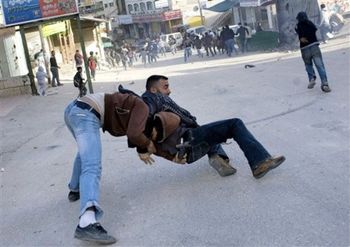
A Palestinian rioter tries to grab a weapon from a plain clothes Israeli police officer, right, during clashes in Shuafat refugee camp in East Jerusalem. Palestinians scuffled with Israeli security forces, after an arrest operation triggered clashes in the camp the day before.
The second photo is from Reuters
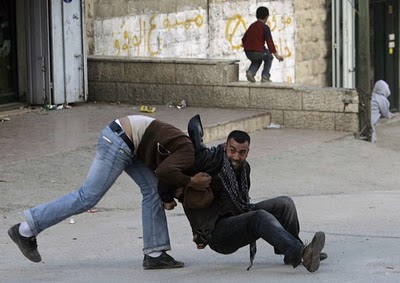
An undercover Israeli police officer (R) scuffles with a Palestinian youth suspected of throwing stones while trying to detain him during clashes in the Shuafat refugee camp in the West Bank near Jerusalem. Clashes erupted between Palestinian stone throwers and Israeli police that entered the refugee camp, a Reuters witness said on Tuesday.
The caption for the two photographs is actually quite different. In one sense, the descriptions do not contradict each other. They both described the scene. But it is possible to conclude with some different interpretations on the basis of the caption alone. In the Reuters version the Israeli appears to be the aggressor because he is trying to “detain” the Palestinian. The readers conceptual background might easily identify the Palestinian as engaged in legitimate revolt and doing little more than throwing stones at the bigger more well armed soldier and his comrades. It is the classic David and Goliath image. Anyone writing a caption should have the typical reader in mind. But in the AP version the Palestinian is characterized as more aggressive because he is trying to grab the weapon and will probably use it on the policeman. The policeman’s aggressive behavior would of course be justified in this case.
In the Reuters version, the fighting “erupted” and apparently the Israeli police entered the refugee camp which was sufficient provocation. But in the AP version there was an arrest operation that provoked the violence. The websites “Elder of Zyion” and “Honest Reporting” claim that the Reuters organization used an Arab stringer for a description of the events.
This poses an interesting question with respect to the newsgathering process and how stories are framed. Some news outlets have websites and phone numbers that one can call in order to report a story. So anyone can fill out a form on the web and provide a description of some event or activity and perhaps attract the attention of a news organization. The person leaves phone numbers and email addresses where he or she can be reached and the news organization contacts them. This of course can be an excellent source of news and is the sort of contact that results in specified and situationally-based stories. But on the other hand, this process can be abused. It can result in stories that are biased as a result of the selection process or stories, even worse, that are staged or distorted in some significant way.
Actually, the description underneath the photographs is a cutline and not a caption. A caption is a little headline and a cutline describes the photograph in more detail. Reader psychology and tendencies are important because the photo sparks interest and then readers typically move underneath seeking explanations. It’s important for cutlines to perform their duties. Cutlines like stories answer the who, what, why, when, and how question of journalism. When cutlines are more on the objective side of the dimension they satisfy reader’s understanding of the picture but have not necessarily told the reader what to think. The more cutlines are politically motivated the more they draw the reader’s attention toward some specified reality on the part of the news outlet.
A picture may be worth a thousand words but each of those words is capable of altering the meaning of the picture. A skilled cutline writer knows these things and chooses his words carefully.
The Deficient Traditional News–and Then There are Blogs
To the dismay of many communication scholars, the Internet and forms of new media have not become very effective mass communication outlets. Most websites do not reach as many people as television or other traditional forms of media. It is true that some blogs have become more effective than traditional media and this is because they satisfy reader needs and help compensate for the deficiencies in the typical press. An interesting article pertaining to these matters appears here. The article makes the case that the media fail to reach standards of democratic expectations as well as not living up to their own professional expectations. There are four reasons for a deficient traditional media and I will describe and elaborate on these four below.
1. The author of the article in the link above (Deva Woodly) begins by making the point that too much of the press originates with public officials and represents elite opinion. This charge has been leveled for some time and charges the press with hegemonic political communication. The press is owned by influentials who have interests in managing the debates in society. The solution to this problem is for more information and dissent to bubble up from the populace. I think this happens more than the author realizes but remains a difficult process. The relationship between the press and a democratic community is often characterized as a conversation. In other words, an exchange where elites and owners present ideas which are responded to in an effort to continue the conversation. The conversation metaphor is appealing but strained.
2. The second symptom of an anemic press is the emphasis on entertainment and titillation designed to attract viewers. Again this point has been made numerous times and is a standard criticism. It carries plenty of truth but it applies less to quality press then to the numerous press outlets available in the United States. It is true enough that news has increased its entertainment value but the literate reader and consumer of news can find serious information-based news sources easily enough. Moreover, a new story will focus on celebrity personality over deep analysis of social conditions but again these analyses can be found even if it increases the burden on the consumer. It is more common to leave consumers on their own to fend for themselves in finding quality news.
3. One of the most basic principles of American journalism is objectivity even though any high school senior knows that true objectivity is impossible. Still, objectivity can be at least approached or remain an ideal to strive for when the story calls for a straightforward narrative. I have always thought the burden on the news reporter for objectivity is too great. He or she is required to adopt a neutral pose and take a position on a story that is usually contrary to their instincts. There is a difference between bias and perspective – where bias is conscious distortion and manipulation – but perspective is just fine. Some media environments for example in European countries avoid the appearance of objectivity altogether by stating their perspective upfront and expecting the reader to realize the perspective of the press outlet. So, one will choose to read a communist newspaper or conservative newspaper realizing altogether that these perspectives are present. The literate consumer purposely seeks out the Communists press or the conservative press in order to see what they are thinking. This is a more uses and gratifications approach to reading the news because the consumer is making active intellectual choices. I prefer this approach to news.
4. And, according to Woodly, media consolidation is the fourth deficiency of so much news. The media market is dominated by a few large corporations and this is a disturbing development for democracy. This is the result of the tension between the news media and their commercial profit-making interests as opposed to their responsibilities for an informed citizenry. The influence of corporate parents can be even more insidious as the corporation directs the news. Profitability and bottom-line concerns are truly troubling but there’s also little that can be done. News organizations must turn a profit and size is sometimes an advantage in terms of the development of new products and administrative ease.
Traditional media is still powerful and reaches more people than other forms of media. But the blog sphere and the easy availability of user generated content is influential on the structure of political communication. For example, some traditional media use websites and twitter messages to circulate new ideas and influence the debates including what counts as newsworthy. New social media are increasingly an effective pathway to more powerful media and help amateur users influence the issues. Finally, some research seems to indicate that blogs are more argument and evidence-based. This clearly has the potential to expand political knowledge and turn blogs into a more commonly accessed resource.




 Peace and Conflict Politics