Category Archives: Media and politics
Trends in Digitial Technology and Palestinian Media
The data below show interesting trends with respect to media use and news. The data were reported in the Journalist Resource (journalistresource.org/studies/) and represent current trends in the sources of news. The conclusions from these data are not my primary concern here because they reinforce what we pretty much already know. That is, newspaper circulation is in decline, television viewership has dropped and more and more people get their news from social media – online and digital outlets in particular. These are the only two lines moving upward in the graph. But what is interesting is the theoretical possibilities of this trend for any international community. In other words, what are the potential consequences of this shift from traditional media to digital outlets. Below I speculate about a few possibilities with respect to groups in conflict and the Palestinians in particular. Again, the data in the graph do not pertain directly to any other international community, but they do represent a very common trend and one that either does or will influence allcommunities.

Historically, journalism and stories reported in media outlets provided a sense of coherence and at least a certain amount of consistency. Journalism was part of the power network in a culture with considerable respect and cultural capital. This was particularly true in less developed political systems such as many of those in the Middle East and of course the Palestinian Authority would qualify. There was typically one primary news outlet and everyone was exposed to the same information.
In the West Bank political communication was very limited by a combination of Israeli restrictions and undeveloped cultural traditions. From the 1980s into the 1990s penetration rates for news and media outlets were very low. This was because of poor communication infrastructure, economic development that was insufficient to improve access, lower literacy rates, and the general resistance of the culture to adopt new technology.
Things improved as a result of the Oslo Accords in 1993 where the Palestinians gained more control over their own technology. But the Internet became a revolutionary change. Because of the cross boundary capabilities of the Internet, and the fact that the Internet respected no borders, the Palestinians began to thrive with respect to information access and distribution. Internet penetration in the West Bank and Gaza is higher than in many other places such as Syria. New technology has energized Palestinian NGOs, human rights organizations, and made the formation of online communities possible. Also, during periods of violence and uprising when there is damage to buildings and Palestinian communication infrastructure, they are typically back on the air quickly because of availability of advanced technology.
But given that the PNA in the West Bank and Gaza has digital access and opportunity at least comparable to many political systems, it means that they also experienced the consequences of the digital age. One consequence is that Palestinians are now more involved in the media industry and thus more influential. Foreign news organizations use Palestinian talent and there are more young people involved in the news business with more ambition along with critical sensibilities.
There is still the problem of media control with no shortage of leaders who would like to use the media as a voice of propaganda. But multiple media outlets and the possibilities of user generated content make this more difficult. The ease and accessibility of digital forms of communication performs its democracy work in the West Bank and Gaza as well as any other place. Multiple voices and outlets are important and effective constraints on power. Where authoritarian media are governed by obedience and respect for political power, new digital media are more likely to broaden possibilities and make government monopolies difficult.
It is true enough that the Israeli-Palestinian problem is not easily addressed, but it remains the case that the rise in digital technology can structure in certain conflict resolution features that can contribute to a deliberative space responsible for helping to prepare the discourse of problem-solving. Some of the features of new digital technology that can enable the deliberative process are accessibility or availability of use to multiple citizens, equality or fairer access to media by a wider variety of people, along with the potential for more transparency and accountability. All in all, digital technology will benefit many aspects of West Bank and Gaza media. Even organizations that are more authoritarian such as Hamas cannot control digital technology sufficiently to manage the media environment. That is one reason why Hamas will maintain its reliance on violence as a form of control. Still, digital technology will facilitate the availability of mediated information that will one day at least find its way into the qualities of interaction necessary for progress toward mending political divides.
Blogsphere Battles in the Galaxy of the Israeli-Palestinian Conflict
New media are still establishing some definitional clarity but they tend to be differentiated on the basis of seven concepts as typically described by Nancy Baym in Personal Connections in a Digital Age. They are interactivity, temporal structure, social cues, storage, replicability, reach, and mobility. In modern political conflicts one is dealing with technological as well as political issues; that is, the communicative content that characterizes the relationship between conflicting groups circulates through new media that allow for increased contact and interactivity. The Israelis and Palestinians, for example, now fight their battles in competing blogspheres as well as on more traditional looking battlefields.
The blogsphere has two qualities that make it a perfect electronic location to continue the ongoing battle between the Israelis and the Palestinians. First the blogsphere is egalitarian and after overcoming some simple entry barriers anyone can participate. The ideology displayed in various blogs is on an equal basis with the other side and creates a space that transcends time and place. A less affluent Palestinian can operate an electronic platform on par with the Israeli. Second, the blogsphere shrinks distances such that one side’s case can be advanced from anywhere. The blog as an electronic space has energized confrontation and made a discourse possible that is more concerned with values, moral legitimacy, and argument.
An army of Israeli blogs (see, for example pro-Israel blogs) confront an army of Palestinian blogs (see, for example, Sabbah) in such a way that the political arena intersects with the international public sphere. These blogs are active at many levels including institutional, individual, and national. One interesting quality is the effect on the discourse of blogsphere communication that originates and lives in non-territorial space. In other words, there is no argument about where to meet or the symbolism of a physical location because the meetings are in electronic space and, from my own casual observations, lends itself to a more moderate environment. Moreover, the blogsphere media are cue rich such that messages can be appealing to a variety of senses. This has, of course, its disadvantages because of the easy availability of manipulation.
My own travels throughout the blogsphere in the galaxy of Israel and Palestine have resulted in two conclusions about this form of new media contact. One, both sides use arguments that are most advantageous to their own interests. The Israelis blog mostly about security and terror and the Palestinians about occupation. The world is most sympathetic to Israeli security concerns as well as its opposition to terrorism, but the international community also sympathizes with the struggles of the Palestinians. Interestingly, this aptly characterizes the conflict with the two sides performing individual narratives without much engagement of the other. Even in the blogsphere it seems to be the “dialogue of the deaf.” Both sides are also particularly personal; they relate personal instances and stories designed to increase the emotional intensity of the issues. They take personal instances and place them within the framework of national conflict. This is a classic characteristic of intractable conflicts when the society is saturated with the ethos of the conflict. Both sides utilize all electronic qualities of the blog including photographs, connections to other sites, and visuals.
Secondly, the blogsphere battles are filled with calls to action. Both sides use the blog to initiate campaigns designed to delegitimize the other side. Calls for boycotts and confrontations are common. Blogs in conjunction with other social media such as Facebook have demonstrated some success at organizing and arousing political action.
I should note in conclusion that access to the Internet and the blogsphere holds potential for increasing dialogic intimacy between the two sides as well as remaining a platform for conflict. The Internet can provide a channel of contact for productive communication if proper conditions are established. There are more than a few instances of successful contact where the qualities of new media such as distance shrinking genuinely serve the purposes of interaction between the two groups.
New Media Revolutions: The Problems
Facebook must be truly a magical medium. It cannot only reconnect you with your old high school friends but whip up a democratic revolution in its spare time. It received so much initial credit for the Arab Spring that political activists in places like Egypt began to question whether or not they were sufficiently committed or worked hard enough. Well, that was all an exaggeration but it is the case that Facebook had at least “something” to do with influencing the uprisings.
I enjoy my twitter (that’s me @dellis2) and Facebook accounts and they represent truly important advances in technology and the puffed up power of information networks. But as of now their media created images remain more potent than the reality; the impact of online activists is exaggerated although not unimportant. Marc Lynch, writing in Foreign Policy (Twitter Devolutions), argues that the power of social media must be tempered, that activists and academics sang the praises of these new media too loudly and they are subject to more criticism than has been levied. Moreover, the gritty politics that follow these uprisings is more important for shaping political life, yet if you judge by news coverage new media seem to have little to do with this. Facebook and twitter only seem to rear their heads during times of revolution. Off-line politics is turbulent but remains more central to the struggle for transition from authoritarian systems to more democratic ones. Below are some questions and issues that must be addressed with respect to new media because on the one hand new media get too much press, but on the other they are truly impactful. This means our understanding must be more nuanced.
1. Why do social media seem to get more attention or have more impact during revolutions or times of upheaval? During quiet times Facebook seems to offer little more than a pleasant pastime or benign exchange of information. There is still a tinge of awe surrounding new technology that lends technologically laden significance to a story that it carries. The story is not trivial because it is circulating on new media; on the contrary, it is important. When there is a crisis or political instability Facebook and Twitter seem to structure stories quickly as “good vs. evil” or “right vs. wrong.” I would guess, and I have yet to see data on such an effect, that any flurry of new media activity has a polarizing effect that results in binary oppositions such as “right vs. wrong.”
In the article cited above, Lynch observed that during the most active times in Cairo the Muslim Brotherhood and the non-Islamist online community structured their Twitter and Facebook exchanges exactly as described. Every time a story was critical of the Muslim Brotherhood it was quickly shared and reinforced by additional stories critical of the Brotherhood. And the same was true of the other side, every story critical of non-Islamist political activists was redistributed and shared by the Muslim Brotherhood thus perpetuating spirals of polarization. Habermas’s glorious inclusive and democratically aesthetic public sphere was nowhere to be found.
2. Why is it that social media are better at organizing and stimulating upheaval then routine politics? The new media seem to love energy and issue-driven controversies rather than the slow work of building political organizations. Again, Lynch points out that Twitter and Facebook were more successful at merging once disparate coalitions than mobilizing masses of voters. Perhaps Facebook is simply easier and faster and works best when a political situation is amenable to faster organization. Moreover new media can quickly employ the power of visual and auditory messages that increase their impact. Violence or a grisly death can be captured immediately on a cell phone and uploaded within minutes. This captures the attention of activist groups and encourages involvement. There is a “thrill” to new media because of its speed and multisensory impact that is not present during routine politics.
3. The political strengths of Twitter and Facebook can be easily challenged by any regime willing to be as repressive as it needs to be. Places like Bahrain and Saudi Arabia, not to mention Iran and Syria, are finding new ways to interfere with online activism including shutting them down when necessary. After enough pressure, and it does not take much, citizens and active account users will simply stop participating in online activity in order to avoid persecution and even violence. The possibility of harassment and arrest make it quite easy to withdraw from the online community.
The various social media did not create revolutions in Egypt or the Arab spring, but they did play a role. They have undermined traditional models of information and helped elites and activists empower themselves in order to facilitate change. But if we hail the opportunities for elites and activists to encourage democratic changes, we have to also recognize the problems and limitations of these new forms of communication. At the moment, given the instabilities still raging in Egypt and other countries, no advocate for new media would want to take credit for the current political realities.
The European Union Gets Nobel Prize for Conflict Resolution
The European Union just received the Nobel Peace Prize. This seems like an odd political unit to receive the Nobel Prize. It usually goes to an individual or organization making significant contributions to peace. But people often forget that the European Union, along with the legal and philosophical justifications, was created as a conflict resolution mechanism. The abstract political entity called the EU just received the Nobel Prize for peace. Can you imagine an integrated entity called the Middle East Union (MEU) one day receiving the same prize? Probably not, but take some comfort in the fact that a generation ago the same thing would have been said about Europe. Up through World War II European countries had fought one another on a regular basis at least once a decade for the previous 200 years. The development of common currency, economic cooperation, and promises to use established institutions to resolve conflicts was first and foremost an experiment in peace. And even though the EU has rejected Turkey’s membership they required Turkey to make a variety of political changes as preparation for membership and even that has had the salutary effects on Turkey and their relationship with European countries.
The primary goal when solving conflicts anywhere, whether it is in the Middle East or Europe, is to avoid segmentation and cultural and political distance. There is simply no substitute for quality human contact (read communication). I underscore the term quality because contact alone is not sufficient. After World War II secular political theorists fantasized about the unification of states and about how old differences would fade away. They thought that values would converge and political entities would harmonize. Coupled with new technology and less reliance on religion and ethnic identity, human institutions were supposed to recognize their dependence on one another for stability.
But alas, this dream is been deferred. And although new technology does increase contact and facilitates the values of weak ties and organization, it also permits increased parochialism and opportunities to reinforce existing beliefs and values rather than integrating them with others. Political polarization in the United States is a commonplace enough example. Citizens are even less informed than ever and more reluctant to encounter differences in a constructive manner. They have trouble making the distinction between bias and perspective, and are easily “upset” and put off by argument. Even those who endorse the whining generality that political campaigns are too negative are usually only being squeamish about drawing genuine contrasts between candidates. Americans consume almost 95% of news produced only in America and have very few opportunities and exposure to news from other countries.
Still, the EU is an important experiment. There are clear divides amongst European countries and certainly important differences that exacerbate pressures toward divergence and segmentation. But governing a divergent and multilateral set of organizations is very difficult and typically results in chaos. Nevertheless, integrated contact and interdependence is the only solution. We must not be naïve about convergence and recognize not only the inevitability but the naturalness of differences all the while energizing points of commonality.
New media are in a strong position to effect some of these changes necessary to increase convergence and decrease differences. Traditional mainstream media often perverts conflict and seeks not only violence but issue dualism. But new social media – even with all of the recognized limitations in mind – does present a public sphere capable of meaningful interaction where ideas are formed. New media can change the communication order by transforming traditional structures of communication (hub and spoke) into a more distributed model that maximizes connections. These do, as we have seen in places like Egypt and Tunisia, have innovative potential. A resonance and sense of shared experiences is an oft cited difference between political leaders and citizens in cultures in conflict. Citizens typically have more commonalities and a greater capacity for empathy. We have seen for example Israeli citizens use new media to reach out to Iranians during times of deep tensions over nuclear capabilities (go here for story). This is made possible by a networked public and not that different conceptually from EU integration.
Something interesting to read on social media’s potential for increasing integration between groups in conflict can be accessed here. It’s definitely a moment in media history when human volatility can be moderated.
New Media and Political Conflict
Claims that new media such as Facebook, Twitter, and the Internet have significant impacts on political activity and protest continue to swirl around in the academic world in particular. It takes little more than a local citizen to be interviewed and report his use of Facebook for the world believe that these fancy new media are responsible for protest and the outbreak of Jeffersonian democracy. Consequently, there is contentious debate about the role of social media in crystallizing events in certain countries. The long-term research on these matters is sparse but we can introduce a scholarly perspective and at least “sum up” our current state of knowledge. There is a review article pertaining to the Internet and politics here. Below I will intertwine some commentary with a statement of the general direction of this research.
It is true that social media play a role in political protest and organization. But it is important not to overstate the role. The riots and eventual overthrow of Mubarak were influenced by social media but not caused by them. This is especially true as a protest spreads because it becomes more difficult to contain information. If the social upheaval gains traction, if it refuses to fade away and the size of the crowds swell, then many participants will begin documenting and sharing images. This becomes a self reinforcing cycle as it becomes apparent that more people are participating and thus encouraging others to participate.
The opportunity for what is termed “user generated content” is a special feature of new media. This means that information and stories about political activity are removed from the sole hands of the official journalist community. Bloggers and users of Facebook and Twitter begin to produce content, write stories, and take pictures and essentially become citizen journalists. A so-called “citizen journalist” will have a different perspective than the professional journalist. He or she will have a more subjective and “on the ground” view with a more hard hitting human impact. That is one reason why social media are better at coordinating leaderless challenges to authority than they are at organizing democratic processes. Dramatic photographs that come to characterize a political movement (burning flags, violent police or security people, dead innocents) are increasingly likely to be taken by citizens with new media capabilities. The amount and quality of user generated content is also dependent on the richness of the media system of the country. Egypt, for example, had greater use of Twitter with more tweets from organizations and activists then did Tunisia. It is not surprising that Egypt and Tunisia, which have more new media users than any country in the region, experienced greater social upheaval and pressure toward change. An interesting future research question will be to explain why some countries have experienced unsuccessful protests (Algeria, Bahrain) or no protest at all (Saudi Arabia) even though these are cultures with access to new media.
New media lowers the cost of collective action. It makes organization cheaper and available to more people. A key challenge in all social organization is to take networks of people with weak ties and coordinate and motivate them. The quick, inexpensive, and pervasive contacts available through Twitter or Facebook make this easier. But the downside is that the ease of contact and organization made possible by new media makes it more difficult to build permanent and durable social structures. This is related to the term “slacktavist” or the tendency for new media to be an easy way to contribute, a way that does not require much effort, but make people feel like they are doing more than they actually are.
This tendency to make dramatic claims for the effects of new media continues: Jay Carney, a spokesman for the White House, claimed that the video offensive to Islam caused the riots in Libya. We know now of course that the video had no such potency. Still, because the Internet is not confined by physical boundaries it provides political actors with a number of opportunities. It becomes easier to destabilize social systems from afar. There are now electronic diasporas that enable ethnic or religious communities to stay in touch with their home countries and maintain identities rather than assimilate into a host country. Muslim communities that ring the city of Paris are one example. Lack of cohesion, difficulty with language and employment, and regular cultural tensions are consequences of failing to assimilate and maintaining an identity within ethnic homeland. It is also important not to forget that the Internet is more vulnerable to censorship than you might think. There is an association between Internet use and democratic processes in a country, but this is probably more likely the result of democracies allowing widespread Internet use.
In the future it will be impossible to study social protest or conflicts without including the Internet and the tools that it makes available. New technologies are increasingly integrated into our political consciousness and more than anything else are influencing the information process. In other words, it will affect what news becomes available to different cultures, how fast it reaches various subgroups, and as exemplified by Wikileaks it will make new information available. In the end, social movements are increasingly dependent on new media but it remains the case that such movements have ethnopolitical explanations and that politics and history come first.
Fauxtography in the Political Conflict Media
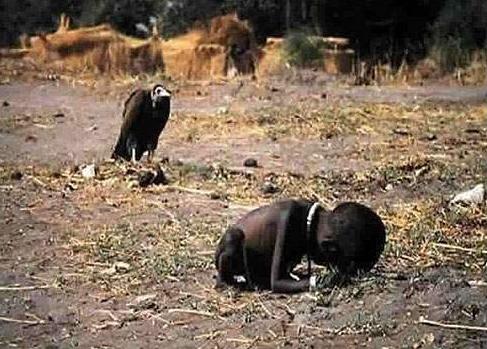 The above is the Pulitzer prize-winning
photograph taken by Kevin Carter in the Sudan in 1993. The girl was trying to
make it to a feeding center when the vulture landed. Carter waited about 20
minutes, took the picture, and then the vulture flew off. Carter was criticized
for not doing more to help the girl. He committed suicide a year later.
The photograph is haunting and
grippingly captures the consequences of famine and poverty. But what is the
practical effect of these photographs? They are powerful but there are some
misconceptions about such media effects. This is essentially a question of the
CNN effect, the idea that persistent around-the-clock media coverage influences
official political decision-making. It is termed the CNN effect but really refers
to a broad range of persistent real-time media that can set political agendas,
impede governmental actions, or accelerate them because of immediate news
coverage. There are some general misconceptions about this media effect.
THE MEDIA’S ROLE IN IMAGES OF SUFFERING:
To spend a moment looking at this picture and absorbing its impact is an
emotional experience. The vulture’s presence is ominous and captures the agony
between deep human identification and the raw reality of nature. But what is
the practical and political impact of these pictures? Do they cause people to
act, do pictures of suffering pressure governments to initiate humanitarian
aid? Surely, such pictures sometimes encourage action but not always. Political
leaders calculate the costs of interventions. If providing aid is relatively
easy and cheap then aid is easily forthcoming. But governments are conservative
about interventions when it involves troops and long-term commitments.
There was pressure to do something in
Bosnia where there was horrific Serbian violence against Muslims and pictures
of emaciated corpses. But the Bush administration was not going to commit the
troops and resources necessary to effect change. The media were manipulated in
this case to make it appear as though the US were providing aid when in fact
our reaction was minimal. Media images of suffering had little effect on
foreign policy. Clinton did not intervene in Rwanda in 1994 and the airways
were full of coverage of slaughter. A study once showed that contributions to
relief agencies do not increase during periods of wartime and images of dead
soldiers. But there is an uptick in contributions when the pictures are of
innocents – women and children. So the CNN effect must be conditioned. It can
inform and energize a public as it makes the public aware of atrocities, but it
does not dictate so easily to governments.
The two photos below are from the public relations service of Iran’s Revolutionary Guard and first appeared 2008. As was explained at that time, a second missile from the right seems to be the sum of the two missiles in the image. The shape of the smoke match perfectly near the ground as well as the immediate wake of the missile. There are some slight variations of color but they are very minor. The photos were quickly retracted. After being shown the photos a representative of a London-based Institute for Strategic Studies pointed out that the photos appeared to be doctored to cover up what was apparently a firing mistake on the part of one of the missiles.
These photos actually have appeared more than a few times over the last four years. They are a good example of fauxtography.


The media do play some role in either stoking or calming passions – especially with visual images. In the Middle East, for example, no reporter leaves the scene indifferent to the passions involved in the region. And a thoughtful reporter recognizes the feelings of both sides. This requires reporters and analysts to be “morally careful” so that the true enduring and important issues are represented as accurately as possible. Visual images are coded and cognitively processed quickly with a high-impact message. They are not the medium of careful analysis but better communicators of passions and feelings.
Television is a visual medium and the primary source of information about political conflict for most people. Television sets the agenda and signals which issues are most and least important. This is done at least primarily through visual means. It hasbecome so easy to manipulate visual images that it is only a matter of time before our memories and images for history are increasingly distorted. I suppose the only answer is a sort of visual fact checker who finds the truth about either starving children or misfiring artillery.
WikiLeaks and Freedom of Expression Versus Security: Part 1
Julian Assange is currently seeking refuge in the Ecuadorian Embassy in London. Assange is an interesting character with some quirky and brilliant personality traits, but these are not my main concern. Assange is considered a criminal in the United States because he gained access to secret documents by way of an American soldier named Bradley Manning. Manning is imprisoned in the US for leaking documents to Assange.
Assange manages the website Wikileaks which organizes and makes available thousands of government and diplomatic documents once classified as “secret.” Assange makes the argument that his work is centered in the long tradition of open expression and the importance of citizens keeping an eye on their government. Wikileaks publishes information from whistleblowers and seeks to make political governance a far more open process. Assange is no fringe character. He considers himself a revolutionary democratic leader devoted to freedom and has been the recipient of awards from Amnesty International, Time Magazine, and other journalistic outlets. The governments from which he took documents do not quite see it that way. They see Assange as challenging the security rights of the United States and violating laws designed to protect the nation. The US wants to charge Assange with jeopardizing national security, a charge that could result in life imprisonment. Hence we have the tension between freedom of information and security.
In what has been described as an Evita moment, Assange gave a speech from the Ecuadorian Embassy balcony which you can see here: Wikileaks
There was a large crowd and he spoke of freedom of the press. There have been other cases where journalists have reported from what is considered to be improper access to government documents. The Pentagon papers in the United States, albeit under quite different political and military conditions, were also considered a potential threat to national security. Israel has more than a few examples of journalists writing stories based on classified documents.
Opinions differ on this matter. Some see Assange, Bradley Manning, and journalists who report from secret government documents as traitors who reveal government secrets and expose the nation to damages that result from security breaches. On the other hand, they can be seen as advocates for free speech and transparent information for exposing the public to a full critical analysis of issues facing them. Some people take a third position by parsing the issues into justified and unjustified release of information. Thus, they criticize hacking into American government sites but support the release of documents from authoritarian governments such as those in Syria, Zimbabwe, or Saudi Arabia.
Because Assange is an interesting and charismatic figure, and because he has been accused of sex crimes (always a matter of interest), he has been able to use his celebrity status to rally thousands of people around the world and perhaps delay his arrest and generate interest in his cause. But it remains the case that all governments support their own security interests. And they will all in the end oppose improper access and leaking of classified material. Moreover, they will continue to sing songs of media freedom but maintain a common refrain about their own security rights. The tension between freedom of the press and security will continue because many documents marked “secret” are not really very important. It is easy to classify a document as secret but much less easy to justify the content of the document as truly requiring a “secret” classification.
There is no easy answer to these issues but the following are necessary in a democratic society, which is where we must begin. Openness to information is a far less threat to the general body politic than excessive secrecy or security. From the Johannesburg Principles on National Security and Freedom of Expression (http://www.article19.org/data/files/pdfs/standards/joburgprinciples.pdf) we can quickly pose the following requirements for a democratic society that wants to limit freedom of expression:
To establish a restriction on freedom of expression or information it is necessary to protect a legitimate national security interest, a government must demonstrate that: (a) the expression or information at issue poses a serious threat to a legitimate national security interest; (b) the restriction imposed is the least restrictive means possible for protecting that interest; and (c) the restriction is compatible with democratic principles.
In the next post I will turn our attention more specifically to the legal and philosophical issues that we must grapple with in order to balance the freedom of expression versus security scale.
Peace Journalism
One of the best ways to transform ethnic conflict is by means of consensus democracy or the sharing of power between groups. Consociation is an ideal to be sure, but it remains an important aspiration. At a minimum, it rules out the use of force for achieving unilateral objectives. An additional deliberative goal is a media that is oriented toward peace and solving problems rather than intensifying them. This would be part of a consensus democracy project and would represent a shift in priorities from sensationalism trying to attract readers to conflict resolution. This has been termed peace journalism by McGoldrick & Lynch, a term often met with skepticism as too simplistic.
Journalist organizations remain convinced that the media are not only positioned to illuminate conflicts but to actually resolve them and encourage cooperation. By practicing the best journalism the media can contribute to bridge building between conflicting groups. This calls for an activist journalism that relies on a set of practices that go beyond straightforward reporting about conflicts. The International Federation of Journalists (IFJ) calls on reporters to be trained in conflict resolution and to have the promotion of peace as their goal. They are asked to be well versed in the narratives of both sides of an issue and scrupulously avoid reinforcing violence. Moreover, journalists should be equally as concerned with solutions and common ground as much as the basics of a story. McGoldrick and Lynch pose a set of guidelines for the coverage of conflicts that are too numerous to list here, but include techniques such as (1) avoid simplifying the contest by enumerating the various goals of the conflicting parties, (2) avoid stark distinctions, (3) see ourselves in others, (4) avoid reporting on only violence, (5) report on peace initiatives, (5) identify wrongdoers, (6) avoid demonizing words, (7) do not see signing documents and military victories as creating peace, and others.
These recommendations can lead one to believing that clear reporting and sensitive concerns will enlighten readers and advance peace. But journalists live and work in political, economic, and power systems like everyone else. They are not independent actors who can determine effects. Hence, a biased and aggressive media will have less impact on an educated audience than and uneducated one; a prosperous and comfortable society will be less responsive to a challenging media. Nevertheless, it remains the case that the media can contribute to a helpful deliberative environment. Transparency, rationality, diversity, and the promotion of quality journalism are all part of peace journalism as well as deliberation. Bell (1997) refers to a sort of peace journalism as the journalism of attachment, that is, the concern is more for people than issues. Attachment journalism is not necessarily deliberative but it does represent a broadened sensibility to balance. It helps quiet the persistent refrain about how violence and drama captures attention, and peace is boring. Most journalism related to conflicts is “war” journalism and preoccupied with propaganda and violence. But “peace” journalists can be easily manipulated and subjected to propaganda that they are not able to understand. Gowing (1997) explains how journalists are easily manipulated and not always able to check facts. They sometimes begin to identify with one party and simplify or distort information. In the end, journalism must take a critical stance such that it does not encourage violence but also avoids disseminating peace propaganda. The critical stance requires transparency and, most important, a diversity of opinion that comes with exposure to quality disagreement and the avoidance of polarization.
Settlements and the Two-State Solution
I’ve been living and teaching at Ariel, a large Israeli settlement, and spending time talking to settlers and people who work with them. There’s an interesting gap between how settlers think of themselves and how others do. Much of the Western liberal world considers settlers at the center of the problem and assume their communities will be removed as a result of a peace treaty. People who live in these communities cannot imagine it; at least they do not see themselves as radicals interfering with peace. But the issue of the settlements for many is the most difficult and fundamental problemIsraelfaces. The legal issues and the definitions ofIsraelproper versus settler expansion into contested territory that violates state and international laws are not very resonant for members of these communities. They easily swipe away arguments about legality.
Like so many others I am lamenting the possible demise of the two-state solution to the Israeli-Palestinian conflict. Perhaps I remain naïve, but it seems to me to be the only sensible answer. Also in my naïveté I do not understand why the Palestinians would not be enthusiastic about the possibility of their own state. Why would they not want to start the process of building institutions, educating their kids in their own schools supported by a sovereign state, creating art and philosophy and watching their society develop? I know, I’m a Westerner in these are Western ideals. But from what I know of the Palestinian population such goals are consistent with their desires. Moreover, two sovereign states independent but working together is the only way thatIsraelremains a democracy committed to Jewish particularity. No solution or lack of solution is going to jeopardize the Jewish nature of the Israeli state. But the “Jewish” nature of the state is a thoroughly different and interesting question.
There is some sort of failure of will and failure of leadership that is choking the life out of the two-state solution. Netanyahu has publicly stated his support for a Palestinian state but seems to do little to bring it into effect. I suppose he’s a talented political animal skilled at swaying with the wind, but his victories are in the realm of security and protection not peace, even accepting the fact that they are related. Netanyahu and Barak ran the country once and now they’re running it again. Unfortunately, political survival seems to be their primary goal.
Even if there were two states there would be a tremendous amount of cooperation between the two required. Transportation and movement, business relations, oversight of holy sites, and any number of governmental and commercial transactions would be shared experiences between the Israelis and the Palestinians. That’s why Herb Kelman in his overview of the solution to the problem in the journal Middle East Policy calls it “two states in one country.”
Here’s one suggestion for saving the two-state solution day: work with the Palestinians and the United Nations on the declaration of a state that is satisfactory to both Palestinians and Israelis, not a unilateral Palestinian declaration. The West Bank andGazawill have to be part of the new Palestinian state with agreements about land exchanges.Israelcannot make demands on a Palestinian state that essentially deny the nature of the state. The Palestinians must be satisfied with the political and geographic conditions. A number of negotiators believe the issue of the status ofJerusalemand refugees can be solved relatively easily. Many of the issues related to these problems have been aired and it’s a matter of bold leadership to make a decision.
I have an Israeli friend who makes the case for a political system that is federal-like or involves independent Palestinian communities without removing settlements. In future posts I will explore the issues around such solutions as well as political arrangements that involve the single state.
The Quality of Fox News Reporting

The above is an example of reporting by Fox news. Notice anything about the graph? The location of the trend line for the most recent number of 8.6 for November is higher than the placement of the line when the number was 8.8 back in March. Media matters first pointed this out. According to them when the unemployment rate dropped to 8.6 Fox news rounded up to 9.0! Maybe the chart below (also from media matters) gives a more accurate picture? I don’t think so but it does make the point. The claim that it is easy to manipulate impressions with “misleading” graphs is easy enough to defend and requires no additional elaboration.


Notice anything about the above picture? Seems like they got Romney wrong. It remains quite impressive how Fox news can continue to manipulate images and political inclinations. The Republican debate sponsored by Fox had very little to do with the press’s noble goals of providing fora for issues. The audience was loud and highly partisan and many questions were designed to highlight Republican platform positions and attack Obama rather than clarify issues.
Rush Limbaugh and the conservative talk radio crowd have been using these techniques for some time. These issues are a little beyond the “peace and conflict” subject matter of this blog, but they do speak to the issues of the press and its role in a political environment.
Democratic values as they apply to the press are important. Issues such as accuracy, independence, freedom from bias, and integrity are important. The news media should always make the distinction between factual news stories and opinion pieces. Fox’s manipulation is to blur this distinction. When conservative talk hosts are attacked for their partisanship the Fox leadership claims that they’re not supposed to be news but entertainment. There certainly is a place for intelligent opinion and perspective which are often essential to understanding the consequences of the story. But we can see from the above examples that Fox is a little sloppy when it comes to representing accuracy and authority.
A recent study of Reuters proprietary websites examine their reporting related to the Middle East conflict. The study ran tests of articles for problems with logical fallacies, propaganda, and violations of Reuters handbook. These were tested in order to determine attitude shifts and support for belligerent parties in the Middle East conflict. The results indicated that there were over 1,000 occurrences of reporting and ethical failures that attitudes did shift as a result of being exposed to these reporting and ethical transgressions. For example, atrocity propaganda or lies and manipulations about the extent of violence and atrocities increased favorability and sympathy toward Palestinians. The same was true for the use of pity and subordination propaganda. The authors of the study concluded that Reuters engaged in systematically biased storytelling in favor of the Palestinians, and these biases directly influenced audience affect and behavior. On the one hand, these findings are not surprising but they certainly demonstrate that errors, biases, and manipulated frames do have strong effects. Both Fox News and Reuters must work on improving clarity and accuracy.
A diverse employment environment is one response to these biases. This includes more than simply gender and ethnic differences but must include differences in terms of knowledge and perspectives. Fox with respect to national political news and Reuters with respect to international news must do better at accuracy, error correction, focusing on intelligent and coherent perspectives rather than bias, information quality, and balance. Fox will continue to maintain its distinction between traditional news and editorial or opinion and defend their use of the media designed to direct perspectives in a certain manner. They have found a business model that allows them to maintain a conservative ideology and still garner enough of an audience. Although there is nothing particularly wrong with representing a coherent political ideology, there is something very wrong with rank partisanship and mistakes.



 Peace and Conflict Politics