Category Archives: Political Conflict
Finding New Ways to Communicate
I will admit that my first reaction to the attack on Israel by Hamas was to “unleash hell” in retaliation. Revenge is a difficult emotion to control. At times like this I get that sense of psychological surety as if I could somehow sweep Hamas away by flicking them off me like so many annoyances that can be easily disposed of. Military action lends itself well to this sort of thinking as it is usually associated with gaining ground or killing soldiers from the other side.
But, alas, this is not how foreign policy works. And there are clear operational and procedural steps that must be confronted if we want to truly solve the problem. Responding too aggressively will put the hostages in jeopardy, escalate the intensity of the potential outcomes, and increase the polarization that already exists between the two sides.
But trying to “solve the problem” is now just the problem. It has become apparent to me that the typical attempts at conflict management and resolution, whatever you want to call it, have failed.
The political arena is filled with seminars, discussion groups, training, and various forms of control mechanisms designed to discourage aggressiveness or change attitudes about the other group. And I have been a part of plenty of them. These groups typically draw on social science theory in an effort to change the reality of the conflicting groups. For example, members of conflicting groups (e.g. Israelis-Palestinians, Blacks-Whites, Muslims-Jews) might meet on a regular basis and engage in some joint project. This, according to theory, stimulates collaboration and teaches the participants to learn the habits of cooperation.
Israelis have been lectured to and chided more than a recalcitrant child and even so they woke up one morning and saw the genocidal monster called Hamas in the backyard. Things are not going well here. Still, how do you deal with a stubborn monster. The monster is not rational to the extent that there is not some justifiable relationship between the monsters’ behavior and a desirable outcome. In Hamas’s. Statement of Principles the destruction of the state of Israel and reclaiming the land are foundational goals that guide Hamas’s behavior. Hamas believes that the entire Zionist project is illegitimate including the historical documents that established the state of Israel. The land is indivisible and sacred. This leaves no room for the State of Israel. It means that nothing is negotiable, nothing can be shared, and neither side can tolerate the other’s presence.
It is clear that Israelis were caught flat-footed, and the charge that Netanyahu took his eye off the ball as he spent his time trying to save his political life, is defensible. Netanyahu speaks to the matter of leadership during a time of crisis and its role in setting the conditions of the conflict to the best of his ability. But Netanyahu will not be ousted so easily. He has the respect of many Israelis and they believe he can protect them during a time of war. As Einstein observed, the definition of insanity is doing the same thing over and over and expecting different results. We must find new ways to communicate. But what kind of communication understands killing babies and children? How do we learn new ways to communicate when mass killing is the norm? How do we learn new ways to communicate when both are labeled morally unacceptable by the other? Recently, an Israeli Defense Forces specialist observed that Israel will have to take steps that are wider and typically considered unacceptable by the United States. If so, we will have circled around to the beginning where, once again, we will have done the same thing with the same results, and we will have to find new we ways to communicate.
Blah, Blah, Blah, and Claims of Media Bias
A couple of nights ago I went to a Jewish Community Center to listen to a talk by a respected scholar of Middle Eastern politics and the Israeli-Palestinian conflict. It was an enjoyable evening with pleasant enough talk. Actually, it was more like a prayer meeting than a community political lecture. The audience was composed of Israel supporters and there were prayers and the singing of Hatikvah.
But what struck me was the casual and confident ease with which people claim media bias. One presenter proudly and enthusiastically declared that she was going to cancel her subscription to the New York Times, as if that would do anything other than make her less informed. I know the media are an easy target and as an active specialist in these areas myself I encounter the charge of media bias regularly. Still, it is frustrating how little effect I have on people when I explain the multitude of perceptual distortions that go into their conclusions about bias, followed by an explanation of the difference between “bias” and “perspective”.
We can’t seem to explain to the public that people watch the news for a multitude of reasons, many of which have little or nothing to do with the acquisition of accurate information. We watch news for mood management, social rehearsals, and all sorts of cognitive needs. The more one watches the more they are bound to encounter bias or develop distrust.
You know that individual psychology and cognitive distortions are implicated when both sides of an issue claim bias. There are a dozen studies that show the same footage or text to two different groups, only to have that message interpreted completely differently by the two different groups depending on their entering perspective. No news story is completely free of values, and no story includes all potentially relevant information.
In one study available here the authors found that presentation variables such as agency in headlines and focal point of photographs all contributed to different (perhaps just “different” and not distorted) interpretations. And just as one would predict, according to the hostile media affect, the roomful of Israel supporters saw bias against Israel everywhere, noting the New York Times, when in fact the research cited above indicates that the New York Times is mostly pro-Israel. The hostile media affect is the tendency for highly involved individuals to see media coverage of their issue as biased against their own position. Their own ego involvement and engagement with the issues makes it impossible for them to process a new story objectively. In fact, coverage of the Israel Palestine conflict has traditionally been so supportive of Israel that the American public is uninformed about the Palestinian narrative and political position. Zelizer and colleagues in the reference cited above found that the New York Times, Washington Post, and Chicago Tribune had remarkably similar coverage of the intifada with the Times being more supportive of Israel.
But the difficulty people have with the distinction between “perspective” and “bias” is particularly disappointing. Not a single person at the lecture interpreted news stories as a perspective; they only saw bias everywhere they looked. A perspective is a defensible and explainable viewpoint from which one member of the group sees an issue; it is a point of view. The perspective can be impartial and defensible. To say it is defensible means that the holder of the perspective is fair-minded and has come to his or her opinion on the basis of acceptable reasons and evidence. This does not mean that other evidence is not available or different interpretations are not possible, just that the holder of the perspective has thoughtfully considered alternatives and sincerely tried to weigh competing evidence. Being a “liberal Democrat” or a “Zionist” is defensible and can be explained on the basis of acceptable reasons. But the same is true for being a “conservative Republican” or an “anti-Zionist.” It is the clash of these perspectives that results in reasonable disagreement. There is disagreement because the two perspectives support different positions and hold different values, but both perspectives are defensible from evidentiary, rational, and cultural standpoints.
A bias is holding an unfair and indefensible attitude or opinion. The holder of the bias is typically close minded and unwilling to consider additional evidence and alternatives because he or she pre-judges new information and alternative perspectives and refuses to engage in proper and sufficient information processing that might result in opinion change. Certainly, putting aside beliefs and working to form new conclusions is difficult. But it remains a communicative behavior that is central to problem-solving and part of the general communicative process that forms the foundation of democratic conflict resolution and the management of conflicting groups.
Fake News and The Semantics of Post Truth

Since the ideas surrounding truth and post truth are circulating again given the polarization of American society, I thought I would republish this from Jan 4, 2021. More on related issues to come.
This enigmatic term – “post truth” – has been around for some time now and it is confusing for most people. Since the Oxford English Dictionary concluded that the concept of post truth was significant enough that it was identified as word of the year in 2016, we are certainly justified in trying to make more sense of it. What does it mean and how did the concept of post truth get so central to the interpretation of some important ideas in contemporary culture? It is no accident that the concept of post truth exists at the same time as ideas such as fake news. What follows is an explanation of post truth and how it informs the notion of fake news.
Briefly, post truth is the idea that objective facts are not so important in shaping opinion as opposed to emotional appeal and personal beliefs. The “anti-maskers who refused to wear a mask or quarantine during the Covid crisis because they didn’t recognize the validity of the science behind immunology or network theory are one example of a group of people who represent a post truth mentality. Some theorists have argued that political policies are no longer developed on the basis of facts and the distinction between fake and real is unimportant. Consequently, democracies become emotional political processes.
If facts become unimportant or nonexistent then they become victims of a strong social construction; that is, it becomes possible to have everyday citizens be the determinants of what gets defined as a “fact.” There is something terribly paradoxical about this. Facts are supposed to be the sine qua non of stable truth. If anything should not be subject to the whims of human emotion and variability, it is facts. How can you argue that facts are pushed to the background and unimportant? Are not facts supposed to be stubborn and true? The answer, within the post truth theoretical tradition, is “no” facts are subject to the same social influences as any other construct and hold no privileged position in political discourse. Facts can be redefined, manipulated, and reinterpreted to mean anything and the key issue is how many converts can I create.
Trump set about the business of delegitimizing the press. Of course, the press is the one institution that holds Trump’s feet to the fire. The single institution that fact checks him, exposes his lies and manipulations, and records his indiscretions. So, it makes sense that he would go after the press and he did so by making the distinction between fake news and real news. Of course, real news was only stories supportive of Trump. Anything critical was labeled fake news.
Facts are under siege. They are becoming highly politicized where people express their own facts – what they believe to be facts or want to be facts – in order to turn the concept into a rhetorical weapon. The term fake news is a good example. It is appropriated by political actors in order to attack opponents. The concept of “fake” is no longer a measurable or precise definitional question but one of political authority because the issue is who gets to control the definition in order to use it for his or her own purposes and is therefore in a position to dismiss others.
Trump’s appropriation of the term fake news is so extreme as to be laughable. A skilled manipulator of meaning will exploit certain commonalities of meaning in order to lend them some credibility. Those who accuse liberals on the left as being socialist have been effective because certain concepts and ideas that emerge from the political position termed “liberalism” do in fact have at least some similarity to positions emerging from theories of socialism. That is why those who attack liberals by deploying the word socialist have been successful. They conflate the two terms (liberal and socialist) sufficiently such that the relationship between the two terms is plausible and the narrower more aggressive and distasteful ideas associated with “socialism” are more easily transferred to “liberalism.” But Trump declared even before the election that if he did not win the process was rigged. He baldly asserted the “fact” that there were election improprieties even though no charge was ever accepted and not a single claim supported.
It is clearly possible to cite more precise meaning and fact-based issues that distinguish liberalism from socialism, but this is not my concern at the moment. Because the role of communication is so central to democracies, these democracies are saturated with disagreement over what is “real” and what is “false.”
of this essay will examine the nature of democracy and how one discourse follows another in terms of how much accepted disagreement it can tolerate. I will clarify how post truth rejects a rational political discourse that results in consensus; thus, post truth contends that maintaining a multitude of political voices, all contained in their subjective reality, is a more accurate reflection of the work of democracies and must grapple with the idea that logical and rational problem-solving is the definitive approach to managing differences, which is the goal of democratic processing.
New Ways to Argue in America
 America has always benefited from the tradition of rational discourse. It is part of our political DNA. And more than many other political cultures, we have at least approached the Habermasian ideal of moral communication conditions and the value of the best argument. The bases of American political history – that is, the foundational ideas upon which the nation is based did not fundamentally begin with religious precepts, the divine right of kings, or an oligarch’s economic theories. This is not to say, however, that we are not a religious country. We are. But a country in which Jeffersonian pragmatics and democracy were more important to our founding ideals then kings or religions.
There is no arguing with kings and religions. They have an immovable set of principles and everything is measured against those principles. The epistemology of ignorance begins with moral absolutes and the desire to consistently reproduce their truth value. It is what Jacob Siegel writing in Tablet calls the arguer-commander or that person who believes himself to be the deliverer of justice. It used to be the case that the American tradition of rational empiricism in the political realm sought truth and logically justified inferential conclusions. In the true scientific sense, it was possible to change your mind, be wrong, or accumulate new information that intellectually forced one to change or consider new options.
But the argument-commander, who rejects science for example, emerges more from a tradition of religiosity than deliberation. This new form of argument is populated by people who do not represent the tradition of reasoning from empirical premise to conclusion but consider themselves rhetorically untouchable. For example, a racist who holds a set of distorted beliefs about racial characteristics that he or she considers inviolate, thereby concludes that certain issues are beyond dispute. The person will consider a right to be beyond argumentation.
And holding these moral commandments that are so true they are beyond justification is not the sole province only of the left or the right – although it is more characteristic of the right – because both positions can hold commanding precepts that the arguers are more interested in perpetrating than in some type of genuine deliberation.
Holding a moral-political position that one considers so fundamentally true that it releases him or her from the normal requirements of reason and reflection is related to the polarization in American society.
The basic component of the epistemology of ignorance is that ignorance underscores distortions in thinking such as racism, sexism, or ethnic stereotypes and establishes arguments based on different assumptions; it has the potential to reveal the role of power in the construction of what is known and provide a lens for the political values at work in knowledge practices. Rather, they play a role in promoting racism and white privilege. But ignorance is not simply a tool of oppression wielded by the powerful. It can also be a strategy for survival, an important tool to wield against white privilege and white supremacy.
There are distinct and deep-rooted traditions of rational empiricism and religious sermonizing in American history. But these two modes seem to have become fused together in a new American mode of argumentation that is validated by elite institutions like the universities, The New York Times, and especially on the new technology platforms where battles over discourse are now waged. Intermingling the technical vocabulary of reasoning with endless moral generalities about rights and truths, held passionately by individuals, results in the corruption of defensible discourse. The arguer-commander is animated by rhetorical purgatory—unremitting racial oppression that never improves despite myths about progress and society as a ceaseless subjection to identity assault. “In possession of justice, the arguer-commander is free at any moment to throw off the cloak of reason and proclaim you a bigot—racist, sexist, transphobe—who must be fired from your job and socially shunned.”(See Siegel reference above)
Practitioners of the new argument bolster their rationalist veneer with constant appeals to forms of authority that come in equal parts from biology and elite credentialing. Again, as Siegel points out “Have you noticed how many people, especially online, start their statements by telling you their profession or their identity group: As a privileged white woman; as a doctoral student in applied linguistics; as a progressive Jewish BIPOC paleontologist —and so on?”
In the end, the execution of Michael Brown, George Floyd, Treyvon Martin and others is a white supremacy lethal public health issue that should be treated as such. I will continue to make the case but increasingly “I don’t know how to argue in America anymore.”
New Ways to Argue in America
America has always benefited from the tradition of rational discourse. It is part of our political DNA. And more than many other political cultures, we have at least approached the Habermasian ideal of moral communication conditions and the value of the best argument. The bases of American political history – that is, the foundational ideas upon which the nation is based did not fundamentally begin with religious precepts, the divine right of kings, or an oligarch’s economic theories. This is not to say, however, that we are not a religious country. We are. But a country in which Jeffersonian pragmatics and democracy were more important to our founding ideals then kings or religions.
There is no arguing with kings and religions. They have an immovable set of principles and everything is measured against those principles. The epistemology of ignorance begins with moral absolutes and the desire to consistently reproduce their truth value. It is what Jacob Siegel writing in Tablet calls the arguer-commander or that person who believes himself to be the deliverer of justice. It used to be the case that the American tradition of rational empiricism in the political realm sought truth and logically justified inferential conclusions. In the true scientific sense, it was possible to change your mind, be wrong, or accumulate new information that intellectually forced one to change or consider new options.
But the argument-commander, who rejects science for example, emerges more from a tradition of religiosity than deliberation. This new form of argument is populated by people who do not represent the tradition of reasoning from empirical premise to conclusion but consider themselves rhetorically untouchable. For example, a racist who holds a set of distorted beliefs about racial characteristics that he or she considers inviolate, thereby concludes that certain issues are beyond dispute. The person will consider a right to be beyond argumentation.
And holding these moral commandments that are so true they are beyond justification is not the sole province only of the left or the right – although it is more characteristic of the right – because both positions can hold commanding precepts that the arguers are more interested in perpetrating than in some type of genuine deliberation.
Holding a moral-political position that one considers so fundamentally true that it releases him or her from the normal requirements of reason and reflection is related to the polarization in American society.
The basic component of the epistemology of ignorance is that ignorance underscores distortions in thinking such as racism, sexism, or ethnic stereotypes and establishes arguments based on different assumptions; it has the potential to reveal the role of power in the construction of what is known and provide a lens for the political values at work in knowledge practices. Rather, they play a role in promoting racism and white privilege. But ignorance is not simply a tool of oppression wielded by the powerful. It can also be a strategy for survival, an important tool to wield against white privilege and white supremacy.
There are distinct and deep-rooted traditions of rational empiricism and religious sermonizing in American history. But these two modes seem to have become fused together in a new American mode of argumentation that is validated by elite institutions like the universities, The New York Times, and especially on the new technology platforms where battles over discourse are now waged. Intermingling the technical vocabulary of reasoning with endless moral generalities about rights and truths, held passionately by individuals, results in the corruption of defensible discourse. The arguer-commander is animated by rhetorical purgatory—unremitting racial oppression that never improves despite myths about progress and society as a ceaseless subjection to identity assault. “In possession of justice, the arguer-commander is free at any moment to throw off the cloak of reason and proclaim you a bigot—racist, sexist, transphobe—who must be fired from your job and socially shunned.”(See Siegel reference above)
Practitioners of the new argument bolster their rationalist veneer with constant appeals to forms of authority that come in equal parts from biology and elite credentialing. Again, as Siegel points out “Have you noticed how many people, especially online, start their statements by telling you their profession or their identity group: As a privileged white woman; as a doctoral student in applied linguistics; as a progressive Jewish BIPOC paleontologist —and so on?”
In the end, the execution of Michael Brown, George Floyd, Treyvon Martin and others is a white supremacy lethal public health issue that should be treated as such. I will continue to make the case but increasingly “I don’t know how to argue in America anymore.”
Virtue Signaling in Political Discourse

In a post-truth world, and one where the death of expertise is an increasing threat, it makes sense that artificial moral dialogue should find a place in political discourse. In other words, as Tom Nichols has pointed out in his book The Death of Expertise, the low-information voter and other sorts of political ignorance (e.g. the uninformed who disdain proper sources of expertise, the claim that those who are experts are nothing more than elitists, the emergence of the customer satisfaction model in education, and the merging of information and entertainment) have begun to rely more on virtue signaling than actually making an argument or refining their moral discourse.
Virtue signaling is a pejorative term for the expression of a moral position that signals the speaker’s morally superior stance on some issue. When your office mate declares that she does not eat red meat and advises that for the good of water management and the environment you adopt a vegetarian diet, she’s engaging in virtue signaling. It is a message (signal) that expresses the speaker’s virtues and carries the underlining implication that the speaker is morally superior. Trump’s “Make America Great Again” is a banality that carries no logical path and is little more than a generality designed to portray Trump as someone who recognizes what it means to be great and therefore must be great himself. It carries the quality of virtue signaling because it’s not really designed to change minds as display himself as someone who is great.
All points along the spectrum of political philosophy virtue signal – those on the left and the right. But there seems to be slightly more moral outrage in the form of virtue signaling on the left. Social programs, the democratic state, moral positions on gun-control and welfare, etc. easily lend themselves to virtue signaling.
Signaling of course is part of human evolutionary development. Humans have evolved ways to signal availability for reproduction, danger, and ways to control the costs of signaling.
You are more likely to see virtue signaling in environments where decisions cannot be traced to a single person. In logical environments where actions are understood as having a connection between one act and another virtue signaling is less effective. So, businesses making financial decisions don’t virtue signal very often because it’s difficult and costly. But when a corporation wants to express its good citizenship it can virtue signal by common conscious slogans such as “We Are Going To Go Green” and our products are “Environmentally Friendly”. An article in Aeon explains how the use of religion to virtue signal is common. Appeals to God and religious morality certainly signal the speaker’s virtue along with a clear moral discourse.
Most citizens feel overwhelmed when it comes to real political action. They are exhausted by the possibilities and requirements, both organizational and financial, and consequently do nothing. So, the performance of ostentatious displays of virtue and high diction condemnations of others on the basis of “social justice” takes the place of actual moral mechanisms that guide our action.
It’s not surprising that virtue signaling has surfaced as an alternative to tighter logical systems of reasoning and decision-making. An alternative that political figures exploit in order to supply ideological images that stir our emotions more than anything else.
ISIS Communication Strategies

Like any social or political institution, ISIS needs communication strategies, information campaigns, propaganda, and technological access in order to manipulate its audiences, inspire volunteers, and complete the general tasks of public communication. ISIS is sophisticated and relies on any number of communication strategies in order to further its goals. ISIS’s leader, Abu Bakr al-Baghdadi, has set numerous persuasive goals: He seeks to reestablish the caliphate and must convince others of the worthiness of this achievement; ISIS competes with al-Qaeda and must position itself competitively as the two groups compete for status and recognition. And, for lack of a better word, propaganda plays an important role in motivating and encouraging fresh recruits into the ISIS psyche so they will carry out brutal acts of violence and further jihadist propaganda. Essentially, ISIS uses two general strategies of persuasion. You can read more about ISIS persuasive strategies here.
The first is based on the value of establishing cultural resonance between individuals and the traditions of Arabic and religious rhetoric. More specifically, sermons delivered by ISIS leaders exploit the rhythm and metaphors of liturgical sermons. These sermons have a long history and theory of oratory and narrative that defines the Arab world. ISIS leaders will invoke the structure of the Quranic verses – which include prayers, invocations, quotations, and sermons – all in the service of messages designed for religious or political purposes. al-Baghdadi’s speech announcing the establishment of the caliphate is a good example of his use of narration and religious invocations to justify his arguments. Moreover, he invoked religious symbols and structure to justify ISIS’s policy of violence including execution, imposition of sharia law, taking of hostages, and violence if necessary toward rival political and religious factions.
The second predominant persuasive communication strategy is the adept use of various communication channels designed to reach targeted audiences. ISIS’s early use of the Internet was quite successful at maintaining anonymity, finding specific audiences, and presenting innovative forms of propaganda. The Internet is able to handle longer disquisitions on politics as well as shorter messages and video. But the Internet is also full of misinformation, potentially poor security, rumor and innuendo, as well as a host of other mistakes and distortions. Consequently, the Internet has lost some of its power and effectiveness although it is still an important persuasive tool.
ISIS’s magazine called Dabiq remains a successful publication outlet that seeks to provide religious and political justification for ISIS. You can read about it and retrieve a copy of Dabiq from its Wikipedia page here.
In addition to online magazines and Internet sites, ISIS broadcasts on a radio station (al-Bayan) as well as a TV station. The TV station makes for sophisticated possibilities with respect to programming and high quality visuals. Social media are often used very skillfully to create characters that signify historical leaders and powerful individuals who speak the language of jihad and express opinions and historical claims consistent with the ISIS political agenda.
ISIS could not succeed without some communication and persuasive strategy designed to produce messages that direct their desired audiences toward a particular definition of reality. ISIS has been particularly adept at discovering effective channels of communication and exploiting them. And, of course, their use of traditional Arabic religious symbols and liturgy has been crucial to their success. But we should remember that all forms of communicative contact have security vulnerabilities capable of being breached. This is a breach we must step into in order to moderate, if not defeat, these messages.
Jerusalem for Dummies
 The essay title “Jerusalem for Dummies” has been taken (go here) but I thought it was sufficiently descriptive so I appropriated it. There are of course any number of places where one can read about the history of Jerusalem and its various twists and turns with respect to legal standing, cultural icon, religious center, and capital. But below is a brief overview that helps place Trump’s announcement in context. You can listen again to Trump here: Trump’s bold statement about Jerusalem and the Jews.
Historically, Jerusalem was a small town on the outskirts of the Ottoman Empire. It was mostly significant for religious reasons as water and natural resources were scarce and not particularly strategically located. But as time went on Jerusalem became symbolically more important and a tense mixture of politics and religion. One of the nearby hills in Jerusalem was called “Zion” and it became the term to refer to the entire area and the base of the word Zionism which is the modern movement calling for the reestablishment of the Jewish people and state.
Still, Jerusalem was never automatically assumed to be “Jewish” because of its significance for both Christianity and Islam. Jerusalem is significant to the three Abrahamic religions Judaism, Christianity, and Islam. The Al-Aqsa Mosque on the Temple Mount is believed to be the place where Mohammed ascended to heaven. There is no denying the significance and importance of these religious sites and whatever ends up happening Jerusalem must ensure access to these holy places.
The Zionist leaders were mostly secular and were unsure about the significance of Jerusalem Or, shall we say, they were uncomfortable with the power of the religious connection to Jerusalem and did not want a future Jewish state to be overly religious.
It is significant that when the United Nations divided Palestine into two states (one Arab, one Jewish) in 1947, it left Jerusalem out of this equation. Jerusalem and its surroundings were designated as a separate territory to be overseen by an international body. Many Jews were unsure about this but were satisfied with relinquishing Jerusalem in order to establish the state. But when the Arabs rejected the plan to divide Palestine and attacked Israel Jews considered themselves no longer bound by the UN partition plan and moved in on Jerusalem militarily. At the end of the war of independence Israel had taken the Western part of the city, the Jordanians the Eastern part including the old city and significant religious sites. By now the significance of Jerusalem was increasingly apparent and Jews fixated their identities more on Jerusalem. The city was divided by the new state of Israel and Jordan.
Israel declared Jerusalem as its capital after annexing West Jerusalem. The Jordanians annexed East Jerusalem and there were two capitals up until the Six-Day War in 1967. For 19 years, 1948-1967, tensions between Israel and the Arab world remained and no progress was made on the status of Jerusalem or its unification. The city was not recognized as either Israeli or Jordanian. During the Six-Day War Israel captured East Jerusalem along with a few neighborhoods that were not historically in Jerusalem. Israel has moved all of its government offices to Jerusalem including the Knesset and has consolidated their presence in the city.
Israel’s position is that they are not bound by the UN partition plan or the original partition of Palestine because they acquired Western Jerusalem while defending themselves. The two sides have hardened their position as Israel would now never give up Jerusalem as its capital and the Palestinians maintain a belief in their rights to the city also. Very little progress has ever been made on the status of Jerusalem and the city remains confused according to international law as well as the contradicting claims of each side.
For these reasons official recognition of Jerusalem has been moot for most countries. But Donald Trump changed all that.
Incomplete Theorization: A New Way to Think about the Israeli-Palestinian Conflict

Some problems can’t be solved. The fundamental assumptions and philosophy of two competing sides ensnared in the problem cannot be reconciled. Let me elaborate with an example:
There is a concept used by myself and conflict resolution specialists, a concept in particular associated with work by Cass Sunstein, called incomplete theorization. Sunstein, as a lawyer, is concerned with constitutionalism and how you write such constitutions that are effective when people disagree about so many things. Here is how Sunstein poses the issue. Again, he is talking about constitutions but tell me whether or not incomplete theorization sounds like the primary conundrum for the Israelis and Palestinians.
Incompletely theorized agreements help illuminate an enduring constitutional puzzle: how members of diverse societies can work together in terms of mutual respect amidst intense disagreements about both the right and the good.
People often agree on practices but not on theories. Therefore many problems have to be solved as incompletely theorized agreements. Sunstein continues:
The agreement on particulars is incompletely theorized in the sense that the relevant participants are clear on the practice or the result without agreeing on the most general theory that accounts for it. Often people can agree that a rule—protecting political dissenters, allowing workers to practice their religion—makes sense without entirely agreeing on the foundations of their belief.
Incomplete theorization has the advantage of turning attention away from difficult philosophical issues which are typically a combustible mix of foundational beliefs that cannot be reconciled. Moreover, attention to concrete practices has a better chance of success and acceptance which can likely lead to other areas of agreement as participants practice the habits of agreement.
So, let’s incompletely theorize an issue for the Israeli-Palestinian conflict.
The division of Jerusalem into municipalities will not be solved by weighty discussions of Jerusalem’s history and who has rights conferred by kings or gods. But East Jerusalem neighborhoods are home to 300,000 Palestinians–and no Jews. The parties can’t wait for philosophical issues to be solved about historic Jerusalem. Separating the neighborhood would reduce the number of West Bank Palestinians subject to direct Israeli rule and remove a serious point of contention. Also, it would lighten Israel’s economic burden. Moving the security fence away from a hostile population, rather than moving people, would certainly be easier and less traumatic. Both Israelis and Palestinians would benefit without agreeing to any kind of philosophical supporting rationale.
Here’s another incompletely theorized condition.
Israel has serious security issues and must remain in control of the “West Bank.” However, Palestinians should have full autonomy as an “unincorporated territory.” Until the Palestinians agree to peace with Israel, they could be welcomed as partners in the Israeli economic system and should be able to fully participate in Israel’s commercial and creative life. Even without statehood, in less than a generation the Palestinians could become more prosperous and prepare one day for peace.
If one thought this through I would expect there are many practicalities that could be achieved without the burden of deeper philosophical rationales.
The Kurds and the Jews: A History of Oppression and Unwelcoming Neighborhoods
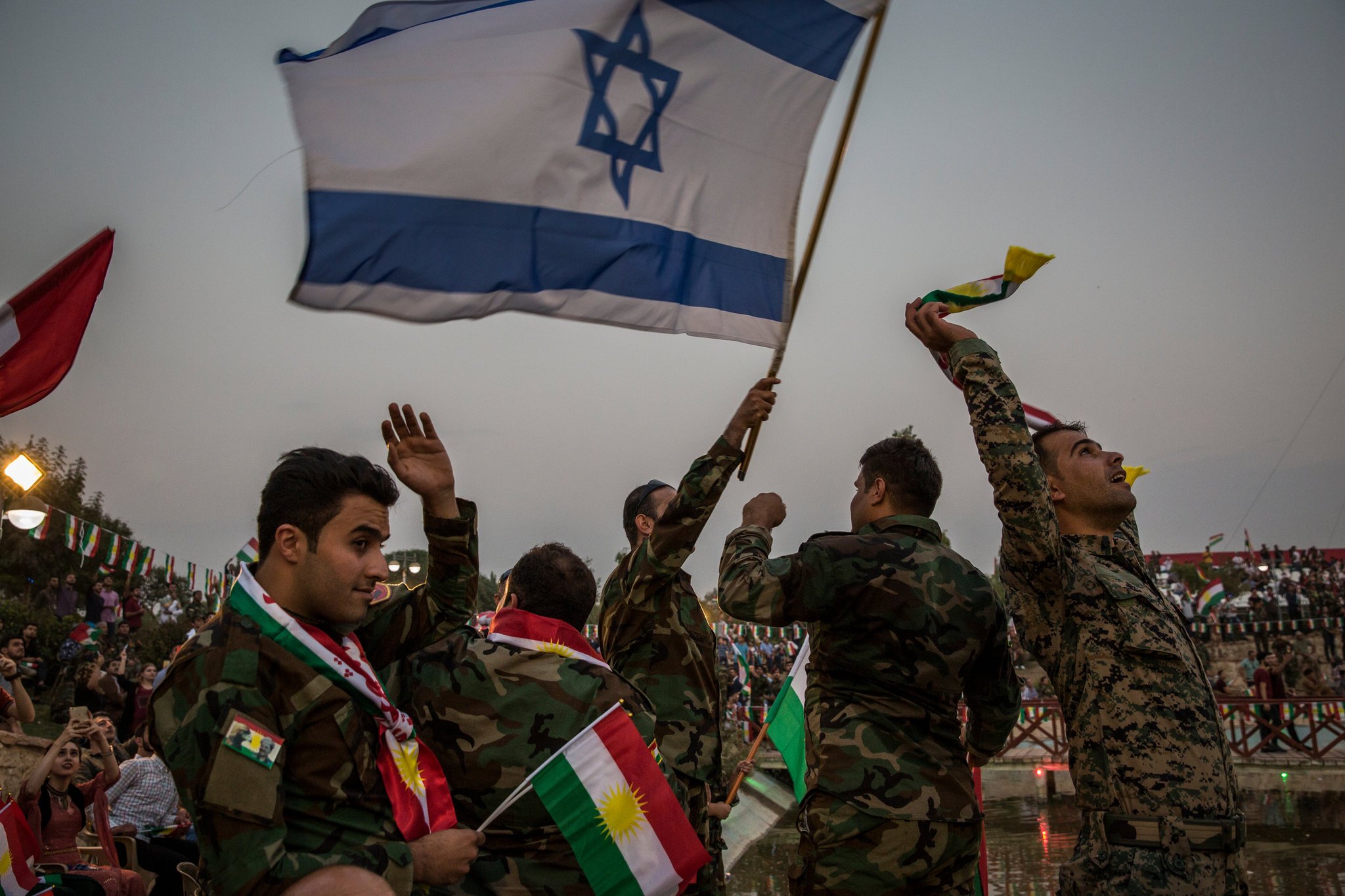
A few weeks ago I published an article in the Jerusalem Post in support of the Kurds and their quest for independence. You can read that article here. And it remains the case that if you are generally supportive of states with democratic processes and cultures oriented toward mutually tolerant relationships, then you’re in support of the Kurds. Moreover, the Kurds have been good friends to Israel. Last week Prime Minister Netanyahu stated publicly his support for Kurdish independence and the referendum. The Kurds welcome Israel’s support but have remained quiet for fear of antagonizing the Arab world.
In Saturday’s edition of the New York Times there is a story on the relationship between the Kurds and Israel. It is a clear and well stated article explaining the relationship between the Jews and the Kurds, a relationship about which many people don’t understand or are unaware of. The Kurds and the Jews of Israel in particular share a history of oppression and both groups are minorities in an unwelcoming neighborhood. There are about 200,000 Kurdish Jews and a strong Kurdish presence in Israel. Most notably was the assistance from Kurds in helping Jews escape Baghdad in 1969 after a mass hanging of Jews.
Netanyahu’s support for the Kurds and the independence resolution was a gutsy move made in isolation, because most powers in the region including the United Nations and the United States either directly oppose or have reservations about the referendum. The Iraqis oppose it because they don’t want their nation to be broken up; the Americans oppose it for fear that it will interfere with the defeat of the Islamic State and complicate their mission in that area of the world; Iran and Turkey oppose the referendum for fear of stimulating separatist thinking and even potential violence.
But Israel is publicly supportive of the Kurds because Israel needs friends. The Kurds are potentially very useful friends and would be a valuable resource in the region. And to the joy of just about everybody, the Kurds don’t care about the Palestinians. They assume it is Israel’s problem and are willing to be helpful if possible but otherwise just stand aside.
The Kurdish Independence Referendum
On September 25th Kurds will hold a referendum that will not be legally binding but is a vote on whether or not the Kurds should be an independent political entity. The referendum is a payoff for the consolidation of external military successes and help with the fight against the Islamic State. The Kurdish efforts to defeat ISIS have won the Kurdish leadership considerable praise and resources. But a cynical interpretation is that the Kurds are at the peak of their popularity and the time to declare independence is now. There have also been numerous reactions to the idea of a referendum. Some see it as a genuine deserving reward for the Kurds, others see it as a move by the old guard to cling to power.
In the end, a strong independent Kurdish state will certainly require help from the United States but also Kurdish attention to their own institutions and political trajectory. The Kurds have much work to do with respect to economic development and ensuring that institutions are a platform for democratic processes. There must also be a shared sense of Kurdish nationhood that unites the young and the old, the different localities, and final discussions about borders.
The referendum is generally a good idea and while it will interfere with the political maneuvers of some states the Kurds have to think about their own political future more than that of others.
Danger to the U.S. Drips from Trump

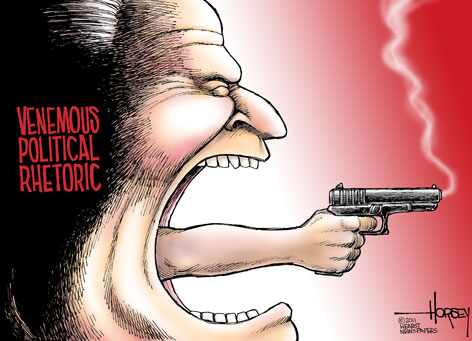
You know you’re under the jackboot of second-rate leadership when that leader invokes the cartoonish and overheated rhetoric of Armageddon or the Apocalypse. Trump’s threat to hit North Korea with “fire and fury like the world has never seen” is ignorant, unhelpful, potentially dangerous, and represents little talent and sophistication with respect to international affairs. He has done nothing more than put himself on the same plane as pathetic terrorists who mistake their rhetorical fury for reality. I suggest the readers of this blog get together with a few friends for drinks and see how many of these puerile hyped-up platitudes they can come up with. Here, I will get you started.
“Allah will unleash the fires of hell to consume the infidel in Allah’s glory.”
“The Jewish trickster conspires to mongrelize White America by pumping black blood of Africa into his veins.”
“The coming race wars will scorch and then cleanse the earth as it awaits the rebirth of the white race.”
You get the picture. Even these exaggerated for humor sayings can’t seem to avoid some common themes: typically, something is “contaminated” and it is “cleansed” by fire. For the racist it’s the nonwhite race that is contaminated and fire will wipe it away until the new dawn of White supremacy awakens. For the Muslim extremist the “fires” consume the enemy rather than cleanse the earth, as the terrorists see the destruction of the world. Jews are not typically associated with fire but they are with blood given the historic blood libels. And the Jew is a “trickster.” He is clever and manipulative and not to be trusted.
Trump, of course, has no more to offer than the standard apocalyptic refrain of “fire and fury.” He has probably seen too many movies. But his discourse is consistent. It’s the rhetoric of nativism and certainly aligned with slogans to “make America great again” or “America first”.
This nativist discourse is relatively standard and on par with the profiles of intergroup conflict. That is, there is (a) a clear ingroup-outgroup distinction where the ingroup is favored and the outgroup as disfavored along with all of the exaggerations and distortions that accompany an ingroup-outgroup distinction;(b) the outgroup is demonized; and (c) the outgroup is rhetorically conquered. There is nothing wrong with trying to rhetorically control the outgroup – that is essentially what campaigns and social movements do but within the confines of normative democratic discourse.
Trump is frighteningly irresponsible. For the President of the United States, not some tin can leader, to engage in this brinkmanship with his shallow knowledge of the target culture, and the fact that fire will be returned with near certainty, can only be explained by the President’s personal macho and certainly not by any coherent policy of international relations.
And the childishness of it all. There is not even what anyone would consider to be even a remotely justifiable reason. This is just name-calling. Of all the sophisticated conflict resolution work and research, the answer in this case is simply to shut up and stand down.



 Peace and Conflict Politics