Category Archives: Political Conflict
Obama and the Language of Contention
I’ve been a little surprised at the number of people who want the President of the United States, a man of dignity and diplomacy, to sound like some macho character out of a movie. Obama has lately been chastised for not labeling ISIS an Islamic threat and identifying its specific religious motivations. I personally have no problem recognizing the religious roots of ISIS despicable behavior and have even pointed it out myself on occasion. But it is not fitting for the President who speaks to numerous audiences and is responsible for maintaining the peace and representing the interests of diverse groups (even mainstream Muslims).
When it comes to the language of contention as soon as you label a group that label begins the construction process – the construction of characteristics and emotional responses associated with the group. “Naming” is the first step in the stereotype and prejudice formation process. As soon as ISIS or some other jihadist group is named and becomes increasingly defined as “Muslim” the name becomes the basis for perceptual discriminability and these characteristics are more likely to become the basis for defining groups.
Very simply, by labeling these groups as Islamic the act of categorizing them triggers negative stereotypes associated with the term “Islamic.” Consequently, the problem is exacerbated rather than managed. Moreover, labeling extremist groups as Muslim exaggerates ingroup-outgroup biases and increases the sense of essentialism that accompanies the definition of outgroups. Having a world leader label the international criminal behavior of groups such as ISIS just makes them more salient.
The Narcissism of Small Differences
Hate is a powerful unifying passion and it is even more dominant in extremist movements. As soon as a movement or ideology is associated with “hate” other meanings creep in – meanings such as disgust, fear, contempt, and others. Elites and those with regular public voices (such as the President of the United States) can more easily energize the feelings of ordinary people against groups labeled negatively in some way. And this activates what Freud called “the narcissism of small differences.” The story below exemplifies the fragile state of group relationships when they are isolated and differentiated to such a degree that “any difference seems to be a difference”.
I was walking across a bridge one sunny day, and I saw a man standing on the edge, about to jump. I ran over and said: ‘Stop. Don’t do it.’
‘Why shouldn’t I?’ he asked.
‘Well, there’s so much to live for!’
‘Like what?’
‘Are you religious?’
He said: ‘Yes.’
I said. ‘Me too. Are you Christian or Buddhist?’
‘Christian.’
‘Me too. Are you Catholic or Protestant?”
‘Protestant.’
‘Me too. Are you Episcopalian or Baptist?’
‘Baptist.’
‘Wow. Me too. Are you Baptist Church of God or Baptist Church of the Lord?’
‘Baptist Church of God.’
‘Me too. Are you original Baptist Church of God, or are you reformed Baptist Church of God?’
‘Reformed Baptist Church of God.’
‘Me too. Are you Reformed Baptist Church of God, reformation of 1879, or Reformed Baptist Church of God, reformation of 1915?’
He said: ‘Reformed Baptist Church of God, reformation of 1915.’
I said: “Die, heretic scum,” and pushed him off the bridge.
If the President of the United States begins to label mainstream Muslims, who are more like us than not, as dangerous or violent or any other even minor characteristic then the narcissism of small differences triggers because according to Freud and a few that follow him we reserve our most intense dislike and feelings of threat for those who are more like us than not like us. The very strange “other” can certainly be threatening but we don’t identify with that person or group. But the more a group or an individual is “nearly-me” the more I project my own distasteful qualities. The narcissist’s natural tendency to distinguish and separate himself from others causes him to exaggerate differences in the service of his narcissism. So, small differences that should be ignored or evaporate become big differences. The President of the United States can halt or prevent this process by carefully choosing his language and avoiding the “language of contention.”
Blaming the US for Trouble in the Middle East Is Simply a Stretch
 Last week a respected friend and colleague sent me an email making the standard claims about how all the problems in the Middle East are the result of imperial borders, colonialism, and US foreign policy. It’s the “blame the US” refrain. If you believe the West is responsible for ISIS and Middle East violence then you are easily manipulated by the Islamic state into believing just what they want you to believe. Sure, there is much to criticize about colonialism but borders are not so central to contemporary problems. Let’s take up the case of Iraq (for additional reading go to an article in The Atlantic available here). The three provinces of Iraq – Mosul, Baghdad, and Basra – were historically treated as the one area (called Mesopotamia) and Iraq’s eastern border with Iran dates back to the early Ottoman Empire. The boundaries of Iraq are not so arbitrary. Interestingly, the country with some of the newest Western carved out borders is Jordan and it is the more stable country as a result of King Abdullah.
We fool ourselves into believing that how the Middle East was carved up after World War I and the fall of the Ottoman Empire is responsible for all the problems. Did you ever ask yourself what it is about a political culture that allowed extremism to take root in the first place! I can give you five explanations for the spread of fundamentalist violence and jihadism. The answers to these issues are always complex, and surely the United States is not completely innocent, but the list below better captures the realities of the political system that absorbs extremism.
- It is not a stretch, and an easy connection to make, when one blames so many leaders in the Middle East who failed to deliver a semblance of prosperity and freedom. Countries like Egypt modeled their secular world on the Soviet Union rather than Western market economies and have paid the price ever since.
- Political participation is one of the last things authoritarian leaders want so they have encouraged citizens to take solace in mosques. Consequently religion and the language of religion is the most common currency. Saudi Arabia has directly supported the fundamentalist Wahhabi strand of Islam.
- Ruling elites must give up something and guide the transition to democracy and open economies, but they have failed to do so in many places. Elites are crucial for the transition to modern political systems.
- The Middle East has lived by oil and will die by oil. An economy based on one resource is doomed to fade away in time but for now provides tremendous wealth to some but not others. The Gulf economies have failed to develop in certain economic areas and once again Islam stepped in as a refuge. The work of diversifying economies has yet to be done.
- Finally, the Muslim confrontation with modernity has partially damaged the culture rendering it less able to adapt and once again reinforcing religion as the common identity binding language.
It’s natural to look for explanations for things but reducing the violence, and confusion, and complexity of the collection of countries in what we call the Middle East to American foreign policy or humiliations is not very productive.
ISIS, which probably constitutes the most stable future threat, was created by all sorts of forces very few of which are rooted in US foreign policy. An excellent reading on this matter is “Who is to blame for the rise of ISIS?” It explains how the Iraqi Army has failed to defend borders and people; the Iraqi people have not challenged ISIS sufficiently; Nouri Al-Maliki the leader of Iraq failed to put together a majority power-sharing government; and even premature troop withdrawal is partially the blame for the rise in ISIS’s power.
In the end, ISIS came to power because individuals made the choice to adopt and support the movement. They chose violence over reconciliation. The vile quality that allows ISIS to consider itself murderously superior is well enough understood in history and social scientifically. Western democracies such as the US are not primarily responsible for the creation of ISIS, but will certainly have to play a major role in its elimination.
The Sin of Sanctity
Below is a video of Obama’s comments at the prayer breakfast where he compared the Crusades to the religious extremism of ISIS. It was a clumsy comparison and I probably would have counseled him to find another way to make the point. But he was speaking casually. Still, he was not wrong. The general principle that any exclusivist claim to truth – whether it be religious or secular – creates a psychology of sanctity and sets into motion extreme justifications is defensible.
The sense that a group or an idea is larger than us and we identify with it is basic to our evolutionary psychology. Group and ideational identification has a survival value and it is deeply set in our consciousness. That’s why people identify so strongly with political groups, national entities, belief systems of various types (communism, socialism, capitalism, Stalinism), and of course religions. But it remains true, as others have quipped before, that you will die for your ethnic or religious group but not for your golf club. You might belong to a book group and acquire some group identity as a result, but you cannot imagine dying for your book group in the same way you would for your country or your religious group. The difference is sanctity or the belief that your national or religious group and its actions have divine reality. Nobody believes their book group is divine.
In the most extreme cases death and an afterlife become a truer reality for believers. One Muslim extremist group commented after a bombing that they “chose death as a path to life” a sentiment that on its face makes no sense but upon reflection refers to a truer and higher reality yet to come. They seek and believe in a divine reality that transcends individuals and requires integration. Violence in the service of this higher divine reality is simply a tool. The Rev. Paul Hill, who killed a doctor at a women’s clinic, spent his days in jail exclaiming that “the Lord had done great things through him.”
When something is sacred it takes precedence over everything else. In the heart of the true believer nothing stands in the way of duty to God, sacred land, or artifacts. Yet it remains worth asking the question why some resort to such vicious violence and others do not. Some Christians, Jewish religious settlers, and Hindus (BJP) have all engaged in violence, and have a strong sense of the sacred, but not on the scale of ISIS. One explanation is the centrality and intensity of sanctity along with the politics that requires purification. The more this world is considered “unclean” and the next world is “more real than this reality” then moral and ethical frameworks that soften judgments of others begin to melt away.
Acting in the name of a nation or the simple politics and power of resource acquisition is a mundane concern that has pragmatic value only. But when a territory or an idea is sacred boundaries close in and walls go up with almost no room for interpretive latitude. Moreover, the actions of an individual or group hold no value when they are simply pragmatic and consequently it is easier to perpetrate violence against them. And one reason managing conflict with the sanctity motivated is so difficult is that the very act of changing your behavior either for others or because of secular incentives is understood as a violation of the sacred. It becomes proof that the “true path” is being violated.
So, it is nothing doctrinal about Christianity, or Judaism, or Islam that supports greater violence; rather, it is the intensity of the sacred.
How to Create a Terrorist – Criminal Justice or War
 The newspapers are full of stories about how these Jihadies get created. The typical headline reads “The Journey to Extremism,” or “The Radicalization of Mohammed,” or “From Amateur to Slaughter.” The “from-to” structure is apparent as the story always tells a tale of the evolution (or should we say devolution) of the terrorist’s political consciousness and radicalization.
The fact is that we know quite a bit about this process. Terrorism has been the subject of study for some time with an accepted enough definition regarding the use of violence against noncombatants for the purpose of political goals. The problem is that the distinction between combatants and noncombatants has been getting fuzzier for some years. The US killed lots of innocent people during the bombing of Serbia and even during World War II.
The Western, and shall we say more developed world, continues to be chagrined at the creation and presence of terrorists because our first reaction is that they must be psychologically damaged or “crazy.” But we have known for some time that psychopathologies are no more likely among terrorist than non-terrorists. In fact, if terrorists were truly crazy and psychopathological it would be easier to track them and prevent their destructive ways. So, how does it happen? Does a terrorist just decide one day to be a terrorist?
First, from the work of Horowitz and McCauley we know that terrorists kill for a combination of ideology and group dynamics. They are attached to a cause that is worth dying for but more importantly the cause and the ideology are seen as greater than the individual even leading perhaps to immortality. The most normal person believes in something greater than himself (a religious group, a political party, the social ideology).
Secondly, the group dynamics become even more important as death or violence becomes nearer because the group membership gives it meaning. The group becomes the same as a family or culture allowing members to embrace its values. And any set of important values will do. The common refrain is that religion accounts for so much death but secular ideology (Maoists, Shining Path, Red Brigade, Baader Meinhof, communism, Stalinism) accounts for and justifies more death than religion. Although these secular ideologies have met their match in jihadist Islam.
Third, there are few conditions more potent than a collection of highly focused intense like-minded people who reinforce one another. We all belong to lots of groups but when one group becomes dominant and foregrounded in our consciousness with respect to identity the group becomes particularly powerful. Other members of the group become like family with intense interpersonal commitments fueled by a belief in a just cause. The psychology of extremist behavior is normal psychology but just intensified.
Criminal Justice or War
How do we handle the French terrorists or the Boston Marathon bombers? Are they criminals engaged in illegal activity in which we must provide evidence of illegal behavior, or is this a war? For starters, describing something as a war moves it away from individual responsibility toward group responsibility. But this just feeds into terrorist goals which are to convince you that their individual behavior represents the will of large groups. It is true enough that we should always examine foreign policy to see how we might be contributing to discontent, but this is certainly no excuse for the typical violence associated with terrorism. When we call for a “war” on the terrorists we are using language that justifies broader military operations and of course different legal implications.
It is time to move beyond simple questions about where these terrorists come from and how they are created. We know a lot about the development of violent behavior and under the right conditions most people are capable of it. We need, instead, a concerted effort to understand how we might defuse these conditions. This would include a more systematic defense of liberal values by Western leaders as well as efforts by group leaders (e.g. mainstream Muslims) to direct grievances away from violence.
Try Communication, Torture Doesn’t Work
It sounds a little benign, but the issues surrounding torture are very much communication issues. I don’t consider pure torture to be communicative in the proper sense of the term but a decision not to torture is certainly communicative because it means information will be extracted and processed through the communication process. There is nothing wrong with interrogating someone purely through the interactional process with the goal of trying to get information, as long as this process remains fully symbolic. But of course any process that is fully symbolic and “interactive” in the most straightforward sense of the term is subject to wide latitudes of interpretation, pragmatic complexities, and semantic confusions. Prevarication is always part of a pure human symbolic activity not to mention time constraints, speed of information acquisition, and other practical limitations.
People start to justify torture when the information is considered crucial and must be obtained quickly. Moreover, the moral argument is typically overcome by the principle of the “greater good.” In other words, the potential to save lives or do good outweighs the opportunity to maintain moral purity. Security and intelligence specialists feel responsible for protecting the lives of others and thus acquiring information from an enemy is vital. Torture becomes justified by an appeal to a “higher” good.
There remains the question of simply whether or not torture works. In other words if a political system institutes a program of torture is it the case that inputting torture leads to an output of truth. Arrigo posits three potential theoretical suggestions for how torture leads to truth. These are the animal instinct model, the cognitive failure model, and the data processing model. Each has complexities and strengths and weaknesses that are beyond our concern here but all share an “informational” quality in terms of predictions about whether or not the model leads to the truth it seeks.
Briefly, the animal instinct model is simply that in order to avoid pain or death one will meet the demands of the torturer and utter the truth. The problem with this model is that it requires considerable brutality and subjects will say anything to avoid the pain. A second model is the cognitive failure model and it holds that torture creates incompetence in the subject and it is impossible for him to maintain any deceptions. This process is lengthy which makes information less valuable over time of and often the subject can’t distinguish between true statements and erroneous ones. The third model is the data processing model and it poses the theoretical position that extracts bits and pieces of both true and false information from subjects and then uses that with other information to complete a comprehensive analysis. This is the most common model and approximates the way interrogation specialists whether they inflict pain or not actually operate. They defend the information value of their work by defending the notion of accumulating small bits of information that finally amounts to something.
In the end, torture just doesn’t work very well. Of course appeals to morality and democratic liberties are potent arguments that must be respected. But the arguments for enhanced interrogation or torture by any definition always include the pleas for speed and the “ticking bomb” argument that some disaster must be prevented immediately. More than a few studies have reported the ill consequences of coercive interrogation which are serious societal moral objections, false evidence, manipulated evidence, corrosive corruption and secrecy, and even the involvement of organized crime. Arrigo reports that changes in information value when torture is permitted are negligible.
When the public feels threatened it resorts quickly to extreme means to solve problems and identify dangers. The public support for torture varies as a function of its perception of threat. Managing these threats through communicative and political means will eliminate the conditions that nourish the demand for coercive interrogation, and eliminate the time pressure that justifies such interrogations.
Strategies for Hate Applied To Islam
 Muslims, for a lot of obvious reasons, have been the recipients of hate crimes and this is quite unfortunate. In addition to old-fashioned violent hate fueled by fierce emotions there is the more benign form of hate that simply tries to dispute Islam’s status as a religion. This is usually the territory of the more educated who are able and patient enough to do close analyses that they consider to be insightful with respect to the “true” nature of the religion. One example of this is Bill Warner who has written about Islam and lays out a rather thorough analysis about how Islam is not really a religion but a political system based in force. Warner thoroughly rejects Islam as a religion and describes it as “warlike,” and concerned predominantly with “annihilating civilizations.” You can watch an interesting video of Warner explaining his position here. Warner masks his extreme hostility to Islam in academic images of critical analysis. He refers to Islam as not coming from the tradition of critical thinking but one of authoritative thinking. He states clearly that Islam is nondemocratic the supply and its alien stance toward the West.
Warner’s analysis is really quite skilled in that he denies the concept of the “golden rule” in Islam because Muslims, according to Warner, do not believe in equality for all. Rather, they believe in equality only for a few and how you are treated depends on what groups and social class you belong to. His “golden rule” example is an appealing comparison that the average reader can relate to. Warner goes on to state emphatically that Islam is primarily interested in destroying civilizations and conquering the world. His arguments play nicely into the hands of those prepared to receive them.
Another hate strategy for anti-Muslim groups is to portray them as strange and alien. Prayer and worship are fundamentally different than the Judeo-Christian tradition and are typically associated with negative traits. Muslims are portrayed as aggressive, irrational, and unsympathetic to violence, child marriage, and the roles of women. Clearly Islam is associated with terrorism and understood as a justification for terrorism. A study on the relationship between hate crimes and terrorism found that a crimes or violence against a group like Muslims do not necessarily lead to or predict terrorist activities. Still, anti-Muslim groups believe that Islam is a danger to the United States and typically think of Muslims as a fifth column waiting in the wings to damage American democracy and Western civilization. Their fears are accompanied by paranoia about population growth that will one day overwhelm majorities.
Finally, Muslim hate groups characterize Islam is an evil religion capable of great violence and hate itself. They presume that Islam has no core human values and is inferior to the West. The Southern Poverty Law Center produces the hate map which identifies various hate groups in different states in the United States. The hate map is an important source of information because people can be easily misled by the skilled rhetoric of those who speak for these groups. Additional Muslim hate groups have been identified and had their rhetoric and strategies exposed.
Hate is an extreme emotion capable of great violence. Yet, I recognize that Islam is currently in the grip of a violent force in terms of Jihadis who do have a violent doctrine with vicious capabilities. But clichéish as it sounds this strand of Jihadi violence is not the essence of Islam. We are not in the midst of a battle for the soul of Islam, but perhaps for the influence of a particular path. Anti-Muslim hate groups must not win undue influence.
If You Were Born in Jerusalem Were You Born in Israel? Maybe not

There is currently a court case in the United States about to be heard by the Supreme Court pertaining to Menachem Zivotofsky who was born in Shaare Zedek hospital in Jerusalem – Western Jerusalem. As reported in the Wall Street Journal on October 31, 2014 Menachem’s parents are US citizens but when they went to the US Embassy in Tel Aviv to apply for his passport they listed his place of birth as “Israel.” The consular officials said no. The case is currently under consideration and interestingly is a major issue in foreign policy. Let’s explain with a little background first.
Some Background
Jerusalem from 1517 was part of the Ottoman Empire up until the First World War. It was an international city mostly of interest because of its religious sites traced to the Abrahamic religions. After World War I Jerusalem was part of the British mandate and in 1948 the United Nations partitioned Palestine and Jerusalem was declared a “separate body” with special political status. After the establishment of the State of Israel Jordan controlled East Jerusalem and Israel maintained control in West Jerusalem. Jerusalem was divided for 19 years and after the 1967 war, Israel retook the old city and declared Jerusalem united.
Status of International Law
UN resolution 181 in 1947 declared Jerusalem a “separate entity,” and would be managed on the bases outlined in the United Nations Proposal 181 which concerned the partition of Palestine. Israel has always considered the partition proposal null and void because the Arabs rejected the UN resolution and attacked the new state of Israel. Consequently, separating Jerusalem out as a separate entity was unjustified. Israel was again attacked in 1967 and as result of their victory in the Six-Day War Jerusalem was reunified, or reclaimed by Israelis, as a Jewish city. Since 1967 all residents including Arabs were offered Israeli citizenship, although most of them declined. The Palestinians argue that in violation of United Nations principles Israel acquired land by military means and the unification of Jerusalem was illegal.
Israel in 1980 declared Jerusalem as its eternal capital and made the argument that such claims are rooted in 3000 years of history citing King David, biblical events, the structure of Jewish prayer which turns toward Jerusalem three times a day, as well as the foregrounding of Jerusalem in the thoughts and liturgies of Jews everywhere.
Still, the Palestinian Authority claims all of East Jerusalem including the Temple Mount and maintains that West Jerusalem and its final status can only result from negotiated agreements between the two sides.
So What Is to Become of young Menachem Zivotofsky?
The United States prefers Jerusalem to remain an international city with final status to be the result of negotiations. It does not recognize Jerusalem as the capital of Israel according to international law. The United States position is specific in that it supported the partition plan but not UN control of Jerusalem. The US also objected to all unilateral action, including moving its embassy to Jerusalem from Tel Aviv, that made decisions for Jerusalem outside the boundaries of negotiated agreements.
US foreign policy became entangled in this issue when Congress passed a law in 2002 that directed the State Department to allow US citizens born in Jerusalem to identify “Israel” as their place of birth. This allowed people like Mr. Zivotofsky to self identify. But the Bush and Obama administrations have refused to implement the rule claiming their exclusive powers in foreign policy and avoiding antagonizing the Arab world by maintaining the international standing definition of Jerusalem.
As of now, Jerusalem remains a potentially contentious definitional issue with much of the world automatically associating it with Israel and other parts of the world refusing. It has found its way into a political battle between Congress and the presidency with respect to who is most authoritative when it comes to directing the nation’s foreign affairs. Can the executive branch just ignore Congress, and can Congress direct legislation over the head of the President. These are the matters influencing the Supreme Court decision while Menachem Zivotofsky waits to see where he was born.
The Klinghoffer Opera and History
 We have become so committed to the fluid and malleable sense of history that the existence of facts or truth has lost its moorings and, more than that, you are considered unreconstructed if you believe in such things. This is especially true in academia where the “social construction of reality” rules the day. History is considered to be the result of myths, subjective narratives, flawed memory, social construction, or written by the victors with all of their self-serving perspective.
I’m thinking in particular about the Klinghoffer Opera currently being staged at the Metropolitan in New York. This is a controversial opera by John Adams called “The Death of Klinghoffer” which has generated protests in New York and demonstrations in front of the Met. These protesters take serious objection to the portrayal of the Palestinian terrorists who killed Leon Klinghoffer on the cruise ship Achilles Lauro. Note: I have not seen the Klinghoffer Opera but I’m not writing about it as if I had. You can read some background on the controversy here.
Very briefly, in 1985 Palestinian terrorists hijacked the cruise ship Achilles Lauro and singled out Jewish passengers. One passenger was a wheelchair bound Jew by the name of Leon Klinghoffer. The terrorists shot Klinghoffer in the head and threw him and his wheelchair overboard. It has always been considered a vicious act of murder, terrorism, and anti-Semitism.
The opera “The Death of Klinghoffer first appeared in 1991 and it was accused of sanctioning blatant murder and rationalizing and legitimizing the terrorism that took place on the Achilles Lauro. The play apparently was sympathetic or at least asked the audience to consider its sympathies for the Palestinians. The opera has since been edited with scenes removed and is being re-staged at the Metropolitan Opera. John Adams, the composer of the opera, and the librettist Alice Goodman have been accused of portraying false moral equivalence between the historical plight of Jews and that of the Palestinians. Adams talks about his work in the opera here.
The Klinghoffer daughters stated that the opera “perverts the terrorist murder of our father and attempts to romanticize, rationalize, legitimize and explain it. The political approach of the composer and librettist is evident with the opera’s disingenuous and dangerous juxtaposition of the plight of the Palestinian people with the coldblooded, terrorist murder of an innocent disabled American Jew.” The arts are central to the full expression and comprehension of political issues, but the Klinghoffer Opera does not critically examine world events; rather, it rationalizes violence and manipulates the historical truths that make up the Palestinian narrative.
History As a Lump of Clay
History can be changed and molded and even if it isn’t particularly easy, over time, and with systematic efforts, what was once true can now be false. The campaign against Israel and the redefinition of Zionism and the historical plight of the Jews is relentless. Even the Holocaust, which is associated with Jewish particularity and the primary stimulus for the creation of the state of Israel, of which there is reams of evidence, is chipped away at, challenged, denied, and ultimately turned back on the Jews. The Palestinians now blatantly claim that they were put in internment camps by Israelis and suffered the same Holocaust.
These issues remain difficult because a committed group of people can always be relied on to daze and confuse others. And they will always be successful with at least some group of people. Part of the answer is to become more rigorous about language. We must continue to try and recognize the distinction between narrative and flagrant manipulation. Of course, the hell of it is that we will never be completely successful at such a distinction. But we must try.
The Semiotics of Beheadings
 Everyone has seen the images of the poor fellow on his knees with the hooded executioner standing over him. The imminent death of the captive is sufficient existential horror, as we all have a momentary absorptive identification with what it must be like, that moment, but the real focus of our identification is the violence made visible by the idea of a severed head. There are many quick and efficient ways to kill somebody, especially in the modern era. Then why behead someone? ISIS and like extremist groups are skillful users of media and savvy about manipulating images so they know that beheadings have a long history and carry a symbolism that resonates not only with Islamic traditions but captures the attention of the audience. The beheadings may be part of Islamic true believer’s traditions – of which I will say more about below – but they also hold a special horror in the West and have a long tradition of literary and artistic representation. Since beheadings are not the most rational or simplest way to kill somebody, they must carry extra social significance. Moreover, “ritual” beheadings are particularly symbolic and infused with cultural symbols. Beheadings, in fact, constitute a system of meanings that serve strategic as well as internal group purposes. It is always is difficult to draw a line from religious and cultural precepts to contemporary events. But it also is a mistake to pretend that these things don’t matter.
Perlmutter, in her explication of honor killings and ritual murder, begins with a basic Islamist tribal code originally designed to recognize proper social values, establish differences between right and wrong, and bind the community together. These evolved into Sharia law and have maintained their tribal commitments to ancestry worship, solidarity, purity, and powerful ingroup-outgroup mentalities.
It is purity that is most associated with the evolution of the moral code and this is true in most fundamental religions including Orthodox Judaism and Christianity as well as Islam. But Islamism in particular observes moral and purification rights by establishing prohibitions and practices on everything from dietary laws to sexual behavior. Ritualization inculcates these principles into the social unit and assists with learning and repetition. When an individual is afforded status or respect in the group it is because he or she is representing honor and adherence to the code. Dishonor and humiliation are to be avoided and when they are present in an individual or the community, then restoration in the form of vengeance is called for. Beheadings are form of vengeance and restoration.
As Perlmutter explains, ritualized killing of enemies is even more barbaric than honor killings because the enemy represents the threat of eradication. A beheading is a masculine response that restores honor because it is particularly vile but represents the group as brave, powerful, and heroic. Westerners may not recognize it, but the hooded fellow standing over the debilitated and restrained victim is experiencing an orgiastic sense of power, status, and honor.
In a symposium on violence, terrorism and Islam, participants made regular reference to “shame” cultures and the honor-shame continuum. Shame is associated with feminine qualities of weakness, defeat, acquiescence, and the loss of masculine identity. Shame requires a culture to move it more toward the honor end of the continuum and the shame is redressed by restoring masculine qualities such as violence. Shame resides in two places – the sexual organs and the face. One results in “honor” killings, and the other in the killing of enemies. The face is the focal point of human interaction and the location on the body that carries meaning, insights, and communicative expression. Beheadings, then, represent a strike at the core of one’s humanity and a form of mutilation that robs the other of manhood.
In her book titled Losing Our Heads, Beheadings in Literature and Culture, Janes identifies five types of severed heads: venerated, trophy, presentation, sacrificial, and judicial, corresponding to five types of traditionally authorized beheadings in human culture. There is the ancestral head, removed after death; the trophy head, taken in warfare or raid; the sacrificial head taken from a living person by decapitation in the performance of a religious rite; the presentation head, taken in a political struggle to remove a contender or rival; and the public execution, proceeding from a legal decision.
Beheadings, thus, are infused with meanings. They are the visible signs of deep cultural meanings and make manifest the inner workings of the culture. Knowledge of such workings is a crucial first step toward some sort of reconciliation, if not transformation.
Managing Extremism and Dealing with ISIS
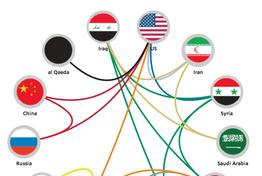
Maybe some of you saw the article from the Wall Street Journal on August 30, 2014. It graphically depicted (see the accompanying screenshot) all the various relationships among political actors in the Middle East and how they changed from enemies to friends or discovered common interests. So, historically Iran and the United States have been at loggerheads but Iran is a Shiite country and ISIS is a Sunni movement therefore Iran and the United States are in league with one another against the common Sunni enemy. Shiite Iran and Sunni Saudi Arabia have been fierce competitors but both parties now have the same enemy in the radical Islamic movement. It’s the old story that “the enemy of my enemy is my friend.” You can read more about it at the link above.
The various combinatorial factors of allegiance can be actually quite humorous if we carry out this “enemy of my enemy is my friend” shibboleth far enough. ISIS is a threat to Al Qaeda therefore Al Qaeda and the United States can form common cause. Syria has no love loss for ISIS so we can coordinate with them. Even Israel, who almost nobody chooses as a dance partner, shares interests with Egypt in opposing Hamas.
While these political associations have some element of truth to them, they are highly temporary, ad hoc, and abstract. They might cooperate for a couple of minutes behind the scenes but don’t count on the development of quality new relationships. There are too many problems and inconsistencies to forge much of a relationship. Moreover, if the United States does cooperate with one group they antagonize another. Can you imagine the US actually getting closer to Iran and the implications of that for our relationship with Israel and Saudi Arabia? That would be a complex dance indeed. Actually, the potential alliances are quite confusing and our judgments about the various alliances are probably distorted by media images and their general lack of information about ISIS.
Still, they do represent examples of commonalities that we are always calling for. We are surrounded by media messages pertaining to violence when it comes to news and information about ISIS. The availability heuristic would predict that we use and overemphasize information that is easily available to us. Since we can imagine images of violence easier than ones of peace and reconciliation, simply because these images are more available, we tend to think that such images and relationships are more characteristic of the conflict. And certainly the same is true of the negativity bias, which holds that negative information is more easily attended to and brought to mind than positive information. So when we think of the Israeli-Palestinian conflict we think of negative things such as violence, religious differences, and a whole host of tragedies that cause us to remember those more than anything else. These heuristics of negativity and availability can fundamentally define an intergroup conflict and contribute significantly to its intractability.
There is no escaping the requirement that any genuine and diligent effort to resolve Islam-West differences must confront extremism and violence. The first step, and this will be difficult for many, is to view extremism as a genuine relational term that is a reaction to economic and cultural issues. Hence, the issue is a problem that requires efforts from both sides. Defining a problem relationally implies a similarity dialectic; it forces the two parties to interpret differences as similarities or at least the recognition of mutuality of the problem. These common enemy situations can play a part. If there is going to be a compatibility perspective rather than a rivalry perspective, which is an initial crucial step toward ameliorating conflicts, then extremism must be confronted. These temporary relationships are opportunities for contact and defining problems more relationally. They at least provide entrées into the issues.
The current conflict represents simplistic belief systems that reduce the other side to essentialist practices and end up rendering everyone uninformed. For Muslims the fundamentalism gravitates toward puritanical religious ideology that defines offenses and outsiders. For Westerners fundamentalism equates liberal democracies with the natural flow of history and market economies as beyond criticism.
Real security is not a private good but one that is achieved by developing consensus, and cooperation, and interdependence – all relational terms. Justice cannot be imposed by one side but must be a concept that binds the two sides into a just relationship. They need a bigger story, another narrative that continues to develop the narrative of complementarity and compatibility. These temporary interdependencies formed against common enemies allow at least a toe if not a foot in the door.



 Peace and Conflict Politics