Category Archives: Political Conflict
What You Probably Do Not Know about the Syrian Conflict.
It’s possible that the matter of Syria and chemical weapons is a distraction and not really the main issue, although it may have ended up serving the interests of Russia. Let me explain.
The Syrian rebels want to overthrow Assad and some may have high aspirations about democracy and regime change, but a large geopolitical energy issue is being played out here. It’s the kind of story that does not interest most people, nor get much attention in the press. God only knows that religious conflict, evil dictators, chemical weapons, and Muslim sects killing each other is far more interesting, not to mention the grandiose abstractions about democracy development.
In 2016 what is called the Islamic pipeline is set to open. This will be the largest gas pipeline in the Middle East and is being constructed by Iran, Iraq, and Syria. It is designed to run from the south of Iran to Europe and it will weave its way through Iraq, Syria, South Lebanon and the Mediterranean. As you might imagine, the pipeline has been politicized with some Muslims calling it a Shiite pipeline that will serve Shiite interests. There are more than a few journalists and commentators who have suggested that the current conflict in Syria is highly related to the pipeline politics. There are claims that Sunnis will be disadvantaged; Al Qaeda will be resurgent; Saudi Arabia wants to eliminate Assad; and Middle Eastern countries want to deny Russia. You can read more about the pipeline here.
Russia is such a big player and so prominent in the news about the Syrian conflict because they currently supply a very large portion of Europe’s energy. The new pipeline poses a threat to Russian capabilities and supply orders. Qatar would like to see Assad relieved of his duties because they proposed a gas pipeline that would traverse Syria and ship energy to Europe. Assad nixed the deal and instead signed a deal with the Russians.
A few people, mostly the alternative media, have thoroughly dismissed the issue of Assad and chemical weapons and suggested that the entire matter is about the natural gas pipeline. The charge goes that Saudi Arabia wants to remove Assad and install a favorable government which will allow the Saudis to control the flow of energy. Russia, on the other hand, supports Assad partially because he helped block the flow of natural gas to Europe which is helpful for the profits of Gazprom.
You want to hear the left-wing conspiracy theorist on this issue? Check out the site called Who Is Really behind the Syrian War? The reasoning on this site is quite poor because the commentator selectively chooses some information and interviews and uses these as authoritative when they are clearly ideologically motivated. Not only that, the assumption is that the United States and Israel are intentionally trying to destabilize the Middle East and there is a sort of conspiracy going on to topple various governments for energy reason. Again, the person who controls the site makes connections between people and countries that are unjustified in the service of some sort of conspiracy theory about Israel being concerned with the greater Israel, and the United States doing Israel’s bidding.
The news stories are full of claims about how Obama has been outmaneuvered by Putin. Putin has been close with Assad for a long time and even helped him acquire chemical weapons. The Russians have a real stake in the relationship with Syria and have probably made promises to the Syrian regime that they would help them manage the United States. It is rare that the Russians would become so involved in directly challenging the US with respect to military activity. But Putin has done just that. He has blamed chemical attacks on the rebels rather than the government, sent his representatives out to lobby the U.S. Congress, and promised to play a more supportive role in the United Nations.
Say what you will about Putin and his political and diplomatic maneuvers, it remains the case that Obama did what American citizens wanted him to do which was to avoid military intervention in Syria. Obama is to be applauded for accepting the possibility of a diplomatic solution, avoiding military action, satisfying the interests of most Americans, and “keeping the peace.”
What to Think about Syria
Maybe Saddam Hussein did not have chemical weapons but Bashar Assad does. Assad has always planned a murderous response to any sort of protest or revolt. Reports are that there are 100,000 dead Syrians, and that’s a number that is difficult to even think about. I would recommend the article below on Syria “to bomb or not to bomb.” It is a re-blog from the CNN publication called “This Just in.” The article lays out the issue pretty well with respect to a subject that does not pose any simple answers.
Like all political decisions in a democracy the answer is the result of debate and the particularly difficult problems are not easily solved. There is simply no way to know “for sure” that a military response to Syria will be successful or not. There is no way to know whether the result will be something better or worse. But that does not absolve us from the responsibility of making a decision and so it is incumbent on all of us to acquire the best information and make the best arguments. That’s why the reply below is useful. But here is the essence of my thinking.
One of the main arguments to strike Syria is that we cannot stand on the sidelines and allow such an odious act as the use of chemical weapons go unchallenged. People remind us of the 1930s and how Hitler went unchallenged until it was too late. I have grown tired of Holocaust and Hitler references over the years; it is usually a sign that the discussion is degenerating. But still, the argument does resonate. When you just stand by and do nothing than evil, as the saying goes, will prevail. Even though some people will hide their heads in the sand for a long time, you can’t do it forever.
A second argument is that nuclear and chemical weapons are considered particularly heinous and we have not seen use of them to any significant degree since World War I. And the reason for that is international condemnation and the surety of a punishment that will make their use counterproductive. I think we have to honor this historical convention. We just can’t let the use of the weapons go unnoticed; there must be a price to pay.
Third, is a moral argument. Such arguments usually fall on deaf ears and do not carry the weight of realistic foreign policy but there is a moral position to be taken based on the indiscriminate death that result from chemical weapons, and their violations of just war principles. A weapon in a just war should be a last resort and designed only to immobilize an enemy combatant – not used for psychological purposes or with a blind eye toward collateral damage, which is unavoidable in the case of an uncontrollable gaseous substance.
The leadership of the Syrian government is intertwined with some of the most anti-Semitic and violent terrorist groups and political regimes, namely, Hezbollah and Iran. Moreover, according to the New York Times the world looked away while Russia helped the Syrians acquire chemical weapons. Between Hezbollah, Iran, and Russian support Syria is on its way to being a combustible proxy state that could cause future damage to the Middle East and Israel in particular. If the Syrian regime cannot be taken down then it must be stabilized.
Assad is just a slicker version of Saddam Hussein. He’s essentially a replica of the Iraqi model where anyone who stood in the way was eliminated, and the platform of the major political party was designed to perpetuate a sectarian dictatorship. The Syrian government has been killing rebellious citizens for a number of years. And is one more example of the inconsistent application of force and foreign-policy pressure because it defies imagination how the left could call for intervention and control of the Israeli-Palestinian conflict, but seem to lose their integrity when it comes to intervening in Syria. Some sort of limited military intervention in Syria will not solve many problems or do much to change the situation. And, of course, the idea that the United States could get “sucked in” to additional military responses is a defensible enough point. But it is not inevitable. It is possible to maintain strong relations and diplomatic pressure and still find certain activities unacceptable and deserving of a military response. I think the use of chemical weapons satisfies anyone’s definition of “unacceptable”.
Back to the Future for Egypt: They Have Returned to the 1950s
I’ve been skeptical about emerging democracies in the Middle East in general but Egypt in particular. There have been a few positive signs here and there and that is encouraging. Last week’s post was devoted to REAL democracies and, if I do say so myself, was a pretty convincing comparison of what even rudimentary democracies should look like and how places like Egypt do not measure up.
But I thought Walter Russell Mead’s article in the Wall Street Journal on the failure of our grand plans in the Middle East was particularly insightful. You can find the article here. In fact, I thought his main point about what actually happened with the takedown of Mubarak was so convincing that my dose of depression about Egypt’s supposed emerging democracy is on the increase. And although I’m not convinced of each point made by Mead, his analysis of the relationship between the military and the government is spot on. The military is a privileged organization in Egyptian society. The military leadership is an elitist segment of the society that garners significant benefits and perks, which they are not about to give up easily. Some of the strongest and most accomplished leaders in Egypt are military, and they move easily between the military and the civilian government. The military is highly integrated into Egyptian politics and considers itself the dominant and most important state institution.
It turns out, according to Mead, that Mubarak was trying to arrange for his son to be his successor and avoid altogether the military’s role in choosing a future leader. This would have turned Egypt into a family dynasty rather than a military republic. The military leadership was having none of this and was involved in fighting back partially by creating unrest. The military touted their democratic credentials by standing back and letting protest movements challenge Mubarak until he fell. They then stepped in and restored peace and quite skillfully played the father-protector role. Even though the military is more powerful than the Muslim Brotherhood, they accepted the appointment of Morsi initially believing they could manage him. When Morsi turned out to be less than competent and failed to understand his role the military removed him. Again, Morsi’s Muslim Brotherhood credentials worked to his disadvantage since both the military and the general population is suspicious of the Brotherhood.
So, what do we have now! We have the Egypt in the 1950s. Egypt is a military republic that has come full circle and made no progress toward democracy. Mead continues to explain that the population assumes that only the military can protect them from the Islamists and hence maintain a sympathetic attitude toward the military. The other two forces in society – liberals and the Muslim Brotherhood – are fluttering in the background incapable of doing much.
Both Mubarak and the leaders of the Muslim Brotherhood are on trial which I presume will justify military political goals. Mubarak, who is from the military, was sentenced to life imprisonment but a retrial was ordered. This will allow the military to remove Mubarak but pay their debts to one of their own. The military has skillfully deposed Mubarak and appeased the population who would have revolted had they watched him walk away free, but the military will ensure that Mubarak’s final days are quiet and in the background.
Egypt is an important culture and strategic ally of the United States. A couple of years ago there was great hope and optimism for enlightened progress in Egypt. But such hope and optimism are waning. We have to sit back for a while and let Egypt stabilize before altering our foreign-policy stance. But we can’t sit back for too long because issues related to Iran, the peace treaty with Israel, Islamism, terrorism, and various strategic interests await us.
Best of Luck to the Kerry Talks between Israelis and Palestinians: But There Is Not yet Enough Pain
The fact that Secretary of State John Kerry has organized talks between the Israelis and Palestinians is noteworthy for two reasons – it’s a positive anytime you can bring these two sides together, and the world has issued a collective shrug. Israelis are generally bored with the Palestinians and don’t believe there is anyone really to talk to. The cynicism over the possibility of anything actually coming of these talks is extensive. Few people are even paying attention because they are so sure that this will all be an empty exercise. Even President Obama seems distant from the process.
But we should avoid cynicism and I am all for any sort of engagement and it can be anytime, anyplace, and even under less than ideal conditions. There are numerous posts on this blog at various points in time explaining the advantages of communicative contact (e.g. see July 8th 2013). There are good reasons to have talks all of which are pertinent to unpacking this complex conflict and repackaging it into something sustainable. Let’s look at a few of them, but first a little context.
The Unique Nature of the Talks
The Kerry Talks are supposed to focus on final status issues; that is, the crucial six issues which are the status of Jerusalem, refugees, borders, Israeli security, settlements, and the Palestinian right of return. These issues have been ignored in the past and sometimes defined as too difficult and hence put off for a future date. Read some background on final status issues here . Barak and Arafat made some attempts at a final status agreement as did Olmert at Annapolis. These efforts failed and the explanation always was that the two sides were still too far apart. But it is also the case that both sides simply cannot imagine themselves settling on the decision. Conservative political blocs in Israel oppose the creation of a Palestinian state, and Palestinian leadership is a proxy for the larger Arab world and feels very uncomfortable giving up anything or recognizing Israel.
The divisions that separate these two groups run deep especially when it comes to the special status of Jerusalem and refugees. Jerusalem just may be the most intractable problem because of its sanctity. The Palestinians, on the other hand, choke on the possibility of any recognition of Israel and will not accept their presence as a Jewish state. Gritty and thorny as these issues are talk is all the two sides have and there are reasons to engage it.
The Palestinians have been frustrated and thus decided to go around the Israelis through, for example, their petition to the United Nations as a basis for claiming statehood. Any final agreements must be and should be the result of negotiation between the two principal sides, and the Palestinian petition to the United Nations was counterproductive and responsible for the deterioration of the process. Israel and the United States opposed the Palestinian petition to the United Nations and threatened financial pressures. The proposed talks can help repair the damage to the relationship between the three parties (the US, Israel, and the Palestinians) and move the center of discussion back to the principals.
Secondly, the United States does not have the luxury of waiting around. Even though the conflict has been with us for decades and seems to be a constant on the political playing field, one in which the issues are fixed in people’s minds and will not change much, it remains a powerful symbol of difficult ethnopolitical conflict and the “clash of civilizations.” Moreover, the US has practical “on the ground” concerns with respect to terrorism, balanced international relations, oil, democracy development, and national security. Although the claim that the Israeli-Palestinian conflict is the cause of so much international tension is simply unjustified, it is a combustible political symbol that arouses ethnopolitical passions around the world.
The settlement issue must be solved. Israel will have difficulty moving settlers and the Palestinians have stated that they want no Israeli presence in the future state of Palestine. A Palestinian state must be negotiated by the two sides and cannot come into being otherwise. The two-state solution is the only way that Israel remains Jewish and democratic and there is considerable work to be completed before the contours of this potential state are fashioned.
Finally, talking to one another is the only way that compromises and adjustments will be made. Both sides have powerful positions that control aspects of the discussion and direct communicative encounters are the only way these compromises and adjustments will come into being.
My guess is that these talks will fail but at least represent a step in a long journey. It’s possible that both sides believe the other will be the cause of the failure and have agreed to enter into the discussions for that reason alone. Sadly enough, I’m still of the opinion that there is insufficient pain. In other words, if conflicting parties have to wait until they are at a “hurting stalemate” before they get serious than these two parties simply aren’t hurting enough yet.
I Told You So! You Don’t Want Islam Running the Department of Waste Management
In February of 2011, over two years ago, I posted a blog with the title “Do You Really Want Islam Running the Department of Waste Management?” With the rise and now fall of Morsi in Egypt we had a chance to watch what happens when the Muslim Brotherhood or Islam is governing. It wasn’t pretty. Morsi was dumped by the Egyptian military for his autocratic and incompetent governance. Local Egyptians have been “put off” by the shortfall in fuel, electricity, and a crumbling economy. Human Rights Watch said that Morsi continued the abusive practices of Mubarak, and any number of journalists and political activists have been prosecuted unfairly.
The Foundation for the Defense of Democracies reported on July 9, 2013 that apparently a document proving six-figure payments to top Muslim Brotherhood officials has surfaced. This document is important because as Islamists the Brotherhood claimed that they were more religious and had higher morals and were less subject to corruption. Morsi had apparently replaced hundreds of judges and officials with Muslim Brotherhood figures and was assumed to have adopted the political corruption of his predecessors.
It’s just possible that Morsi failures signal the end of religious politics in Egypt. Much of the population is unhappy with the Muslim Brotherhood’s politicization of religion and unfair treatment of the opposition. The Egyptian Constitution is wise with respect to its principles of separation of religion and politics. Religious parties are illegal because they could not maintain the respect for the differences between religion and politics. The Muslim Brotherhood has failed to respect this principle which is crucial for democracy.
Democracy through its persistent debate and contest maintains a check and balances system that is constantly responding to needs and threats posed by different groups in society. Different religious, ethical, and political groups need to have their rights met but also achieve a degree of unity. Such unity will not be found in a comprehensive political or religious system; that is, a system of fixed ideas about the universe and preference for only those who hold such ideas. In that case the political entity would be governed by a single group with the regular maximization of differences and inequality. The most successful form of unity tying pluralistic groups together is broad but not necessarily very deep. It represents a political conception of justice that is capable of including multiple groups.
Hence, the logic of the European liberal experience has demonstrated that tolerance cannot be separated from liberalism. And, continuing the logic, tolerance cannot be separated from a loss of certainty. Tolerance results in a loss of faith and in the experience of at least unfreezing one’s attitudes. This is why religious groups – whether they are Muslim, Christian, or Jewish – who are highly Orthodox in their beliefs and unwavering often isolate themselves from others. They fear contamination in the form of exposure to unwanted influences. Tolerance is firmly rooted in a communication process, governed by conditions of civility and debate, which sets into motion political activity that questions one’s own certainty. One of the difficulties for the liberal state is for its members to subscribe to a shared point of view about justice and recede from religious justifications, but subscribe to this shared morality on the basis of their own religion and point of view. The key point here is that the result of discovering this common point of view or common morality is justified on moral grounds acceptable to both competing parties. As Rawls (1993) maintains, this sort of overlapping morality can only emerge from the public sphere on the basis of public reasoning.
Such conditions are very alien to the religious Muslim. Not that this is required because there are ways to think about and interpret Islam in a somewhat more accommodating manner. But such is not the case for the Brotherhood.
Hold onto your hat! Israeli-Palestinian Violence Is Coming
Ethan Bronner of the New York Times last week wrote about the disconnect between Israelis and the general problem they face with the Palestinians. Bronner, who was a former Jerusalem bureau chief for the New York Times, had recently returned to Israel and found Israelis to be almost intoxicatingly removed from the Israeli-Palestinian conflict. They could “care less” about it and are more removed from the political situation than ever. Israel is a very successful economic culture and, various social inequities notwithstanding, they are enjoying the fruits of Western democracies and market economies. Bronner writes that even the Israeli left is increasingly insignificant, and a shell of its former activist self.
I must say that this is generally consistent with my own experiences. I was teaching in Israel last year at this time and quite struck by how “bored” the average Israeli is with the entire matter. They don’t believe there is anyone to talk to or that the Palestinians are serious. I spoke to plenty of students, wait staff, bartenders, and average citizens and the majority is fed up and has simply decided to ignore the whole thing. Cynicism about the peace process is so great that nobody cares to talk about it. Israelis don’t understand the extent of their international condemnation; Israelis don’t understand how anyone could offer up political and moral support for organizations like Hamas and Hezbollah; Israelis don’t understand why the world can’t learn from the lesson in Gaza that giving the Palestinians in Gaza what they wanted (an Israeli pullout) resulted in more rockets fired into Israel.
The Palestinian Authority is in bad shape and things will get even worse with the resignation of Salam Fayyad who was focusing on economic and institutional security in the West Bank. Things are quiet at the moment with John Kerry’s diplomatic efforts deserving of some credit. Even though the Palestinian Authority continues to receive criticism, it’s unlikely for now that the system will be pushed to its limits. The Palestinians are just as tired as the Israelis but for different reasons. They are fed up with their own political leaders and divided amongst themselves with respect to how to proceed. The issues of checkpoints, settlements, prisoners, and financial matters are weakening with respect to their individual issue capabilities. In other words, these matters do not hold the intensity they once did because the population has spent the political capital associated with them and the peace process is still elusive.
The International Crisis Group (go here) issued a report on May 29, 2013 concluding that the Palestinian Authority is in financial trouble and cannot pay salaries. And although they have been recently lulled into a sleep-like state with respect to larger peace issues with Israel, things are beginning to change. The Palestinian Authority, according to the crisis group, is under threat of dissolution. It is simply likely to evolve away into a different reality as Abbas ages. Abbas has a certain amount of historical legitimacy and is committed to a negotiated settlement. But with the Palestinian Authority so fragile, and enough time has gone by such that patience is running thin, any political act (settler violence, clashes in Jerusalem, hunger striking prisoners, or some act of violence) will spark the combustible mixture into a conflagration.
It does not matter how complacent Israelis feel or how content they are about their own good faith efforts, the current situation is not sustainable for very much longer. There remains economic fragility, violence, humiliation, and perceived injustices that cannot stand a much longer test of time. Images of the Titanic come to mind with some killer iceberg waiting in the not-too-distant dark.
Captions and CutLines Lie Like Cameras
The two photos below represent different captions designed to frame the story in a particular manner. The first photo is from AP and was reported by Elder of Ziyon.
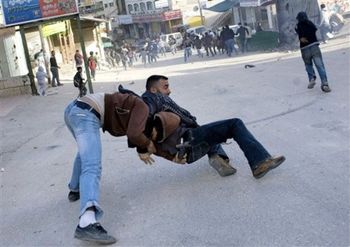
A Palestinian rioter tries to grab a weapon from a plain clothes Israeli police officer, right, during clashes in Shuafat refugee camp in East Jerusalem. Palestinians scuffled with Israeli security forces, after an arrest operation triggered clashes in the camp the day before.
The second photo is from Reuters
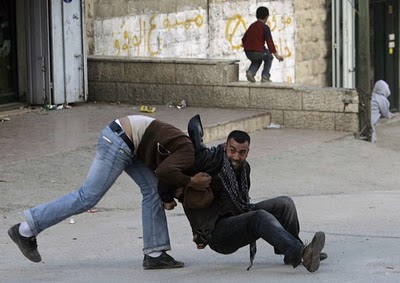
An undercover Israeli police officer (R) scuffles with a Palestinian youth suspected of throwing stones while trying to detain him during clashes in the Shuafat refugee camp in the West Bank near Jerusalem. Clashes erupted between Palestinian stone throwers and Israeli police that entered the refugee camp, a Reuters witness said on Tuesday.
The caption for the two photographs is actually quite different. In one sense, the descriptions do not contradict each other. They both described the scene. But it is possible to conclude with some different interpretations on the basis of the caption alone. In the Reuters version the Israeli appears to be the aggressor because he is trying to “detain” the Palestinian. The readers conceptual background might easily identify the Palestinian as engaged in legitimate revolt and doing little more than throwing stones at the bigger more well armed soldier and his comrades. It is the classic David and Goliath image. Anyone writing a caption should have the typical reader in mind. But in the AP version the Palestinian is characterized as more aggressive because he is trying to grab the weapon and will probably use it on the policeman. The policeman’s aggressive behavior would of course be justified in this case.
In the Reuters version, the fighting “erupted” and apparently the Israeli police entered the refugee camp which was sufficient provocation. But in the AP version there was an arrest operation that provoked the violence. The websites “Elder of Zyion” and “Honest Reporting” claim that the Reuters organization used an Arab stringer for a description of the events.
This poses an interesting question with respect to the newsgathering process and how stories are framed. Some news outlets have websites and phone numbers that one can call in order to report a story. So anyone can fill out a form on the web and provide a description of some event or activity and perhaps attract the attention of a news organization. The person leaves phone numbers and email addresses where he or she can be reached and the news organization contacts them. This of course can be an excellent source of news and is the sort of contact that results in specified and situationally-based stories. But on the other hand, this process can be abused. It can result in stories that are biased as a result of the selection process or stories, even worse, that are staged or distorted in some significant way.
Actually, the description underneath the photographs is a cutline and not a caption. A caption is a little headline and a cutline describes the photograph in more detail. Reader psychology and tendencies are important because the photo sparks interest and then readers typically move underneath seeking explanations. It’s important for cutlines to perform their duties. Cutlines like stories answer the who, what, why, when, and how question of journalism. When cutlines are more on the objective side of the dimension they satisfy reader’s understanding of the picture but have not necessarily told the reader what to think. The more cutlines are politically motivated the more they draw the reader’s attention toward some specified reality on the part of the news outlet.
A picture may be worth a thousand words but each of those words is capable of altering the meaning of the picture. A skilled cutline writer knows these things and chooses his words carefully.
The Boston Terrorists and Their Imaginary Kinship with Chechnya
The Tsarnaev brothers have little to do with Chechnya. They have spent most of their life in the United States and their connection to Chechnya is on the basis of an imaginary kinship with an ethnonational group. The brothers have been described as “self radicalized.” In other words, over time they developed a powerful sense of their ethnic identity and its humiliation which resulted in decisions to unleash extreme measures. How does this happen? How is it that generally average American boys, with Chechnyan heritage, all of a sudden foreground that Chechnyan heritage and behave so violently?
Well, ethnic identity is like a plot in a murder mystery; it thickens over time. But it remains true that this identity has to be activated or triggered. The more interesting question is how such an identity is triggered. What are the issues most associated with stimulating differentiated group identity? Such identity is rooted in tradition, sacred mythology of the past, and a collective consciousness. The work of Anthony Smith directs attention to the power of myths, memories, traditions, and symbols of ethnic heritage that are used by people like the Tsarnaev brothers to tap into and construct a narrative that tells the story of injustice and retribution. Under particular circumstances this can happen pretty quickly and easily. And it does not only apply to angry groups bent on violence to redress a past injustice. I have seen Jewish students with little knowledge of their Judaism and few touch points with Jewish culture and religion travel on the Birthright trip to Israel and return significantly influenced and changed if not transformed. They have experienced little more than the activation of their ethnic identity through symbols and myths that historically position them within something greater than themselves of which they assume a long kinship.
The map below is just for general information because most people (although not the readers of this blog!) think we are talking about Czechoslovakia rather than Chechnya. Some earlier research on terrorism found that terrorist groups achieved their goals one of which was gaining attention. In other words, immediately following a terrorist act the public turns its attention to the issue or cause of the terrorist. Palestinian terrorism in the 60s and 70s is generally known to have been successful at laying the foundation for future international sympathies toward Palestine. Consequently, I’m sure that Google was filled with searches about Chechnya a few days after the Boston bombings. The public simply asks “who are these people and what are they talking about.” At least that’s true of some of the public but unfortunately large segments remain oblivious and apathetic about conflicts in strange places far away.

Very briefly, the Chechens are autonomous people in the Russian Federation in the North Caucasus. They have been in conflict with the Russians for generations and this conflict has radicalized many and been violent, very violent sometimes, on the part of both sides. There has been a raging controversy between Chechens and the Russian government since the early 19th century when Persia gave the territory to the Russians. They became increasingly focused on Islam given the proximity of Chechnya to Turkey and Chechnya’s continuous desire for help from Turkey. In 1944 Stalin committed atrocities and massive human rights violations by deporting the entire population of Chechnya’s to Central Asia because Stalin claimed they were supportive of Hitler. In 1991 after the breakup of the Soviet Union Chechen separatists sought independence from Russia and this resulted in bloody wars. Chechnya continues terrorist activities rooted in ideological Islam and national pride.
Ethnic identity is a relational concept such that the categorization of an ethnic group is based not only on ingroup qualities but differences from outgroups. This is what Edward Said meant when he described the “Oriental” as inferior because he was relationally in opposition to Westerners. The Tsarnaev brothers somehow began to foreground their Chechnyan identity and define it in relational opposition to an American identity (as well as probably a Russian one). The added intensity of having a stigmatized Chechnyan identity (oppressed, mistreated, misunderstood) was probably sufficient to ratchet up their sense of humiliation and justification for violence. Unfortunately, the rising expectations about democratic development and the concurrent increased respect for group rights probably means that we have not seen the last of such violence.
“The Law” and the Settlements
Even the beginning student of conflict management knows that some people simply will not change their mind or be convinced by arguments, no matter how unassailable, about historical incidents and accuracy. But the law is one of the best ways to understand an issue. Everyone wonders about the legal standing of settlements eventually. The video lecture below is a well done explanation of some issues and I highly recommend it.
Click The Legal case for Israel to hear the lecture.
But let me make a few other points. When some states don’t even recognize the legal legitimacy of the state of Israel, you know that” the law” is as easily manipulated and fungible as any other domain of knowledge. My goal here is not to explicate in detail elaborate legal arguments but to try and find some clear simplicity. In addition to the video above, a good reading pertaining to the legality of the settlements appeared a couple of years ago in the American Interest. It can be found here. Read the article in the American Interest at your leisure but we must begin with some basics.
What is now the West Bank was part of the outskirts of the Ottoman Empire that was largely ignored and lightly governed. After the Turks were defeated in World War I the current area of Palestine was assigned to the British who were given a “mandate” to administer the territory. Jews flowed into the territory of Palestine until 1947 when the British government wanted out of the mandate and the UN recommended the adoption of the partition plan creating one Jewish state and one Arab state. The Arabs rejected the partition and war ensued. It’s important to first point out that the UN resolution partitioning Palestine has no legal standing. The General Assembly has no authority of international law and the resolution was a recommendation only. As a result of the Six-Day War in 1967 Israel made further incursions into the West Bank as a security and buffer zone. This incursion resulted in increased “occupation.”
Some legal scholars argue that the West Bank and Gaza remain unassigned by the mandate. Others claim it is Palestinian territory. But one of the strongest arguments against the legality of the settlements results from the Geneva Convention in 1949. It stated that no occupying power (that would be Israel) can transfer its own citizens into occupied or newly acquired territory. Moreover, UN resolution 242 calls for the withdrawal of Israeli troops from occupied territory. But it is also clearly recognized that Israel in the Six-Day War fought a lawful war based on its inherent right of self-defense recognized by the UN charter. Israel’s incursion into the West Bank was the result of aggression and Israel had every right to defend itself including maintaining a security presence.
Two Arguments That Support the Legal Status of Israel and the West Bank
1. Since the defeat of the Ottoman Empire in World War I no country has any firm legal standing or recognized legal rights to the occupied territories. Hence, what is termed the territories has never been part of a legally recognized sovereign and consolidated state and thus the prohibitions about population incursions from the Geneva Convention do not apply. If Spain overwhelmed Portugal and began to establish Spanish communities and populations in land acquired through violence then this would be a clear violation of the Geneva Accords. But what is termed “the territories” does not meet the definitional standards of a sovereign state.
In addition, it has been cogently argued that the Geneva Accord was designed to respond to the Nazis who transferred populations for the purpose of colonization and to obliterate the existing population. This, the argument goes, has nothing to do with Israel whose settlements are not designed for colonization.
2. A second argument is that the occupied territories were assigned to the Jews by both the mandate and the United Nations partition thus giving Jews the right to use and settle the land. This is based on the assumption that the legal status of the territories has not been established and Jews have no fewer rights or less justified legal standing than anyone else.
I will state the arguments for the illegal nature of the settlements perhaps in the next post. But it is important to underscore that legal arguments are not always the best way to solve a problem. They often enough lack clarity and specificity and do not satisfy sufficiently both sides. Making a legal claim, especially in an unclear legal environment, can fail to satisfy either party. The Israelis and Palestinians should solve their problems themselves.



 Peace and Conflict Politics