A Conservative’s Proposal for One State in Israel
 The proposal for a one state solution in Israel usually comes from the far left, which defends a one state solution on the basis of a pure liberal democracy and universal values that would not privilege a Jewish state, or from the far right that wants to simply appropriate the land and maintain its controlling stance. That’s why my ears perked up when I began to see announcements of Caroline Glick’s new book on the one state solution. You can read something more about it here.
Glick is a tough and articulate conservative who writes for The Jerusalem Post and has been an assistant foreign policy advisor to Netanyahu. Over the years I have found her to be worth reading, even though I often disagree, and a relentless conservative defender of Israel.
Glick has given up on the two-state solution. She claims that the whole thing was doomed from the beginning and she has now become a defender of a one state solution. I found myself eager to read on because I can’t imagine a one state solution that does not significantly disadvantage Israel. Most sensible defenders of Israel – the ones who realize Israel’s mistakes and don’t want to oppress anyone – just want a state to be standing in the end that is devoted to Jewish particularity with the Constitution or Statement of Principles that makes it impossible to eliminate the Jewish character of the state. So how would Glick reconcile this?
She begins by making arguments such as the following: the two-state solution it turns out makes it impossible for Jews to live and pray in Jerusalem and to assert any rights to the traditional lands of Judea and Samaria. This is because Palestinians would be there and living in a Palestinian state including areas of Jerusalem. I never thought of this as a problem but rather an integrative solution. Yes, in some hypothetical two states sections of Jerusalem would be Palestinian and make for a peaceful and coordinated community rather than one that denies Jews access to holy sites. Such a solution, I always presumed, would not have been negotiated in the first place. For all intents and purposes Glick’s argument here is to establish a dominant Israeli Jewish society that somehow magically treats the Palestinians appropriately but keeps them from full power in the political system. I don’t know how this is supposed to work.
Then, Glick makes the argument from history about Israel’s legal claim to sovereignty over Judea and Samaria and how it is grounded in international law. She cites a few experts and documents and then seems actually to believe that the issue is settled. She lists out the standard statements about cease-fire lines not being political borders and the Arab rejection of the partition and again seems to accept these as a given. Surely she does not think that Arab states will simply accept Israel’s rights to the West Bank,that arguments about borders from history are clear and cannot be confounded. These arguments have been contested for decades. Their easy rejection is part of the nature of intractable conflicts where history becomes the plaything of each side.
Glick’s solution is essentially to extend Israeli law to the West Bank and East Jerusalem. She seems to think the Palestinians will accept Israeli law the same way the Druze and Arab residents have. Additionally, one of her reasons for the rejection of the two-state solution is that Palestinian leaders are deeply anti-Semitic and the establishment of a state would be problematic for Israel. I accept that the Palestinians probably have more than a few misconceptions about Jews, but transforming these stereotypes and prejudices must be part of the peace process and can be facilitated by the existence of their own state.
In the end, I found Glick’s proposals to be reasonably shallow and unworkable. The Palestinians are deserving of their own national entity and if they turn their attention to the noble work of state building then both groups of once or now displaced people (Jews and Palestinians) can experience a “return.”
People Can Change – In Defense of Communicative Contact
 What are the communicative, cognitive, and social psychological processes associated with change? Or, how do positive outcomes associated with contact come into being. Below I explain the processes most associated with how and why contact ameliorates or make change possible between conflicting parties.
Humans are open system information processors who are always subject to the influences of information. Even the most prejudiced person, with the most rigid boundaries and categories for classifying others, can unfreeze or loosen those categories in order to process new information or integrate new meanings. Any process of reciprocal interaction (contact) requires cues and stimuli to be integrated and made sense of. This is a conscious activity guided by individuals who take any sort of inconsistency, puzzlement, new information, or confusion and make sense of it. Consequently, two members of conflicting parties can have contact with one another and expect some sort of information processing that alters the cognitive content and boundaries of each. Surely this will vary by individuals with some being more recalcitrant and resistant to change than others. But all individuals by the very nature of their information processing capabilities are subject to change. The contact hypothesis, in the hands of knowledgeable facilitators, is designed to direct this process as much as possible; the conditions of contact can be controlled such that they maximize the opportunities for communication to work. Contact, and the information processing that accompanies it, is by definition communicative and interactive and potentially transformational even if the transformation is minimal. By emphasizing interpersonal exchanges the chances for altering attitudes, beliefs, stereotypes, and perceptions are increased potentially resulting in change for individuals and groups. This possibility for learning and integrating new information makes it possible to develop practices related to positive change such as restorative justice, forgiveness, cooperation, and reconciliation. It is grounded in a cultural context and articulates a subjectively central interaction where the participants are the primary resources.
Groups in conflict must adjust and change for the purpose of peaceful relationships, political order, and the recognition of group rights. Interactions between divergent groups, then, are subject to different perspectives and patterns of communication necessary for reaching across symbolic divides and working toward consensus on difficult issues. Contact experiences can be designed for maximum conditions essential to the linking and convergence sought after by conflicting groups. Dryzek (2010), for example, makes the distinction between bonding communication and bridging communication. Bonding communication takes place when people in groups are similar and share similar backgrounds and cultures. Bonding intensifies commonalities and identification with others. For instance, Yasser Arafat was known to speak one way to his own people and another way to international or culturally different groups. When speaking to his own cultural group he engaged in bonding forms of communication by using Arabic communication patterns and emotionally arousing discourse. This type of communication intensifies group identity and deepens divisions with outgroups. Of course, President Bush adopted a bonding discourse in order to solidify support after 9/11. Bonding discourse can separate groups into polarized differences and reinforce attitudes. It is not the kind of communication most conducive to unfreezing prejudices or moderating stereotypes of outgroups. Rather, a contact experience would benefit from communicative arrangements designed to “bridge” individuals and groups. Bridging communication takes the perspective of the other and works to incorporate it into one’s own outlook. The goal is to bridge or transcend differences between groups by providing some pathway from one group reality to the other. Contact experiences are fundamentally concerned with bridging disparate realities by using communication to coordinate and manage meanings and relationships. Such bridging contact can be difficult because group members must recognize and understand the attitudes and beliefs of the other and adjust or incorporate them in some way. There are any number of psychological barriers, filters, and defense mechanisms that make bridging communication difficult. The burden of bridging communication is considerable especially when one group is a discriminated against minority. Bridging communication must find overarching shared values that appeal to and connect both sides. So, for example, even though one side (e.g. Palestinians) is discriminated against they must participate in the task of building bridges in order to achieve full rights and representation.
The Nuclear Deal with Iran is a Good One and in The Right Direction – Yes, Even for Israel.
 The nuclear deal with Iran is just fine and a strong piece of international diplomacy that Obama should get credit for. Let’s take a closer look at the issues and try to respond on the basis of good policy and evidence rather than fixed ideological positions. We can begin by examining the consequences of doing nothing. In that case, the only options are to continue the let Iran develop nuclear power until it is weaponized or respond with violence by bombing their facilities and resources. Both options are just counterproductive. Bombing Iran – the position of knee-jerk conservatives and those with fantasies about killing all your enemies in one easy swoop – would be extremely provocative and probably bring about just what it is we are trying to prevent. That is, it would justify Iran’s counterattack as well as any other forms of military action. It would jeopardize Israel and the United States and move relationships backward rather than forward.
Of course the deal is not perfect and it is dependent on the quality of inspections and the conscientiousness of all the parties involved. But it’s a negotiation, a compromise, a synthesis emerging out of a thesis and antithesis with all due respects to Hegel and the logic of epistemological value. We should try to rise above the rank ideological analyses that simply equate this with appeasement of the Nazis in the 1930s (I invoke my typical refrain that every time you compare a foreign policy decision to Hitler or the Nazis the quality of the arguments and discussion has just declined). This is an attempt at rational management and the prevention of unspeakable violence. There are more reasons why this deal is a step in the right direction.
First, it is not an act that leaves Israel vulnerable. If it sets the foundation for some stability, it will protect Israel rather than threaten Israel. If the sanctions work properly they will become even more intense if Iran violates the tenets of the deal. Iran must be approached as a rational actor that cares about protecting its citizens. I understand its religious proclivities and irresponsible statements regarding the existence of Israel and the U. S. (The Great Satan) but Iran is also a historically sophisticated culture that many believe want a seat at the table of civilized nations.
Secondly, the most cynical among us claim that Obama cares about nothing but his legacy. Really! Obama instituted this process with his own reputation in the future in mind only? Obama has always been more interested in a slower hand and a diplomatic stance than anything else. He believes in dialogue and contact with enemies when necessary leaving violence as a last resort. Obama recognized the importance of a nuclear deal and worked hard to achieve it.
And third, Iran may be a historical enemy of the United States, especially after the hostage crisis and the revolution in 1979, and even be a threat to some of our allies but again the nuclear deal potentially brings stability. The possible payoff of improved relations with Iran is considerable and includes a counterbalance to ISIS who are Sunni and an opportunity for Iran to forge a more stable relationship for the U. S. among some unstable places like Syria, Yemen, and Lebanon all of which are in Iran’s sphere of influence. If, and I certainly recognize that this is a conditional, this deal is even minimally effective and Iran spends more time in bridging discourse with the United States than this in itself will be a significant achievement and foundational to the management of conflict.
Assuming that Congress expresses support for the deal – and I think they will since some polls show that close to 80% of Americans support the deal – then Iran’s nuclear capabilities will have been constrained, and that is the primary goal. As of now, this agreement is a diplomatic achievement and with just the smallest amount of commitment and moral fortitude it will evolve into a significant stabilizing force in international relations.
The Relationship between Israel and the US: Big Brothers and Little Brothers Fight
My conservative friends ask me how I can be supportive of Obama given his stance on Israel. I usually explain to them what friendship is like and point out how they are getting hysterical over little. His relationship with Israel is no different than that between two friends who argue politics, often think the other is crazy, but each is the first to call the other in time of trouble. Sure things are a little tough at the moment and Netanyahu’s visit certainly was an offense, but they still have each other’s back.
Conservative Republicans and blind Israel supporters continue to cast Obama in the role of Israel’s antagonist. They embrace Netanyahu and criticize Obama. Obama is regularly cast as unsympathetic toward Israel or, worse, ignorant of Israel’s true security needs. Those on the fringe end of the conservative spectrum, the ones that call Obama a socialist, continue to believe that Obama prefers international liberal rights to individual group rights. Consequently, they assume Obama is willing to kick Israel to the curb while placating Arabs and the international left.
Those of us who spend many waking hours thinking, or writing, or teaching about these issues are not surprised that the big brother and little brother fight. The suggestion that a two state solution use borders somewhere along the 1967 lines is so common in the literature and in discussions about resolving the conflict that the statement has little effect on me. Most people, including the majority of the Israeli public, prefer a two state solution with borders being defined as somewhere along 67 lines. Netanyahu is correct that those borders would not be sufficiently defensible. But with buffer zones, electronic surveillance, and swaps it’s possible to establish borders for a Palestinian state. To pounce on this single statement was simply inaccurate and unfair.
Moreover, Obama’s has made some very supportive statements throughout his presidency. And playing politics or simply grubbing for the Jewish vote does not explain these comments
because they commit Obama to a course of action. Hence Obama told AIPAC that “Jerusalem will remain the capital of Israel and it must remain undivided.” This is an unbelievably provocative statement and probably will not be included in some final two state solution. Obama has stated clearly that the two state solution is subject to negotiation between Israelis and Palestinians in order to determine a final status. But even with the latest moves in the UN I bet this issue just fades away. Any ultimate solution will be negotiated with the Israelis and Palestinians. I trust Israel will do nothing that undermines its own security.
Obama has chastised Assad; he has encouraged Yemen’s president Saleh to leave office; he has supported the people in the streets in Tunisia and Egypt. Calling on him to send in troops or overtly assert American power is simply politically irresponsible. Obama has recognized emphatically the special relationship between Israel and the United States.
Obama is not trying to appeal to everyone. He is encouraging the Israelis to make necessary movements in an effort to stimulate discussion. Right now nothing is going on. Netanyahu is not going to negotiate with a Palestinian government that includes Hamas; he’s adamant about 67 borders not being defensible so he wants to encroach into land east of Jerusalem toward the Jordan River. The Arab world is in flux so it does not seem to be the time for discussions. I credit Obama was trying to encourage additional contact.
Having said all this, it is clear that Netanyahu is not Obama’s favorite international leader. Obama does have a more accommodating and diplomatic style whereas Netanyahu knows exactly what he thinks and has little interest in modifying it. But Obama believes that he is serving the needs of peace and thereby the needs of Israel. He has acknowledged the problems of dealing with Hamas. He knows that the 67 borders will require adjustments and land swaps. And Obama supports and has stated as such Israel’s right to be a Jewish and democratic state, including its capacity to defend itself. This is important because the Jewish nature of the state remains problematic. Israel faces tremendous demographic pressures as well as political ones that threaten the Jewish and democratic nature of the state. Netanyahu is making a mistake if he thinks the special nature of the US – Israel relationship means he can behave any way he wants. The world grows weary of this conflict and is already turning its attention elsewhere, and everyone’s patience has limitations.
Obama was very helpful to Israel by avoiding issues such as the Arab Peace Initiative, settlements, and discussion of refugees. It takes leadership to talk about the Middle East “as it should be.” Obama recognizes that the current situation is untenable, and that any UN vote will precipitate many problems. Of course, Obama’s primary lesson is to value human
rights over locked-jaw nationalism. In the past Obama has recognized Arab freedom fighters and advocates for democracy and rhetorically positioned them along with Martin Luther King and Rosa Parks. Praise for Arab freedom fighters is good for Israel.
Post based on May 25, 2011 post
Netanyahu and The Future: Israel and the Peace Process Will Make Little Progress

Well, Netanyahu has been elected for an historic fourth time. His path to the Prime Minister’ s office this time is strewn with damaged relationships (think US), international political stunts (speech before Congress), the race card (“the Arabs are voting in droves”), and desperate political appeals (“there will be no Palestinian state”). As much as I understand that he can be a charismatic leader, and Israelis obviously respect him, I also cannot shake the feeling that he is increasingly embarrassing. He has moved from being a strong and impressive leader to just another crude politician. But he also seems to have lost his political sophistication by failing to satisfactorily consider the negative consequences of his behavior. Let’s look at a few examples.
First, trying to scare Israelis about how many Arabs are voting was equated by the White House to the tactics of Southern racists who tried to scare the population about the black vote. Now there is a smart move if you’re dealing with the Obama administration. This is a president who is steeped in issues both professionally and personally related to minority rights. They were not going to be sympathetic to such talk.
Secondly, the statement about there being no Palestinian state, as a few observers have pointed out, undercuts the US argument in the United Nations. We have consistently supported Israel on the basis of bilateral negotiations; that is, the argument has been that solutions should emerge from discussions between the two sides. But if Israel is on record as opposing the future Palestinian state then why have the negotiations in the first place. Then again, Bibi does not want the UN to be involved in outlining a Palestinian state anyway.
There just is not going to be a Palestinian state on Netanyahu’s watch. Netanyahu is not going to be the leader of Israel who goes down in history as responsible for the establishment of the Palestinian state. And this is why Netanyahu is actually dangerous for Israel. No one can think about Israel in the future as an intact stable political system that is both democratic and Jewish without imagining a separate Palestinian state. Netanyahu has become a force leading increasingly in the direction of one state and all sorts of demographic difficulties.
I want to underscore the importance of a stable Palestinian Authority. Israel and the United States subcontract out security issues and border patrol to the Palestinian Authority and as they teeter things get more unstable. Even Israel would rather deal with the Palestinian Authority then some other more politicized and religiously fueled group (e.g. Hamas). So there are incentives to keep the Palestinian Authority stable even though this is distasteful to Netanyahu. Of course, there is the entire matter of settlements which I will not take up here but suffice it to say that Netanyahu’s predatory settlement expansion is a major sticking point.
Finally, there is the looming presidential campaign and US politics. Leaders of the Democratic Party have to find a way for Hillary to run to the right of Obama on Israel if she wants to guarantee the Jewish vote. Running to the right of Obama on Israel is not particularly difficult but it would be far easier for her to run if there is an actual UN resolution outlining final status parameters.
It is distressing that Israel continues to reelect the one person who is resistant to final status preparations. I just have the feeling that Bibi’s heart isn’t in it and he is trying to play both sides. What I mean by that is Netanyahu fundamentally rejects the idea of a Palestinian state, but must present himself as receptive to it. The US will maintain its deep commitment to Israel, but Bibi is not making it any easier.
Just for the fun of it if you want to hear Minister Farrakhan’s take on Israel and Netanyahu click here.
The Power of Just Not Giving a Damn (about some things anyway)
 I was listening to an old Charlie Rose interview (from about two years ago) with the Iranian ambassador to the United Nations Mohammed Khazaee. At the end of the interview Rose asked the ambassador if he had seen the movie Argo about the escape of some Westerners from Iran during the revolution. Khazaee said that he had seen the movie and there were numerous mistakes such as Iranian linguistic conventions for “hello” and “goodbye.” He then went on to demand the movie producers (that would be George Clooney) apologize to the Iranian people for this great insult. Such heated and indignant insults simply demand retribution! Again, I thought about how these demands for an apology were more damaging than anything else and tensions would diminish if people just “didn’t give a damn.”
Muslims regularly report that they feel humiliated by the West, which most Westerners do not understand, and some genuine political events notwithstanding, there seems to be little reason to feel such humiliation. Let’s take a brief look at the value of not giving a damn, or the philosophy of apathy.
I’m not suggesting that we should not care about some things just that too many people care about too many things. One of the tricks of maturity for both an individual and an ethnopolitical group is to develop a sufficiently strong self-esteem that you find little interest in caring about greed, status, self-righteousness, and minor slights. Of course, care about community, the environment, and fairness but always maintain enough empathy and knowledge of the other side to temper your own feelings and recognize even minor legitimacies of the other side. Moreover, we value passion and engagement but it is not worth being passionate and engaged in something you have little control over and can even do without. It is possible to care too much and hence hurt others with words and deeds.
Again, I’m not diminishing the intensity and difficulties of ethnopolitical conflict such as that between the Israelis and the Palestinians. And I understand enough about human psychology to understand the accumulation of anger and distorted messages that result from generations of conflict. But containing and framing that anger is equally as important. Just as every child who matures into adulthood should understand the mistakes his or her parents made, it’s equally as important for personal development and maturation to “get over those mistakes.” The same is true for conflict groups; there are certain slights and humiliations that must recede into the background. Here are a few additional suggestions: 1. Most other groups – most, not all – don’t care about you. If you do not bother them they will not bother you. 2. You do not have to be friends with everyone; you do not have to like everyone in the same way. 3. A certain amount of obscurity is desirable. There’s a pleasure in fading into the background and not being noticed. The people engulfed in the passions of political conflict could use a few more experiences where they shrug their shoulders and sound like teenagers. They should say things every once in a while like “whatever.”
Netanyahu’s Bonding Discourse and 1% Decisions


Anything interesting, novel, or exciting about Netanyahu’s speech to Congress was absorbed by the flap over the diplomatic slight. And even if President Obama was feigning a gigantic yawn to signal his disinterest, it was an apt response. To be sure, the Prime Minister is an interesting and engaging fellow who is always worth listening to. But this time there was very little new and the content of the speech was rather bland.
Benjamin Netanyahu lives in a world of 1% decisions. These are decisions that have a low probability of occurrence (1%), but the consequences of being wrong are catastrophic. Hence, the probability of Iran actually using a nuclear weapon – even on Israel – is small, but if you are wrong, well, you will not recover. Decision-makers in these conditions of 1% decisions usually figure they have to protect themselves, that they cannot take the chance of being wrong, so they respond aggressively in order to prevent the low probability occurrence in the first place. This sort of thinking and decision strategizing escalates the consequences quickly. One side, say Netanyahu and Israel, immediately takes more extreme measures because even though the threat is small it is existential. What Netanyahu would really like, although he will not say this directly, is for the United States to bomb Iran. I don’t think this is going to happen under any sort of President but clearly the Prime Minister is trying to scare the United States so we will react more aggressively.
I actually waited a little while before posting about Netanyahu’s speech because I wanted to see what issues emerged. I was pretty sure he would do three things. First, as I said above, he would try to scare the United States into feeling the same existential threat as Israelis. That is, he would work to enlist the support of the United States (and especially the people in that room) with some bonding discourse characteristic of groups with much in common. There would be lots of references to the shared cultural, political, and democratic nature of the United States and Israel. Secondly, I was quite convinced he would portray Iran as a crazed Islamic Republic seeking to dominate first Arab capitals and someday Western ones. There would be references to religious extremism and the triumphalist mentality of jihadism. And third, I knew he would argue that the current efforts to contain Iran’s nuclear capabilities or stop it completely through negotiations was either impossible or as he put it a “bad deal.” He did criticize the nuclear deal implying everybody’s naïveté but his own.
Israel’s foreign policy is based on existential threat. And one cannot be naïve, they do have their share of enemies and anti-Semitism and the equation of Zionism with colonialism is on the increase. But from a rather “rational” standpoint rather than the gut feeling that describes most thinking about Iran’s barbaric and aggressive nature it is just as easy to argue that Iran would not use a nuclear weapon. First, if Iran used a weapon they certainly know that they would invite a response. It would justify the other country, namely Israel, using their weapons. Secondly, any culture that used a nuclear weapon would immediately become an international pariah and suffer in such a way that they might not recover. Third, there are some solid ways to include the international community in Iran’s nuclear program and maintain some control to ensure that its nuclear material does not become weaponized. Netanyahu, as we saw from his acceptance of the speaking engagement without consulting the president, has a tin ear when it comes to diplomacy so why would we expect him to be any better at diplomacy when it comes to Iran?
I don’t think that other issues (such as his upcoming election) are particularly pertinent although Israelis may have enjoyed the image of their strong leader speaking to the U.S. Congress. It is possible to view Netanyahu’s appearance before the U.S. Congress, which is a fairly conservative Congress, and his bonding discourse as dangerous. When divergent groups “bridge” and try to close gaps between them, more extreme positions are moderated. So, if the Israelis and Palestinians have contact and build a bridge from the discourse of Zionism to Palestinian nation building, then extremists will be marginalized and the discourse of violence will subside. But bonding discourse, which is what Netanyahu did with the Congress, among the like-minded exaggerates differences, intensifies the sense of cohesion, and creates polarization. Netanyahu probably did not accomplish much with respect to the specifics of the treaty with Iran, and he probably did not scare too many people, but he did make his case to the world.
The only problem is that Netanyahu was talking to the wrong people. He does need to talk to the world or bond with his friends – he needs to walk over the bridge and talk to his neighbors.
Obama and the Language of Contention
I’ve been a little surprised at the number of people who want the President of the United States, a man of dignity and diplomacy, to sound like some macho character out of a movie. Obama has lately been chastised for not labeling ISIS an Islamic threat and identifying its specific religious motivations. I personally have no problem recognizing the religious roots of ISIS despicable behavior and have even pointed it out myself on occasion. But it is not fitting for the President who speaks to numerous audiences and is responsible for maintaining the peace and representing the interests of diverse groups (even mainstream Muslims).
When it comes to the language of contention as soon as you label a group that label begins the construction process – the construction of characteristics and emotional responses associated with the group. “Naming” is the first step in the stereotype and prejudice formation process. As soon as ISIS or some other jihadist group is named and becomes increasingly defined as “Muslim” the name becomes the basis for perceptual discriminability and these characteristics are more likely to become the basis for defining groups.
Very simply, by labeling these groups as Islamic the act of categorizing them triggers negative stereotypes associated with the term “Islamic.” Consequently, the problem is exacerbated rather than managed. Moreover, labeling extremist groups as Muslim exaggerates ingroup-outgroup biases and increases the sense of essentialism that accompanies the definition of outgroups. Having a world leader label the international criminal behavior of groups such as ISIS just makes them more salient.
The Narcissism of Small Differences
Hate is a powerful unifying passion and it is even more dominant in extremist movements. As soon as a movement or ideology is associated with “hate” other meanings creep in – meanings such as disgust, fear, contempt, and others. Elites and those with regular public voices (such as the President of the United States) can more easily energize the feelings of ordinary people against groups labeled negatively in some way. And this activates what Freud called “the narcissism of small differences.” The story below exemplifies the fragile state of group relationships when they are isolated and differentiated to such a degree that “any difference seems to be a difference”.
I was walking across a bridge one sunny day, and I saw a man standing on the edge, about to jump. I ran over and said: ‘Stop. Don’t do it.’
‘Why shouldn’t I?’ he asked.
‘Well, there’s so much to live for!’
‘Like what?’
‘Are you religious?’
He said: ‘Yes.’
I said. ‘Me too. Are you Christian or Buddhist?’
‘Christian.’
‘Me too. Are you Catholic or Protestant?”
‘Protestant.’
‘Me too. Are you Episcopalian or Baptist?’
‘Baptist.’
‘Wow. Me too. Are you Baptist Church of God or Baptist Church of the Lord?’
‘Baptist Church of God.’
‘Me too. Are you original Baptist Church of God, or are you reformed Baptist Church of God?’
‘Reformed Baptist Church of God.’
‘Me too. Are you Reformed Baptist Church of God, reformation of 1879, or Reformed Baptist Church of God, reformation of 1915?’
He said: ‘Reformed Baptist Church of God, reformation of 1915.’
I said: “Die, heretic scum,” and pushed him off the bridge.
If the President of the United States begins to label mainstream Muslims, who are more like us than not, as dangerous or violent or any other even minor characteristic then the narcissism of small differences triggers because according to Freud and a few that follow him we reserve our most intense dislike and feelings of threat for those who are more like us than not like us. The very strange “other” can certainly be threatening but we don’t identify with that person or group. But the more a group or an individual is “nearly-me” the more I project my own distasteful qualities. The narcissist’s natural tendency to distinguish and separate himself from others causes him to exaggerate differences in the service of his narcissism. So, small differences that should be ignored or evaporate become big differences. The President of the United States can halt or prevent this process by carefully choosing his language and avoiding the “language of contention.”
Blaming the US for Trouble in the Middle East Is Simply a Stretch
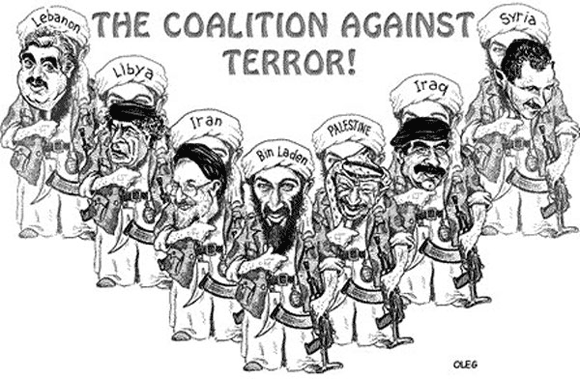 Last week a respected friend and colleague sent me an email making the standard claims about how all the problems in the Middle East are the result of imperial borders, colonialism, and US foreign policy. It’s the “blame the US” refrain. If you believe the West is responsible for ISIS and Middle East violence then you are easily manipulated by the Islamic state into believing just what they want you to believe. Sure, there is much to criticize about colonialism but borders are not so central to contemporary problems. Let’s take up the case of Iraq (for additional reading go to an article in The Atlantic available here). The three provinces of Iraq – Mosul, Baghdad, and Basra – were historically treated as the one area (called Mesopotamia) and Iraq’s eastern border with Iran dates back to the early Ottoman Empire. The boundaries of Iraq are not so arbitrary. Interestingly, the country with some of the newest Western carved out borders is Jordan and it is the more stable country as a result of King Abdullah.
We fool ourselves into believing that how the Middle East was carved up after World War I and the fall of the Ottoman Empire is responsible for all the problems. Did you ever ask yourself what it is about a political culture that allowed extremism to take root in the first place! I can give you five explanations for the spread of fundamentalist violence and jihadism. The answers to these issues are always complex, and surely the United States is not completely innocent, but the list below better captures the realities of the political system that absorbs extremism.
- It is not a stretch, and an easy connection to make, when one blames so many leaders in the Middle East who failed to deliver a semblance of prosperity and freedom. Countries like Egypt modeled their secular world on the Soviet Union rather than Western market economies and have paid the price ever since.
- Political participation is one of the last things authoritarian leaders want so they have encouraged citizens to take solace in mosques. Consequently religion and the language of religion is the most common currency. Saudi Arabia has directly supported the fundamentalist Wahhabi strand of Islam.
- Ruling elites must give up something and guide the transition to democracy and open economies, but they have failed to do so in many places. Elites are crucial for the transition to modern political systems.
- The Middle East has lived by oil and will die by oil. An economy based on one resource is doomed to fade away in time but for now provides tremendous wealth to some but not others. The Gulf economies have failed to develop in certain economic areas and once again Islam stepped in as a refuge. The work of diversifying economies has yet to be done.
- Finally, the Muslim confrontation with modernity has partially damaged the culture rendering it less able to adapt and once again reinforcing religion as the common identity binding language.
It’s natural to look for explanations for things but reducing the violence, and confusion, and complexity of the collection of countries in what we call the Middle East to American foreign policy or humiliations is not very productive.
ISIS, which probably constitutes the most stable future threat, was created by all sorts of forces very few of which are rooted in US foreign policy. An excellent reading on this matter is “Who is to blame for the rise of ISIS?” It explains how the Iraqi Army has failed to defend borders and people; the Iraqi people have not challenged ISIS sufficiently; Nouri Al-Maliki the leader of Iraq failed to put together a majority power-sharing government; and even premature troop withdrawal is partially the blame for the rise in ISIS’s power.
In the end, ISIS came to power because individuals made the choice to adopt and support the movement. They chose violence over reconciliation. The vile quality that allows ISIS to consider itself murderously superior is well enough understood in history and social scientifically. Western democracies such as the US are not primarily responsible for the creation of ISIS, but will certainly have to play a major role in its elimination.
The Sin of Sanctity
Below is a video of Obama’s comments at the prayer breakfast where he compared the Crusades to the religious extremism of ISIS. It was a clumsy comparison and I probably would have counseled him to find another way to make the point. But he was speaking casually. Still, he was not wrong. The general principle that any exclusivist claim to truth – whether it be religious or secular – creates a psychology of sanctity and sets into motion extreme justifications is defensible.
The sense that a group or an idea is larger than us and we identify with it is basic to our evolutionary psychology. Group and ideational identification has a survival value and it is deeply set in our consciousness. That’s why people identify so strongly with political groups, national entities, belief systems of various types (communism, socialism, capitalism, Stalinism), and of course religions. But it remains true, as others have quipped before, that you will die for your ethnic or religious group but not for your golf club. You might belong to a book group and acquire some group identity as a result, but you cannot imagine dying for your book group in the same way you would for your country or your religious group. The difference is sanctity or the belief that your national or religious group and its actions have divine reality. Nobody believes their book group is divine.
In the most extreme cases death and an afterlife become a truer reality for believers. One Muslim extremist group commented after a bombing that they “chose death as a path to life” a sentiment that on its face makes no sense but upon reflection refers to a truer and higher reality yet to come. They seek and believe in a divine reality that transcends individuals and requires integration. Violence in the service of this higher divine reality is simply a tool. The Rev. Paul Hill, who killed a doctor at a women’s clinic, spent his days in jail exclaiming that “the Lord had done great things through him.”
When something is sacred it takes precedence over everything else. In the heart of the true believer nothing stands in the way of duty to God, sacred land, or artifacts. Yet it remains worth asking the question why some resort to such vicious violence and others do not. Some Christians, Jewish religious settlers, and Hindus (BJP) have all engaged in violence, and have a strong sense of the sacred, but not on the scale of ISIS. One explanation is the centrality and intensity of sanctity along with the politics that requires purification. The more this world is considered “unclean” and the next world is “more real than this reality” then moral and ethical frameworks that soften judgments of others begin to melt away.
Acting in the name of a nation or the simple politics and power of resource acquisition is a mundane concern that has pragmatic value only. But when a territory or an idea is sacred boundaries close in and walls go up with almost no room for interpretive latitude. Moreover, the actions of an individual or group hold no value when they are simply pragmatic and consequently it is easier to perpetrate violence against them. And one reason managing conflict with the sanctity motivated is so difficult is that the very act of changing your behavior either for others or because of secular incentives is understood as a violation of the sacred. It becomes proof that the “true path” is being violated.
So, it is nothing doctrinal about Christianity, or Judaism, or Islam that supports greater violence; rather, it is the intensity of the sacred.



 Peace and Conflict Politics