How New Media Changes Religion: Goods Not Gods

Data seems to pretty clearly indicate that Americans in particular are changing their relationship with religion. It has been commented upon and written about with increasing frequency. The most typical change reported is that religion is becoming more individual; people are picking and choosing their own beliefs and practices and forming hybrid combinations that represent individual feelings and emotions. Moreover, private and subjective spirituality is replacing what were once coherent religious beliefs rooted in history and social and intellectual development. Finally, we hear more and more about the abandonment of institutions and the community’s general distaste for long-standing religious institutional doctrine and practices. Somehow the accumulated wisdom that informs institutional practices is fading away to be replaced by private preferences.

Bryan Turner, writing in the Social Science Research Council, offers up some interesting insights into the relationship between communication and religion (go here). Traditionally, the religious practice of communication was authoritative and hierarchical. It was a unitary system of beliefs influenced by clearly established sources of knowledge and wisdom (Popes, Priests, Imams, Rabbis). One receives messages and information from authoritative sources and the layperson’s communication was a node in a hierarchical chain with upward supplication and downward instruction.

New media – in the form of the Internet, Facebook, Web 2.0, cell phones, etc. – has upset this traditional religious communication structure. In the new media environment communication is more horizontal than hierarchical and certainly more diverse and fragmented than unitary. User generated possibilities have changed messages because such messages have become more devolved from authoritative status sources and more subject to negotiation and multiple interpretations. Turner points out that in Islam there has been an inflation of authoritative sources such that any local mullah can turn himself into a source of authority. Knowledge about religion has been democratized such that the Internet and pamphlets are equally as authoritative as individuals. People feel less need to attend their collective religious service because their needs are met with individual preferences and online religion.

Again, in the case of Muslims, they are learning increasingly more from the Internet especially Muslims in the diaspora. There is a correlation between the electronic network and the social network. This correlation has altered various distinctions between types of contact. As I said above, pagers, videophones, email, websites, and cell phones have transformed social relations in religious communities (especially diaspora communities) and offered new ways to theorize those communities. Some authors have explained how communities of people with religions in common use the Internet to cultivate a cosmopolitan democracy that addresses broader issues.

In the future we will see the increasing frequency of new public spheres because electronic media will provide access to thousands of individuals who share interests. The mobilization qualities of new media will make it possible to quickly amass like-minded individuals into electronic communities. Perhaps, we will come full circle and reconstitute larger institutional organizations. Globalization will be very dependent on the Internet as a source of connection to other cultures, including one’s home culture, and the combination of new interpersonal networks with the broad and fragmented information on the Internet will serve to reinforce individualism. Individualism and religion is a two edge sword; it can be associated with rigid thinking and fundamentalism as well as creativity and expressiveness.

New media and horizontal relationships rather than vertical ones will result in a form of individualism consistent with the general commodification of culture. In other words, religious choices and consumption are becoming more important than informed absorption into an established religious system. People want religious “goods” not “gods.” And although established religions will maintain a fair amount of strength and presence, processes for deinstitutionalization are in play as individuals learn to defend their own subjective spirituality and participate more fully in horizontal relationships formed and sustained by new media.
Also posted in Hartfordfavs.com

I Told You So! You Don’t Want Islam Running the Department of Waste Management

In February of 2011, over two years ago, I posted a blog with the title “Do You Really Want Islam Running the Department of Waste Management?” With the rise and now fall of Morsi in Egypt we had a chance to watch what happens when the Muslim Brotherhood or Islam is governing. It wasn’t pretty. Morsi was dumped by the Egyptian military for his autocratic and incompetent governance. Local Egyptians have been “put off” by the shortfall in fuel, electricity, and a crumbling economy. Human Rights Watch said that Morsi continued the abusive practices of Mubarak, and any number of journalists and political activists have been prosecuted unfairly.

The Foundation for the Defense of Democracies reported on July 9, 2013 that apparently a document proving six-figure payments to top Muslim Brotherhood officials has surfaced. This document is important because as Islamists the Brotherhood claimed that they were more religious and had higher morals and were less subject to corruption. Morsi had apparently replaced hundreds of judges and officials with Muslim Brotherhood figures and was assumed to have adopted the political corruption of his predecessors.

It’s just possible that Morsi failures signal the end of religious politics in Egypt. Much of the population is unhappy with the Muslim Brotherhood’s politicization of religion and unfair treatment of the opposition. The Egyptian Constitution is wise with respect to its principles of separation of religion and politics. Religious parties are illegal because they could not maintain the respect for the differences between religion and politics. The Muslim Brotherhood has failed to respect this principle which is crucial for democracy.

Democracy through its persistent debate and contest maintains a check and balances system that is constantly responding to needs and threats posed by different groups in society. Different religious, ethical, and political groups need to have their rights met but also achieve a degree of unity. Such unity will not be found in a comprehensive political or religious system; that is, a system of fixed ideas about the universe and preference for only those who hold such ideas. In that case the political entity would be governed by a single group with the regular maximization of differences and inequality. The most successful form of unity tying pluralistic groups together is broad but not necessarily very deep. It represents a political conception of justice that is capable of including multiple groups.

Hence, the logic of the European liberal experience has demonstrated that tolerance cannot be separated from liberalism. And, continuing the logic, tolerance cannot be separated from a loss of certainty. Tolerance results in a loss of faith and in the experience of at least unfreezing one’s attitudes. This is why religious groups – whether they are Muslim, Christian, or Jewish – who are highly Orthodox in their beliefs and unwavering often isolate themselves from others. They fear contamination in the form of exposure to unwanted influences. Tolerance is firmly rooted in a communication process, governed by conditions of civility and debate, which sets into motion political activity that questions one’s own certainty. One of the difficulties for the liberal state is for its members to subscribe to a shared point of view about justice and recede from religious justifications, but subscribe to this shared morality on the basis of their own religion and point of view. The key point here is that the result of discovering this common point of view or common morality is justified on moral grounds acceptable to both competing parties. As Rawls (1993) maintains, this sort of overlapping morality can only emerge from the public sphere on the basis of public reasoning.

Such conditions are very alien to the religious Muslim. Not that this is required because there are ways to think about and interpret Islam in a somewhat more accommodating manner. But such is not the case for the Brotherhood.

Two Ways to Think about Egypt and the Birth Pangs of Democracy

We are in a very real sense witnessing Egypt’s struggle to shed the skin of authoritarianism and emerge as a democracy. One of the more important debates that accompany this struggle is just how democracies do emerge. Must they go through phases? Are certain cultures susceptible to authoritarianism and will never democratize? How long does it take? There is lively debate over these matters and I encourage anyone to read the Journal of Democracy (JOD).

Few people would question the value of democracy as a form of governance. In fact, it is on its way to becoming a universal value. It simply has tremendous advantages such as an outlet for conflict resolution, rarely waging war against one another, promoting privatization and economic development, and generally less likely to abuse its citizens. The thorny issues are still how we turn antiquated cultures into democratic ones. Some people stress preconditions such as economic development, equality, and certain cultural traits having to do with associational skills. Sheri Berman (Journal of Democracy, 18, 2007) offers an insightful summary of how democracies emerge. She explains how the “preconditionists” stress the importance of national prerequisites and others are “universalists” who claim that democracy can develop in many ways and be successful in diverse political environments. The “third wave” of democracy beginning in 1974 seemed to favor the “universalists” since dozens of countries with diverse cultural backgrounds made the transition.

Egypt seems to be one more domino falling into line after Tunisia, Libya, and Syria. The universalists are convinced that democracy can emerge anywhere and such an attitude prompted the United States incursion into Iraq and Afghanistan. We were convinced that we can plant the seeds of democracy and watch them grow in these alien soils. It remains to be seen just how naïve we have been. But more interesting, and related more directly to Egypt, is a new perspective by preconditionists who insist that a developmental path must be followed and places like Egypt have much to do to cultivate that path. Fareed Zakaria suggests there must be a tradition of liberalism for democracy to succeed. In the end, the march toward a stable democracy is long and slow but the best way to understand these transitions is to study the countries that have experienced them.

First of all, there is the matter of overthrowing authoritarian regimes and then the matter of replacing them with democracy. These are two different processes requiring two different sensitivities. The old order will desperately hold onto its privileges, and we are seeing some of that now with Egypt’s military. On the other hand, some theorists believe that a strong military and authoritarian government will lead to democracy faster than a weak and feeble semi-democracy. We’ll have to wait and see what direction the Egyptian military takes. Berman in her article mentioned above concludes that it is easier to bring down an authoritarian order then it is to replace it with a stable new one. That is probably a pretty safe conclusion.

In the end, the path to democracy is complex and neither the “preconditionists” or the “universalists” are completely correct. Democracy does not come into being peacefully and it does not emerge in a straight line. It is certainly true that political qualities such as freedom, prosperity, and tolerance both stimulate democratic sensibilities and are in turn developed as a result of democratic behavior. I’m afraid there are no easy answers for the Egyptians. They must undo an old order but put into effect a new one of which they have no experience. It is of little consequence to those living in Egypt now, but only future generations will bring new democratic opportunities to the Egyptians.

Dangerously Rigid Political Opinions Can be Changed: Here is One Approach

Extreme opinions are one of the thorniest issues when it comes to trying to solve problems and the necessary “difficult conversations” required. But related to extreme opinions are rigid opinions; that is, those people who hold firm opinions from which they will not waiver. They are convinced that they are correct and will not listen or engage in communication designed to solve problems or result in integrative solutions to.

A recent study in the journal Psychological Science (2013) found that those who hold extremely rigid opinions often support those opinions by the illusion of understanding. These people believe that they understand things better than they actually do. The study examined how much people really understood a particular policy or issue, and the extent to which the rigidity of their opinions contributed to polarization. The authors then predicted that asking subjects in the experiment to explain political issues would make them aware of how poorly they actually understood issues and hence they would subsequently moderate their opinions. We will get to the results of the study in a moment. But first it’s important to say something about extreme opinions and their deleterious effects on the political process. Polarization, or the increased perceived distances between people’s political opinions and the resulting paralysis with respect to problem-solving, is a serious problem.

After Obama was elected president Mitch McConnell in the United States Senate declared that the only agenda for him was to make sure the president did not succeed. If we take this statement seriously it means that this elected official will subject himself to no communication that upsets his belief system. He has made decisions about where he stands and will not subject them to any decision-making processes to the contrary. This is not much different than the religious Muslim or Orthodox Jew who has a comprehensive worldview and will not depart from it.

Rigid opinions are capable of inciting violence. Such opinions are usually accompanied by intense belief that includes emotions and justifies strong reactions. We can see this operating when politicians or religious people use the “politics as a war” metaphor. It codes into the discourse all of the language of war including the fact that your adversary is your “enemy” and he or she must be “vanquished”. So political leaders have enemies lists and incorporate all of the aggressive and clandestine language associated with such lists. Our culture is filled with individuals, journalists, and talk show hosts characterized by combative personalities who are more rigid than extreme.

Throughout the 1980s conservatives made considerable progress by maligning liberals and turning the word “liberal” into a shibboleth used to attack democrats. Again, I’m less concerned about the content of a political opinion that I am its fixed nature. An opinion becomes extreme and dangerous when it cannot be moderated or there is no sense of perspective and proportion. Politics is not warfare; in fact, it is the antidote to warfare. Politics and communication with those who are unlike you is the alternative to warfare. It is the only consequential and morally legitimate means of solving problems and avoiding violence.

So what did the authors of the study referred to above discover? Interestingly, they found that those people with particularly strong opinions were unjustified in their confidence with respect to how thoroughly they actually understood policies. Very simply, they understood policies and political positions considerably less than they thought. When subjects in the experiment were asked to produce what are termed “mechanistic explanations” they were exposed to their ignorance and thereby moderated their opinions. Mechanistic explanations are explanations about how things actually work such as legal positions and social policies. When subjects in the study were simply asked to list the reasons that they supported something they were less likely to be influenced by their own lack of knowledge and did not moderate their positions. The assumption is that asking someone to list the reasons for supporting or not supporting a political position allows them to tap into values and general principles that do not require much knowledge and are more fundamental emotional attachments.

It turns out that educating people about how policies and positions actually work tends to increase their exposure to other perspectives and improves the quality of debate. This is one more weapon in the “difficult conversation” arsenal (to continue the war metaphor) that can serve as a corrective and ameliorate the polarization process. Rigid opinions will not disappear but improving knowledge promises to be an effective unfreezing of attitudes procedure.

Right-Wing Blood and Soil Nationalism in London

Just a few days ago I returned from a conference in London (the International Communication Association). Reading the local newspapers is one of the pleasures of international travel. I thoroughly enjoy immersing myself in the local issues and journalistic agendas of wherever I am. Of course such “news of the world” is easily available these days online, but I reserve regular online reading for a few particular favorites. In any case, in reading the English newspapers I was struck by the resurgence of the English Defense League (EDL).

The EDL is a right-wing movement, characterized by all the standard fears of foreigners and militaristic jingo we have come to expect from these groups. The EDL is particularly anti-Islam and has been reenergized recently by the large-scale immigration of Muslims into Europe and in particular by the murder of Lee Rigby. Briefly, the EDL has much in common with sports hooliganism but has developed into a right-wing nationalist group that calls for the support of particular political parties and mobilizes up to 3000 supporters when necessary. Little is known about their membership or actual size but they have been successful at gaining public attention in turning out larger crowds.

I asked two British colleagues about the EDL and one said they were a minor nuisance and not to be particularly concerned about. The other said their influence was growing and we should definitely pay attention to them. I think we always need to “keep our eye on these groups” even if they do not seem to be effective. They are associated with violence and other groups such as fascists, racists, and violent civil disobedience. The EDL has been accused of burning down mosques, fire bombings, ugly graffiti, and all sorts of provocative street behavior designed to incite violence.

An interesting reason for the resurgence of the EDL, according to an article in The Guardian and a few other analyses, is that the press in general and the population is more put off by Islam and sympathetic to Islamophobia. The media are generally full of hostile attitudes about Islam and Muslims whereas in the past they were more sympathetic to targeted groups such as Jews. The EDL has all of the organizational and discursive standards of highly nationalistic groups whose particular ideology is rooted in racism but flowers in immigration laws. These groups are in serious conflict with democratic values and can represent harsh blood and soil nationalism. The possibilities of violence are always present in these groups and things get tense very quickly.

The Home Secretary, for example, last week was asked to ban the invitations for two right-wing American speakers whom the EDL invited to speak. On June 29 the EDL is planning a march on Armed Forces Days as a show of military might and militaristic symbolism in support of “pure” English culture. The two American speakers are Pamela Geller leader of the American Freedom Defense Initiative and Robert Spencer who manages a Jihad watch website.

Violence is the most defining characteristic of these groups and is justifiable grounds for preventing speech. Even though extreme opinions are not by themselves necessarily dangerous, they are typically the inducement to violence. Unfortunately, over the last few years we have increasingly defined others as “enemies.” This language immediately categorizes the other as more extreme and potentially dangerous and hence justifies more extreme behaviors. The word “enemy” is the language of the military and responsible for the ethos of undemocratic and morally indefensible tactics.

Through the growing network of television and new media it’s easier to reach large audiences by organizations like the EDL. Moreover, the immediacy of new media keeps emotional intensity stimulated and makes it easier to continue the vision of politics as warfare. The maintenance of principles for free expression will always require nuance and disagreement, but we should never lose our outrage for extremism wrapped up as nationalism.

What’s Happening in This Picture?

It’s always a legitimate question to ask whether or not a photograph is telling the truth.

Mideast Israel Palestinians
This photograph was captioned by Time magazine on April 29, 2013. It is reproduced here from Hariman and Lucaites’ No Caption Needed. The photo was slightly enhanced but apparently within journalistic limits.The original caption had an incorrect date and location and although such mistakes can be important it is not my concern at the moment.

You can see, however, that there are additional issues at stake. If you look closely the man being restrained by the police is rubbing his eyes and the one soldier is holding a spray can and pointing it toward him. The restrained man apparently resisted and the soldiers resorted to spraying something in his eyes. You can actually see a small cloud of the spray coming from the canister.

Every time I see one of these photographs I’m reminded of the Eddie Adams photograph of the Saigon chief of police holding a gun to the head of a Vietcong and about to pull the trigger. You can see it here.
Eddie Adams Photo of Vietcong

This is a Pulitzer prize-winning photograph. Regardless of what you think of the picture it is a powerful and compelling moment that communicates the tension and anxiety just before the instance of having your brains blown out.

The photograph has been associated with lawlessness and the street justice that took place during the Vietnam War and rightfully so. But the man who was shot was a known Vietcong sympathizer who apparently had committed violent acts of his own and was far from innocent. Again, I am not in any way defending the street lawlessness portrayed in the photograph but it is helpful to know what happened immediately before the moment of the photograph. Israelis often complain about a lack of context or understanding about what preceded an Israeli military incursion and that using tanks as weapons is usually a response to earlier aggression rather than an initiative. It is typical for newspapers around the world to show for example an Israeli tank destroying a house and leaving it at that – with the conclusion that Israel is engaging in excessive force. The Israelis are always chagrined at how no one asks who was in that house and what preceded the tank attack. It’s a matter of context.

We might ask the same question about the fellow rubbing his eyes and the soldier holding a spray can. I presume the soldiers are trying to disable the man so that he is no longer a threat.The caption for this picture could have read “Israeli police pepper-spray protester” and directed attention to perhaps improper behavior on the part of the police. Or, the caption could have read “man being arrested” and framed the protester as a criminal.

Lucaites and Hariman (see No Caption Needed link above) elaborate on the role of captions by pointing out that they can tell you what to think about as well as tell you what to ignore. Moreover, it’s interesting to note that this photograph is typically cast as an Israeli “peace image.” Such a classification equates peace with security which, on the one hand, is consistent with the Israeli sense of existential threat that it lives with on a daily basis. Yet, it is not an image of a warm peace rooted in cooperation and mutuality.

Images are powerful and persuasive. The public often forgets that images are designed for particular audiences on the basis of the message they express. Sometimes these designs are highly calculated and represent strategies to reinforce or create new attitudes. The role of images in the peace process – the strategic role – remains reasonably unexamined. There are, for example, moral questions that still challenge the best practices of using photographic images.

Hold onto your hat! Israeli-Palestinian Violence Is Coming

Ethan Bronner of the New York Times last week wrote about the disconnect between Israelis and the general problem they face with the Palestinians. Bronner, who was a former Jerusalem bureau chief for the New York Times, had recently returned to Israel and found Israelis to be almost intoxicatingly removed from the Israeli-Palestinian conflict. They could “care less” about it and are more removed from the political situation than ever. Israel is a very successful economic culture and, various social inequities notwithstanding, they are enjoying the fruits of Western democracies and market economies. Bronner writes that even the Israeli left is increasingly insignificant, and a shell of its former activist self.

I must say that this is generally consistent with my own experiences. I was teaching in Israel last year at this time and quite struck by how “bored” the average Israeli is with the entire matter. They don’t believe there is anyone to talk to or that the Palestinians are serious. I spoke to plenty of students, wait staff, bartenders, and average citizens and the majority is fed up and has simply decided to ignore the whole thing. Cynicism about the peace process is so great that nobody cares to talk about it. Israelis don’t understand the extent of their international condemnation; Israelis don’t understand how anyone could offer up political and moral support for organizations like Hamas and Hezbollah; Israelis don’t understand why the world can’t learn from the lesson in Gaza that giving the Palestinians in Gaza what they wanted (an Israeli pullout) resulted in more rockets fired into Israel.

The Palestinian Authority is in bad shape and things will get even worse with the resignation of Salam Fayyad who was focusing on economic and institutional security in the West Bank. Things are quiet at the moment with John Kerry’s diplomatic efforts deserving of some credit. Even though the Palestinian Authority continues to receive criticism, it’s unlikely for now that the system will be pushed to its limits. The Palestinians are just as tired as the Israelis but for different reasons. They are fed up with their own political leaders and divided amongst themselves with respect to how to proceed. The issues of checkpoints, settlements, prisoners, and financial matters are weakening with respect to their individual issue capabilities. In other words, these matters do not hold the intensity they once did because the population has spent the political capital associated with them and the peace process is still elusive.

The International Crisis Group (go here) issued a report on May 29, 2013 concluding that the Palestinian Authority is in financial trouble and cannot pay salaries. And although they have been recently lulled into a sleep-like state with respect to larger peace issues with Israel, things are beginning to change. The Palestinian Authority, according to the crisis group, is under threat of dissolution. It is simply likely to evolve away into a different reality as Abbas ages. Abbas has a certain amount of historical legitimacy and is committed to a negotiated settlement. But with the Palestinian Authority so fragile, and enough time has gone by such that patience is running thin, any political act (settler violence, clashes in Jerusalem, hunger striking prisoners, or some act of violence) will spark the combustible mixture into a conflagration.

It does not matter how complacent Israelis feel or how content they are about their own good faith efforts, the current situation is not sustainable for very much longer. There remains economic fragility, violence, humiliation, and perceived injustices that cannot stand a much longer test of time. Images of the Titanic come to mind with some killer iceberg waiting in the not-too-distant dark.

New Media and “Information” versus “Deliberation”

New media cloud

The answer to the question about what exactly defines “new media” is usually a list of new technological developments. Web 2.0 is most associated with new media because of its interactivity and user-generated design capabilities. Rather than passive viewing of content on a screen content can be created and shared by users. Examples are blogs, wikis, Facebook, twitter, you tube, pod casts, social networking, RSS feeds, and each have numerous marketing and social applications. The most popular of these are the social networking sites (SNS) such as Facebook, Myspace, and YouTube. For our concerns here, it is necessary to locate these technological developments within communication and deliberative political processes. We can begin by making the distinction between “mediated information” and the “deliberative experience.” New media is mostly helpful with the mediated information environment; that is, it stresses an information environment composed of the press, television, blogs, talk radio, etc., and the quality of discussion among people. It contributes more to the information community rather than the public. New media makes information available in asynchronous time and space. Except for research on online discussions new media is not usually associated with the deliberative experience which involves a form of dialogue to seek a new consensus. This is not to diminish its importance in the information society. Facebook, for example, has been successful at establishing discussion forums that facilitate public discourse. In fact, ideal speech conditions are enhanced in some instances.

During the 2008 presidential election, Facebook was used seriously for political communication. The campaigns followed traditional communication strategies, but included Facebook as well. Facebook can facilitate communication. It combines the features of local bulletin boards, newspapers and organization and places them in one location that is available any time any place. Also, political leaders can use Facebook as a medium to communicate with members of the public or their own group. It thus provides leaders with an effective way in which they can reach the public. The Israelis and Palestinians have numerous Facebook pages devoted to peace, friendship, the two-state solution, the nature of the conflict as well as partisan and ideologically narrow pages.

New media played a role in the 2009 Iranian elections as well as providing information and contact with the outside world during protests. Twitter was used by people outside Iran to spread information and report on what was happening. These media also made it possible for women, whose participation is restricted by Islamic law, to play a more significant political role. The mainstream media also benefited from new media because new media users send out information when the traditional media are banned. In other examples, social media played an increasingly significant role in the Gaza war of 2008-2009 termed “Operation Cast Lead.” Israel mounted its own YouTube site to show off the accuracy of its weapons, and Hamas used blogs to demonstrate their strength (Arab Media, 2009). Banning the traditional media, as was the case in Gaza, makes it possible for a political entity (e.g. Israel or Hamas) to have more control over the message. This empowers so called “citizen journalists” and gives them some control over content, but still lacks the depth and breadth of professional journalism. Not all new social media is very successful. Facebook, for example, receives a lot of media attention and can attract support, but its group formation requirements are so low that individuals show little commitment. People join Facebook groups to express personal identity and solidarity with others because it cost little and requires even less from them.

What we call new “social media” has a few unique qualities that sometimes, but not always, makes them adversative to the political process. The Habermassian public sphere is a communicative arena for rationale, inclusive deliberative discourse; it is an environment where participants in a conflict can get together for debate and discussion under maximally communicative conditions. But new social media are characterized by deterritorialization, that is, a mediated publicness of non-localized space. The participants are spread out geographically and the interaction is an attempt to be intimate and authentic rather than rational and focused on the common good. But this multiplicity of voices remains important to the deliberative process. As Mouffe explains, there must be a place for the expression of dissensus and this is especially true in political conflicts where, according to Mouffe, conflict is constitutive of the political. This is the notion that a fully constituted democracy emerges out of conflict or the clash of identities and political interests. The more there is a clash of differences the more fully articulated is the democratic polity or, in the case of ethnopolitical conflicts the more fully realized is the solution potential. One of the most powerful features of new social media is the extent to which they extend networking and linking. It is simply easy to tap into new networks of information and establish contact with others. There is, for example, a considerable amount of contact between Israelis and Palestinians. But none of this represents revolutionary implications for deliberation. Moreover, new media can be controlled, exclusionary, and fragmented: States actively filter the internet, bloggers are harassed, and users are often intimidated. Cammaerts warns that it is difficult to produce a deliberative sphere on the internet. And although there is potential for serious participation, these technologies are rife with contradictions.

Democracy and the Defeat of Radical Islam

When groups or political parties form in society along religious lines they organize themselves into difficult political cleavages. And this is particularly true when the political party is radicalized and immovable with respect to consensual decision-making and tolerance for other points of view. These groups are a problem and difficult to contain but ultimately must be controlled and defeated.

The United States has often taken the military and security approach but this only goes so far. You can’t kill them all. So what is a political culture like the United States to do if it is going to address these problems politically? Political Islam stresses international grievances and includes their own anger, frustration, and humiliation. Surely broad scale international relations are part of the answer: American drone attacks, the Israeli-Palestinian conflict, stability in Iraq and Afghanistan, and genuine engagement with Iran are all part of the equation that might lead to dignity and moderation.

But this is not enough. These rigid authoritarian political systems, that produce frustration and violence, must be more directly confronted. In essence, these Muslim countries characterized by extremist religious parties are failing to provide economic development, political voice, and human rights. Something more direct must be done but that something must be moral and politically viable. Members of these authoritarian cultures typically report feeling humiliated and hopeless. In places like Algeria, Egypt, and Pakistan large segments of the population are young and in need of jobs as well as a sense of self-worth that comes from something other than confrontation with the West.

Our military efforts in Iraq might be characterized as noble attempts to begin the process of regime change and redress of injustices heaped on the people by corrupt and authoritarian leaders. But American military presence just exacerbates the claims of imperialism and humiliation. That’s why political solutions are more important than military ones. And although no single approach or strategy will solve the problem the best way to achieve lasting change is through good democracies that protect freedom, control corruption, and have effective systems of checks and balances. These democracies cannot be what are called “illiberal” democracies; that is, democracies in name only but really have unfair elections, authoritarian leaders, and laws that limit personal freedom.

Democracy promotion in these countries is not easy. It is slow and risky and fraught with dangers. But here are some steps in the right direction:

1. There is much distrust of the United States and we must restore trust by not promising more than we can deliver.
2. We have to find better ways of stabilizing political cultures than supporting authoritarian figures such as Mubarak and Egypt. Support for Mubarak was of course practical but costly in terms of trust.
3. Our knowledge of other cultures must improve. As diverse and multicultural as the United States is, we still have shallow understanding of many cultures, and Muslim cultures in particular.
4. There must be a way to talk to Islamist political parties. This is not naïve. There are some Islamist parties who do not envision a new caliphate but would prefer to accommodate others. Moreover in the era of new technology there must be more creative ways to make contact.
5. Some people, and I include myself, consider the basic tenets of democracy to be universal values. We need to use new media to broadcast these values.
6. Most of the world is highly sensitive to basic human rights and the rights of women. The argument that women should be liberated and have increased freedoms should be pressed such that cultural and legal repression is challenged wherever it occurs.

Wherever possible the United States must push for transition to democracy. There are a variety of paths to democracy and different countries must move at different speeds. But principles such as the rule of law, an independent judiciary, constraints on corruption, and protection of human rights are easy enough to defend. The United States is an important player on the international scene and is in a position to intelligently and seriously push for Democratic reforms. This takes skill and nuance but it’s possible with some rethinking of how to promote democratic principles.

Captions and CutLines Lie Like Cameras

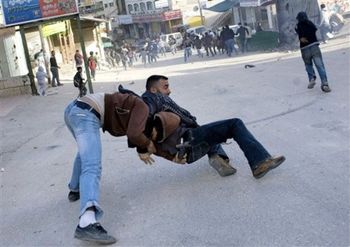
The two photos below represent different captions designed to frame the story in a particular manner. The first photo is from AP and was reported by Elder of Ziyon.

scuffle

A Palestinian rioter tries to grab a weapon from a plain clothes Israeli police officer, right, during clashes in Shuafat refugee camp in East Jerusalem. Palestinians scuffled with Israeli security forces, after an arrest operation triggered clashes in the camp the day before.

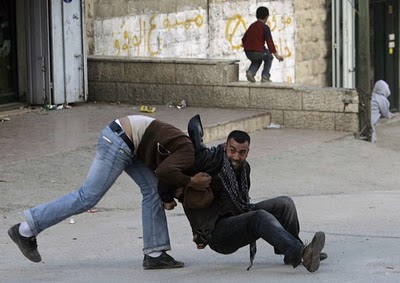
The second photo is from Reuters

scuffle1

An undercover Israeli police officer (R) scuffles with a Palestinian youth suspected of throwing stones while trying to detain him during clashes in the Shuafat refugee camp in the West Bank near Jerusalem. Clashes erupted between Palestinian stone throwers and Israeli police that entered the refugee camp, a Reuters witness said on Tuesday.

The caption for the two photographs is actually quite different. In one sense, the descriptions do not contradict each other. They both described the scene. But it is possible to conclude with some different interpretations on the basis of the caption alone. In the Reuters version the Israeli appears to be the aggressor because he is trying to “detain” the Palestinian. The readers conceptual background might easily identify the Palestinian as engaged in legitimate revolt and doing little more than throwing stones at the bigger more well armed soldier and his comrades. It is the classic David and Goliath image. Anyone writing a caption should have the typical reader in mind. But in the AP version the Palestinian is characterized as more aggressive because he is trying to grab the weapon and will probably use it on the policeman. The policeman’s aggressive behavior would of course be justified in this case.

In the Reuters version, the fighting “erupted” and apparently the Israeli police entered the refugee camp which was sufficient provocation. But in the AP version there was an arrest operation that provoked the violence. The websites “Elder of Zyion” and “Honest Reporting” claim that the Reuters organization used an Arab stringer for a description of the events.

This poses an interesting question with respect to the newsgathering process and how stories are framed. Some news outlets have websites and phone numbers that one can call in order to report a story. So anyone can fill out a form on the web and provide a description of some event or activity and perhaps attract the attention of a news organization. The person leaves phone numbers and email addresses where he or she can be reached and the news organization contacts them. This of course can be an excellent source of news and is the sort of contact that results in specified and situationally-based stories. But on the other hand, this process can be abused. It can result in stories that are biased as a result of the selection process or stories, even worse, that are staged or distorted in some significant way.

Actually, the description underneath the photographs is a cutline and not a caption. A caption is a little headline and a cutline describes the photograph in more detail. Reader psychology and tendencies are important because the photo sparks interest and then readers typically move underneath seeking explanations. It’s important for cutlines to perform their duties. Cutlines like stories answer the who, what, why, when, and how question of journalism. When cutlines are more on the objective side of the dimension they satisfy reader’s understanding of the picture but have not necessarily told the reader what to think. The more cutlines are politically motivated the more they draw the reader’s attention toward some specified reality on the part of the news outlet.

A picture may be worth a thousand words but each of those words is capable of altering the meaning of the picture. A skilled cutline writer knows these things and chooses his words carefully.