Someday Hamas and Israel Will Talk
There is only one solution to the current fighting in Gaza and that is some sort of negotiated agreement. It sounds naïve I understand but until that time we will have little more than the standard conflict resolution mistake of “more of the same.” Deliberation in any form is impossible until the two sides are sufficiently willing and we are certainly not there with respect to the Israelis and Palestinians, especially the Palestinians in Gaza. But if that day ever comes the deliberative conditions below will be important.
Deliberation is a powerful normative ideal to strive for and in its heart it is concerned with the careful and balanced consideration of alternatives under conditions of democratic fairness. To transform the deliberative ideal into actual communication is essentially to operationalize deliberation and lower its level of abstraction. It is to take a theoretical ideal and convert it to symbolic behavior. But this operationalization is never easy or direct. Deliberative democracy is also primarily concerned with democratic decision making, whereas deliberative communication is, shall we say, messier. Deliberative communication includes broader intersubjective meaning creation and is inclusive of many forms of discourse and linguistic structures. Moreover, the polysemic nature of communication, where messages can take on a variety of meanings depending on context and other factors, makes identifying qualities that make communication “deliberative” even more difficult. But as I have noted in other places, deliberation is not one big philosophy seminar characterized by rational argument only. It must include the possibility that judicious argument and sound decision making can take many communicative forms. In general, deliberative communication has the following five characteristics.
(1) There is a confrontation of perspectives and argument is the primary communication mechanism for adjudicating differences. Argument takes the form of reasoned opinion where a speaker is required to support reasons and defend against critique. This includes evaluating materials, judging the quality of sources, and defending background assumptions. It is also true that some forms of reasoning maintain ideological dilemmas.
(2) There is a relational component to deliberation whereas participants respect the other and genuinely listen to their perspectives. Participants actually engage one another and avoid monologues that do not take up the perspective of the other. Participants acknowledge autonomy and mutuality in a civil and respectful manner.
(3) Consensus is the goal to strive for. This includes will formation such that the collective is ultimately committed to decisions. In order for consensus to be a goal deliberators must be concerned with disagreement. Disagreement is an indication of the diversity that is inherent in divided groups. Deliberative communication should include participants having their own views critically examined because of the presence of disagreement. This improves the quality of opinions. Consensus is a goal but lower levels of agreement are acceptable.
(4) The position of authorities, tradition, and power are up for discussion in deliberative communication. Participants must meet the objective of the meeting but other foundational assumptions are acceptable topics for deliberation. As Young explains, “Truly democratic deliberation must not rule out self interest, conflicting interests, or relatively emotional or intuitive expressions. . .” (p. 472) (Young, 2000).
Deliberative communication must allow for equality and symmetrical power relations as much possible. People must be on equal footing and no one should unfairly dominate the interaction. Reciprocity would be an important indicator of equality. These forms of communication are specifically suited to diversity and pluralism that are consequences of ethnopolitical divides.
For more detail see Donald Ellis (2012). Deliberative Communication and Ethnopolitical Conflict. Peter Lang Publishers.
Obama’s Last Term and the Middle East: What’s Next?
It is common political wisdom that things change when a president is elected to a second term because he is no longer constrained by the need to be reelected. He can govern in a more freewheeling manner consistent with his most deeply held convictions and the next election be damned. This is a slight simplification since presidents have other obligations and limits on their behavior, but it remains true that a second term in office makes it more possible to legislate for one’s legacy. So how will Obama’s second term in office change his approach to the Middle East and Israel in particular? I think there are three changes we might see during Obama’s second term.
First, Obama and Netanyahu need to start over or at least recalibrate their relationship. During his first term Obama was not particularly energized by the Israeli-Palestinian conflict. Of course, he would like to be remembered as the president that achieved the elusive goal of peace but probably realizes that this is unlikely. Still, Obama will not forget that Israel is a true friend and he will continue to support it through good times and bad. Obama and Netanyahu will move closer together and work to achieve common goals and manage common threats. Obama mentioned Israel many times during the campaign and this was more than simple campaign rhetoric. It represented the importance of the Israel-US relationship.
Israel and the US have a long and strong relationship that has changed somewhat but remains a strategic advantage to both. Israel assists the US with security threats and increasingly influences US military research and development. The two countries not only cooperate economically but have strong cultural resonances. Despite the fact that the US jeopardizes its relationships with the Arab world because of its close relationship with Israel, the US continues to balance these relationships. For example the US still relies on stable but nondemocratic countries such as Saudi Arabia to influence interests in the area. This represents US pragmatism as well as fundamental foreign policy convictions. All of this is consistent with Netanyahu’s primary concern for Israel’s safety and security. The relationship between the US and Israel as well as the importance of cooperation (on issues such as a nuclear Iran, terrorist intelligence, foreign aid, and military readiness) will be the foundation for a renewed relationship between Obama and Netanyahu.
Secondly, Obama has other issues in the Middle East he must attend to. Syria is coming apart, a nuclear Iran is coming together, and the politicization of Islam is on the rise. Netanyahu and Israel will certainly be helpful with these matters but, ironically, Israel must be kept at bay otherwise their presence will inflame the situation. But there are limits to what Obama can do to resolve these conflicts. In the cases of Syria and Iran Obama must diplomatically pull strings from the background and this is always slower and more difficult. But one thing is for sure: Obama will be better in managing this than Romney. Obama is more interested in helping Israel with less violence and more compromise and this is important. This is a different perspective than the one from those who supported Romney for president because they thought Obama lacked a clear commitment to Israel.
Obama represents a more diplomatic and a slower foreign-policy hand than either Romney or Bush before him. A second term will ensure that he will be better able to express this agenda. I think Obama will spend more time working with moderate regional states to achieve interests on their own rather than waiting for the United States. For example, the US does not have a taste for supplying Syrian rebels with weapons; thus, Obama will work to triangulate interests of others to form blocks and coalitions that might be better able to achieve goals. Again, this is slower and more frustrating – and leads those with more macho foreign-policy tendencies to be critical – but is closer to an approach that will be successful. International alliances based on common interests of preventing terrorism and stopping those who would intimidate their own citizens are most able to build successes.
A third trend for Obama’s second term should be increased attention to human rights, especially with respect to foreign policy. Obama was actually not very vulnerable to attack from the right during the campaign with respect to strength in foreign policy. His killing of Osama bin Laden, the “surge” of troops in Afghanistan, and his rather casual acceptance of questionable security practices (under the guise of security and strength) have been roundly criticized. Obama has been lax with respect to the promise to close Guantanamo, warrantless wiretapping, and drone attacks. I am convinced that he continued these policies for fear of appearing to be a weak liberal and now that he has no more elections to condition his behavior, Obama will turn his attention to the recognition of human rights. Drone attacks have essentially replaced the interrogation room and courtroom. They deliver a death sentence without confronting the knotty legal questions about interrogation or innocence.
The campaign is over but not the resonances in the deserts of the Middle East. After the world is finished congratulating him on his election victory, they will look to the United States for assistance and guidance. Obama will be more puppetmaster than puppet.
The Two State Solution and the Next Four Years
The cynics among us will believe that nothing much will change in the next four years in the Middle East but that is a particularly narrow view. There have been important changes in the Israeli-Palestinian conflict along with the relationship between the US and Israel. The Bush administration was aggressive in their efforts to reshape the region and trapped in a narrow ideological position that always seemed to favor the military. Obama’s first four years were characterized mostly by patience and changes in certain political conditions such as the Palestinian economy, settlement construction, and security. But Obama did not foreground the Israeli-Palestinian conflict; he did not stake his presidency on it or claim that he had new ideas or directions.
The problem now, and Obama’s most prominent obstacle should he be reelected, is resuscitating the peace process and getting back to discussions about the political viability of the Palestinians. Benjamin Netanyahu’s coalition with the right wing parties is necessary for him to govern but brings about a mix of partners that is thoroughly incapable of making the necessary adjustments that will improve the situation. The tensions between Hamas and Fatah continue and keep the conflict inflamed such that Hamas can interfere with any progress on the part of Fatah. But if Obama gets another four years he might be able to play a more significant role in a two state solution because the main parties – the Israelis and Palestinians – are incapable of reaching an accord on their own.
Things have been quiet of late. There have been few efforts toward settlement and many believe it’s a calm before the storm. Of course the Israeli leadership has been waiting until after the elections (which will be just a few days from now) to see who they will be doing business with. But whomever is elected president must engage in a workable two state solution that addresses the history and aspirations of both sides. Romney, at present anyway, is thoroughly incapable of doing this. A significant campaign plank for Obama has been that a vote for Romney is a vote to return to a way of doing things more characteristic of the Bush administration. This will be equally true in foreign policy as in economic policy. And although Romney is probably more moderate than the campaign represents, I have still seen nothing in his policy or speeches to indicate the sympathy or nuance necessary for genuine settlement of this dispute. At present, the task of solving the conflict is made more complicated by a loss of confidence in the two state solution. The Israeli-Palestinian conflict has become even more dangerous and unsolvable because the most viable and politically legitimate option (the two state solution) is losing credibility.
In the earlier days of the conflict the Palestinians expressed little interest in the two state solution because they saw it as artificial and, more importantly, were clearly not inclined to offering the Israelis a parallel right to a state. Later they came to accept a two state solution but not with full enthusiasm. But a second Obama administration will be in a much better position to inaugurate a state even though conditions are more difficult. Interestingly, there is more enthusiasm for building a Palestinian state among global leaders and Europeans than from the Palestinians themselves. A Palestinian state in the future will provide one barrier against extremism and help with forging coalitions with Iran and other Islamists.
The next president will have to approach the Israeli-Palestinian conflict with skill and sensitivity. There’s a danger that a two state solution is an American solution or, even worse, an Israeli one rather than a mulilateral solution. Many Palestinians feel that the idea of statehood has been distorted and that anything they agree upon would be something other than their own.
There is a real chance that statehood could dissolve into the background as a Palestinian achievement. There’s so much cynicism and lack of confidence in the process that both sides see statehood is an impossible achievement. But Obama is actually in a better position than any previous president to resuscitate the two state solution because of his ability to speak to diverse audiences and thereby improve America’s standing. If Obama actually became engaged in the Middle East peace process and deployed all of his powers of diplomacy he just might succeed.
The world is growing weary of the endless repetition of issues such as security, refugees, Jerusalem, and borders. The entire peace process is filled with slogans and clichés about peace that does not get anyone any closer to goals. Obama is in a position to find a new language to reconnect both sides to their national aspirations and do it in such a way that all sides are strengthened. All of this of course is assuming he is reelected.
“Political Friendship” A New Kind of Weak Tie Deliberative Relationship
Solving ethnopolitical conflicts involves initiating the two conflicting groups into the larger cultural conversation, where the understanding is that the conversation is about the relationship between the two groups. This involves creating a relationship where members of each group understand that they must engage in reasonable discourse, accept the burdens of justification, and reject illiberal attitudes and behaviors. Another way to think about it is as a network of weak ties. Weak ties are important forms of relationships that are more casual friendships or work relationships (e.g., acquaintance or coworkers) and engage in less intimate exchanges and share fewer types of information and support than those who report stronger relationships. Strong ties include in their exchanges a higher level of intimacy, more self disclosure, emotional as well as instrumental exchanges, reciprocity in exchanges, and more frequent interaction. We have fewer strong ties and they are more important to our personal lives. Facebook and electronic contacts create numerous weak ties that serve important functions.
What Danielle Allen (2004), in her book “Talking to Strangers”, describes as “political friendship” is a sort of important weak tie. This is the sort of friendship that goes beyond the close relationships we have with family members and intimates. Political friendship is a set of practices and habits used to solve problems and bridge difficult differences. Emotional attachment to the other is less important than the realization of interdependence and the need for practical problem resolution. This form of a communicative relationship serves as a useful outlet for conflict resolution, and allows minority groups in multicultural societies to establish mature relationships with the dominant group. The polarization described by Sunstein that currently characterizes the American political environment is a consequence of the degeneration of political friendships. Allen’s political friendships treat opponents as respectful adversaries that have common interests in problem resolution as much as anything else. The issue sophistication that comes with political friendship is quite compatible with the ability to sustain “reasonable disagreement.”
The concept of political friendship is important and deserving of some elaboration. It is necessary to develop a healthy path to the resolution and reconciliation of group conflicts in order to provide either citizens or members of competing groups with political and interpersonal agency. The idea of political friendship is particularly associated with citizenship which is not necessarily a matter of civic duties but a communicative role that values negotiation and reciprocity. It is an excellent relationship to cultivate between members of different cultural and political groups because it is based more on trust than self-interest. Political friendship recognizes self-interest but develops a relationship that rests on equitable self-interest; that is, a relationship where each attends to the utilitarian needs of the other. As Allen (2004) writes, “Equity entails, above all else and as in friendship a habit of attention by which citizens are attuned to the balances and imbalances in what citizens are giving up for each other.” (p. 134). Political friendship is less concerned with intimacy because intimacy is reserved for relatively few relationships that are more absorbing and based on sacrifice and strong identity with the other. But utilitarian political relationships can apply to large numbers of people and is focused on the pragmatics of problem solving or resource gratification. Parent-child, ruler and ruled, or superior- subordinate relationships are not political relationships because they limit the autonomy and agency of one person (the child, ruled, or subordinate) and are based on maximization of differences. In short, the political friendship relationship is central to the problems associated with multicultural contact and the ability of groups to develop their capacities for trust and communication. As Allen (2004) points out, we have to teach people how to “talk to strangers.”
It is necessary to identify some conditions of political friendship. These are habits of communication that facilitate the relationship. They include recognizing and publicly acknowledging groups and their differences as well as promoting deliberative environments and intelligent judgment. Many of these communication behaviors require exceptional sensitivity and tolerance. Recognizing a group, for example, that is less talkative or more remote from Western habits of thinking and either accepting the differences or trying to meld cultural norms is difficult. So minority groups simply need to learn communication skills most associated with success depending on the nature of the dominant culture. Diverse groups must understand their problems as “public” problems. Under the best conditions different groups will have secure knowledge of each other and a similar level of understanding about what is occurring between them.
Breaking Double-Bind Intractable Conflict Relationships – Dialogue or Deliberation
Imagine the following double-bind relationship of an intractable conflict: An Israeli Jew feels so victimized by historical discrimination and anti-Semitism that the state of Israel was created as a consequence of the Holocaust. Moreover, he now feels doubly victimized by Palestinians who refuse to recognize Jewish cultural and historical rights and blame the Zionist entity for their oppression. At the same time a Palestinian feels victimized by Jews and Zionism. Each denies that he is the oppressor and they continue a pattern of accusation-counter-accusation that often leads to violence. Each considers the other responsible for its lived experience. And each time one group denies the claims of the other the denial is heard as additional oppression providing additional evidence for the truth of the claim in the first place. Every defense is an offense and thought to justify additional offenses. This is a classical double bind logic that cannot be escaped within its own system but must be redefined. What kind of communication helps the redefinition – is it dialogue or deliberation? Can you debate your way out of this problem? Is dialogue a special form of communication that allows for solutions to these double-bind conflicts?
Click here and take a look at debate-dialogue table.
The table is a nice distillation of the differences between dialogue and debate. It is reprinted from the book “Moral Conflict” by Pearce and Littlejohn. I take differences like the one described above as a given; that is, resources, skills, perceptions, and ideas are not equally distributed amongst people and this makes for the politics of difference. Hence the goal of communication and problem solution in general is to manage these differences – whether they are political, ideological, commercial, or ethnic – and communication is the primary mechanism for managing these differences, for reaching across the divides that separate people. Some form of communication has to be capable of breaking double-bind conflicts.
Traditionally, the type of communication most conducive to closing gaps between people has been termed “dialogue.” I tend not to use the word dialogue in my own writing very much because it carries a certain baggage. That baggage is mostly centered on a sense of unachievable authenticity and openness that includes deep engagement, attentive listening, empathy, and a host of other idealistic abstractions. I’ve resisted the word and you will not find it very often in anything that I’ve written. Moreover, there is sometimes the expectation that “dialogic” communication is of the highest form and most desirable, when in fact debate that it is contrasted with is an equally important and useful pattern of communication.
But over time I have become increasingly unable to distinguish dialogue as it is usually written about from other types of engaged interaction, namely, deliberation. As I write about deliberation (see my recent book here), which is a more controlled discussion, the lines that once separated dialogue and deliberation are blurring. Oh, distinctions can be made, and we will save those for another time, but those distinctions are less clear. I think the table that distinguishes debate from dialogue is a very good presentation of two types of communication. Certainly the presidential debates in the United States are more “debate like.” Nobody would call the exchanges between Romney and Obama a dialogue. Most discussions between international actors contain more of the qualities of debate rather than dialogue. The two participants (a) prepare cases designed to be presented, (b) represent positions that they want to force on the other, (c) present a dominating persona, (d) speak as representatives of groups (political parties, constituencies) rather than for themselves, (e) try to “win” rather than solve problems, (f) offer little new information, and (g) work to defeat the other side by winning argument strategies.
Deliberation is more “debate like.” It is concerned with evidentiary credibility, reasoning, consistency, and a tenacious concern for inclusion in legitimacy. But deliberationists recognize the limits of debate and that alternative forms of communication are often called for. Moreover, deliberation must still confront culturally grounded rhetorical forms of communication that do not meet standards of reason and rationality. Language and meaning are situated and designed to direct attention toward selected portions of reality. So deliberation, like dialogue, must confront talk that is required to transform how one understands others and themselves. If two competing groups or individuals seek to transform the other or develop new realities more shared between them then there must be a willingness to risk change. This is certainly true if any progress is to be made on double-bind conflicts
Deliberation turns out to require some of the same assumptions as dialogue. For example the recognition that communication is not linear but multifaceted. Or that deliberation always bumps into tangential issues of identity, emotions, and incommensurate attitudes and beliefs. This is perhaps the thorniest issue that deliberation and dialogue share. If problem-solving were automated and purely rational then cultural rhetoric’s and peripheral issues would not interfere and therefore not be a problem. But even the strictest deliberation practitioner runs into “real” people whose communication and lifeworlds must be accommodated.
An important point pertaining to dialogue, and one often overlooked or misunderstood, is that requirements such as finding “common ground” or “resolving differences” are not necessarily the central goals of dialogue. Rather, dialogue recognizes the maintenance of differences and that conflict and contradiction are natural enough such that a goal of unity or problem resolution is typically elusive. Deliberation is very grounded in its epistemic function such that deliberation results in new knowledge and new ways of seeing problems. This epistemic function can also apply to traditional notions of dialogue. Both deliberation and dialogue except that individuals or groups can hold their ground and defend a position, but only require them to remain open to engagement with the other. Both dialogue and deliberation also have a critical stance one that refuses to privilege a single perspective or ideology or at least insists on a serious confrontation with such a perspective or ideology. Although I do not want to completely conflate dialogue and deliberation they share more space than not. The role of each in solving double bind conflicts remains an empirical question.
The European Union Gets Nobel Prize for Conflict Resolution
The European Union just received the Nobel Peace Prize. This seems like an odd political unit to receive the Nobel Prize. It usually goes to an individual or organization making significant contributions to peace. But people often forget that the European Union, along with the legal and philosophical justifications, was created as a conflict resolution mechanism. The abstract political entity called the EU just received the Nobel Prize for peace. Can you imagine an integrated entity called the Middle East Union (MEU) one day receiving the same prize? Probably not, but take some comfort in the fact that a generation ago the same thing would have been said about Europe. Up through World War II European countries had fought one another on a regular basis at least once a decade for the previous 200 years. The development of common currency, economic cooperation, and promises to use established institutions to resolve conflicts was first and foremost an experiment in peace. And even though the EU has rejected Turkey’s membership they required Turkey to make a variety of political changes as preparation for membership and even that has had the salutary effects on Turkey and their relationship with European countries.
The primary goal when solving conflicts anywhere, whether it is in the Middle East or Europe, is to avoid segmentation and cultural and political distance. There is simply no substitute for quality human contact (read communication). I underscore the term quality because contact alone is not sufficient. After World War II secular political theorists fantasized about the unification of states and about how old differences would fade away. They thought that values would converge and political entities would harmonize. Coupled with new technology and less reliance on religion and ethnic identity, human institutions were supposed to recognize their dependence on one another for stability.
But alas, this dream is been deferred. And although new technology does increase contact and facilitates the values of weak ties and organization, it also permits increased parochialism and opportunities to reinforce existing beliefs and values rather than integrating them with others. Political polarization in the United States is a commonplace enough example. Citizens are even less informed than ever and more reluctant to encounter differences in a constructive manner. They have trouble making the distinction between bias and perspective, and are easily “upset” and put off by argument. Even those who endorse the whining generality that political campaigns are too negative are usually only being squeamish about drawing genuine contrasts between candidates. Americans consume almost 95% of news produced only in America and have very few opportunities and exposure to news from other countries.
Still, the EU is an important experiment. There are clear divides amongst European countries and certainly important differences that exacerbate pressures toward divergence and segmentation. But governing a divergent and multilateral set of organizations is very difficult and typically results in chaos. Nevertheless, integrated contact and interdependence is the only solution. We must not be naïve about convergence and recognize not only the inevitability but the naturalness of differences all the while energizing points of commonality.
New media are in a strong position to effect some of these changes necessary to increase convergence and decrease differences. Traditional mainstream media often perverts conflict and seeks not only violence but issue dualism. But new social media – even with all of the recognized limitations in mind – does present a public sphere capable of meaningful interaction where ideas are formed. New media can change the communication order by transforming traditional structures of communication (hub and spoke) into a more distributed model that maximizes connections. These do, as we have seen in places like Egypt and Tunisia, have innovative potential. A resonance and sense of shared experiences is an oft cited difference between political leaders and citizens in cultures in conflict. Citizens typically have more commonalities and a greater capacity for empathy. We have seen for example Israeli citizens use new media to reach out to Iranians during times of deep tensions over nuclear capabilities (go here for story). This is made possible by a networked public and not that different conceptually from EU integration.
Something interesting to read on social media’s potential for increasing integration between groups in conflict can be accessed here. It’s definitely a moment in media history when human volatility can be moderated.
New Media and Political Conflict
Claims that new media such as Facebook, Twitter, and the Internet have significant impacts on political activity and protest continue to swirl around in the academic world in particular. It takes little more than a local citizen to be interviewed and report his use of Facebook for the world believe that these fancy new media are responsible for protest and the outbreak of Jeffersonian democracy. Consequently, there is contentious debate about the role of social media in crystallizing events in certain countries. The long-term research on these matters is sparse but we can introduce a scholarly perspective and at least “sum up” our current state of knowledge. There is a review article pertaining to the Internet and politics here. Below I will intertwine some commentary with a statement of the general direction of this research.
It is true that social media play a role in political protest and organization. But it is important not to overstate the role. The riots and eventual overthrow of Mubarak were influenced by social media but not caused by them. This is especially true as a protest spreads because it becomes more difficult to contain information. If the social upheaval gains traction, if it refuses to fade away and the size of the crowds swell, then many participants will begin documenting and sharing images. This becomes a self reinforcing cycle as it becomes apparent that more people are participating and thus encouraging others to participate.
The opportunity for what is termed “user generated content” is a special feature of new media. This means that information and stories about political activity are removed from the sole hands of the official journalist community. Bloggers and users of Facebook and Twitter begin to produce content, write stories, and take pictures and essentially become citizen journalists. A so-called “citizen journalist” will have a different perspective than the professional journalist. He or she will have a more subjective and “on the ground” view with a more hard hitting human impact. That is one reason why social media are better at coordinating leaderless challenges to authority than they are at organizing democratic processes. Dramatic photographs that come to characterize a political movement (burning flags, violent police or security people, dead innocents) are increasingly likely to be taken by citizens with new media capabilities. The amount and quality of user generated content is also dependent on the richness of the media system of the country. Egypt, for example, had greater use of Twitter with more tweets from organizations and activists then did Tunisia. It is not surprising that Egypt and Tunisia, which have more new media users than any country in the region, experienced greater social upheaval and pressure toward change. An interesting future research question will be to explain why some countries have experienced unsuccessful protests (Algeria, Bahrain) or no protest at all (Saudi Arabia) even though these are cultures with access to new media.
New media lowers the cost of collective action. It makes organization cheaper and available to more people. A key challenge in all social organization is to take networks of people with weak ties and coordinate and motivate them. The quick, inexpensive, and pervasive contacts available through Twitter or Facebook make this easier. But the downside is that the ease of contact and organization made possible by new media makes it more difficult to build permanent and durable social structures. This is related to the term “slacktavist” or the tendency for new media to be an easy way to contribute, a way that does not require much effort, but make people feel like they are doing more than they actually are.
This tendency to make dramatic claims for the effects of new media continues: Jay Carney, a spokesman for the White House, claimed that the video offensive to Islam caused the riots in Libya. We know now of course that the video had no such potency. Still, because the Internet is not confined by physical boundaries it provides political actors with a number of opportunities. It becomes easier to destabilize social systems from afar. There are now electronic diasporas that enable ethnic or religious communities to stay in touch with their home countries and maintain identities rather than assimilate into a host country. Muslim communities that ring the city of Paris are one example. Lack of cohesion, difficulty with language and employment, and regular cultural tensions are consequences of failing to assimilate and maintaining an identity within ethnic homeland. It is also important not to forget that the Internet is more vulnerable to censorship than you might think. There is an association between Internet use and democratic processes in a country, but this is probably more likely the result of democracies allowing widespread Internet use.
In the future it will be impossible to study social protest or conflicts without including the Internet and the tools that it makes available. New technologies are increasingly integrated into our political consciousness and more than anything else are influencing the information process. In other words, it will affect what news becomes available to different cultures, how fast it reaches various subgroups, and as exemplified by Wikileaks it will make new information available. In the end, social movements are increasingly dependent on new media but it remains the case that such movements have ethnopolitical explanations and that politics and history come first.
Your Muslim Neighbor
There are about 1 billion Muslims and they are probably here to stay. Historically, Muslims cared little about others and kept to themselves. Christians and Jews were strange sects that were deserving of a certain amount of condescending respect as people of the book and part of the Abrahamic religious tradition, but were assumed to be misguided and lost. Even as transportation and new technology made the world smaller, and Islam fell behind on measures of progress, Muslims stayed within the confines of their religion and allowed themselves to become subjects of European rulers.
Muslims are now our neighbors both locally and globally and, like it or not, we are required to live with them. But the relationship is not very neighborly. Our Muslim neighbors have formed a block party in which they regularly claim they are disrespected. The easiest way to do this is to assert that Mohammed and their holy book have been insulted. That’s why the silly and amateurish film “The Innocence of Muslims” was so easily effective. Neighborhood watch leaders have to do little more than claim disrespect in order to stoke the fires that burn in their followers. We Western neighbors are particular targets and have always been the subject of Muslim criticism. The defining leaders of modern Islam and the Muslim Brotherhood such as al-Banna and Qutb saw America as the palatial neighborhood whorehouse that was libidinous and unkempt.
Our new global neighbors have obliterated boundaries so there are unclear distinctions between groups and each believes in its own foundational truths. We in the western portion of the neighborhood have “free speech” and “democratic rights” and our Muslim friends hold dear to the belief that Allah is the God of everyone. Therefore both neighborhood groups feel authorized and permitted to force their values on the other. The distasteful Internet video was insensitive but still protected by freedom of expression according to the Western neighbors; on the other hand, our Muslim friends in the East hold the same foundational belief about insulting Islam – it’s not protected symbolic expression. The clash of these “universal” values is powerful and the streets are aflame in riots and protests.
Egyptians have a difficult future ahead of them as more extreme fundamentalists fight pragmatic politicians. Difficult as it may be to understand, and as conservative as the Muslim Brotherhood might be, they are no match for the Salafists and their desire to purge Islam and Muslim lands of all Western influences. The Salafist leaders, if they get their way, will destroy tourism because they do not want to see people in bathing suits; they will stunt the growth of business and the economy by refusing to conduct transactions with certain cultures; half of the population (women) will be denied basic human rights and prevented from contributing productively to the economy.
During the Egyptian “revolution” when Mubarak was removed there was a glimmer of hope that the key political and intellectual battle would be between the Muslim Brotherhood and Egypt’s secular nationalists and developing liberals. But it looks like the closer relationship (Muslim Brotherhood and Salafist) will contend for the soul of Egypt. And as events play out in the news the same might be true of Libya and Syria. So the neighborhood is reorganizing itself such that more difficult groups will be contending for leadership. This does not bode well for future problems with respect to weapons accumulation. It’s likely that proud and conservative governments, with traditions of demands for dignity and respect, like the one emerging in Egypt may want to follow in the footsteps of Iran and amass weapons thereby consolidating their demands for respect but making the neighborhood an even more dangerous place to live.
Trouble with my neighbor can be handled in one of two ways – arm and isolate my household to protect myself, or carry over fresh baked goods and chat. Neither alternative will do all by itself but we should stand firm on our demands that our neighbors learn from us and trust us. And, of course, we have to engage them. Yes, protected symbolic expression is important and one does not behave violently or riotously just because they were insulted. But it’s also true that “holding one’s tongue” and cultural adaptability remain part of the democratic governance we want to encourage.
Fauxtography in the Political Conflict Media
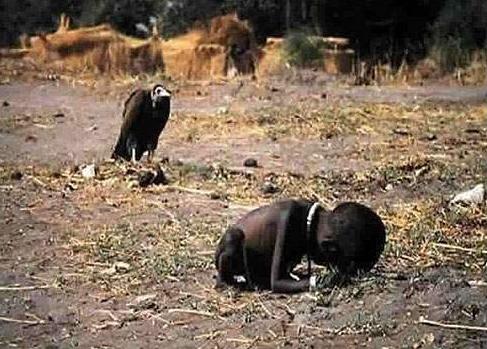 The above is the Pulitzer prize-winning
photograph taken by Kevin Carter in the Sudan in 1993. The girl was trying to
make it to a feeding center when the vulture landed. Carter waited about 20
minutes, took the picture, and then the vulture flew off. Carter was criticized
for not doing more to help the girl. He committed suicide a year later.
The photograph is haunting and
grippingly captures the consequences of famine and poverty. But what is the
practical effect of these photographs? They are powerful but there are some
misconceptions about such media effects. This is essentially a question of the
CNN effect, the idea that persistent around-the-clock media coverage influences
official political decision-making. It is termed the CNN effect but really refers
to a broad range of persistent real-time media that can set political agendas,
impede governmental actions, or accelerate them because of immediate news
coverage. There are some general misconceptions about this media effect.
THE MEDIA’S ROLE IN IMAGES OF SUFFERING:
To spend a moment looking at this picture and absorbing its impact is an
emotional experience. The vulture’s presence is ominous and captures the agony
between deep human identification and the raw reality of nature. But what is
the practical and political impact of these pictures? Do they cause people to
act, do pictures of suffering pressure governments to initiate humanitarian
aid? Surely, such pictures sometimes encourage action but not always. Political
leaders calculate the costs of interventions. If providing aid is relatively
easy and cheap then aid is easily forthcoming. But governments are conservative
about interventions when it involves troops and long-term commitments.
There was pressure to do something in
Bosnia where there was horrific Serbian violence against Muslims and pictures
of emaciated corpses. But the Bush administration was not going to commit the
troops and resources necessary to effect change. The media were manipulated in
this case to make it appear as though the US were providing aid when in fact
our reaction was minimal. Media images of suffering had little effect on
foreign policy. Clinton did not intervene in Rwanda in 1994 and the airways
were full of coverage of slaughter. A study once showed that contributions to
relief agencies do not increase during periods of wartime and images of dead
soldiers. But there is an uptick in contributions when the pictures are of
innocents – women and children. So the CNN effect must be conditioned. It can
inform and energize a public as it makes the public aware of atrocities, but it
does not dictate so easily to governments.
The two photos below are from the public relations service of Iran’s Revolutionary Guard and first appeared 2008. As was explained at that time, a second missile from the right seems to be the sum of the two missiles in the image. The shape of the smoke match perfectly near the ground as well as the immediate wake of the missile. There are some slight variations of color but they are very minor. The photos were quickly retracted. After being shown the photos a representative of a London-based Institute for Strategic Studies pointed out that the photos appeared to be doctored to cover up what was apparently a firing mistake on the part of one of the missiles.
These photos actually have appeared more than a few times over the last four years. They are a good example of fauxtography.


The media do play some role in either stoking or calming passions – especially with visual images. In the Middle East, for example, no reporter leaves the scene indifferent to the passions involved in the region. And a thoughtful reporter recognizes the feelings of both sides. This requires reporters and analysts to be “morally careful” so that the true enduring and important issues are represented as accurately as possible. Visual images are coded and cognitively processed quickly with a high-impact message. They are not the medium of careful analysis but better communicators of passions and feelings.
Television is a visual medium and the primary source of information about political conflict for most people. Television sets the agenda and signals which issues are most and least important. This is done at least primarily through visual means. It hasbecome so easy to manipulate visual images that it is only a matter of time before our memories and images for history are increasingly distorted. I suppose the only answer is a sort of visual fact checker who finds the truth about either starving children or misfiring artillery.
Pro/Con One State or Two States
|
The below represents the two general reaction statements to the two state solution. They lack details and represent the general reactive position. It is from: Procon I invite reactions and comments. PRO Israel and/or CON Palestine Statements |
PRO Palestine and/or CON Israel Statements |
| PRO:“Well, there has emerged, over the course of the past ten years at least, a sense that the only way out of the situation in the Middle East is to establish a State of Palestine alongside Israel so that there will be an end of conflict. There is no other solution to end the conflict in reality.There is an international consensus about it as reflected by the so-called Road Map Quartet [the United States, the European Union, Russia and the United Nations], which is after all the whole world. You have the United States, you have Europe, you have the Russians and the United Nations, which is the whole world, and then there is the Arab League, which is twenty-two different states, and there is the previous Palestinian administration, and the Israeli administration, all of them committed to the two-state solution.”
— Ziad J. Asali, MD |
CON:“The paradigm of the Two States will not bring about stability. No! . . . (The Two-State solution) is not relevant. Not relevant . . . (The Palestinian state) will undermine the State of Israel. From there, the confrontation will go on.The State of Israel is ready to give the Palestinians an independent Palestinian state, but the Palestinians are not ready to give us an independent Jewish state . . . Every agreement you make will be the starting point of the next irredenta. The next conflict. The next war.The establishment of a Palestinian state will lead at some stage to war. Such a war can be dangerous to the State of Israel. The idea that it is possible to set up a Palestinian state by 2008 and to achieve stability is disconnected from reality and dangerous.”
— Moshe Yaalon |
| PRO: “The next diplomatic formula that will replace the ‘two states for two peoples’ will be a civilian formula. All the people between the Jordan and the sea have the same right to equality, justice and freedom.. [T]here is a very reasonable chance that there will be only one state between the Jordan and the sea – neither ours nor theirs but a mutual one. It is likely to be a country with nationalist, racist and religious discrimination and one that is patently not democratic… But it could be something entirely different. An entity with a common basis for at least three players: an ideological right that is prepared to examine its feasibility; a left, part of which is starting to free itself of the illusions of ‘Jewish and democratic’; and a not inconsiderable part of the Palestinian intelligentsia.The conceptual framework will be agreed upon – a democratic state that belongs to all of its citizens. The practicable substance could be fertile ground for arguments and creativity. This is an opportunity worth taking, despite our grand experience of missing every opportunity and accusing everyone else except ourselves.” | CON: “Although the one-state approach proposes a united entity between the Jordan and the sea, in fact it represents King Solomon’s original proposal to cut the baby in half. In reality, one state means that Israelis and Palestinians each receive a mutilated and unsustainable version of its national dream. The Palestinians will never get the national self-determination they seek in a Jewish-dominated single state. Jews will achieve neither the democracy and inner harmony they seek (or ought to), nor legitimacy from the world, as long as they obstruct Palestinian rights to national self-expression in their single state – even before Jews become a minority.Finally, this conflict is tragically likely to ignite again over ‘some damn foolish thing in the settlements’ (with apologies to Bismark). A one-state solution not only fails to prevent settlements from ripping into Palestinian land and courting violence, it legitimizes expansion – since there is no border. Sadly, we all need one.” |



 Peace and Conflict Politics