Blog Archives
What Kind of Mentality Kills Teenagers Because They are Jewish or Palestinian? I’ll Tell You What Kind.


You have to be pretty far outside the category of “human” to kidnap three scared teenagers and shoot them in the back of a car. Shoot them for no reason other than they fit the category of “other.” The murder of Naftali Frenkel and Gilad Shaar, both 16, and Eyal Yifrach 19, and the Palestinian Mohamed Abu Khdeir reveals the monstrosity that can arouse itself in humans whenever group membership is highly salient and fueled by powerful beliefs such as religion. Let me explain how framing a conflict can be murderous.
Experts talking to lay people usually make the point that the Israeli-Palestinian conflict is not about religion or culture but land and national rights. It is a conflict between national political movements – Zionism and Palestinian nationalism – and perhaps includes broader Arab nationalism. Framing the conflict this way is actually quite good and beneficial. In addition to the practical implications, describing the conflict as one between two national political movements makes the conflict more amenable to management and resolution with all of the attendant rational and political bargaining. It implies sensible trade-offs and compromise along with future relationships and the positive attitudes and beliefs that will accompany these compromises and future relationships. Each side will broaden its circle of humanity and slowly include more of the other.
But with the integration and the unity government formed between Hamas and Fatah, not to mention the Hamas Charter and its aggressive religious history, we have a powerful religious element introduced. Islamizing the conflict is our worst nightmare and begins from the simple category definition of the conflict as one between two rival religions Islam and Judaism. Or, to put it in even more intractable terms, a conflict between two opposing absolutes. Now attitudes about the other are not subject to rational trade-offs and the anticipation of future relationships. And yes, the conflict can be Judiazed but there are important differences which we will take up at another time. This post is mostly about Islamizing the conflict. I will deal with revenge later.
Turning the conflict into a religious one between Islam and Judaism means you operate with only two categories – the ingroup and the outgroup with all of the biases and mental distortions that demonize and dehumanize the outgroup and wildly exaggerate the truth of the ingroup.
The murderers of these teenagers did not see human beings, they did not see naïve young boys, and they certainly did not see three individuals who like sports, school, and their friends. No, they saw three Jews or a Palestinian who are all alike; they saw the “other” who was responsible for usurping the holy land; they saw grossly distorted historical monsters who – as the Hamas Charter indicates – were a demonic force on earth, bloodsuckers and the killers of prophets.
And it’s getting worse. As Hamas asserts itself Judaism becomes its primary enemy. The hate and narrowing categories of acceptance will reach hallucinogenic proportions as Jews are described in demonic terms and according to the Hamas Charter are a “corruption on earth.” It will be increasingly easier to kill innocent teenagers because Islamizing the conflict drained them of any remnant of humanity.
The Hamas Charter – and I encourage everyone to read it to fully appreciate the depths of its depravity – relies on the Protocols of the Elders of Zion. The old charges of the Jews controlling everything would be laughable if they were not so consequential. Hamas is not bargaining over land because Palestine is sacred and not subject to division or occupation by anyone else. There will be no discussion of borders, or settlements, or land swaps. Palestine is dar al-Islam (the abode of Islam).
Islamizing the conflict is the worst thing that can happen from a contemporary social science and intergroup conflict point of view. It will increase the distance and differences, and decrease opportunities for positive contact even more than they are. As the two groups retreat into their own worlds and formulate their psychological and communicative categories such formulations will be increasingly based on misinformation, distortions, historical inaccuracies, stereotypes, and emotions until the two groups retreat to their respective corners each having drained the other of even the slightest consideration. At that point it becomes easy to murder teenagers.
Evidence-Based Thinking is Necessary for Proper Deliberation
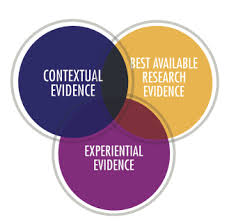
I have a sinking sense that schools don’t teach much “evidence-based thinking” anymore. They do teach critical thinking which is related but students are remarkably poor at defending propositions and recognizing thoughts and beliefs worth having. Although here is a blog site devoted to evidence-based thinking by two energetic young fellows. This spills over into the deliberative process because many citizens and political activists suffer from some of the same deficiencies. For some time now we have seen the diminution of the effects of Enlightenment thinking and science. From religious extremists to Tea Party members there’s plenty of anti-rationalist thinking and pseudo-intellectual discourse.
But things get worse. There is a clear disdain for logic and reasoning in some circles with many holding a toxic dependency on popular culture. This is not a particularly new phenomenon because Richard Hofstadter’s Anti-Intellectualism in American Life published in 1963 began to note the decline of the principled and evidentiary intellectual society and its replacement – the persuasion of single-minded people tenaciously holding onto a belief, opinion, or feeling and doing nothing but looking for support for that belief rather than its improvements, or accuracy, or truth value. I term this, the backside of evidence based thinking, confirmatory thinking in honor of the confirmation bias which is that people favor information that confirms what they already believe. But it gets worse. I count four ways that thinking is deficient because it is not evidence-based.
The difference between coincidence and causality is sometimes not completely clear but important to understand. Those who oppose vaccinations believe that all drugs have negative effects and any new vaccination would be the same thereby confirming their depreciated knowledge about medicine. They hold a mistrust of government and consequently any government program – even a highly evidence-based program that saves children’s lives – is rejected. A consistency of their own belief is more important than the evidence that supports the value of vaccinations.
A second sign of diminished capacity for evidence is simply how science and methods for making decisions work. The past and knowledge is strewn with failures and disappointments. Even when studies are unsuccessful and wrongheaded they make for a certain amount of information that is still of scientific value. It is comparable to the quip attributed to Edison that after he failed 200 times to make a light bulb he was not frustrated because he learned 200 ways not to make a light bulb. Evidence-based thinking requires developmental and evolutionary attitudes towards the unfolding of better and more precise information. Even though information can be wrong and lead you down wasteful paths, these paths are part of the process.
Basic misunderstanding of the logic of research is also a third issue. I’m not talking about standard logic or sophisticated mathematics but about basic principles of research and conclusions based on quantitative data. What it means for something to have a mean (average) and variation around the mean. Or, to have a sense of why and how numbers are influenced and change over time. This would include the logic of the experiment and the quality of conclusions when conditions are controlled and only a single experimental factor could have caused variation.
Lastly, one of the easiest ways to never get out of your own head and to hold fast to wrongheaded beliefs is to dispute, challenge, and dismiss those who are credible; in other words, to care more about maintaining your own consistency by rejecting experts and those more knowledgeable. We cannot all be experts on scientific and political matters so we must often rely on the expertise of others. And even though challenging and checking on the credentials of others to ensure source reliability is an important critical stance, this is not the same as knee-jerk rejection of experts. It seems as if those on the conservative end of the spectrum are quick to label all sorts of science as biased against the environment, or the climate, or finance because they inherently mistrust the source of any information and easily gravitate toward rejecting inconsistency with their own ideas then truly exploring and integrating new information.
There are all sorts of ways to distort information or disengage from it. And even the most conscientious thinker allows biases to creep in. But the attitude and willingness to engage, integrate new information on the basis of sound evidentiary principles, and change as a result of this evidence is what makes for more rigorous thinking.
Academic Boycotts Are Damaging, Anti-Intellectual, and Political Posing
There is truly little more distasteful than boycotting academic institutions for questionable political reasons. I mean if any organization is committed to problem-solving, analysis, and understanding it is academia. The American Studies Association (ASA) is an insignificant but highly politicized minor academic organization that is regularly critical of the United States. Last November the ASA was manipulated by an anti-Israel organization into supporting a resolution to boycott Israeli academic institutions. The ASA has about 5000 members and approximately 16% of them voted. A majority of that biased 16% voted in favor of the resolution and it technically passed. Additional details are available at Scholars for Peace in the Middle East. For now, let’s look a little more closely at what happened.
Who is the American Studies Association?
The ASA focuses on the study of American culture in general but with a strong anti-American sentiment. On the website you can find numerous resolutions critical of the US and imbalance with respect to the consideration of many political issues.
What is the justification for this resolution according to ASA?
The basic argument is that Israeli academic institutions are part of the system that discriminates against Palestinians. Moreover the playing field between the Israelis and the Palestinians is unequal because academic freedom is denied to Palestinians. And finally, Israeli universities are part of state policies that discriminate against Palestinians. The resolution claims not to discriminate against individual scholars engaged in research. The ASA asserts that this resolution is a form of social justice.
What has been the response to the resolution?
The response has been overwhelmingly negative with many of university presidents and leaders calling for the rejection of the boycott and for the resolution to be rescinded. Moreover, the ASA is a tax-exempt academic organization but such exemptions are denied if an organization is blatantly political. Lawyers are beginning to work on removing the tax-exempt status of the ASA. Lee Bollinger’s statement opposing the boycott appears here.
Still, the media coverage of the boycott has been strong and successful at raising the issue in the consciousness of most people. Many of the distinguished newspapers across the country have been critical of the ASA and these criticisms range from the left (e.g. The Nation) to the right (Commentary). Some criticisms from the left have claimed that the ASA resolution will weaken other causes, and some from the right simply defend Israel’s right to defend itself and question the political and legal challenges in the West Bank. The president of the Palestinian Authority Mahmud Abbas also rejects boycotts against Israel except in certain instances, and these refer to particular products, beyond the green line. The ASA appears to be stunned by the negative reaction and has begun manipulating its website and adopting a stance designed to minimize the damage.
The ASA has shown itself to be counter to the traditions of academic freedom and even potentially dangerous to inquiry and progress. If the resolution has any effect at all it will probably be to damage and make more difficult the work of just those individuals most able to work toward the resolution of the problems between Israelis and Palestinians. Resolutions such as these are typically political posing designed to attract attention rather than solve problems. And although attracting attention is a key component of the political communication process, the Israeli-Palestinian conflict is beyond such simplicities and in need of serious attention by serious scholars – not the kind of attention that comes from the safe stances of fashionable progressives who make pronouncements but don’t “get in the fight.”
Deliberation and Exposure to Differences: The Importance of “Hearing the Other Side”
The below is adapted from my book on deliberative communication. A full citation appears on the “deliberation issues” page.
One of the key issues for the news media, either print or broadcast, with respect to its contribution to deliberation is its ability to expose people to the other side of a conflict. This is an essential component of any conflict-resolving endeavor on the part of the media. Ethnopolitical conflicts face the problem of cognitive and moral differences that emerge from different conceptual frameworks used by different cultural groups. These differences can undermine the possibility of finding common ground. It is true that different conceptual frameworks surface from a lack of common ground and the different moral and cognitive grounds are greatest between groups with the greatest cultural and political differences. But the first requirement for invigorating the discourse of opposing views is exposure to the other side, or exposure to disagreement. The media in a conflict can play a particularly important role in exposing one party to the arguments, perspectives, and emotions of the other side.
Exposure to conflicting groups with different political and conceptual moral domains is the essence of the media’s role in the deliberative and democratic process. It is the media’s most fundamental contribution to conflict resolution. Peace and conflict resolution does not depend on similarity among conflicting parties because such a condition will never be met. Rather, the ability to create meaningful discourse between divergent groups is most important. The psychological tendency to balkanize and polarize ourselves is powerful and has become a concern to conflict specialists as a result of increasing tendencies toward emphasizing differences and distinctions. The press has been increasingly remiss at stimulating significant discussion across differences and people retreat into media enclaves and are exposed to different political discourse. In general, as Mutz (2006) reports, exposure to divergent opinions is a positive quality of democratic values because it helps people understand the arguments and rationales for those who think differently. And democratic values are even more encouraged when people actually reach across differences and try to engage others. True, that engaging those who are different than us can be dangerous and risk termination of the relationship, but the rewards are considerable if the risk is overcome. The elite press in particular must confront the effects of fewer opportunities to learn about others by making conflicting discourses available to its audience.
Hearing the other side, which makes one aware of legitimate and defensible arguments from the other side, also improves tolerance for differences. The ability to see more than one side of an issue translates into tolerance because recognition of a defensible argument makes it easier to accept the argument or lend it credence. I may not accept the opposing argument in the full sense of the word, but I can tolerate it. I will be more willing to compromise my own position and extend recognition to the other. This tolerance for differences is invigorated should the differing parties to a conflict have any sort of personal relationship. Typically during protracted ethnopolitical conflicts, where peace processes are often started and stopped, the participants to the conflict have contact with one another which results in trust improvement and some sense of a personal relationship. This development of even an imperfect personal relationship between “enemies” can weaken the identity-based differences between the two and lessen the probability of conflict erupting because of differences. Even a small personal tie will contribute to tolerance.
By demanding that the media expose publics to disagreement and different opinions, I am not suggesting that the media fail if they do not meet an idealized standard of perfect balance. Such balance is probably impossible to define, let alone attain. And it is impossible to impose such a requirement on any one news outlet. It is probably true, however, that the marketplace of ideas works well enough as long as there is sufficient diversity and competition in the information environment. Competition for news and information is effective and clear ideas will find their way into both conflicting communities. The crucial factors for a deliberative media are competition and diversity. When opposing viewpoints contend shared values are more likely to emerge. The online environment poses an interesting example because as Wojcieszak and Mutz (2009) discovered, exposure to the others who disagree occurs more with nonpolitical groups. They studied chat rooms and message boards and discovered that politically oriented networks tended to agree with one another in the first place. Thus, one is more likely to be exposed to political disagreement in casual networks not devoted to politics.
Captions and CutLines Lie Like Cameras
The two photos below represent different captions designed to frame the story in a particular manner. The first photo is from AP and was reported by Elder of Ziyon.
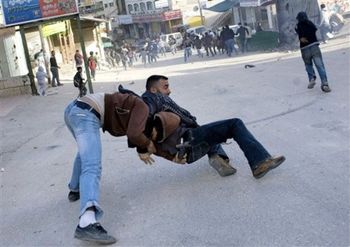
A Palestinian rioter tries to grab a weapon from a plain clothes Israeli police officer, right, during clashes in Shuafat refugee camp in East Jerusalem. Palestinians scuffled with Israeli security forces, after an arrest operation triggered clashes in the camp the day before.
The second photo is from Reuters
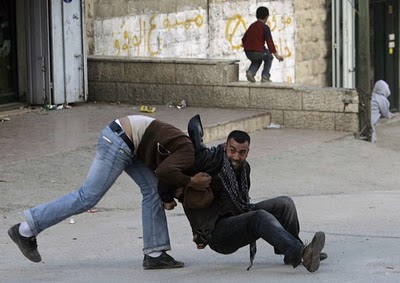
An undercover Israeli police officer (R) scuffles with a Palestinian youth suspected of throwing stones while trying to detain him during clashes in the Shuafat refugee camp in the West Bank near Jerusalem. Clashes erupted between Palestinian stone throwers and Israeli police that entered the refugee camp, a Reuters witness said on Tuesday.
The caption for the two photographs is actually quite different. In one sense, the descriptions do not contradict each other. They both described the scene. But it is possible to conclude with some different interpretations on the basis of the caption alone. In the Reuters version the Israeli appears to be the aggressor because he is trying to “detain” the Palestinian. The readers conceptual background might easily identify the Palestinian as engaged in legitimate revolt and doing little more than throwing stones at the bigger more well armed soldier and his comrades. It is the classic David and Goliath image. Anyone writing a caption should have the typical reader in mind. But in the AP version the Palestinian is characterized as more aggressive because he is trying to grab the weapon and will probably use it on the policeman. The policeman’s aggressive behavior would of course be justified in this case.
In the Reuters version, the fighting “erupted” and apparently the Israeli police entered the refugee camp which was sufficient provocation. But in the AP version there was an arrest operation that provoked the violence. The websites “Elder of Zyion” and “Honest Reporting” claim that the Reuters organization used an Arab stringer for a description of the events.
This poses an interesting question with respect to the newsgathering process and how stories are framed. Some news outlets have websites and phone numbers that one can call in order to report a story. So anyone can fill out a form on the web and provide a description of some event or activity and perhaps attract the attention of a news organization. The person leaves phone numbers and email addresses where he or she can be reached and the news organization contacts them. This of course can be an excellent source of news and is the sort of contact that results in specified and situationally-based stories. But on the other hand, this process can be abused. It can result in stories that are biased as a result of the selection process or stories, even worse, that are staged or distorted in some significant way.
Actually, the description underneath the photographs is a cutline and not a caption. A caption is a little headline and a cutline describes the photograph in more detail. Reader psychology and tendencies are important because the photo sparks interest and then readers typically move underneath seeking explanations. It’s important for cutlines to perform their duties. Cutlines like stories answer the who, what, why, when, and how question of journalism. When cutlines are more on the objective side of the dimension they satisfy reader’s understanding of the picture but have not necessarily told the reader what to think. The more cutlines are politically motivated the more they draw the reader’s attention toward some specified reality on the part of the news outlet.
A picture may be worth a thousand words but each of those words is capable of altering the meaning of the picture. A skilled cutline writer knows these things and chooses his words carefully.
The Deficient Traditional News–and Then There are Blogs
To the dismay of many communication scholars, the Internet and forms of new media have not become very effective mass communication outlets. Most websites do not reach as many people as television or other traditional forms of media. It is true that some blogs have become more effective than traditional media and this is because they satisfy reader needs and help compensate for the deficiencies in the typical press. An interesting article pertaining to these matters appears here. The article makes the case that the media fail to reach standards of democratic expectations as well as not living up to their own professional expectations. There are four reasons for a deficient traditional media and I will describe and elaborate on these four below.
1. The author of the article in the link above (Deva Woodly) begins by making the point that too much of the press originates with public officials and represents elite opinion. This charge has been leveled for some time and charges the press with hegemonic political communication. The press is owned by influentials who have interests in managing the debates in society. The solution to this problem is for more information and dissent to bubble up from the populace. I think this happens more than the author realizes but remains a difficult process. The relationship between the press and a democratic community is often characterized as a conversation. In other words, an exchange where elites and owners present ideas which are responded to in an effort to continue the conversation. The conversation metaphor is appealing but strained.
2. The second symptom of an anemic press is the emphasis on entertainment and titillation designed to attract viewers. Again this point has been made numerous times and is a standard criticism. It carries plenty of truth but it applies less to quality press then to the numerous press outlets available in the United States. It is true enough that news has increased its entertainment value but the literate reader and consumer of news can find serious information-based news sources easily enough. Moreover, a new story will focus on celebrity personality over deep analysis of social conditions but again these analyses can be found even if it increases the burden on the consumer. It is more common to leave consumers on their own to fend for themselves in finding quality news.
3. One of the most basic principles of American journalism is objectivity even though any high school senior knows that true objectivity is impossible. Still, objectivity can be at least approached or remain an ideal to strive for when the story calls for a straightforward narrative. I have always thought the burden on the news reporter for objectivity is too great. He or she is required to adopt a neutral pose and take a position on a story that is usually contrary to their instincts. There is a difference between bias and perspective – where bias is conscious distortion and manipulation – but perspective is just fine. Some media environments for example in European countries avoid the appearance of objectivity altogether by stating their perspective upfront and expecting the reader to realize the perspective of the press outlet. So, one will choose to read a communist newspaper or conservative newspaper realizing altogether that these perspectives are present. The literate consumer purposely seeks out the Communists press or the conservative press in order to see what they are thinking. This is a more uses and gratifications approach to reading the news because the consumer is making active intellectual choices. I prefer this approach to news.
4. And, according to Woodly, media consolidation is the fourth deficiency of so much news. The media market is dominated by a few large corporations and this is a disturbing development for democracy. This is the result of the tension between the news media and their commercial profit-making interests as opposed to their responsibilities for an informed citizenry. The influence of corporate parents can be even more insidious as the corporation directs the news. Profitability and bottom-line concerns are truly troubling but there’s also little that can be done. News organizations must turn a profit and size is sometimes an advantage in terms of the development of new products and administrative ease.
Traditional media is still powerful and reaches more people than other forms of media. But the blog sphere and the easy availability of user generated content is influential on the structure of political communication. For example, some traditional media use websites and twitter messages to circulate new ideas and influence the debates including what counts as newsworthy. New social media are increasingly an effective pathway to more powerful media and help amateur users influence the issues. Finally, some research seems to indicate that blogs are more argument and evidence-based. This clearly has the potential to expand political knowledge and turn blogs into a more commonly accessed resource.
Photo Manipulation by Hamas in Gaza
Photo manipulation has been with us a long time. There are two types of manipulations: the first is to alter the image and the second is to simply deceive the viewer about the content or story behind the image. Lesser artists tried to copy the great masters and pass them off as originals. In later years images were touched up with ink, double exposure, and airbrushing. But the possibilities for manipulation of photographic images with the advent of the digital age increased exponentially. It also has become easier to copy and send images such that they circulate and take on a reality of their own. An image can be false or deceptive but millions of people have been exposed to it before discovering the deception. Take the example below:

This is the sort of disinformation that can be easily spread by manipulating images. The picture of the dead child spread quickly across the Internet and was described as a dead girl in the arms of the Palestinian Prime Minister Ismail Haniyeh. The child was killed during the Gaza war in December 2012 and, as reported by Palestinian sources, was killed by an Israeli rocket. But according to Honest Reporting, a website that tracks deception and manipulation, the child was not killed by Israel but rather an errant rocket fired by Hamas. This image spread through Twitter and Facebook and imprinted itself in the minds of many before the correction.
The picture below is of an Israeli child wounded by Palestinian rockets. You can see the Hebrew lettering on the jacket of the man holding the child and, as the picture points out, the coat of arms in the upper left is of the city in southern Israel Kiryat Malakhi.

In a very real sense, everything about a photographic image has the potential for manipulation and untruths. Beginning with the choice of lens, available light, and how close or far to stand from the subject a photographer makes ethical decisions. And it is certainly possible to manipulate an image in the interest of increasing accuracy or improving the emotional impact for artistic reasons. But these composition decisions are more controllable and subject to standard considerations than blatant lies about the content of a photograph.
The press has a particularly important relationship between photographic images and their publication. There is a fiduciary relationship between the press and the public. And the press should not be in the position of corrupting this relationship. Granted, simply uploading an image to the Internet and making a false claim about it is easier because the individual and the Internet audience have no fiduciary relationship. This does not make the act of lying about an image any less despicable but the perpetrator gets away with it because he’s not turning a sound relationship into an impure one.
One consequence of this easy deception is a loss of faith in the photojournalistic profession and the power of the visual image. Since the goal of political photographs or journalistic photography is to reproduce accurately some social or political reality a powerful source of truth and emotion is lost as confidence in the accuracy of images diminishes.
To extend the Churchillian metaphor from the photograph above, truth has to get its pants on faster. This is an issue of the distribution of images rather than their compositional manipulation. Visual processing is powerfully analogic and impressionistic and only takes a few seconds. The old refrain of “a picture being worth 1000 words” is true enough. The deadening cynicism that results from exposure to too many manipulated, exaggerated, and false visual images makes it even more difficult for quality images to do the work for which they are intended. These visual “lies”, perpetrated mostly by Hamas detract from the peace process and exacerbate the conflict rather than mediate it. Agreement on disallowing these practices must be part of a final peace process, otherwise truth will not only be slow to get its pants on it will trip over itself.
Islam and Political Correctness
Below is some terminology from: www.sfcg.org. It is a sort of political correctness guide but I’m curious about distortions and loss of meaning. What do you think? Below is an analysis of one term “Islamic terrorism.” Other terms are listed along the right side. Is this sort of sensitivity justified or does the phrase “Islamic terrorism” accurately capture what it is you want to say. I will post more of these on occasion.
|
|||||||||||||
|
Additional Distinctions
|
|||||||||||||
|
|||||||||||||
|
|||||||||||||
The Quality of Fox News Reporting

The above is an example of reporting by Fox news. Notice anything about the graph? The location of the trend line for the most recent number of 8.6 for November is higher than the placement of the line when the number was 8.8 back in March. Media matters first pointed this out. According to them when the unemployment rate dropped to 8.6 Fox news rounded up to 9.0! Maybe the chart below (also from media matters) gives a more accurate picture? I don’t think so but it does make the point. The claim that it is easy to manipulate impressions with “misleading” graphs is easy enough to defend and requires no additional elaboration.


Notice anything about the above picture? Seems like they got Romney wrong. It remains quite impressive how Fox news can continue to manipulate images and political inclinations. The Republican debate sponsored by Fox had very little to do with the press’s noble goals of providing fora for issues. The audience was loud and highly partisan and many questions were designed to highlight Republican platform positions and attack Obama rather than clarify issues.
Rush Limbaugh and the conservative talk radio crowd have been using these techniques for some time. These issues are a little beyond the “peace and conflict” subject matter of this blog, but they do speak to the issues of the press and its role in a political environment.
Democratic values as they apply to the press are important. Issues such as accuracy, independence, freedom from bias, and integrity are important. The news media should always make the distinction between factual news stories and opinion pieces. Fox’s manipulation is to blur this distinction. When conservative talk hosts are attacked for their partisanship the Fox leadership claims that they’re not supposed to be news but entertainment. There certainly is a place for intelligent opinion and perspective which are often essential to understanding the consequences of the story. But we can see from the above examples that Fox is a little sloppy when it comes to representing accuracy and authority.
A recent study of Reuters proprietary websites examine their reporting related to the Middle East conflict. The study ran tests of articles for problems with logical fallacies, propaganda, and violations of Reuters handbook. These were tested in order to determine attitude shifts and support for belligerent parties in the Middle East conflict. The results indicated that there were over 1,000 occurrences of reporting and ethical failures that attitudes did shift as a result of being exposed to these reporting and ethical transgressions. For example, atrocity propaganda or lies and manipulations about the extent of violence and atrocities increased favorability and sympathy toward Palestinians. The same was true for the use of pity and subordination propaganda. The authors of the study concluded that Reuters engaged in systematically biased storytelling in favor of the Palestinians, and these biases directly influenced audience affect and behavior. On the one hand, these findings are not surprising but they certainly demonstrate that errors, biases, and manipulated frames do have strong effects. Both Fox News and Reuters must work on improving clarity and accuracy.
A diverse employment environment is one response to these biases. This includes more than simply gender and ethnic differences but must include differences in terms of knowledge and perspectives. Fox with respect to national political news and Reuters with respect to international news must do better at accuracy, error correction, focusing on intelligent and coherent perspectives rather than bias, information quality, and balance. Fox will continue to maintain its distinction between traditional news and editorial or opinion and defend their use of the media designed to direct perspectives in a certain manner. They have found a business model that allows them to maintain a conservative ideology and still garner enough of an audience. Although there is nothing particularly wrong with representing a coherent political ideology, there is something very wrong with rank partisanship and mistakes.




 Peace and Conflict Politics