Blog Archives
Captions and CutLines Lie Like Cameras
The two photos below represent different captions designed to frame the story in a particular manner. The first photo is from AP and was reported by Elder of Ziyon.
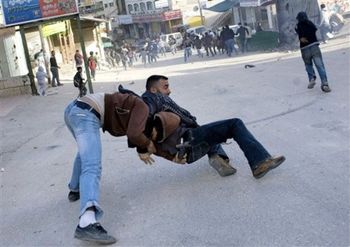
A Palestinian rioter tries to grab a weapon from a plain clothes Israeli police officer, right, during clashes in Shuafat refugee camp in East Jerusalem. Palestinians scuffled with Israeli security forces, after an arrest operation triggered clashes in the camp the day before.
The second photo is from Reuters
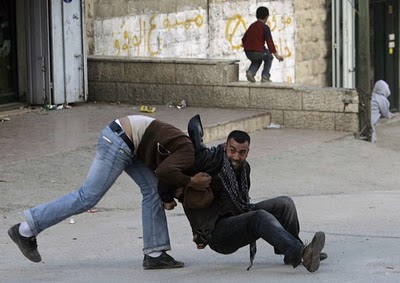
An undercover Israeli police officer (R) scuffles with a Palestinian youth suspected of throwing stones while trying to detain him during clashes in the Shuafat refugee camp in the West Bank near Jerusalem. Clashes erupted between Palestinian stone throwers and Israeli police that entered the refugee camp, a Reuters witness said on Tuesday.
The caption for the two photographs is actually quite different. In one sense, the descriptions do not contradict each other. They both described the scene. But it is possible to conclude with some different interpretations on the basis of the caption alone. In the Reuters version the Israeli appears to be the aggressor because he is trying to “detain” the Palestinian. The readers conceptual background might easily identify the Palestinian as engaged in legitimate revolt and doing little more than throwing stones at the bigger more well armed soldier and his comrades. It is the classic David and Goliath image. Anyone writing a caption should have the typical reader in mind. But in the AP version the Palestinian is characterized as more aggressive because he is trying to grab the weapon and will probably use it on the policeman. The policeman’s aggressive behavior would of course be justified in this case.
In the Reuters version, the fighting “erupted” and apparently the Israeli police entered the refugee camp which was sufficient provocation. But in the AP version there was an arrest operation that provoked the violence. The websites “Elder of Zyion” and “Honest Reporting” claim that the Reuters organization used an Arab stringer for a description of the events.
This poses an interesting question with respect to the newsgathering process and how stories are framed. Some news outlets have websites and phone numbers that one can call in order to report a story. So anyone can fill out a form on the web and provide a description of some event or activity and perhaps attract the attention of a news organization. The person leaves phone numbers and email addresses where he or she can be reached and the news organization contacts them. This of course can be an excellent source of news and is the sort of contact that results in specified and situationally-based stories. But on the other hand, this process can be abused. It can result in stories that are biased as a result of the selection process or stories, even worse, that are staged or distorted in some significant way.
Actually, the description underneath the photographs is a cutline and not a caption. A caption is a little headline and a cutline describes the photograph in more detail. Reader psychology and tendencies are important because the photo sparks interest and then readers typically move underneath seeking explanations. It’s important for cutlines to perform their duties. Cutlines like stories answer the who, what, why, when, and how question of journalism. When cutlines are more on the objective side of the dimension they satisfy reader’s understanding of the picture but have not necessarily told the reader what to think. The more cutlines are politically motivated the more they draw the reader’s attention toward some specified reality on the part of the news outlet.
A picture may be worth a thousand words but each of those words is capable of altering the meaning of the picture. A skilled cutline writer knows these things and chooses his words carefully.
The Power of Just Not Giving a Damn
I think we under estimate the communicative and reconciliatory value of just “not giving a damn about some things.” There was a story in the paper last week about a 26-year-old boy, Ethan Saylor, with Down syndrome who went to the movies with a caretaker. When the movie ended his caretaker asked him to wait while she went to get the car. The boy walked back into the theater and sat down when the theater personnel came in and told him to leave. The theater manager called mall security who forcibly removed the boy from the theater while he was crying and calling for his mother. Somehow, while restraining the boy and wrestling him out of the theater he went into distress and died. The theater manager and the mall security agent were more intent on upholding rules and “doing their job” then they were concerned for the safety of Mr. Saylor. Who cares if this young boy was in the theater without a ticket? It was not something worth “giving a damn about.”
Along a similar vein, I was listening to Charlie Rose interview the Iranian ambassador to the United Nations Mohammed Khazaee. At the end of the interview Rose asked the ambassador if he had seen the movie Argo about the escape of some Westerners from Iran during the revolution. Khazaee said that he had seen the movie and there were numerous mistakes such as Iranian linguistic conventions for “hello” and “goodbye.” He then went on to demand the movie producers (that would be George Clooney) apologize to the Iranian people for this great insult. Such heated and indignant insults simply demand retribution! Again, I thought about how these demands for an apology were more damaging than anything else and tensions would diminish if people just “didn’t give a damn.” Read the rest of this entry
The “Business” of Peace
Establishing new relationships between adversaries is always a primary goal of the peace process. There is much in the research literature that talks about transforming relationships and typically this discussion focuses on changing attitudes, stereotype reduction, and humanizing the other. But one relationship change that receives relatively little attention but is quite effective is the process of what I call “rationalizing” relationships. Rationalized relationships are based less on personal intimacy and more on instrumental and pragmatic interdependencies. “Business relationships” are the best examples of a rationalized relationship where the two parties benefit and interact on a regular basis but do not have to be personal. Of course, an ideal goal rooted in theories such as the contact hypothesis would be to improve the quality and personal nature of the relationship since this mitigates various tensions. But this more personalized relationship is not the primary goal.
These “business relationships” are slightly different from the political relationships I wrote about on October 29th because they are less oriented toward problem-solving. Still, emotional attachment to the other is less important than the realization of interdependence and the need for practical coordination. This form of a communicative relationship serves as a useful starting point for conflict resolution, and allows minority groups in multicultural societies to establish mature relationships with the dominant group. Business relationships treat others as respectful partners that have common interests in problem resolution as much as anything else. The experience of rationalized relationships is quite compatible with the ability to sustain “reasonable disagreement.”
Business relationships recognize self-interest but develop a relationship that rests on equitable self-interest; that is, a relationship where each attends to the utilitarian and practical needs of the other. These rationalized business relationships entail, above all else and as in friendship a habit of attention by which participants in a conflict are attuned to the balances and imbalances in what they are giving up for each other. Business relationships are less concerned with intimacy because intimacy is reserved for relatively few relationships that are more absorbing and based on sacrifice and strong identity with the other. But utilitarian business relationships can apply to large numbers of people and is focused on the pragmatics of resource gratification. Parent-child, ruler and ruled, or superior- subordinate relationships are not business relationships because they limit the autonomy and agency of one person (the child, ruled, or subordinate) and are based on maximization of differences. In short, the business relationship is central to the problems associated with multicultural contact and the ability of groups to develop their capacities for trust and communication.
Recently, a United States Institute of Peace special report (special report 315) outlined the ways in which the business sector could foster peace and assist with the conflict resolution process. The relationship between business and peace is certainly complex and potentially fraught with problems of ownership, ethics, corruption, tribalism, and preoccupation with narrow market interests. And there is a line of research that points to how business exacerbates problems and can be a source of strife and tension. For example, the routine operations of a company can have negative effects on the local community, degrade the environment, and engage in unfair labor practices. But business can also sustain peace because it is based in nonviolence and consensus ethical relationships. The USIP report describes five main areas in which business relationships can be promoted of peace.
The first is economic activity which helps alleviate the relationship between poverty and violence. Jobs and a vibrant business environment creates a context for people of different religious and ethnic backgrounds to work on common goals. Cisco Systems, for example, connects Palestinians and Israelis through a $10 million investment in Palestinian technology development.
Secondly, there are benefits that accrue by respect of the rule of law associated with international labor standards. Businesses with strong ethical commitments are powerful models for the value of respecting the rule of law and clearly an avenue of peace.
A commitment to good organizational citizenship, which includes attention to local community and culture, stimulates a positive social environment and teaches the lessons of responsibility. Moreover, these relationships develop outside the company and establish an organizational-cultural relationship that engenders trust and promotes the habits of democracy.
The interaction between track one and track two diplomacy is a fourth feature of business relationships that helps lessen tensions. Business leaders can partner with government leaders to address political challenges. Finally, businesses can engage in assessment of practices that are particularly suited to the political environment. By paying attention to the unique concerns of employees, customers, and suppliers business relationships continue to rationalize the political culture.
USIP report 315 outlines these issues in more detail and extend the discussion of the relationship between business prosperity, the relationships that business engenders, and political stability and conflict prone environments.
Someday Hamas and Israel Will Talk
There is only one solution to the current fighting in Gaza and that is some sort of negotiated agreement. It sounds naïve I understand but until that time we will have little more than the standard conflict resolution mistake of “more of the same.” Deliberation in any form is impossible until the two sides are sufficiently willing and we are certainly not there with respect to the Israelis and Palestinians, especially the Palestinians in Gaza. But if that day ever comes the deliberative conditions below will be important.
Deliberation is a powerful normative ideal to strive for and in its heart it is concerned with the careful and balanced consideration of alternatives under conditions of democratic fairness. To transform the deliberative ideal into actual communication is essentially to operationalize deliberation and lower its level of abstraction. It is to take a theoretical ideal and convert it to symbolic behavior. But this operationalization is never easy or direct. Deliberative democracy is also primarily concerned with democratic decision making, whereas deliberative communication is, shall we say, messier. Deliberative communication includes broader intersubjective meaning creation and is inclusive of many forms of discourse and linguistic structures. Moreover, the polysemic nature of communication, where messages can take on a variety of meanings depending on context and other factors, makes identifying qualities that make communication “deliberative” even more difficult. But as I have noted in other places, deliberation is not one big philosophy seminar characterized by rational argument only. It must include the possibility that judicious argument and sound decision making can take many communicative forms. In general, deliberative communication has the following five characteristics.
(1) There is a confrontation of perspectives and argument is the primary communication mechanism for adjudicating differences. Argument takes the form of reasoned opinion where a speaker is required to support reasons and defend against critique. This includes evaluating materials, judging the quality of sources, and defending background assumptions. It is also true that some forms of reasoning maintain ideological dilemmas.
(2) There is a relational component to deliberation whereas participants respect the other and genuinely listen to their perspectives. Participants actually engage one another and avoid monologues that do not take up the perspective of the other. Participants acknowledge autonomy and mutuality in a civil and respectful manner.
(3) Consensus is the goal to strive for. This includes will formation such that the collective is ultimately committed to decisions. In order for consensus to be a goal deliberators must be concerned with disagreement. Disagreement is an indication of the diversity that is inherent in divided groups. Deliberative communication should include participants having their own views critically examined because of the presence of disagreement. This improves the quality of opinions. Consensus is a goal but lower levels of agreement are acceptable.
(4) The position of authorities, tradition, and power are up for discussion in deliberative communication. Participants must meet the objective of the meeting but other foundational assumptions are acceptable topics for deliberation. As Young explains, “Truly democratic deliberation must not rule out self interest, conflicting interests, or relatively emotional or intuitive expressions. . .” (p. 472) (Young, 2000).
Deliberative communication must allow for equality and symmetrical power relations as much possible. People must be on equal footing and no one should unfairly dominate the interaction. Reciprocity would be an important indicator of equality. These forms of communication are specifically suited to diversity and pluralism that are consequences of ethnopolitical divides.
For more detail see Donald Ellis (2012). Deliberative Communication and Ethnopolitical Conflict. Peter Lang Publishers.
Breaking Double-Bind Intractable Conflict Relationships – Dialogue or Deliberation
Imagine the following double-bind relationship of an intractable conflict: An Israeli Jew feels so victimized by historical discrimination and anti-Semitism that the state of Israel was created as a consequence of the Holocaust. Moreover, he now feels doubly victimized by Palestinians who refuse to recognize Jewish cultural and historical rights and blame the Zionist entity for their oppression. At the same time a Palestinian feels victimized by Jews and Zionism. Each denies that he is the oppressor and they continue a pattern of accusation-counter-accusation that often leads to violence. Each considers the other responsible for its lived experience. And each time one group denies the claims of the other the denial is heard as additional oppression providing additional evidence for the truth of the claim in the first place. Every defense is an offense and thought to justify additional offenses. This is a classical double bind logic that cannot be escaped within its own system but must be redefined. What kind of communication helps the redefinition – is it dialogue or deliberation? Can you debate your way out of this problem? Is dialogue a special form of communication that allows for solutions to these double-bind conflicts?
Click here and take a look at debate-dialogue table.
The table is a nice distillation of the differences between dialogue and debate. It is reprinted from the book “Moral Conflict” by Pearce and Littlejohn. I take differences like the one described above as a given; that is, resources, skills, perceptions, and ideas are not equally distributed amongst people and this makes for the politics of difference. Hence the goal of communication and problem solution in general is to manage these differences – whether they are political, ideological, commercial, or ethnic – and communication is the primary mechanism for managing these differences, for reaching across the divides that separate people. Some form of communication has to be capable of breaking double-bind conflicts.
Traditionally, the type of communication most conducive to closing gaps between people has been termed “dialogue.” I tend not to use the word dialogue in my own writing very much because it carries a certain baggage. That baggage is mostly centered on a sense of unachievable authenticity and openness that includes deep engagement, attentive listening, empathy, and a host of other idealistic abstractions. I’ve resisted the word and you will not find it very often in anything that I’ve written. Moreover, there is sometimes the expectation that “dialogic” communication is of the highest form and most desirable, when in fact debate that it is contrasted with is an equally important and useful pattern of communication.
But over time I have become increasingly unable to distinguish dialogue as it is usually written about from other types of engaged interaction, namely, deliberation. As I write about deliberation (see my recent book here), which is a more controlled discussion, the lines that once separated dialogue and deliberation are blurring. Oh, distinctions can be made, and we will save those for another time, but those distinctions are less clear. I think the table that distinguishes debate from dialogue is a very good presentation of two types of communication. Certainly the presidential debates in the United States are more “debate like.” Nobody would call the exchanges between Romney and Obama a dialogue. Most discussions between international actors contain more of the qualities of debate rather than dialogue. The two participants (a) prepare cases designed to be presented, (b) represent positions that they want to force on the other, (c) present a dominating persona, (d) speak as representatives of groups (political parties, constituencies) rather than for themselves, (e) try to “win” rather than solve problems, (f) offer little new information, and (g) work to defeat the other side by winning argument strategies.
Deliberation is more “debate like.” It is concerned with evidentiary credibility, reasoning, consistency, and a tenacious concern for inclusion in legitimacy. But deliberationists recognize the limits of debate and that alternative forms of communication are often called for. Moreover, deliberation must still confront culturally grounded rhetorical forms of communication that do not meet standards of reason and rationality. Language and meaning are situated and designed to direct attention toward selected portions of reality. So deliberation, like dialogue, must confront talk that is required to transform how one understands others and themselves. If two competing groups or individuals seek to transform the other or develop new realities more shared between them then there must be a willingness to risk change. This is certainly true if any progress is to be made on double-bind conflicts
Deliberation turns out to require some of the same assumptions as dialogue. For example the recognition that communication is not linear but multifaceted. Or that deliberation always bumps into tangential issues of identity, emotions, and incommensurate attitudes and beliefs. This is perhaps the thorniest issue that deliberation and dialogue share. If problem-solving were automated and purely rational then cultural rhetoric’s and peripheral issues would not interfere and therefore not be a problem. But even the strictest deliberation practitioner runs into “real” people whose communication and lifeworlds must be accommodated.
An important point pertaining to dialogue, and one often overlooked or misunderstood, is that requirements such as finding “common ground” or “resolving differences” are not necessarily the central goals of dialogue. Rather, dialogue recognizes the maintenance of differences and that conflict and contradiction are natural enough such that a goal of unity or problem resolution is typically elusive. Deliberation is very grounded in its epistemic function such that deliberation results in new knowledge and new ways of seeing problems. This epistemic function can also apply to traditional notions of dialogue. Both deliberation and dialogue except that individuals or groups can hold their ground and defend a position, but only require them to remain open to engagement with the other. Both dialogue and deliberation also have a critical stance one that refuses to privilege a single perspective or ideology or at least insists on a serious confrontation with such a perspective or ideology. Although I do not want to completely conflate dialogue and deliberation they share more space than not. The role of each in solving double bind conflicts remains an empirical question.
Julian Assange and Information Rights: Part 2
As I stated in the previous post, Julian Assange is clinging to free speech rights and access to information rights to defend his release of government documents. He’s being held criminally for releasing such information and violating presumed security rights of the state.
All speech is free speech except for that which is justifiably constrained. The nature of this constraint and meaning of “justifiably constrained” is what we will explore here for the moment. We begin with the entering assumption that freedom of expression is a basic human right and if we are going to error than we will error on the side of free expression. So, we take the most well-known example of yelling “fire” in a crowded theater when there is no fire, people rush to the exits and hundreds are trampled to death, and then “free speech” is your defense of what you did. You do not of course have the right to freedom of expression when it endangers so many people. You obviously cannot be responsible for the deaths of hundreds of moviegoers and stroll away comfortably on the basis of freedom of speech.
Moreover, the most specific constraint on freedom of expression is “imminence.” This means that you cannot cause imminent or immediate danger as a result of your expressive behavior. So the Nazis and skinheads have a right to express their political opinions (noxious as they might be) but they do not have the right to express those opinions while marching through a Jewish neighborhood creating imminent danger and clearly provoking violence. One of the legal arguments against Assange is that he retrieved government documents that had been classified and were not available to the public. But it is easy to “classify” something. And even though we cannot have individuals making their own decisions about what justifies being classified and what does not, the principle of available access to information and free expression does require justification if your rights are going to be constrained. Last February on this blog I wrote about bloggers and new media with respect to their contribution to the Arab Spring. I retrieved from Wikileaks a copy of a briefing (reference ID 09CAIRO544) about bloggers broadening their discourse. The briefing from 2009 warned that Egypt’s bloggers were playing an increasingly important role in broadening the scope of the acceptable political communication. Bloggers’ discussion of sensitive issues such as the military and politics represented a significant change from the previous five years and had influenced society.
As recently as 2009 the cable noted that a more open atmosphere had been created. Bloggers were influencing independent media to break important news and cover previously ignored or forbidden topics. One personal rights activist in Egypt stated that the youth were able to express their views about social and political issues in ways they never could before. Free speech tends to produce free speech, and the accumulation of effects from blogs in Egypt is apparent.
This post about blogs was an effort to explain how more information was circulating in Egypt and that was at least partially responsible for political uprising demanding even more freedoms. Was the release of a cable that reported on the general state of bloggers in Egypt a security matter? Surely such a cable does not rise to the level of significance of military secrets or something that can directly affect the safety of the state. In fact, if a government is tracking bloggers and writing reports about blogging in an effort to thwart access to certain information then this should be known to the public. It does not threaten the security of the state.
It does hold, and is imperative, that if citizens of a state are going to monitor the conduct of their government and engage fully democratically then they have to have access to state information – at least certain types of state information. Moreover, government should not be allowed to impose limitations on the citizenry under the pretext of national security and their rights to “classify” information.
The burden, if you will, must be not on access to information but on the government’s decisions to constrain that access by classifying information; that is, freedom of information and symbolic expression is the default political condition and the burden of proof that communicative rights must be limited is on the state. Below are a few more specific principles:
- As much as possible any restrictions on freedom of information must be prescribed by law beforehand. Restriction conditions should be drawn as precisely as possible.
- There must be opportunities for independent courts to judge the quality of safeguards for freedom of information.
- To restrict freedom of expression or information there must be a compelling explanation for the protection of national security. Some examples are in cases of war or military threat, internal sources of discord, or incitement to overthrow the government. This explanation must not only be compelling but able to show specific harm.
I’m not defending Julian Assange per se. His methods are of course illegal and of all the thousands of documents he gained access to and released there are probably more than a few that could have been classified as genuine security threats. But it becomes a little easy to accept government restrictions on freedom of information rather than honor the rights of a democratic society. A good way to keep the proper balance between democratic rights and security is to remember the principles below:
- People have the right to information about public officials in the workings of the state. Limitations on those rights must be clearly and strongly justified. A security justification designed to deny information must be unequivocal with respect to protecting national security interests.
- The public’s right to know is the most foundational assumption.
- There should be a clear system in place which provides independent review and credible oversight of situations where information rights are limited.
- If a person discloses information that is not harmful and is found not to pass the test of legitimate constraints, then that person should not be criminally charged.
- It should be possible for the public’s right to know to outweigh the importance of disclosed information.
- Confidential sources should be protected.
- New technology should make information as available as possible and open to scrutiny by the public.
Assange is not the newest hero for freedom of information. He not only has a grandiose ego and sees himself as the great liberator of information, but Assange goes at the problem with a machete rather than a scalpel. He captured access to thousands of documents with no concern for the nuances of their importance. Still, he has infused new energy into a tired but important democratic principle.
News Frames and the Israeli-Palestinian Conflict
If you drew a map of the world and you drew the size of each country proportionate to how much news attention it receives, Israel would be the size of the old Soviet Union. There are a variety of reasons for this, namely, that Israel is a democratic country in which it is possible to walk around and file a story. It is also true that the international appeal of the conflict as well as the prevalence of English make newsgathering easier.
But there is another slightly more insidious reason. Media coverage of Israel is often simply framed in an extreme way or in a regularly consistent manner such that the frame takes on “reality” or a strong sense of “truth.” News stories of Israel are almost always framed around “conflict.” A conflict frame includes “violence”, images of Israel as Goliath and the Palestinians as David, along with accusations about “apartheid,” settlements,” and “occupation.” These violence and conflict frames overwhelm the rest of Israel. In fact, it is frame incompatibility that defines the conflict. An act of violence will be framed as a “security” issue by the Israelis and an “aggression” or “occupation” frame by the Palestinians. Frame management is one important route to conflict resolution.
Arguments can be cast or “framed” in such a way as to direct attention toward a specific type of information or cognitive processing. Framing, wherein the frame casts the same information in either positive or negative terms, has been the focus of substantial research activity in the past three decades.The issue is whether framing an alternative in either a positive or negative manner influences the response. Frames are an alternative to classical rationality. Subjective issues form the cornerstone of framing theory. For instance, as Kahneman and Tversky first pointed out, gaining a hundred dollars by going from $100 to $200 is more significant than gaining hundred dollars by going from $1100 to $1200. The absolute gain in both cases is the same; however the gain in the first example is psychologically greater. The framing perspective for ethnopolitical conflicts is heavily influenced by the presence or absence of various psychological factors. That is, it is an alternative to classical rationality and the effectiveness of the argument is dependent on the qualities associated with accepting or rejecting a particular frame.
A framing effect occurs when, during an argument, relevant considerations of how the argument is framed causes individuals to focus on these considerations when constructing their opinions. The arguments of others are an important window on our own reality; that is, people are influenced by the opinions and arguments of others. Such informational influences demonstrate the value of argumentative exchange; arguments have an informational influence and can direct the development of attitudes about an issue.
For example, the blame frame and the cooperative frame are two typical ways to frame messages, especially between Palestinians and Israelis. Blame is based on the perception that someone is responsible for a failure to achieve a goal or a particular social condition. Blame is also associated with a sense of injustice that can be very motivating and even used to justify aggression. The act of blaming another person or group serves to exonerate one’s own actions. I can ignore my own problematic behaviors because by blaming someone else, attention is directed away from my own behavior, and I can even justify my behavior as a result of someone else’s actions. The attribution of blame serves as moral justification for my own behaviors. The attribution of blame toward a competing party creates a particularly intense reaction because of the negativity bias: the tendency to be more sensitive to potential losses or negative information than to gains or positive information. Negativity is an informational cue that carries a strong negative valence and may have a more powerful effect on attitudes and evaluations. We would expect, then, an argument between Israelis and Palestinians that is framed by “blame” to elicit a defensive tension reducing response that prevents attitude change in the desired direction. Moreover, a “blame” frame acts as a “loss” frame in the Kahneman and Tversky sense of the term. In other words, potential outcomes fall below a reference point, because accepting an argument means accepting responsibility for inappropriate and even immoral behavior. A blame frame is negative stimuli and attracts more attention; it induces more cognitive activity and increases the analytical tension an individual brings to a decision. We would expect, then, that when Israelis and Palestinians argue their respective positions, that couching the argument in blame would be counterproductive and weaken the conflict resolution process.
Message framing is usually a highly intentional activity and used mostly by communication professionals who are crafting messages designed to elicit a particular effect. In the flow of normal deliberative conversation participants are usually, though not necessarily, less conscious of the arguments they are making. Message frames have been described as either forward or backward looking, which are somewhat related to cooperation and blame frames. Backward-looking statements prefer compromises and emphasize the past, including the symptoms of the conflict and implying that the other party is responsible. Forward-looking message frames, in contrast, are characterized by an effort to create a new framework and build a constructive future. The focus is more on similarities and mutual responsibility. Message framing is a powerful component of argument because how a message is perceived is equally as important as the quality of the presumptive relationship. Deliberation relies on quality argument and message framing can be used for good or ill. Deployed deceptively, a message framed in a particular way can detract from proper consideration of issues. On the other hand, framing can elucidate an issue and help provide perspective and clarity.
The Israeli-Palestinian conflict remains fiercely entangled and frame management is one way out of the morass.
The Palestinians Are Nothing If Not Frustrated
In 1998 the then Defense Minister Ehud
Barak was asked by the journalist Gideon Levy what he would do if you were a
Palestinian. Barak answered that he would have joined a terrorist group and be
protesting in the streets. Barak’s answer caused quite a stir in Israel, but it
does represent the deep but unspoken identification with Palestinian
frustration. And Israelis apparently never held it against him because Barak
beat Netanyahu in the elections of 1999.
Even the most persistent defender of
Israel, and I count myself among them, must sympathize with Palestinian
frustrations and the extent to which they have been blocked at every legitimate
avenue. Who can blame them for looking to the U.N ( Palestinians go to the UN) for some sort of
recognition and approval? If Ehud Barak’s identification with the Palestinian
cause is so strong that he would have joined a terrorist group, surely he
appreciates the effort at recognition from the United Nations. Just look at the
obstacles the Palestinians have had to overcome. I am not, mind you, excusing Palestinian
violence and political ineptitude. But if Mahmoud Abbas is to be given any
credit at all, if there’s anything at all genuine about his efforts at state
building and negotiating with the Israelis then he deserves our sympathy.
The peace process is dead and even if it
were still breathing it probably lacks the strength to sustain itself. The
peace process has not maintained Palestinian national aspirations, nor has it
significantly impeded Israeli settlements. After 25 years of trying to achieve
peace the Palestinians are besieged by frustration and failure. Seeking some
sort of “win” by going to the United Nations is a therapeutic act.
And both Israel and the United States
have been nothing but bumbling and unsuccessful at making any sort of progress
in the peace process. The UN recognition gambit is born of nothing but
frustration by the Palestinians who remain Balkanized and politically anemic.
The US has failed to mediate the conflict and cannot reconcile its support for
both Israel and the need for a two state solution. The decision to seek
recognition by the United Nations stimulated the reconciliation of the PLA and
Hamas. I wrote in an earlier post (see June 25, 2011) that this might not be
such a bad idea, and is probably inevitable, but it does complicate matters.
Hamas is a recognized terrorist organization and makes dealing with United
States and Israel even more difficult.
Moreover, the Palestinian political
situation could become even more volatile. The PLO may have once represented
the “glorious Palestinian resistance”, but to many young Palestinians
they are also the old guard who are failing to accomplish political goals.
These young Palestinians are more committed to political ideals then to
political parties.
The Palestinians are seeking membership
in the UN as a state. The political question about what actually constitutes a
state is a little slippery but typically involves four conditions including a
population, a territory, governing institutions, and the ability to engage in
international relations. None of these conditions are met to the full
satisfaction of everyone but they all are probably “good enough.” Still,
the United Nations is not going to take close measurement of these four
conditions and make some sort of rational technical vote. Even though everyone
expects the Security Council to veto the Palestinian bid, it will pass easily
in the General Assembly even though it is nonbinding. The United States will
veto the Palestinian bid in the Security Council and once again maintain its
support of Israel while voting against its interests with respect to solving
the Israeli-Palestinian problem.
The consequences for Israel are surely
negative. Israel will once again be criticized and delegitimized and be on the
losing end of the General Assembly vote. In fact, it will be a wipeout as most
countries in the world will support the recognition of the Palestinians as a
state. The Palestinian bid will define itself as having borders along 1967
borders, establish increased legitimacy for its weak political institutions,
and make all sorts of UN resources available to the newly recognized state.
There have been agreements on none of these issues between Palestine and Israel
and the tension between the two will be exacerbated rather than diminished. It
is true that the Palestinian recognition by the UN will be symbolic, but that
does not mean unimportant.
The consequences of this international
political move by the Palestinians remain unclear. It involves some serious
risks that include increased confrontation with Israel, the United States, and
the failure of the peace process. But one thing is clear – Palestinian
frustration.
Can Israel be a Jewish State and Not Discriminate Against the Arab Minority
The word on
the street in Israel is that Palestinians don’t have much problem with Israel
being a “Jewish state” but they do have problems with the Zionist
enterprise. Of course, they won’t recognize Israel as a Jewish state just yet
and refuse to recognize its existence as such. This is some sort of symbolic
denial of Israel and silly in many ways because the partition in 1947 was
designed to create a Jewish state. The whole idea of Israel doesn’t make much
sense if it’s not Jewish. And some day in the distant future when and if there
is truly an end of conflict Israel will be known as a “Jewish state.”
The conflict
is heavily driven by the Arab refusal to recognize Israel as a Jewish state.
And even though many Palestinians have more problems with Zionism than Judaism,
they use the denial of Israel as a Jewish state strategically to argue for the
rights of Arab citizens. By denying the Jewish nature of the state they leave
the door open for a Palestinian population that will continue to burrow into
the state of Israel. Palestinians have a strong argument in human rights. About
20% of the population of Israel is Arab and they cannot be denied basic human
rights.
An interesting
debate emerges, however, by posing the question as to whether or not Israel
being a “Jewish state” automatically means discrimination against
others. Can Israel be a Jewish state and not discriminate against the Arab
minority? Well, probably not in the purest sense. Activist Palestinians use
this point quite regularly; that is, they make the argument that if Israel is
Jewish it will mean discrimination against its minority citizens. There are two
problems and inconsistencies here.
First, what
does “discrimination” mean? That will depend on how Jewish the state
is. If it is an Orthodox Torah state then discrimination will be considerable
against everybody. But let’s assume Israel becomes a “reasonable”
Jewish state that recognizes Jewish history and culture but still makes the distinction
between the public and private sphere. In other words, anyone will be able to
practice their own religion and culture within the private confines of their
own home. The state will make certain accommodations for Judaism such as rules
of kashrut, the Sabbath, the calendar, cultural touch points such as street
names, religious holidays, education, and the like. The United States certainly
is not a Christian state but Christian influences are pervasive. School
calendars, government offices, and institutional life all respond to Christian
traditions. As a Jewish state, public schools in Israel will teach some Jewish
history and Zionism. But the matter of private schools and whether or not it
will be possible to avoid the state religion will be debatable. There is a
distinction between discrimination and differences. Just because two groups are
different does not mean one is discriminated against.
It is also
curious that this problem emerges with respect to the Jewish state of Israel
with little or no mention of other religious states. This is an easy point to
make: a number of countries contain the name of the religion in the name of the
country such as the Islamic Republic of Iran or the Islamic Republic of
Pakistan. Turkey is increasingly an Islamic country even with its secular
military tradition. Jordan’s constitution says that no one can be king who is
not Muslim and this includes converts. All of these countries have minorities,
and to be sure they’re not treated very well, but these countries also come
from different political and cultural histories. They do not have Israel’s
history of democracy and equal rights, a history that should serve them well as
Israel works out these issues.
Other
countries with more democratic traditions such as Denmark, Norway, in England
also have institutionalized religious identities. The Queen of England is the
guardian of Anglican Christianity. The Danes and Norwegians are all part of an
official Church of Denmark and Norway and these are countries that do not
receive the brunt of the world’s criticism.
The problem of Israel being a “Jewish”
state is really very minor. It is true that the legal aspects of certain
minority rights have yet to be argued through, but these problems should not be
insurmountable. And although conservatives in Israel are increasingly trying to
limit civil rights in an effort to ensure the Jewish nature of the state
through legislation, Israel still has no religious test to hold major office
and the Israeli Supreme Court has a strong tradition of guaranteeing human
rights. I understand that some have fundamental objections to any state with an
official religion, but this is a challenge for another time.
Am I Naïve about Communication and Political Conflict?
Typically, when I write about communication and conflict resolution, or the role of interaction and changing relationships and solving problems, especially with respect to the Israeli-Palestinian conflict, I get comments from a few friends who suggest my naïveté (you know who you are Paul, David, and Joey). In other words, using communication theory and techniques to reach across the divides that separate people is by many people assumed to be too idealistic. These intractable conflicts, so the charge goes, are primordial or so defined by hate and vengeance that simply talking to the other side is a waste of time.
And sometimes I do question myself. Sometimes I think group encounters or problem-solving workshops, where conflicting parties confront one another and work out problems, are not effective and, more importantly, fail to address the issues correctly. But the research indicates otherwise. See chapter 6 of the recent book When Groups Meet: the Dynamics of Intergroup Contact. It can be purchased here. This book is a comprehensive treatment of intergroup dynamics, the sort of dynamics that characterize the Israeli-Palestinian conflict. Face-to-face communication is crucial if conflicting parties are going to overcome distorted and invalid cognitive perceptions of the other. Communicating with our conflictual counterpart is a special kind of discourse that allows the parties to examine each other’s concerns and penetrate the perspective of the other in order for solutions to emerge that are responsive to both sides.
The problem is, however, that groups in political conflict such as the Israelis and the Palestinians are characterized by tremendous power asymmetry and intractability. We typically think of power as simply the ability to control others. Yet, in conflict resolution power is a relational idea that is more than simply the control of rewards and punishments but based on influence and persuasion and consequently normal communication is impossible because of the inescapable presence of the power relationship. Hence, it makes little sense to try and work out solutions to problems when, by definition, the relationship is characterized by power asymmetry. This means that before addressing practical and material problems conflicting parties must do something about the natural power difference between them. They must engage in consciousness-raising about their power differences before confronting one another to redress differences. If they fail to do this, then resolution strategies used by each party usually simply maintain or increase favorable asymmetries and reproduce the inequalities that characterize the conflict.
An interesting theoretical question presents itself: do you work on the problems of the powerless first in an effort to approach equality, or do you try to solve practical problems on the assumption that power differences will dissipate over time. Some scholars of the Israeli-Palestinian conflict argue that issues of justice and reconciliation must come first. In other words, it is wrongheaded and immoral to start with the solutions to practical problems when the solutions will take place in a context of inequality and power asymmetry. In addition, an analysis of conflict that takes place under asymmetric condition will avoid issues of moral responsibility, truth, and justice and fail to achieve desired goals.
Attempts to resolve conflict through communication are not naïve. The conflict resolution enterprise is designed to advantage the disadvantaged and solve problems based on mutual satisfactions. Conflict resolution assumes that violence and communicative distortions must be understood if they are going to be managed. Moreover, conflict is assumed to be natural and unavoidable. Conflict is not to be avoided but to be managed.
In a recent essay by Fisher in the journal Dynamics of Asymmetric Conflict he noted that intractable conflict between identity groups with strong power asymmetry were the least amenable to intervention and resolution. However research continues to support that certain transfer effects, that is, new ideas, novel proposals, and emergent realizations were characteristic of these groups. There are any number of successful encounters between conflicting groups that forge new agreements and created mechanisms for coexistence.
Again, communication between asymmetrical groups has been shown to clarify perspectives, change perceptions, and build important trust that provided a context for successful policy decisions in negotiations. The empirical data demonstrates clearly that communication contributes to both tangible and intangible elements of the peace process. It is true that communication is not magical, it does not easily and efficiently solve all problems. In fact, communication has to be done correctly in order to be effective. Certainly, communicative contact has to be designed to maximize the likelihood of transferring a particular group experience to the larger conflict groups. And this is not easy.
I would close with the observation that if members of conflicting groups really want to solve problems, if they enter a communicative exchange with a genuine goal of solving problems then communication is not only inevitable but the only mechanism of use. Talking just to go through the motions or to use the experience as a context of manipulation designed to maximize self-interest will render few real results and contribute to the sense that communication and group engagement is a waste of time.
But just imagine for a moment that the parties to a conflict are at a hurting stalemate and genuinely decide to encounter the differences between themselves, learn more about the other group, and to focus on more general interests shared by both groups. The communicative power of this condition is significant.
So, no, I don’t think I’m naïve. In fact, if one brackets out war and violence as a problem-solving technique – and I understand the political reality of violence – then communication as I describe it is the only alternative.




 Peace and Conflict Politics