Category Archives: Communication and Conflict Resolution
The Joys of Hate

The noted cognitive scientist and Nobel Prize winner Daniel Kahneman introduced the concepts of System 1 and System 2 or fast and slow thinking. System 1 is fast, instinctive, and emotional. System 2 is slower, logical, and deliberative. System 2 came later in our evolutionary development. System 1 thinking is intuitive and uses quick judgments that we rely on for most decisions. It is also the process that leads to far greater biases in judgment. System 2, our more deliberative thought processes, can be used to dampen the negative effects of our intuitive judgments. System 1 or fast thinking is reptilian and automatic. It has evolved from deep in our evolutionary history. So we respond quickly and easily to sexual associations and danger. System 2 is thoughtful and cognitive. It requires slower thinking and patience.
The experience of hate is I think a System 1 cognitive process but we often try to treat it with System 2 solutions. In other words, the bigot, anti-Semite, and the racist are typically confronted with System 2 rational thinking as if the person is simply experiencing unjustifiable beliefs and misinformation. We try to change the person or educate him by presenting facts, correcting errors, and revealing logical inconsistencies. Curiously, we are dumbfounded and dismayed when this doesn’t work. When our attempt to reason the other person into correct thinking is useless we are chagrined.
The truth is that bigots and racists and anti-Semite’s don’t want to hear it. They are immune to the closed fist of logic that characterizes reasoning. Also, even though it’s a little bit counterintuitive, these people enjoy the experience of hating. It’s a powerful biologically-based experience of information that doesn’t require much from them and is sensually pleasing psychologically. The System 1 experience of emotional engagement for the racist and anti-Semite is fun! The quick and automatic conclusions of System 1 thinking are enjoyable and require little of the hater.
The person’s beliefs are firmly established and foundational to the experience of hating. There’s no questioning or insecurity. Anti-Semites stand sure in their beliefs and the power and pleasures of self-righteousness, condemnation of others, and sense of intense kinship with those who think like them is climactic in its joy.
Just look at the joys of hating:
- That anti-Semite gets to compare Jews to Nazis. What an orgiastic pleasure it is to take the group you hate most (Jews) and compare them to the great symbol of evil Nazis. Hatred is a purifying experience and perhaps the height of its titillating pleasure is the sense of superiority it confers on one. The bully (think Trump), the self-righteous, the judgmental, and the ignorant are all soldiers in this army of those who feel superior. The expressions of their beliefs are immediate and instinctual. And since they have little cognitive analytic sensibility and are incapable of genuine information processing, they don’t even see themselves as anti-Semitic.
- The racist who feels his group is superior transcends the pleasures of superiority and can think of himself as “morally” purified. Everywhere he looks he sees evidence – the confirmation hypothesis at work a System 1 heuristic – of his group’s moral clarity. The history and traditions of the outgroup are the subject of propaganda and deceit as any “good” in the outgroup is automatically attributed to the environment rather than the group thus maintaining the racist’s own sense of purity.
- The instinctual and exaggerated language of the hater quickly categorizes the other and relieves him of the burden of real moral scrupulousness. So one can accuse Israel of violation of human rights or colonialism without doing the hard analytical work of defining and understanding these ideas. These pleasures extend to the Westerner who hates Islam as well. His sense of political supremacy and rectitude produces the same gut feeling that Islam is backward and tribal, thus reproducing his own moral superiority.
Deliberative and thoughtful exchange about others is slow and plodding. It requires correction and revisiting of attitudes and beliefs that must be modified or discarded. The scrupulous attention to cognitive errors and misinformation is evolutionarily new and we are not yet so good at it, especially when deliberation has to compete with the reptilian joys of hate.
First posted 2/24/2014
The Discourse of the Republican Jihad
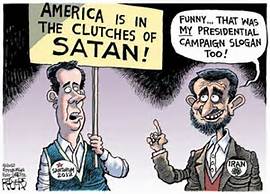
There is a hadith, or saying of the prophet, that goes: “Know that paradise lies under the shade of swords.” Increasingly, this saying makes me think of American party politics as much as an ISIS credo.
I have spent a good part of my professional life studying group conflict that is informed by ethnicity, religion, and ideology. And of all the ugly and murderous strands of conflict the world is subject to those where religion and fundamentalism prevail are the most troubling and recalcitrant. American political discourse, especially inside the conservative wing of the Republican Party, is beginning to sound more like arguing with those who believe they know the mind of God. The unseemly nature of the Republican campaign and the existence of core values that are not subject to adjustment or moderation by democratic discourse, is a communicative expression of these incommensurate conflicts.
There has been no shortage of criticism of the quality and temperament of the leading Republican candidates so I will not elaborate on that except to add my voice to the chorus of those who are dismayed at how vapid Donald Trump is, and how Cruz is a fear-provoking evangelical who believes in using the state to bring about an apocalyptic vision of the end of the world. Rubio is a Roman Catholic but also attends a Southern Baptist Church in Florida probably for pure political expediency. They both have unforgiving religious boundaries and there isn’t much of a difference between them.
For a good and clear summary of evangelicals including their Protestant foundation and politics read an article in Foreign Affairs by Walter Russell Mead.
Turns out that candidates like Cruz and jihadist organizations like ISIS engage in the same rhetoric that is part of the logic of the discourse that characterizes incommensurable realities. (Those competing incommensurate realities are this group of Republican candidates and their liberal opposition). Cruz, who is immovable with respect to walls preventing immigration, the elimination of social safety nets, wiping out the IRS and making taxes unavailable for the public good, and wild and dangerous statements about carpet bombing ISIS, engages in the same rhetorical strategies as the Islamic state does with the West. Here are a few discursive patterns that underscore both groups.
Islam and the West tell different stories and have rival narratives. The language of the stories is constitutive of the meaning and embedded in the psychological, sociological, and political life of each group. Each group is trapped inside a story and there are no points of convergence between them. This is equally true of the Republican candidates exemplified mostly by Cruz. President Obama is not someone to disagree with but must be completely delegitimized; the Supreme Court becoming more liberal is so horrifying that it requires violating the Constitution and stopping the President from making an appointment; our country has been in decline and only the acceptance of Cruz’s God and family values will stay the decline.
Uncontrollable ingroup-outgroup mentalities that distort communication such that contrast effects create a reproducing cycle of perceived differences. Just as the West perceives differences that favor its own group history and culture, so too does the conservative-liberal intergroup mentality maintain a constant sense of differences with positive attributions made to the ingroup and negative attributions made to the outgroup. That’s why “name-calling” is so common and even effective because just labeling someone as a member of an outgroup is sufficiently damaging. There is no place for nuance. Calling someone “right-wing” or “liberal” categorizes them with all the implications.
The political parties (sorry, the Republicans more than the Democrats these days anyway) easily fall victim to the belief that language is dead – as exemplified by the Supreme Court and Scalia’s notion of strict constructionism – and any term or concept has a specifically decided upon meaning whose intent is clear and well understood and cannot be changed. This “dead” notion of language forces a contest between two or more groups for control of the meaning. It directs attention away from trying to find solutions or points of meaningful articulation and more toward self-justification. Meaning, while not completely free, is a living entity that is subject to new insights and discoveries. This mentality has escaped the current campaign as the candidates seem more intent on overwhelming their opponent then actually engaging the public.
ISIS Creates the Difference between the “Rational” and the “Committed.”
 The foundational logic of governing is this: resources, both material and symbolic, are not equally distributed among people. Individuals and groups differ with respect to their personal abilities, education levels, talents, environmental resources, and particular skills. The fact that people in groups are organized around this inequality of resources makes for the “politics of difference.” In other words, politics is fundamentally about managing differences and making it so these differences and the tensions associated with them are under control. It also means that a culturally plural society that demands group-differentiated policies is the norm. Finally, it is a truism that groups seek to maximize their own desired outcomes and it is the communication process that controls these forces. Deliberation, dialogue, bargaining, negotiation, and all sorts of agonistic discourse are part of the political process.
But even though the politics of difference is the norm there are typically forces that are historically more powerful and responsible for driving differences between people and groups. Religion, for example, has become a symbolic resource that separates and marks groups as “different” or an object of distrust. The ISIS revolution is real and a genuine threat. Read Scott Atran on how ISIS is growing and winning its revolution. ISIS is a growing and dynamic counterculture that in two short years has expanded its territory and recruited thousands. It is a radical Sunni revivalism that is beginning to succeed at historic proportions. As a Atran explains, ISIS possesses the largest and most diverse volunteer fighting force since the Second World War.
While the West dithers and considers ISIS’s behavior to be nonrational and horrific it fails, as a Atran explains, to make the distinction between “rational” actors and “committed” actors. Horrific violence is coded into the ISIS religious consciousness so that statements such as “paradise lies under the shade of swords” or there will be “volcanoes of Jihad” become alluring images for the development of a combination of violent and religious consciousness that justifies monstrous behavior with all the power of the “word of God.” What else would prompt a mother to abandon her baby so she could murder innocent people in San Bernardino and then sacrifice her own life. ISIS controls something more than the West controls when it commands behaviors that are infused with significance, when it makes its members feel as though they are part of an authentic consciousness that makes their life worth living. This they are “committed” to. Their behavior is not rational in any practical sense of the term but symbolic of their commitment to this authentic consciousness.
Patriotism, fidelity, obedience, and courage are all abstract psychological conditions that distort the secular motivations of those who are “rational.” These emotions are for ISIS tied to God or Allah and thus held in higher standing. Subjecting them to rationality (e.g. “I will not fight because I might get hurt.” “I must maximize my personal interests.” “My ideals are not worth hurting someone else.”) is ineffective. No, they are subject to commitment. ISIS fighters are committed to obedience and fidelity which makes it easier for them to do anything in the name of obedience and fidelity to God and cause.
Read the Atran article and think more about the “committed.”
“Devoted” Conflict Actors Are Not “Rational” Actors

The participants in intractable conflicts are not “rational” actors; they are, as Scott Atran explains, “devoted” actors. Intractable conflicts are intergroup conflicts and are on the rise. The actors use a logic of identity (I must preference the maintenance of my identity) rather than a logic of consequences (I must maximize my gains) and thus set into motion the construction of ingroup-outgroup distinctions that produce communicative distortions (e.g., false polarization, stereotypes, and attribution errors) and generate misunderstanding and confusion at best, and violence at worst. Identity conflicts and the chauvinism that accompanies them are a major obstacle to peace and a major challenge to a liberal society based on pluralism and respect for differences. The most typical explanation for these ethnic conflicts is Samuel Huntington’s clash of civilizations thesis which is seen as replacing the competition between communism and capitalism with fault lines attributable to ethnoreligious groups. These are intergroup conflicts that require changes in how members of communities interact and perceive one another. Such conflicts are particularly defined by intense ethnic and religious forces and are a recent and virulent form of group conflict.
Divided societies have been studied in an effort to understand their causes and possibilities for resolution. Accordingly, analyses of psychology, economics, politics, and security dilemmas are typical. But a few exceptions notwithstanding , the role of communication has received less attention. There has been a strong tradition of using rational choice theories to explain these conflicts along with social psychologically informed research tradition. Security studies and economic theories represent a second and third strand of research each of which draws on rational choice theoretical assumptions. Rational choice theoretical models assume that group behavior is driven by the consequences of a reward- cost payoff. The utility maximization assumption has been criticized as expecting humans to be cyborg-like maximizers assuming decisions are made in a world of perfect information, when they are not, and failing to understand humans as creative information processors that are subject to more than rational forces. Identity and cultural processes are at the heart of group conflicts and it is essential to explore how culturally constructed identities connect individuals through perceived common experiences. These connections, which are communicative contact links, organize behavior and are responsible for interpreting reality in such a way that conflicts can be mitigated.
Communication is central to understanding and working with these intractable conflicts for four reasons. First, communication is elemental to the conflict; microlevel interactions structure behavior, and actors in intractable conflicts think about the communication process. They strategize, discuss, and manipulate symbols, all in an effort to control others and define themselves. The significant meanings of these conflicts do not reside in individuals but are accomplishments of the participants driven by social and political circumstances. Secondly communication is relevant to both micro and macro levels of society. At the micro-interactional level people argue, persuade, inform, and develop relationships. And then these interactions accumulate into macro structures such as institutions, media systems, and cultural forces that constrain behaviors with respect to racism, sexism, prejudice, and a host of other cultural stereotypes and distortions. These symbolic processes of communication are what bind individuals to political systems. Third, simplistic communication processes cannot resolve intractable conflicts; we know conflicts require interaction. Diplomacy, dialogue, mediation, negotiation and any form of conflict resolution is fundamentally communicative in nature. It is the communication process that reaches across cultural divides and provides the mechanisms by which conflicts are processed. Finally, modern intractable conflicts are ethnopolitical in nature and identity conflicts. They are deeply symbolic and complex with unclear boundaries. Such conflicts require deeper communicative engagement designed to widen the circle of identity and inclusion.
These processes are not naïve or soft, they are the requirements of problem solving.
The Caliphate is a Myth

In a recent issue of Foreign Affairs Nick Danforth likens the caliphate to an abstract concept such as the “dictatorship of the proletariat” that has very little historical basis and is largely made up as different leaders need the concept. Danforth calls the caliphate a fantasy that has been exploited by political and military leaders in order to strengthen their claim to Islamic leadership. Westerners have confused the dream of a unifying religious power, a caliphate, with a cruder military and economic power claiming religious authority.
After Mohammed died in 632 there was no heir to his leadership and the conflict about who should succeed him began. The word caliph means succession and the caliphate is a governing body that manages political and religious affairs of state. You can begin to read more about the caliphate here.
The distinction between Shia and Sunni has its roots in the competition for leadership after Mohammed. Some believe that his son-in-law Ali should serve as leader and he was the rightful heir and they became “Shia.” Those who believe that Mohammed supporters and the people around him were eligible for leadership are the Sunni.
The caliphate is in the tradition of messianic Islam where at some point at the end of times the souls of all Muslims will join Allah. This resurrection is related to the Christian resurrection, but one difference is the restoration of the caliphate. Supposedly, an Islamic state under sharia law will be governed by a Caliph who has authority over all Muslims. The true caliphate will come after unjust kingdoms are destroyed.
But the caliphate has never been much of a governing organization and there are controversies over whether Islamic law is part of the state or not. But the notion of the caliphate has been used to exploit Muslim claims of control of their own rights and the rights of other Muslims. The caliphate is also used as justification for eliminating the borders that Europeans drew between countries and arguing for a transnational Muslim empire.
ISIS is trying to create a pan- Islamic moral order that does not recognize national boundaries. The idea of a caliphate is of course consistent with the Empire mentality of ISIS and their desire to speak with one voice. The presence of a caliphate is threatening to more secular democratic interests and for this reason the notion of a caliphate was outlawed by Ataturk. But Muslim societies are assumed to be fractionated at the moment and not held together by any common authorative source. The idea of a caliphate is pleasing to many and is viewed as a binding and coherent structure that keeps Muslims together. Osama bin Laden was attracted to the idea of a caliphate as one way to redress the humiliations and grievances heaped on Islam.
Finally, Danforth concludes that it would be a mistake to think that the idea of reviving the caliphate is anything but a power move with no basis in clear Islamic principles. The Syrians, Turks, Iraqis, Afghanis etc. are surely bound together by Islam but also represent political and cultural historical differences that would be obliterated by a pan- Islamic power organization called the caliphate. Westerners should not be duped into believing that the caliphate holds Islamic legitimacy; rather, it might slip easily into an unpleasant dominating authoritarian force.
Language and its Power

Language certainly has the power to direct you towards pre-selected portions of reality. It makes it possible for false comparisons and confusion over categories of meaning. For example, there is a common statement that circulates in the public that is not only a facile generality but dangerous. If you actually believe this statement, if you are ensnared by its rhetorical trickery and literally accept the two propositions as being equal, then it reveals you as a less than rigorous thinker who cannot recognize or make important distinctions. If you accept the equivalence of the two propositions you are likely to put yourself and others in danger by being paralyzed with an inability to act and justify definitional clarity that allows for clear decision-making. The dangerous cliché I’m talking about is:
One man’s terrorist is another man’s freedom fighter.
If you believe this then Osama bin Laden and Al Qaeda are the same as what might be considered a defensible national liberation movement. The semantic foundation of the cliché implies that nothing matters except perspective. It’s a cliché championed by terrorists because they want to present their own causes as positive and justified. And the logical extension of this thinking is that no violent act can be too odious because it is all in the service of national liberation. Terrorists love this phrase because it blurs the distinction between goals and the means to achieve the goals, when in fact no political movement can serve as a justification for terrorism.
This issue has emerged again given the events in Paris. And interestingly, ISIS is so extreme there has been very little political justification for their violence.
This cliché cannot stand and we need more political leaders and public intellectuals to condemn it. There needs to be public discussion and argument. Freedom fighters who are truly struggling against oppression do not kill innocent people and sow panic and confusion – murderers do. Why would the democracies and liberal political regimes around the world allow the word “freedom” to be used in this way? ISIS does not bring freedom they carry fear and oppression. The best reading on this is by Boaz Ganor and can be found here. It is crucial to make the distinction between terrorism and national liberation.
Let’s try to be a little clearer about terrorism. As Ganor describes, terror is (1) violent. Peaceful protests and demonstrations are not terrorism. Terrorism is (2) political. Violence without politics is simply criminal behavior. And (3) terrorism is against civilians with the goal of creating fear and confusion. It mixes with the media to produce anxiety. So what is not terrorism? Terrorism is not accidental collateral damage when the original target is military. Using citizens as shields places the onus of responsibility on those manipulating the citizenry, not those who initiated the attack if it was against a military target. It is also important to recognize those situations where targets of violence are clearly military and uniformed soldiers. Using guerrilla tactics does not necessarily mean terrorism.
It is important, too, that motives be taken into consideration. The real thorny problem is the idea that any form of national liberation – believed sincerely by a presumably oppressed group – justifies violence that is not considered terrorism. This perpetuates the dangerous relativism of the cliché. The hard mental work of distinguishing terrorism from other forms of violence is important if we are going to pass legislation to protect the public, have effective international cooperation, and assist those states struggling with terrorism.
If enough people genuinely accept this relativist cliché then all bets are off. Any sort of violence can be justified and the international community will have a collective shrug of its shoulders essentially saying, “who cares” because someone considers the violent group “freedom fighters” wrapped in vacuous rhetoric designed to justify violence. As difficult as it is to fashion a precise definition of terrorism, it is equally as difficult to imagine accepting ISIS and jihadist attacks against the French as the work of “freedom fighters.”
Note: This post was first published December 23, 2013
ISIS Burns Paris and Commits Genocide Against the Yazidis?
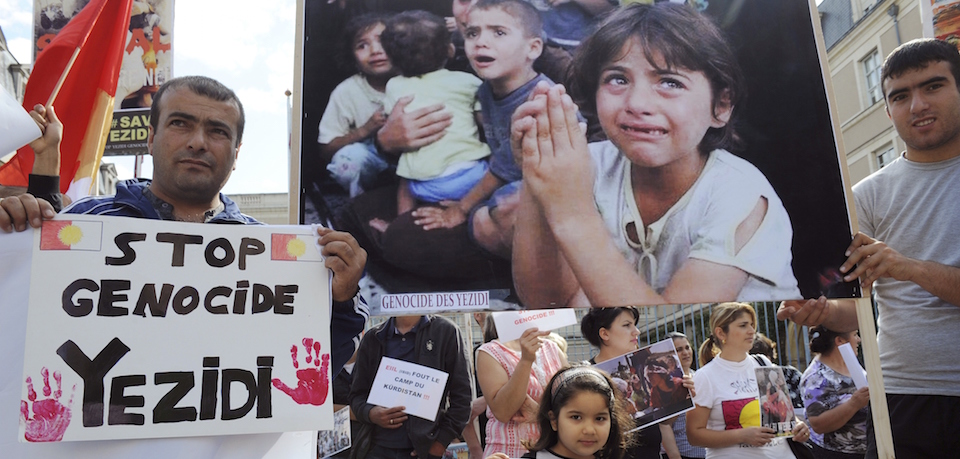
A man holds a placard reading “Yazidi children want to live” and sporting the Yazidi flag next to others holding placards during a demonstration mainly by Yazidi refugees in support of their community in Iraq, on August 20, 2014 in Angers, western France. Yazidi refugees living in France’s Maine-et-Loire department, whom arrived in the region in the last 10 years, demonstrated along with Kurdish speakers on August 20 in Angers in support of Yazidis persecuted in Iraq by the Islamic State (IS). AFP PHOTO / JEAN-FRANCOIS MONIER (Photo credit should read JEAN-FRANCOIS MONIER/AFP/Getty Images)
How long do you stand on the sidelines? How long do you wait? France has declared war finally and the US still isn’t doing enough against ISIS. The Kurds are brave and powerful allies who are the tip of the sword in the fight against ISIS. They need more support and our relationship with Turkey be damned.
The US Holocaust Museum has called the Islamic state’s treatment of the Yazidis genocide. It is unfortunate that terms such as “genocide” get tossed about too often and therefore drained of their power. When people claim genocide for rhetorical purposes only the term becomes weakened and then, like the little boy who cried wolf too often, no one believes him when the wolf is actually at the door. And as much as we want to avoid foreign entanglements and stay out of the business of others, how long do you stand on the sidelines watching one group of people being destroyed by another. I’m careful about Holocaust comparisons and invoking the Nazis as the epitome of evil because it also drains the reality of its power. Moreover, anti-Semitism and the Jewish Holocaust are particularistic enough such that comparisons fail.
But below is the United Nations definition of genocide and it is pretty clear. Every one of the five conditions certainly applies to the Jewish Holocaust and the first three are quite descriptive of the Islamic state’s treatment of the Yazidis.
General Assembly Resolution 260A (III) Article 2. In the present Convention, genocide means any of the following acts committed with intent to destroy, in whole or in part, a national, ethnical, racial or religious group, calculated to bring about its physical destruction in whole or in part.
(a) Killing members of the group;
(b) Causing serious bodily or mental harm to members of the group;
(c) Deliberately inflicting on the group conditions of life;
(d) Imposing measures intended to prevent births within the group;
(e) Forcibly transferring children of the group to another group
But still, there are similarities and it’s important to find consistencies and defensible comparisons of genocide in one case so that we can recognize it in another.
Who are the Yazidis?
I’ll let the reader go to Wikipedia or some convenient Internet site for additional information on the Yazidis. But quickly, the Yazidis are a monotheistic religious community that lives in Iraq. They have been discriminated against religiously for centuries because their chief God is equated with a fallen angel in other religions and therefore Satan. In 2014 they were specifically targeted by ISIS in an effort to purify Iraq of non-Islamic influences. This unleashed a wave of rape and murder and calls for the destruction of the Yazidis by ISIS. Reports of Yazidis fleeing the town of Sinjar where they were being killed by ISIS forces in a genocidal manner are common enough. Young Yazidis women who had been raped by ISIS fighters were committing suicide.
The ISIS digital magazine Dabiq has claimed that slavery and the absorption of Yazidis women and children has religious justification. The US Holocaust Museum has identified the attacks on the Yazidis as genocide. This is based on evidence gathered by the Deputy Director of the museum during a visit to Yazidis camps.
There is clear evidence that the Islamic state has committed genocidal war crimes against the Yazidis as well as other religious offshoots. Every person interviewed claimed the violence against the Yazidis was systematic and more vicious than they had ever seen. Secretary Kerry should formally accuse ISIS of committing genocide and begin an international investigation.
Once again we are confronted with an extremist ethnopolitical group whose hate is of hallucinogenic proportions. Whether it be Jews, French citizens in a restaurant or at a concert, or Yazidis the question remains: how long do you wait before you do something?
ISIS is Weak and Under Performing

Famished and queuing despondently as far as the eye can see, these images will have the Islamic State’s slick propaganda unit spitting feathers.
In scenes more familiar in the most impoverished refugee camps, scores of downtrodden Syrians wait in line for hours for food in the terror group’s self-declared capital Raqqa.
It’s a far cry from the all-conquering image of prosperity its jihadi PR machine would like the world to believe.
The pictures were posted on Twitter by a member of the anti-ISIS campaign group Raqqa is Being Slaughtered Silently who risk their lives every day by documenting atrocities from inside the city.
ISIS looks like a nightmare from the past. Its tactics are brutal, it’s religiously extreme and it is certainly dangerous. By way of their own words, they want to eliminate infidels, impose strict religious law, and establish the “caliphate.” Many feel already psychologically defeated by ISIS; there is a sense that ISIS’s growth in the future is inevitable and that their sophisticated propaganda will succeed in helping them build the foundation of a genuine state and territory it controls.
But as Stephen Walt has pointed out in Foreign Affairs ISIS is not the first extremist group to pose a threat. Similar movements have been associated with France, Russia, the Chinese, Cuba, as well as Iranian revolutionaries. They were all ruthless and sought to demonstrate their power and determination to everyone else. The good news is that these historically violent and revolutionary groups were all contained and their threats, while in some cases still viable, have all been diminished.
Thomas Lynch III, in a recent report that I highly recommend from the Wilson Center, is quite critical of ISIS and argues that they have underperformed in South Asia and failed their constituents in many ways. They pose no serious threat to Al Qaeda in the global Salafi jihadist project. Lynch compares them to the mythological Icarus by writing that ISIS has flown too close to the sun and engaged in brash and risky strategies that will consume it.
Walt explains that outside efforts to destroy revolutionary movements usually backfire because they harden positions and give these movements more possibilities for expansion by enlisting others in the fight against an outsider. A strong US presence with the stated goal of destroying ISIS would likely aggravate the hostility to the West and encourage ISIS’s claim that infidels and outsiders want to encroach upon their land and culture. The US would be better off “leading from behind” which means to stay in the background and provide quiet support. ISIS controls very small amounts of land and has very few military resources to enforce its doctrines. The Soviet Union could impose communism because of its powerful military establishment. ISIS has relatively few troops and no real military power. Moreover, Lynch poses problems for ISIS and their decision to declare an Islamic State. I elaborate a little on these below. All of these are serious weaknesses or mistakes for ISIS any one of which could potentially lead to their downfall.
- The decision by ISIS to declare an Islamic state has encouraged an international coalition of jihadists to oppose it. The declaration of a Caliphate did not resonate with established groups who differ on how they believe the Caliphate should come into being and when the time is right. ISIS will receive no support from various Islamic groups for its proposed Islamic state.
- The declaration of the Islamic state is a significant break and a challenge to Al Qaeda’s that only it will make such determinations. ISIS, for example, believes in violence against local opposition groups where the Al Qaeda believes that infidels (that would be Americans and Westerners) must be eliminated as a first priority. ISIS believes in unbridled violence where Al Qaeda is more willing to temper violence – difficult as that is to imagine.
- Lynch explains that Al Qaeda supports the slow evolution of Islamic Emirates that one day will merge into a caliphate. This strategy is too slow for ISIS who have declared a caliph now (al-Baghdadi). This has again caused a break in Salafist ideology.
The establishment of a caliphate is unlikely to generate much emotional intensity. It has caused divides among the various groups and will weaken everyone’s credibility. ISIS’s methods might scare Americans and attract some fanatics but it is not popular with many Muslims. And it must compete successfully with many Middle East identities that are national, sectarian, religious, and tribal. There’s a good chance both Al Qaeda and ISIS will implode. This means containment is the most sensible avenue at the moment. Let the United States remain cool for now and treat the main actors as an annoyance that we must keep our eye on, and our pistols cocked, but we will still bide our time.
Essentialism: Gender and Islam


 Look at the top picture first and notice the little boy in the wheelchair. He is clearly defined as “different” from the other children and is both spatially and psychologically defined by the chair. He is separate from the class and the chair fundamentally defines him. Now look at the bottom picture. The same little boy is on the right in the stripped sweater. The chair does not define his essence.
The basic tenet of psychological essentialism is the idea that humans have a core belief that unobservable essences are causally responsible for the surface features (behaviors) we observe. As such, the world is divided up into essences from which behaviors can be inferred. It’s the belief in an underlying reality or a true nature that cannot be observed.
At its ugliest, essentialism applied to ethnic groups is a form of racism because we assume that all members of a particular group share an unchangeable core reality with respect to physical or intellectual proclivities. It’s a pretty aggressive verbal attack to accuse someone of essentialism – especially in academia. Note what happened to Larry Summers, then President of Harvard, when he suggested that the scarcity of women in science and engineering might be because of gender differences in intrinsic aptitude. There was an outcry of protest and he no longer holds his coveted position. Moreover, if you believe someone’s behavior is governed by an essentialist property then other avenues of inquiry or explanation are eliminated. Why care about other explanations–social, economic, familial, political, educational–when this unseen essentialist quality explains everything.
Psychological essentialism can function as a “placeholder” in that one can believe that a given category possesses an essence without knowing what the essence is. Seen this way essentialism is a reasoning heuristic. But the reasoning is bad reasoning. The essentialist quality is mysterious and unknown and usually evolved as a result of inductive experiences that lead to mostly unjustified generalities.
One of the most common responses to essentialists is to pose a cultural explanation. But that has become problematic because it trades one orthodoxy for another. The essentialization of culture is no different than the essentialization of women or any other category. Women, for example, have been overgeneralized to the private sphere; that is, their domestic duties have been justified by essentialist explanations. They are assumed to be homogeneous. This has sanctioned the economic and sexual exploitation of women along with a host of distorted opinions, discriminatory practices, all known to be old-fashioned sexism.
In response feminist groups have demanded respect for the diversification of women and recognition of cultural differences resulting in categories such as “African Women,” “Muslim Women,” “Western Women,” “Third World Women,” and the like. These new cultural categories represent a homogeneous collection of heterogeneous people.
There is a conundrum in the feminist literature that depends on belief in women sharing certain properties but also seeks diversity and recognition for individuality. The feminists’ widespread rejection of essentialism has threatened to undermine feminist politics.
How legitimate is it to affix the modifier “Islamic” to some noun. Is there such a thing as “Islamic terrorism?” What essence are we drawing on when we refer to “Islamic art,” “Islamic politics,” “Islamic philosophy,” and “Islamic culture?” Do Islam, or Christianity, or Judaism, have an essence? Irfan Khawaja in his article on essentialism and Edward Said’s Orientalism, asked the question “how can one possibly talk about a single essence of Islam when what we see is irreducible variety?” Said goes about the business of claiming an essence for Orientalism while at the same time philosophically challenging essentialism.
In the end, essentialism is truly a psychological phenomenon in that we believe in essences because they are composed of a logic attributable to the “psyche.” The human belief in essences that represent terminal explanations becomes so reductionist that they are soon reduced to nothing.
The Concept of Peace in Islam

In the West peace means predominantly the absence of war. Peace is the result of institutional agreements or the regulation of behavior and mutual negotiations about what is considered threatening or unacceptable to each side. Solving conflicts is a rational problem-solving activity and reason is primary. It is possible to settle Islamic conflicts and make peace, but it must be done within the conceptual context of the Koran. And in many ways this is not so different from other religions.
In the Muslim tradition peace is associated with human development and justice, but justice that is rooted in the Koran more than secular reason. Peace implies the maintenance of human dignity and a sense of balance and coherence in society. Peace in Islam is associated with God and considered to be one of the names for God. There are roughly 5 approaches to peace.
Power: In Islam sometimes it is necessary to simply assert political power and use secular tools to manage disorder; disorder and chaos are considered threats to Islam and must be dealt with. This approach emphasizes political necessities because the population or some aspect of the community is threatening the good order of Islam.
Peace Based on Koranic Law: Peace is a condition of the Koran and violations of rules are inconsistent with peace. The values of the Koran must be in place or the community is characterized as unstable and disorderly. A situation in which these values are not present may be characterized as disorderly, unstable and un-Islamic. Sometimes this approach can be abused because of the easy or casual assertion that Islamic law is being violated and thus harsh consequences are justified.
Peace Through the Power of Communication: There is a tradition of mediation and arbitration (these are fundamentally communicative in nature) in Islam. The concept of balance remains important here. This is the notion of peace which is consistent with the West and some secular approaches. It recognizes that balance in society is not only maintained by religious precept but by restorative justice. Consequently, those who have experienced loss can be compensated or when one family is disadvantaged by another balance is restored through repayment or restoration of some type.
Peace Through Power: Islam also calls for nonviolence and the maintenance of security even when these things must be maintained through traditional power. Again, the approach is rooted in a concept of coherence and balance where peace is maintained by responding to the other’s needs. Secure and authentic peace must be rooted in human dignity.
Peace Through the Regard for the Other: The love of God in the precepts of Islam make for a broad and encompassing harmony. Again, this is a place where the religious and the secular can meet because one is expressed by the other. Each person is able to turn inward and find the value in the other through Islam. There is room here for change and transformation including the possibility of redemption.
Islam recognizes that humans are social and must live together. Thus, there has developed a line of thinking from religious documents to the daily organization of society. This is essentially the relationship between Islam and the state. There is much in Islam that puts the community’s interest first. But most important of all is the consistency between religious principles and the political system which always provides an avenue of redress. The community always has its mundane and routine needs but these are rooted in tradition, respect, and consistency with Islamic law. Islam is a classically collectivist culture where individuals are less important than the collectivity. Individuals are punished or judged to the extent that they disturb the good order of the community. The individual counts little by himself – a concept quite different in the West. It is the clan or society that has the right to protect itself by punishing a recalcitrant individual. Someone’s guilt or innocence is couched in the context of threatening or sustaining the community. And there must be an authority (textual or human) responsible for maintaining community order. This is regarded as absolutely necessary since society without authority is impossible.



 Peace and Conflict Politics