Category Archives: Israel
What It Means for the State of Israel to Be “Jewish”
In a couple of posts I’m going to explore the issue of an official “Jewish” definition of Israel. I’m going to explore the issues and expose the difficulties and suffer the different philosophical consequences including the conundrums, logical impossibilities, and damning inevitabilities. Then I’m going to conclude that Israel should be Jewish, that the entire history of the country and the Zionist project makes little sense if Israel is not “Jewish.” You will see, of course, that according to some I’m recommending “Jewish lite” and that will be enough to disqualify my conclusions. But ultimately there’s only one way to meet that goal of Israel being both Jewish and operational and that’s for the Judaism to inform the state but not control it.
This question of Israel’s Judaism is really no small matter because it determines whether or not the state serves Judaism or Judaism serves the state. In other words, if the state is Jewish first and democratic second then the democracy has to be flexible enough to fit the Jewish nature of the state. Strongly religious Jews who want Israel to be a Jewish state begin with Judaism and shape all other forms of government to fit the needs of the Jewish community. Places like the United States begin with democracy and shape the society to fit the democracy. This is known as a liberal democracy and in the more pure sense is impossible in Israel if the state is “Jewish.” I would recommend a reading from the Jerusalem Center for Public affairs available here.
If Israel is devoted to Jewish particularity than it begs the question about what that particularity is and whether or not it is sustainable. A society that is truly communal in the sense that everyone holds a religious or ethnic identity is a society that is truly actualized and expressed by the state. The “state” is truly a full expression of the people and not simply a compromise or the sum of the parts. Even at the risk of some exaggeration the state becomes the full expression of the nature of the people. Now, we’ve seen all this before and it certainly wasn’t pretty (think Fascism or the Soviet Socialist Republic). But it is not inevitable that the state will gravitate toward authoritarianism and oppression – even though constant monitoring is required. But Israel will have trouble if it has a strong sense of Jewish identity wrapped up in the state because the community is not cohesive. An officially Jewish Israel will be oppressive for non-Jewish groups such as the Arabs. Again, this is a situation that simply cannot stand. Israel must find a way to be Jewish but acceptably tolerant of the groups within its confines that are not Jewish. It is easy to describe the state as fundamentally expressing a culture when everyone in the culture is the same or holds the same political or religious values. But government is about managing differences and this is going to be true even of Jewish government.
So this is the primary tension. The tension is between Israel as a modern state and Israel as a continuation of Judaism. In what sense is Israel uniquely Jewish? Well, we could begin with the question of the Jewish people living independently in their own country. How important is it that Jews have a sense of completeness and does this depend on living in certain territory? An Orthodox Jew, although not all strands of orthodoxy, will tell you that the task of completing the Jewish people is dictated by God and an in-tact political system is a means to that end. In fact, the reconstitution of the state of Israel in the biblical and religious sense is a sign of the coming of the Messiah. In the Bible a collection of people make up the nation and they are permanent entity. In this image Israel would become a Torah state that might be an honorable expression of the will of Jews, but it would also be discriminatory not only against non-Jewish groups but include gender and the various intellectual discriminations. To be sure, Israel could create a state of the Jewish people and such a state would struggle in contemporary terms.
We are still confronted with the question of how modern Israel fits into the long tradition of Jewish civilization. And if we decide that Israel is Jewish first then there is the daunting question not of Judaism – which will make adjustments slowly to the modern world – but how Jewish Israel fits into the contemporary culture of justice and fairness for all. More later.
Recognition Is at the Core
We will know that real progress is being made on the Israeli-Palestinian conflict when the Arab world explicitly states that it “recognizes” Israel. This concept of state recognition is at the core of the difficulty between these two sides, and I have the feeling that Arab countries choke on the word “recognition” so badly that they just can’t cough it up. In fact, it makes even little sense to negotiate and work to solve problems without such recognition. But it is the official recognition that holds the symbolic value and is more important than the practical outcomes of negotiation.
In a speech at Bar Ilan University Prime Minister of Israel Netanyahu pointed to the refusal to recognize Israel as a Jewish state and the home of the Jewish people as at the core of the Middle East conflict. It really is an excellent speech and I highly recommend it. Some countries recognize Israel from a purely political perspective but not as a Jewish state. There is, of course, a storm of anti-Semitism that accompanies this lack of recognition but my concern here is with more official explanations; that is, with the sources and documents typically used to prop up the objections to recognition. First, let’s take a quick look at what is meant by recognition in international law. These criteria are quite straightforward and easily applicable to Israel:
1. A permanent population that exist together and compose the people of the nation.
2. Territory or a parcel of land that the permanent population lives on. This land must be defined by boundaries and territories.
3. A government or a functioning political system that constitutes the law of the land.
4. The capacity to enter into relations with other states.
These are the criteria for recognition by international law but some states get around these criteria and maintain nonrecognition by the Stimson doctrine which is to withdraw recognition to any new entity that comes into being as a result of illegal actions or force. And of course some Arab states claim this applies directly to Israel because they came into being illegally through the United Nations and as a result of war. On one hand the United Nations is the epitome of official recognition, but many in the Arab world consider the United Nations to be in a position to sanction anything. The definition of illegal actions can be ambiguous. The United Nations resolution 242 was used in the aftermath of the six day war in 1967 and it was agreed to by Israel, Lebanon, Jordan, and Egypt. Israel agreed that it should promote a lasting peace and a peaceful resolution. But the details of this resolution remain murky and there is still confusion over language.
Recognition is a difficult process especially deep and symbolic recognition which is the most important type of recognition. Simple recognition of the state, which means such a state is suitable for routine contact and trade, is easy enough. But recognizing the deeper aspects of a political culture and its legitimate ties to land in history is another matter that requires greater respect and understanding. And, of course, the more the surrounding nations recognize Israel as a Jewish state with a legitimate claim to the land the more they drain their own claims of exclusivity. For example, many in the Muslim world hold the following:
1. Judaism was superseded by Christianity and later by Islam.
2. Jews are not a nation but a religion.
3. Recognition of Israel as a “Jewish state” would question Islam’s claim to be a superior revealed authority.
4. The land the Jews are inhabiting is part of Islamic holy land and can never be associated with another group.
It will be a long time before a collection of Arab leaders stands up and states to the world that it “recognizes Israel as a Jewish state.” This failure of recognition includes a rejection of Jewish prayer, history as well as cultural artifacts. This is dangerous and potentially the “stuff” of anti-Semitism.
This Is What Happens When You Run Computer Simulations to Solve the Israeli-Palestinian conflict
Apparently, monster computers deep in the bowels of universities are cooking up bizarre political solutions that have grotesque shapes and unlikely survival rates. Last week in the New York Times Ian Lustick of The University of Pennsylvania wrote an opinion piece arguing that the two-state solution for the Israeli-Palestinian conflict is dead and based on false assumptions. You can read the article here. The essence of Lustick’s arguments are that Palestine is more likely to be Islamist and unreceptive to the two-state solution, as well as the end of Israel’s Zionist project, demographic threats, and cultural exhaustion. Lustick goes on to explain that the two-state solution has become a slogan kept alive only by the “peace process” industry.
Ian Lustick is a highly capable well-respected political scientist who is interested in state expansion and contraction. He has written cogently about Israel for decades and offers examples of sudden changes in nations and states that result from crossing certain thresholds of acceptability. He cites the sudden rise of revolts in Ireland leading to the establishment of an independent Ireland, the powerful French influence in Algeria which seemed to matter little as Algeria became independent and the Europeans disappeared, and the supposed stability of the Soviet Union that finally broke up and morphed into other arrangements. Ian Lustick is always worth reading.
But Professor Lustick often uses computer simulations to model political polities and institutions that lead to conclusions about what forces in society might expand or contract, or overwhelm other forces in society. These models include measurement of the forces that produce change in one institution caused by another. You can see an explanation of these computer simulations here. One can recognize the language of these simulations in the Lustick article when he says things like “when those thresholds are crossed, the impossible suddenly becomes probable, with revolutionary implications for governments and nations.” These models operate by establishing thresholds that resist change but are often “crossed” and result in new and sometimes creative combinations of unity. If the theory and the simulation are sound the model can generate predictions about shifts in power, new alliances between organizational entities, and the effects of such processes as argument and deliberation.
I fear that Professor Lustick’s computers have now taken on a “Hal” persona and begun saying things that make little sense. The new predicted alliance structures are certainly creative and could only have sprung forth from the mind of an iterating computer model, but that does not make them any less silly. Here are some alliances and new environments stated by Lustick – and predicted as possibilities by his computer, and described as potentially peaceful and secure environments. I quote from the New York Times article.
“Palestinians in Israel and the West Bank could ally with Tel Aviv’s post-Zionists, non-Jewish Russian speaking immigrants, foreign workers and global Village Israeli entrepreneurs.”
“Ultra-Orthodox Jews might find common cause with Muslim traditionalists.”
“Israel’s families that came from Arab countries might find new reasons to think of themselves not as “Eastern,” but as Arab.”
“Israeli Jews committed above all to settling throughout the greater land of Israel may find arrangements based on a confederation, or original formula that is more attractive than narrow Israeli nationalism.”
Predictions of new alliances such as these could only come from a machine modeling theoretical processes – a machine incapable of deep political and cultural understanding. Secular Tel Aviv citizens are going to form an alliance with foreign workers and non-Jewish Russians? How exactly does that work and what do these groups have in common other than secularism. Ultra-Orthodox Jews and Muslim traditionalists make common cause just because both sides are sealed in their respective religious traditions! Are there any computer models that input the history, politics, and differences between these religions and see whether such amalgamations amount to anything? I think these two groups are more likely to escalate competition and violence than form alliances. Israel’s “Eastern population” should ally with Arabs? Professor Lustick is actually suggesting that Israeli citizens develop an Arab identity rather than an Israeli or Jewish one? Difficult to imagine.
The two-state solution has plenty of life in it and is truly the best answer even though Lustick is correct that it is becoming more difficult to grasp even after all this time. Two states for two peoples is the most humane and politically democratic solution. It is a consequence of the belief that the Palestinian people constitute a collective existence deserving of political and cultural expression.
Roger Waters of Pink Floyd: Seeker of Social Justice or Just Another Prick in the Wall

The musician Roger Waters of the rock group Pink Floyd floated a balloon that was a giant pig with a Star of David on it at a recent concert in Belgium. The image is above. You can also watch the concert video. The offending object hovered over the crowd festooned with symbols of various authoritarian governments. Waters is a known Israel hater who has tried to encourage other performers to boycott Israel and has openly espoused the flimsy old Apartheid charge. But his clownish and offensive behavior does not stop here. Waters performed holding a machine gun replica and wore black clothes with an armband reminiscent of Nazi uniforms.
Of course, the most well-known song of Rogers Waters and the rock group Pink Floyd is “Brick in the Wall.” It’s actually an excellent song and the primary refrain “you’re just another brick in the wall” has acquired cultural capital with respect to life as a machine-like authoritarian structure where individuality is blotted out. It is a metaphor for an interesting piece of social commentary. But Waters should stick to music because when he moves into serious political analysis he falters. Still, who is this guy and what should we think of him?
Waters hides behind the freedom of expression defense, which is his right, but does he make legitimate criticisms of Israel or is he just a rank anti-Semite? Rabbi Abraham Cooper of the Simon Wiesenthal Center says Waters is dangerous and an “open hater of Jews.” You can read about Waters and his exchange with the good Rabbi here. Moreover, as blatant and crude as Waters is he holds himself to be a defender of peace and a seeker of justice. When the Rabbi points to his anti-Semitism about all waters can respond with is the old tired cliché about how “some of his best friends are Jewish.” This response would be laughable if it were not so sad.
Waters defends himself by claiming that many religious symbols were used in the show and he is trying to redefine the symbolism of the pig. It, according to Rogers, represents evil and the ill will of a misguided government. In his show Rogers tells the audience that he is going to give the symbol to them as a gift and they should destroy it. The audience then orgiasticly consumes the evil. He then goes into a fierce criticism of Israel referring to it by every anti-Semitic term he can muster.
Clearly, Waters has a right to this performance and although he is mostly just passionate – not to mention pretty uninformed – it turns out that Waters is one of those undereducated disorderly minds who just blurts out opinions without much nuance. In one of Waters’ defense of himself he accuses Rabbi Cooper of being “inflammatory and unhelpful.” For Waters to claim that anybody is inflammatory, as if it were some defect he is not guilty of, belies the imagination. He is certainly guilty of unjustified moral equivalencies. Calling terrorists groups “freedom fighters” or justified political responses, or comparing Israel to South Africa or any number of violent authoritarian groups, is based on false equivalencies that ignore political, cultural, and historical explanations and accounts.
Waters defends himself by saying he uses crucifixes, crescents and stars, hammers and cycles, the Shell Oil logo, the dollar sign, and McDonald’s sign in his shows. I rest my case. This is a mushy and haphazard conglomeration of corporate images and symbols that are supposed to represent oppression and regimentation. It is fine as red meat for the masses but what am I supposed to do with comparisons between the dollar sign and the hammer and sickle. Or, how are Islam and Christianity linked arm in arm in their stance against whatever Waters is resisting?
Israel is not a functioning theocracy nor is it even close to an Apartheid state. The Star of David on a pig is highly offensive and inflammatory and counterproductive for anything other than blatant attack on the other. It is consistent with the modern trends in anti-Semitism which is to single out Israel and ignore other considerations.
Waters turns out to be just another “prick in the wall.”
Best of Luck to the Kerry Talks between Israelis and Palestinians: But There Is Not yet Enough Pain
The fact that Secretary of State John Kerry has organized talks between the Israelis and Palestinians is noteworthy for two reasons – it’s a positive anytime you can bring these two sides together, and the world has issued a collective shrug. Israelis are generally bored with the Palestinians and don’t believe there is anyone really to talk to. The cynicism over the possibility of anything actually coming of these talks is extensive. Few people are even paying attention because they are so sure that this will all be an empty exercise. Even President Obama seems distant from the process.
But we should avoid cynicism and I am all for any sort of engagement and it can be anytime, anyplace, and even under less than ideal conditions. There are numerous posts on this blog at various points in time explaining the advantages of communicative contact (e.g. see July 8th 2013). There are good reasons to have talks all of which are pertinent to unpacking this complex conflict and repackaging it into something sustainable. Let’s look at a few of them, but first a little context.
The Unique Nature of the Talks
The Kerry Talks are supposed to focus on final status issues; that is, the crucial six issues which are the status of Jerusalem, refugees, borders, Israeli security, settlements, and the Palestinian right of return. These issues have been ignored in the past and sometimes defined as too difficult and hence put off for a future date. Read some background on final status issues here . Barak and Arafat made some attempts at a final status agreement as did Olmert at Annapolis. These efforts failed and the explanation always was that the two sides were still too far apart. But it is also the case that both sides simply cannot imagine themselves settling on the decision. Conservative political blocs in Israel oppose the creation of a Palestinian state, and Palestinian leadership is a proxy for the larger Arab world and feels very uncomfortable giving up anything or recognizing Israel.
The divisions that separate these two groups run deep especially when it comes to the special status of Jerusalem and refugees. Jerusalem just may be the most intractable problem because of its sanctity. The Palestinians, on the other hand, choke on the possibility of any recognition of Israel and will not accept their presence as a Jewish state. Gritty and thorny as these issues are talk is all the two sides have and there are reasons to engage it.
The Palestinians have been frustrated and thus decided to go around the Israelis through, for example, their petition to the United Nations as a basis for claiming statehood. Any final agreements must be and should be the result of negotiation between the two principal sides, and the Palestinian petition to the United Nations was counterproductive and responsible for the deterioration of the process. Israel and the United States opposed the Palestinian petition to the United Nations and threatened financial pressures. The proposed talks can help repair the damage to the relationship between the three parties (the US, Israel, and the Palestinians) and move the center of discussion back to the principals.
Secondly, the United States does not have the luxury of waiting around. Even though the conflict has been with us for decades and seems to be a constant on the political playing field, one in which the issues are fixed in people’s minds and will not change much, it remains a powerful symbol of difficult ethnopolitical conflict and the “clash of civilizations.” Moreover, the US has practical “on the ground” concerns with respect to terrorism, balanced international relations, oil, democracy development, and national security. Although the claim that the Israeli-Palestinian conflict is the cause of so much international tension is simply unjustified, it is a combustible political symbol that arouses ethnopolitical passions around the world.
The settlement issue must be solved. Israel will have difficulty moving settlers and the Palestinians have stated that they want no Israeli presence in the future state of Palestine. A Palestinian state must be negotiated by the two sides and cannot come into being otherwise. The two-state solution is the only way that Israel remains Jewish and democratic and there is considerable work to be completed before the contours of this potential state are fashioned.
Finally, talking to one another is the only way that compromises and adjustments will be made. Both sides have powerful positions that control aspects of the discussion and direct communicative encounters are the only way these compromises and adjustments will come into being.
My guess is that these talks will fail but at least represent a step in a long journey. It’s possible that both sides believe the other will be the cause of the failure and have agreed to enter into the discussions for that reason alone. Sadly enough, I’m still of the opinion that there is insufficient pain. In other words, if conflicting parties have to wait until they are at a “hurting stalemate” before they get serious than these two parties simply aren’t hurting enough yet.
Hold onto your hat! Israeli-Palestinian Violence Is Coming
Ethan Bronner of the New York Times last week wrote about the disconnect between Israelis and the general problem they face with the Palestinians. Bronner, who was a former Jerusalem bureau chief for the New York Times, had recently returned to Israel and found Israelis to be almost intoxicatingly removed from the Israeli-Palestinian conflict. They could “care less” about it and are more removed from the political situation than ever. Israel is a very successful economic culture and, various social inequities notwithstanding, they are enjoying the fruits of Western democracies and market economies. Bronner writes that even the Israeli left is increasingly insignificant, and a shell of its former activist self.
I must say that this is generally consistent with my own experiences. I was teaching in Israel last year at this time and quite struck by how “bored” the average Israeli is with the entire matter. They don’t believe there is anyone to talk to or that the Palestinians are serious. I spoke to plenty of students, wait staff, bartenders, and average citizens and the majority is fed up and has simply decided to ignore the whole thing. Cynicism about the peace process is so great that nobody cares to talk about it. Israelis don’t understand the extent of their international condemnation; Israelis don’t understand how anyone could offer up political and moral support for organizations like Hamas and Hezbollah; Israelis don’t understand why the world can’t learn from the lesson in Gaza that giving the Palestinians in Gaza what they wanted (an Israeli pullout) resulted in more rockets fired into Israel.
The Palestinian Authority is in bad shape and things will get even worse with the resignation of Salam Fayyad who was focusing on economic and institutional security in the West Bank. Things are quiet at the moment with John Kerry’s diplomatic efforts deserving of some credit. Even though the Palestinian Authority continues to receive criticism, it’s unlikely for now that the system will be pushed to its limits. The Palestinians are just as tired as the Israelis but for different reasons. They are fed up with their own political leaders and divided amongst themselves with respect to how to proceed. The issues of checkpoints, settlements, prisoners, and financial matters are weakening with respect to their individual issue capabilities. In other words, these matters do not hold the intensity they once did because the population has spent the political capital associated with them and the peace process is still elusive.
The International Crisis Group (go here) issued a report on May 29, 2013 concluding that the Palestinian Authority is in financial trouble and cannot pay salaries. And although they have been recently lulled into a sleep-like state with respect to larger peace issues with Israel, things are beginning to change. The Palestinian Authority, according to the crisis group, is under threat of dissolution. It is simply likely to evolve away into a different reality as Abbas ages. Abbas has a certain amount of historical legitimacy and is committed to a negotiated settlement. But with the Palestinian Authority so fragile, and enough time has gone by such that patience is running thin, any political act (settler violence, clashes in Jerusalem, hunger striking prisoners, or some act of violence) will spark the combustible mixture into a conflagration.
It does not matter how complacent Israelis feel or how content they are about their own good faith efforts, the current situation is not sustainable for very much longer. There remains economic fragility, violence, humiliation, and perceived injustices that cannot stand a much longer test of time. Images of the Titanic come to mind with some killer iceberg waiting in the not-too-distant dark.
Settlements are Clearly Illegal – Say Some
Those who argue that Israeli settlements are illegal cling to their position with considerable passion. They maintain that settlers are living in a fictional world with a tremendous commitment to Israel but not to human rights or anyone else. The arguments are typically made on the basis of international law – which is a questionable and still unclear legal domain with respect to matters of legitimacy and efficacy. But in any case, the challenge to the Geneva Accords is directly confronted. The Geneva Accords, the argument goes, is concerned with people, not land, and claiming that the Accords do not apply to the West Bank because it is not strictly the territory of a sovereign state is inconsistent with the spirit of the convention. The Accords are further interpreted as protecting any group of people who find themselves in the clutches of an occupying power. This argument than devolves into discussion of the minutia of the Geneva Accords including interpretations and intentions that are probably impossible to know with any reliability. Those who deny the legality of the settlements claim that the near universal consensus on the matter is sufficient to establish the argument.
The international standing of the United Nations does not rise to the level of commonly accepted international law, but it is a significant body that functions in a legal capacity. That said, United Nations Security Council resolutions consistently call for Israel’s withdrawal from the territories and reaffirms the conviction that Israel is occupying the land illegally. The UN regularly treats the Israeli occupation as illegal and often defines it as a simple fact which is not subject to dispute. If it is possible to establish the territories as “occupied” then settlement activity is illegal. The West Bank is consistently considered occupied by the UN and this by definition makes settlement activity illegal. Very simply, it is somebody else’s land.
Moreover, if a territory is occupied then the occupying powers cannot transfer its citizens to the conquered territory, making what Israel does illegal. As I stated in last week’s post if the legal status of the land is unclear and no one has a clear political claim then settlement in that territory is permissible and the settlements would be legal. The defenders of legality claim that the prohibition against population transfer applies in cases unrelated to Israel; that is, if the land is available for use than those who moved there to use it are not violating any laws. But, of course, if the West Bank is considered to be official Palestinian territory then Israeli settler encroachment into that territory would be illegal.
Israel insists that its presence in the West Bank is militarily justified because of the attack on Israel in 1967 and Israel’s right to establish defensible borders as a result of success in the 1967 war. But the counter to this point is that Israel’s presence is not necessary for its security and that the occupation is thus illegal because it is a ruse for rank land acquisition. There is what is called “customary” international law which argues for the legal power of such “customary international law” when it represents the accumulated weight of international opinion. Even if there is no legitimately recognized international court, when it is a matter of overwhelming international opinion that settlement activity is illegal and inappropriate then such sentiment has the weight of legality behind it.
Finally, the International Court of Justice concluded that the mandate for Palestine was about self-determination for Palestinians and never mentioned anything about Jewish rights. Accordingly, any Jewish presence in the Palestinian territories is illegal.
The arguments on both sides of the issue can carry weight and have elements of them that are defensible. For that reason, the matter will not be solved on the basis of legal issues alone. Rather, the pressing interest of peace and solutions that respond to the needs of all parties are more important than legal debates. Having said that, I do not mean to diminish the importance of legal precedents and standing except to remind people that the law is simply a form of conflict resolution and some problems are solved by methods that do not involve formal legal arguments. The Israeli-Palestinian conflict will be one of them.
A Few Things That Needed to Be Talked about during Obama’s Visit
Obama’s visit to Israel was important but it probably suffer from too much media manipulation and too many platitudes. This is a time when Israel will be at the center of news stories around the world. And as tired as the world is of the Israeli-Palestinian conflict, there will be increased attention to the issue. For that reason alone it is a good time to influence the agenda and improve the quality of discourse that surrounds key issues in the Middle East conflict. There are three topics that deserve attention and could help move the resolution process forward by improving clarity and accuracy.
1.The first issue that could use some attention is the exaggerated tense relationship between Obama and Netanyahu. This is based simply on the notion that Obama is not sufficiently supportive of Israel. I grant you that Obama talks about Israel and the Middle East with greater nuance and understanding of what it will really take to solve problems but this does not detract from his support for Israel. He recognizes that Israel is essentially a mirror of the United States and, of course, the importance of security issues for Israel. Those who question Obama simply have to look at the record.
It took tremendous courage for Obama to confront the Arab League in Cairo in 2009 and unabashedly declare US support for Israel. Obama told them our support for Israel was steadfast. Expressing some well-placed defensible criticism of Israel (e.g. with respect to the West Bank) should be viewed as part of our support for Israel and its future state; it is certainly no sign of weakness.
2.A second misnomer is that Israel is not interested in peace, and amongst the Palestinians there is no one to talk to. Granted, Netanyahu is a stern negotiator who is not going to jeopardize Israel or give up much on his own watch. But as the saying goes, “there is a new sheriff in town” in the form of a reconstituted government that has moved, albeit slightly, to the center. The peace process is not easy and it never has been so I don’t expect it to change much. Still, Netanyahu has made more than a few conciliatory statements. He has come around to the recognition of a possible state for the Palestinians – at least he’s on the public record – and is capable of advancing the peace process.
The statement that there is nobody to talk to on the Palestinian side is also a common refrain that has the effect of shutting down the process and becoming a self-fulfilling prophecy. Abbas is respected enough and although he is not a powerful charismatic leader he is recognized as the legitimate leader who can make decisions in the name of his people. Abbas does have the challenge of doing something about Hamas and finding a way for future unity, but that seems to be a topic for the far future. Abbas must manage Hamas because most Israelis recognize that the only thing that followed their exit from Gaza was rockets. Israelis rightly claim that there is no evidence that conciliatory behavior on their part is reciprocated. Both sides are to blame for lethargic peace process.
3.The issue of the settlements has to be discussed more specifically and thoroughly. Israel suffers international condemnation and all the unpleasant epithets that go with it because of the settlements. There have been periods of time during settlement freezes when peace talks were supposed to flourish. But that rarely happens. This is because the role of the settlements is exaggerated. Even freezes on development cannot draw attention to realistic solutions. And both sides are equally to blame for perpetuating the conflict by constant references to the settlements. And undue focus on the settlements is part of this sentiment around the world that the Middle East can be pacified if only the Israelis and Palestinians would solve their problems. The Arab spring has brought the problems of the Middle East into sharp relief all of which have little to do with Israel and Palestine.
In the end, it is the quality of discussion and analysis that will make the difference in the peace process. Obama’s visit will help fortify relationships between the US and Israel as well as the Palestinian Authority. Obama should recommit to pressuring Iran and that will pacify the Israelis. But real progress requires more effortful deliberation designed to sharpen preferences and ameliorate differences.
Zionism and the Israeli-Palestinian Conflict: The Triumph of “Narrative” over “History.”
Last week I attended a conference on Zionism at Brandeis University. It was an excellent conference populated by highly capable people all of whom had something to say and are worth listening to. There were lectures on the history of Zionism and its various expressions. The essence of Zionism is a rather simple idea. It was a national movement designed for the care and feeding of Jews who had a history of displacement and discrimination. Zionism was about finding a home and reconstituting the Jewish people as a nation along with the promotion and development of Jewish culture, history, arts and literature. Zionism was a program designed to foster a transition from a dispersed and discriminated religious group to a coherent nation.
This basic idea and many of its ramifications received attention during the conference. But there was a dearth of papers and discussion about the changes in Zionism over the years. Some have argued that Zionism is over; the state of Israel was created and Zionism has successfully served its purpose. Moreover, there was little discussion about the degradation of the term Zionism. Jews and the Zionists have had the contradictory misfortune of benefiting by the movement toward nationhood and nationalism in the last century – a period of time when nationalism was on the ascendancy – along with the deconstruction of nationhood. Contemporary theorists such as Hobsbawm have argued that groups of people have invented history and invented traditions in order to serve their own purposes which are sometimes inconsistent with true nationhood. Of course, Benedict Anderson and his captivating phrase “imagined communities” has been at the center of the claim that traditions are invented. Zionists have been particularly subject to recent efforts to deconstruct historical traditions. Zionism began as a noble effort to find a homeland for a historic people but its enemies successfully degraded the term associating it with at one time or another with “racism” or “apartheid” or “colonialism.”
Two words that appear quite often in discussions of Zionism and issues related to national histories are “myth” and “narrative.” I’ve noticed an increase in use of these terms over time. Both of them imply a subjectivity and I think their increased use is due to academic and intellectual fears of talking about historical facts or truth. The postmodern sensibility that vaporizes “truth” and characterizes knowledge as having lost its moorings needs a new language to talk about historical events and their explanations. This new language includes “narratives” which have a subjectivity and truth coded into them. In other words, a member of one ethnic group or nation does not have a history they have a narrative. And narratives are rooted in individuals and subject to their individual distortions. Hence, one narrative becomes as good as the next if it is tied to an individual and a perception of reality, and there is no historical or evidence-based grounding for the claims of the narrative. The same is true for the word “myth.” The culture does not have events or occurrences in its history that are meaningful, the culture has “myths.”
The Israeli-Palestinian conflict can be understood as filtered through these lenses. The current intractable nature of the conflict is the result of the clash of “narratives.” And narratives are subjective and rooted in the beliefs of one group or collection of individuals. Because narratives are personal and assumed to be the “reality” of the individual or group they must be taken seriously. So a Palestinian can tell his or her story and it must be treated as truthful, real, and respectfully. The same is true for an Israeli Jew. His story must be treated as truthful, real, and respectfully. The two realities are incommensurate and share very little in common, they have almost no sense of overlapping historical evidence or truth, the two narratives are almost incapable of sharing facts or interpretations, but both must be considered “real!” The two sides cannot even narrate one another. The Israeli “war of independence” is a Palestinian “disaster.” This paradox goes directly to the heart of the conflict. The conflict is a consequence of contemporary sensibilities about truth and reality, and a form of political correctness, as much as it is about historical events.
So Zionism, which was so central to the redefinition of Jewish nationhood, is now an opaque and harsh term according to many that has degraded in significance. In the future I think there needs to be more discussion of how this happened and why. Finally, the argument that Zionism has successfully established the state of Israel is a defensible one, but now there needs to be room for some sort of new Zionism: A Zionism that continues the tradition of developing Jewish nationhood but adapts to current political and geographic conditions. This sort of Zionism might include more attention to democracy, conflict resolution, and better ways to coexist in the neighborhood.
Group Level Perceptions and Racism in the Israeli-Palestinian Conflict
When grappling with the difficult issues of intractable conflicts and how to moderate them one always encounters the “contact” solution; in other words, the two competing groups must get together and begin the process of communicating in such a way that the differences dissipate. There is sound research supporting such a suggestion and my own work, along with many others, is deeply focused on the processes of difficult conversations – or, as some term, dialogue.
There is always then a chorus of people who chuckle and say “this won’t work”. The depth and intensity of the conflict between the two parties, so the claim goes, is so great that talk is a waste of time. Well, this is true sometimes. I know of no serious scholar who believes that talk is magic, but I also know of no serious scholar who doesn’t recognize the centrality of interaction, contact, and some properly controlled form of dialogue.
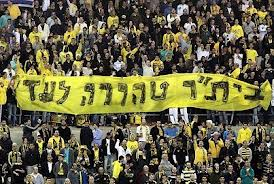
What do you do about situations we’ve been reading about recently? I’m talking about the reports of fan racism in soccer in Israel. Israel has suffered a few difficult instances in the last few years with respect to violence against Arabs and Palestinians. But the sports context seems to exacerbate the problem and provide a context for a poison cocktail of attitudes, energized competition, and ignorance that produces a combustible mixture of racism.
Recently, plans by Beitar Jerusalem soccer club to add its first Muslim players prompted violent and racist incidents in Israel. During a recent match between Beitar and a team from Umm El Fahm hundreds of police had to be deployed. Beitar Jerusalem fans held up the banner above(which reads “Beitar will remain pure forever”) which connotes very unpleasant references to “group purity” an attitude that Jews – at least most Jews – would like to forget. Beitar gets its name from the youth movement, linked to Herut the forerunner of Likud, which opposes Israel’s Arab neighbors. The team name symbolizes a position of honor in Israeli youth movements. Some Beitar fans lead chants calling the Arabs offensive names, which prompts the Arab teams to call out “Allahu akbar.” Some Israeli teams do include Arabs but not Beitar.
The sports environment activates group level perceptions that cause fans and players to identify even more strongly with their national and ethnic group. Sports is a team activity and it is thus easier to foreground a collective group identity. The “individual” versus “group” level of perception is exaggerated in the sports context. People can feel threatened or vulnerable and they can feel this on an individual basis or a group basis, and the two levels of perception can be quite distinct with some situations, such as during heated competition, causing greater distance between the two. For example, if a Jew were asked whether or not he feels vulnerable or threatened he might say “no.” He personally feels secure and not threatened. But if you ask that same person whether or not his group (Jews) is vulnerable or threatened he might say “yes” my group the Jews are vulnerable and threatened. Some studies show that the more one feels his or her group is vulnerable or threatened the more conservative they are with respect to social policies and security.
It’s clear that Israel is expressing its insecurities and hardening its own political stances because it increasingly feels threatened and vulnerable at the group level. The sports context and public displays of demands for “purity” (meaning no Arabs) are troubling examples of the increased polarization in the Israeli-Palestinian conflict. Nothing is separated from politics in Israel because conflicts of such intractability permeate the entire society. The whole culture participates in the conflict ethos. Ultimately the goal is to play soccer without charging ethnic tensions. Talk will not solve the problem at the moment but it will one day.



 Peace and Conflict Politics