Hamas and Fatah Unity: The Theory of Contamination at Work

The unity and reconciliation agreement between Fatah and Hamas holds promise for the future. Clearly, we have to take a wait-and-see attitude. But I consider it potentially a turning point in the relationship between Israelis and Palestinians. Many Israelis reacted negatively to the news and quickly assumed that Hamas would dominate. But let’s consider a few issues.
Hamas and the Theory of Contamination
The argument that this reconciliation will result in something positive is based on the assumption that the PLA will moderate Hamas rather than Hamas “contaminating” the PLA. The theory of contamination is based on the theory of disgust. Briefly, disgust is an evolutionary emotion probably related to knowing what to eat and avoiding food that is bad or contaminated. We always assume that contamination passes from the dirty to the clean and therefore “contaminates” the clean. If I drop a piece of food on the floor, the dirty floor contaminates the clean food. Nobody assumes that cleanliness passes to the dirty and purifies it; the “clean” food does not pass to the dirty floor and make it cleaner.
And so it is psychologically. Things that are considered dirty, harmful, or just plain “bad” are always assumed to contaminate the “good.” A racist will consider his or her neighborhood “contaminated” if a member of an undesirable minority group moves in. Most people assume that Hamas will “contaminate” the PLA. But in the realm of human interaction, in the socio-symbolic world, it is possible to avoid contamination and have influence move in the other direction. The normal theory of contamination would clearly have Hamas contaminating the PLA and making matters worse between Israelis and Palestinians.
But the extension of theories of contamination and disgust into the social world has its limits. It is not inevitable that desirable social processes be contaminated; in fact, contamination as a psychological construct is culturally created. It was learned, and that means it can be unlearned. Let’s hope the PLA can withstand the normal flow of contamination and have a positive influence on the culture of Hamas.
First, a united Palestinian people are going to be more responsive to the peace process. Did anyone ever really think the peace process would be successful with Hamas and Fatah separated and in conflict with one another? Did anyone ever really think a solution to the conflict would include a separate West Bank and Gaza, under separate political entities? The unity of Hamas and Fatah was inevitable. This will be especially true if the two groups unite on some fundamental issues regarding the peace process and international recognition. The United Nations and European Union welcomed the efforts toward reconciliation and the possibility for new dialogue.
Everybody with an opinion on this matter could turn out to be wrong. Two possibilities bound the ends of the continuum. The worst-case scenario is Hamas overtaking the PLA and the government and security services. Hamas maintains its rigidity and continues to call for the destruction of Israel. Hezbollah continues to prosper in Lebanon and the Islamic Brotherhood gains a stronger foothold and provides support for a Hamas driven Palestinian Authority. This scenario will guarantee war, not peace.
The best case scenario, and the one that I think is most likely, is that Hamas is moderated by the PLA and becomes more normally integrated into a Palestinian governing body that realizes the need for certain practicalities. The new Palestinian unity government gains credibility and brings a fresh voice to the peace process. It will take some time for the Palestinian unity government to prove itself to the Israelis. Netanyahu will not go gently into a relationship with Hamas. The Israelis and PLA currently share certain security responsibilities, and it’s hard to imagine continuing this shared security relationship with Hamas. But a Fatah Hamas reconciliation is necessary to a successful peace process. It solves the problem of Israel needing someone to talk to who represents all of the Palestinians.
Hamas is an Islamic militant group and Fatah is a secularist party. The two groups have always opposed one another with respect to tactics and their relationship to Israel. They have separate security systems and there are plenty of stories of Palestinians who are arrested one day by the PLA and the next day by Hamas. But the unity arrangement will strengthen the Palestinians in their quest for a Palestinian state – not two states (Gaza and the West Bank) but one state. This unity agreement could be a new era for the Palestinians.
According to some analysts, it was Hamas who made most of the concessions that enabled the unity agreement. They are perceived as weak and known to have difficulty carrying out legitimate elections. The reconciliation between Hamas and the PLA will present a unified stance for the Palestinians. There is a clever sleight-of-hand operating here also. The United Nations will undoubtedly support a Palestinian state and this will confer legitimacy on Hamas. Hamas will go from a militant Islamist party steeped in violence with extreme political attitudes that are unsustainable in any context, to an internationally recognized political operation that represents the Palestinian people. Although there is an irony to this, it does pressure Hamas to yield to international demands.
The United States and Israel should see this reconciliation as an opportunity. Hopefully, talks can continue and Hamas will find itself in a situation where it must cooperate and engage with United States and Israel. This will include stronger pressures on Hamas to maintain cease fires, eliminate rocket attacks into Israel, and control violence. There’s a good chance that any resultant political platform will be more consistent with the PLA than Hamas. The hope is that Hamas will not contaminate the PLA, but the influence will run in the other direction.
Revised slightly from May 8, 2011.
Reframing Extremism

Terminological note: I realize that drawing generalities about cultures and religion (e.g. “Islam” or “the West”) is perilous business and many distinctions and semantic nuances are either exaggerated or ignored. But peacemaking and problem resolution is called for nonetheless. I continue with this Islam-West distinction because it is characteristic of how the public formulates the conflict. Some will surely be critical of this supposedly simplistic distinction but it does represent the level at which the conflict is talked about. Funk and Said’s discussion of competing narratives categorizes the conflict as between “Islam” and “the West” and uses these categories as the level at which dispute in consciousness operate. It is also a better capture of the conflict then phrases such as “civilizational conflicts,” a terminology probably worth avoiding.
There is no escaping requirement that any genuine and diligent effort to resolve Islam- West differences must confront extremism and violence. The first step, and this will be difficult for many, is not to view extremism as confined to Islam but to view it as a genuine relational term that is a reaction to economic and cultural issues. Defining a problem relationally implies similarity dialectic; it forces the two parties to interpret differences as similarities or at least the recognition of mutuality of the problem. The current cultural insularity means that each side establishes meaning and interpretations about the other independently and separate from broader political and historical frameworks. If there is going to be a compatibility perspective rather than a rivalry perspective, which is an initial crucial step toward ameliorating conflicts, then extremism must be confronted by each group and also avoid insularity. The current conflict is a clash of symbols (including headscarves, religious symbols, and clothing) that act like a clash of stereotypes. They represent simplistic belief systems that reduce the other side to essentialist practices and end up rendering everyone uninformed. This process results in an intergroup pathology where both sides reduce their beliefs to a small subset of meanings which are difficult to communicate about. When this small subset is politicized the result is fundamentalism as each side works to seal off their beliefs and maintain control. For Muslims the fundamentalism gravitates toward puritanical religious ideology that defines offenses and outsiders. For Westerners fundamentalism equates liberal democracies with the natural flow of history and market economies as beyond criticism.
Intergroup images of the other must be replaced and counteracted. Consistent with a long literature on intergroup contact both ingroup and outgroup images must be modified. Dialogue is the mechanism for uncovering the existential reality of the other. In addition, a compatibility framework must appreciate similarities and differences in order to avoid militants and fundamentalist. If a provocation is responded to in a narrow and mechanical manner then fundamentalism is reproduced. Another simple truth is that we are surrounded by media messages pertaining to violence when it comes to news and information about Islam and the West. The availability heuristic would predict that we use and overemphasize information that is easily available to us. Since we can imagine images of violence easier than ones of peace and reconciliation, simply because these images are more available, we tend to think that such images and relationships are more characteristic of the conflict. And certainly the same is true of the negativity bias, which holds that negative information is more easily attended to and brought to mind than positive information. So when we think of the Israeli-Palestinian conflict we think of negative things such as violence, religious differences, and a whole host of tragedies that cause us to remember those more than anything else. These heuristics of negativity and availability can fundamentally define an intergroup conflict and contribute significantly to its intractability.
Still, there is a reason conflicts such as the Israeli-Palestinian conflict are called intractable. They are particularly resistant to resolution because an appeal to shared values and aspirations may not be sufficient. In fact, it would be naïve to think otherwise. The conventional discourse of the West and Islam is filled with assumptions that reinforce ingroup and outgroup mentalities. Security is not a private good but one that is achieved by developing consensus, and cooperation, and interdependence – all relational terms. Justice cannot be imposed by one side but must be a concept that binds the two sides into a just relationship. But neither the West nor Islam can thrive in the midst of extreme antagonism. They need a bigger story, another narrative that continues to develop the narrative of complementarity and compatibility. Neither Islam nor the West can drift into deep bounded subjectivity that fixates on fundamentalism but must discover the active process of dialogue and deliberation capable of generating new forms of communication.
Is This Woman Really so Dangerous That She Must Be Kept from Speaking
The recent dust up over Brandeis University’s decision to revoke an invitation to Ayaan Hirsi Ali to speak and receive an honorary degree is truly interesting. It clearly exposes the issues of free speech and the rights of intellectual contestation as well as shines light on that place on the political spectrum where the left meets the right. A picture of Hirsi Ali is below. First some very quick background:

Ayaan Hirsi Ali has been objecting to the treatment of women by Muslims for over a decade. She was born in Somalia and experienced female circumcision which prompted her to organize in protest against the practice which led to her forceful criticism of Islam. She immigrated to the Netherlands in 1992 and has developed a powerful reputation as an advocate for women’s rights and an opponent of religious extremism of all types but Islam in particular. Hirsi Ali is the recipient of numerous international awards.
Hirsi Ali is in general an honorable and articulate human rights and democracy advocate. Over the years I have enjoyed listening to her and found myself in agreement. But apparently, she goes too far; she’s too strident in her objections to Islam and once referred to Islam as a “destructive, nihilistic cult of death”
She was invited to speak and receive an honorary degree from Brandeis but the invitation was revoked as result of a protest against her criticisms of Islam which were considered extreme and politically incorrect. Muslim students at Brandeis objected to her appearance and she was quickly uninvited by the President of Brandeis. One noteworthy Brandeis graduate, Jeffrey Herf, wrote a damning letter criticizing the President for rescinding the invitation and defending Hirsi Ali. That letter can be found here. In the letter Herf chastises Brandeis for running to the defense of one of the most anti-semitic organizations in recent history and pointed out the inconsistencies between the freedom to criticize Israel versus the freedom to criticize Islam.
Liberals have supported the president claiming that Hirsi Ali’s statements are not compatible with certain values of free speech, namely, tolerance and respect. And conservatives of course are very critical of the president for not supporting free speech and kowtowing to a few minority voices.
This is the place on the political spectrum where the left starts to act like the right. The right typically wants to limit political speech that is critical of the government, and the left wants to limit speech that is insensitive to or critical of ethnopolitical or religious groups. The left in this case stands for nothing. I agree that Hirsi Ali is intemperate but she is also representative of a position, and the nanny state should not be in the business of deciding what people hear – within limits of course. Hirsi Ali should be allowed to speak and if she is too extreme she should be taken to task for it and the issue should be discussed rather than automatically taken off of the discursive table. Brandeis students and faculty are mature enough to listen to Hirsi Ali and not be oppressed by her.
The decision by Brandeis to uninvite Hirsi Ali amounts to using political opinions to determine who speaks on campus, something I think the University community is not interested in. Other critics, such as Yossi Klein Halevi and Abdullah Antepli have suggested that honoring Hirsi Ali would be a slap in the face to Muslim students and a negation of Brandeis values of inclusivism, tolerance, and interdependence. Halevi also made the distinction between a dissident in a renegade where a dissident tries to change things but a renegade just damns them. Hirsi Ali is a renegade according to Halevi, but she remains a renegade with respect to symbolic behavior, that is, language and argument. She is not organizing violent revolution.
The Conditions of “Difficult Conversations.”
Below are the conditions most likely to make for “difficult” conversations. They can be considered part of deliberative and decision-making processes that must be taken into account in order for communication that will be the most workable. The citations can be unearthed for additional insight.
Incommensurate cultural narratives. Difficult conversations are more apparent when the two cultures in conflict are particularly distinct or even incommensurate with respect to cultural qualities. And there is no shortage of descriptors and statistics that report differences between cultures. But our concern here is not with general differences such as those posed by Hofstede (1980) but with those differences that represent cultural conflict. Conflicting cultures such as the Israelis and the Palestinians delegitimize each other and have qualities that exacerbate the differences thus making conversation or contact between the two groups “difficult.” The Israeli-Palestinian narrative represents significantly different accounts of the same historical events. They differ on how they selectively emphasize and organize events and motivations. But neither narrative recognizes very much legitimacy or pain of the other. Each blames the other and offers little recognition of its own behavior and how it has contributed to the conflict. Each sees the other as a threat and focuses on its own fears and reasons. Both sides demonize the other with historical events and have hardened their positions into mutually exclusive categories. The conflict captured by these competing narratives have certain cultural and psychological features that characterize them and these features are useful for understanding more precisely how cultural qualities make conversations difficult.
Cultural conflict becomes more restricted and difficult when both sides are heavily locked into the past, the myths of the culture’s birth and evolution. The Israeli narrative, for example, has been analyzed by many scholars with respect to its images of the past, parade of heroes and villains, and development of a worldview (Zerubavel, 1995). A key point is that these contemporary identities are constructed to meet contemporary needs by fashioning the modern narrative out of the past. The past is understood on the basis of the present. This is clearly the case for the Palestinians whose conflict ethos is completely directed toward its contemporary political conditions with the Israelis. This incommensurability with respect to interpretation of the past is particularly powerful because lessons drawn from the past are viewed as timeless and hence resistant to change. The past becomes glorified as a timeless truth that is a steady beacon of light. Consequently, conversations calculated to unlearn these lessons or change them are particularly “difficult.” There have been occasions when narratives converge and there is a movement toward mutuality. The Oslo Accords and Sadat’s visit to Jerusalem are such occasions in the case of the Israelis and Palestinians. Although they are no guarantee, historical events such as these underscore the importance of leadership and identity widening.
Narrative particularity. Difficult conversations focus on particular emotional experiences that are presented as objective. There is a difference between narrative in history where history is more rooted in collective agreement about events and their meaning. But narrative focuses on particular events and weaves them into a story designed to serve group interests. Groups focus on emotional events such as victories or defeats and spend more time concentrating on the strength and character of their ingroup narrative than they do on the nature of the outgroup narrative. Hence, one’s own narrative becomes sharp and precise with clear defenses and the outgroup narrative is more opaque. Israelis overweight the “war of independence” or the “Six-Day War” while Palestinians interpret these events as a “Nakba” (disaster) or glorify the intifada.
A sharp and precise narrative produces high within-group agreement about the interpretation of events and results in intensified links between people. Consequently, any disagreement within the narrative becomes disloyalty and dissenters are particularly stigmatized as outgroups. Conversations become particularly difficult because high within group pressure is a powerful deterrent to change. Such pressure directs a wall of resistance to the exposure and adoption of new information and perspectives. But a regular discourse of deliberation or resolution does make the accumulation of new perspectives possible because we have seen new attitudes and beliefs emerge from intractable conflicts in a number of cases. The Israeli Zionist narrative, for example, has broken up with the rejection and alteration of many of its tenets and the narrative has somewhat less appeal than it did historically including the diminution of its emotional appeal.
Existential threat. This is a common characteristic of intractable conflicts which of course makes conversations difficult. When a group fears for its very existence it will respond in difficult and defensive ways. But in intractable conflicts the two groups often have a deep history of existential threat. Jews have a long history of discrimination and defeat from Masada to the Holocaust, and the Palestinians also described their history as one of occupation and oppression. Related to existential threat is victimhood and the feeling that one’s own group is vulnerable. Groups that feel vulnerable or weak do not give up very easily and are particularly protective of themselves. Jews have an interesting history of both victimhood but are now in a power position. South African Blacks, Irish, Palestinians, Bosnians, Tamil in Sri Lanka all feel threatened. Such groups desperately hold onto an identity that categorizes everything the other side does as representative of their victimization. This mirror image psychology makes conversations difficult. Group members feel as if they’re going to be attacked both physically and symbolically.
Power differences. Conversations are most difficult and challenging when they are asymmetrical with respect to power (Deveaux, 2003). Power obstructs the pressures toward normative argumentation bound by norms of rationality. A clear position of power by one participant in a conversation pressures the person to use the power and makes him or her less amenable to listening and giving up strategic interests. Power distorts the issues and to the detriment of the process power becomes an issue itself. Dryzek (2010) reminds us that the deliberative and communicative processes involved are supposed to transform participants. They are supposed to help us clarify issues as well as deep commitments. But power makes it possible to exclude others and, more interestingly, it stunts normative reasoning. The conversation is clearly more difficult when the communication processes are distorted because of power asymmetry. And if one party is primarily concerned with its own status, or more concerned about one’s own gain and has the power to realize this, then there is not much incentive for good arguments and reasons in the deliberation process. The powerful party does not feel compelled to seek valid justifications because other easier power moves are available. In fact, an idealized version of deliberation might only reinforce the advantages of powerful participants. This would be especially true if the more powerful party has more symbolic capital than the less powerful party.
Delegitimization. Bar Tal and Teichman (2006) write comprehensively about the psychology of delegitimization that is most fundamental to groups in conflict and perhaps most associated with the experience of difficult interactions. As part of intractable conflicts, where the parties have prolonged violent conflict and are existentially threatened, delegitimization adds stereotypes and distorted communication patterns to the mix. Delegitimization is categorizing the other group as outside the sphere of humanity and subject to moral exclusion (Opotow, 1990). Interaction between the two groups, either individually or on the group level, is more than difficult; it is often impossible. Intergroup relations such as that between Hamas and Israel is an example of delegitimization such that each group refuses to recognize the other and considers the other as undeserving of human recognition. The information received about delegitimized groups is not only distorted but dominated by conflict themes. Negative traits are attributed to the other including troublesome political labels, biased group comparisons, and homogenization of the other group that does not allow for individuality or member differentiations. Bar Tal and Teichman (2006) explain how delegitimization involves stigmatizing the other group, which of course makes conversations difficult. When a group fears for its very existence it will respond in difficult and defensive ways. But in intractable conflicts the two groups often have a deep history of existential threat. Jews have a long history of discrimination and defeat from Masada to the Holocaust, and the Palestinians also described their history as one of occupation and oppression. Related to existential threat is victimhood and the feeling that one’s own group is vulnerable. Groups that feel vulnerable or weak do not give up very easily and are particularly protective of themselves. Jews have an interesting history of both victimhood but are now in a power position. South African Blacks, Irish, Palestinians, Bosnians, Tamil in Sri Lanka all feel threatened. Such groups desperately hold onto an identity that categorizes everything the other side does as representative of their victimization. This mirror image psychology makes conversations difficult. Group members feel as if they’re going to be attacked both physically and symbolically.
How Many More Decades Do We Have To Watch This Silly Shuttle Diplomacy between Israel and Palestinians? It doesn’t work!
How much longer do we have to watch an American diplomat shuttle back and forth between Israel and some neighboring country? From Henry Kissinger in the 1970s to John Kerry it’s all the same process. The tennis match image comes to mind and I would use it if it were not such a cliché. I’m increasingly coming to the conclusion that it’s all pointless and that comes from somebody who believes in talk. Even though I recognize that talk is slow and there’s nothing magical about it, there comes a point when you have to ask yourself whether it’s all worth it.

When talk fails it is usually for one or a combination of three reasons. One, it’s the wrong kind of talk. Two, the wrong people are talking, or three the structural conditions are interfering. All three are at work in the Israel-Palestine shuttle diplomacy. It’s the wrong kind of talk because the two sides are unprepared to have serious political conversations when they need more authentic mutuality. The wrong people are talking because there should be more conversational work at the civil society and interpersonal levels. The structural conditions could be improved to increase democratic forms of communication, inclusion, and more creative and grassroots routes to problem-solving.
Palestinian supporters often boldly claim that resolving the Israel-Palestine conflict is the key to bringing greater peace to the region and although this is an exaggeration supporters have been successful at turning the conflict into the symbolic prototype for all the world’s problems. I think about the ugliness in Syria, the savagery of militant groups, rising religious authoritarianism, escalating economic inequality, Iran and the spread of nuclear weapons, and then discover that serious people in Washington want to talk about West Bank Palestinians!
Of course the conflict must be resolved or at least managed into agreement. But the biggest beneficiary of any resolution is going to be Israel. How long can Israel continue to occupy the West Bank? How long can it remain a security state? How long can Israel maintain its successful democracy and market economy if it has to oversee 2 million Palestinians?
There will not be peace between Israelis and Palestinians – real peace when barriers can be removed – until it emerges from democratic impulses born in civil society. When Palestinians demand more of their own rights from their own leadership they will be in the position to demand rights from Israel. America should be supporting Palestinian political infrastructure by working on the economy, improving governance and civil liberties, and expanding business practices that can rationalize relationships and serve as a foundation for future democratic relationships. But the conflict remains intractable and diplomats like Kerry are operating at the wrong levels.
Muslims and the Jews tell two different stories both of which are fueled by media and policy decisions. Israel tells a story of historical oppression and discrimination culminating in the Holocaust and the creation of the state of Israel. Jews feel vulnerable and threatened. Muslims feel disrespected by the West and the victims of media biases that portray them as fundamentalist and inherently backward, not to mention violent and religiously extreme.
These narratives produce tensions between Islam and the West and are decisive. They make for a cultural divide which results in polarization of identity issues, adversarial framing of historical matters, and rejection of any sense of shared responsibility for conflict. US policy and world media circulate these images and messages to the detriment of any sense of complementarity between the two.
In my opinion, there are two things that can happen: the differences between these stories can be emphasized, which will lead to increased intensification leaving the disputants to be trapped inside their own threatened identity. And the macro level of official contact will continue to founder. Or, these narratives can be reframed in order to seek points of convergence where it is possible to formulate cooperation and mutual affinities that direct them away from a “conflict-saturated” reality. Rather than rival narratives, Jews and Muslims can avoid the drift toward polarization and begin to tell a new story, one that affirms a distinctive identity while acknowledging the “other.” I choose this direction.
Hebrew and Russian Language Vitality and Conflict
One way to track the power and influence of a culture is by watching the shifts in language use. People are attached to the language they speak and the culture it embodies. When a group speaks a language it’s because they perceive that language to have standing and relative importance.
Russia may have just asserted itself and flexed its muscles but it’s really a weakened national polity as evidenced by the erosion of the Russian language around the world. As Marshall Singer reports, in his Foreign Affairs article “Language Follows Power” Russia is no longer the official language among many of its republics and the countries of the old Soviet bloc. Many state powers are turning away from Russia and its language and showing preferences for English and French.
Languages get used when they are functional and vital. A vital language is responsive to new usages and terminology and changes to reflect an active culture. Hebrew is a good example of a restored and revitalized language that is only spoken by about 8 million people but exercises a power beyond its numbers because of its ties to sectors of the economy and popular culture as well as traditional religious groups.
As nationalism broke out among non-Russian nationalities they began to reject Russian culture and especially the language. Singer also reports that the publication of books and the production of television programs has decreased in Russian but increased in other native languages. The Russian language has faded with the power of the Russian political entity – recent militarism notwithstanding.
Hebrew, on the other hand, within its national boundaries is so strong that it has drowned out some minority languages. Freeburg in a study of the revival of Hebrew offers interesting data on how other smaller languages in Israel (Karaim, Ladino, and Yiddish) have almost been threatened out of existence. The revitalization of Hebrew is typically pointed to as a tremendous success story but Freeburg suggests that the negative consequences of the revitalization of Hebrew have been overlooked. Still, as Russian and Hebrew evolve they change their relationship with the process of conflict resolution.
The Role of Language and Conflict Resolution
The assumption of universality is one of the first mistakes conflict resolution theorists make. In other words, they emphasize the common structural features of conflicts. Or, at least what they believe to be the common features. A Westerner will talk about “negotiation” or “reconciliation” and assume that these concepts are shared by the conflicting parties. The Westerner will assume common patterns and regularities even if terminology is different.
But Raymond Cohen has written cogently about emphasizing variations rather than resemblances. The differences between conflicting parties are important because meanings carry cultural weight and depict different versions of reality. Peace may seem to be a familiar enough idea but its use by various cultures contains characteristic distinctions and meanings. As Cohen explains, in English to “compromise” means to balance concessions and is a very laudable and positive term. But Arabic lacks such terminology and even the ones they use can imply a compromise over a principle of honor or justice which is to be avoided not embraced. Moreover, Israelis argue in a direct and pragmatic manner and consider deep philosophical arguments over principles to be paralyzing. But in Arabic there is no word for pragmatism and it is offensive to neglect principles.
Managing and resolving conflicts is an unavoidable human activity that is steeped in cultural values and differences. Consequently, meanings and implications of conflict resolution have accumulated over the millennia and found their way into the deep semantic structure of language. These semantic structures must be extracted and re-formed until conflicting parties see the nature of conflict from the same perspective – or at least the perspective that is “close enough.”
New Trends and Knowledge-Based Journalism
The United States has a long tradition of “objective” journalism. At least we tell ourselves that objectivity is an ideal to strive for. In some other news cultures there is not even the pretense of objectivity. A newspaper, for example, will have a perspective and they will state it clearly and the reader is expected to know the perspective. So there is a communist newspaper, a socialist newspaper, a business capitalist newspaper, and so on. The reader understands the perspective and reads the news with the interpretive lens called for.
But whether there is objectivity or perspective the news is still a sort of “lecture.” The journalist is an authority and the reader is “learning” something. Given the distrust of journalistic institutions, sinking circulation, weak citizen engagement, and low credibility for news this monologic approach is clearly dying off.
But modern incarnations of journalism are more influenced by user generated possibilities as well as new technology. Fueled by the ideas of public journalism and a reinvigorated public sphere where ordinary citizens could communicate about ideas, contemporary thinking about journalism includes more interactive possibilities. (A good reading on these and related matters is by Marchionni in the journal Communication Theory volume 23, 2013) The reader can use various web tools to participate in journalism and this can include supplying content and forming a sort of collaborative journalist-citizen relationship.
These new trends are interesting and grounds for improved engagement between the public and journalism institutions. But I am less concerned with what journalism practices are called (public, participatory, interactive, or conversational) then I am with journalism’s quality and reliability. I prefer the term “knowledge-based journalism” as described by Patterson in his book Informing the News: The Need for Knowledge-Based Journalism. A thorough essay on knowledge-based reporting appears here.
Knowledge-based reporting tries to maintain the tradition of accuracy and truth but recognizes that most of the time the news report will simply do its best to get the best version possible. Still, knowledge-based journalism relies on its tradition of verification. Journalism is not fiction, or entertainment, or propaganda. Patterson, as described in the essay available in the link above, argues that journalism should adopt the thinking and processes of “science.” That is, the journalist formulates guesses and hypotheses, gathers facts, and knows how to apply other facts.
Walter Pincus wrote an article for Columbia Journalism Review accusing journalists of being narcissistic primarily because of journalism’s interest in larger long-term investigatory projects that are likely to bring Pulitzer prizes. The article makes a few counterarguments warning against the narcissism that prompts journalists to devote too much time to one story rather than making a variety of issues available to readers.
But deep knowledge and competence and specialization are at the core of knowledge-based reporting. Patterson reminds us that journalists who are uninformed and lack detailed knowledge are more subject to manipulation by sources, make more mistakes, and vulnerable to a few experts.
Finally, communication scholars have pointed out that journalists are just fine at providing the who, what, where, and when but fail miserably at the “why” question. I have asked journalists about this and they typically reply that they do not want to turn the press into a school text. But this hardly seems like an inevitability. And with new technology and graphics the possibilities for likely presentations and explanations seem ample. I will not repeat the cliché about democratic and free societies relying on quality information. But “democratic and free societies rely on quality information.”
Ethnopolitical Capitalism and Access to Communication Technology
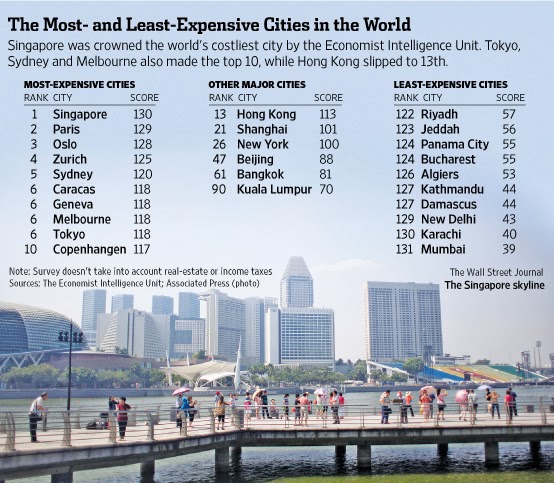
The table above represents the most and least expensive countries in the world. I’m not so concerned in this posting with a discussion of cost of living but with the relationship between how expensive it is to live somewhere and access to media, computers in particular. There is a correlation, a strong correlation, between developing countries and what has been termed the “digital divide.” This lack of access to information and information technology is not a simple unfortunate byproduct of other things, but a crucial issue with respect to economic and social development. Media access will provide the crucial information and knowledge that make developing countries more productive.
The full implication of the consequences of the digital divide are still being untangled, but there is no doubt that the cheapest places to live are usually developing countries and they lag significantly behind industrialized countries when it comes to technology and the Internet. Even more interesting and perhaps detrimental to developing cultures is the fact that these developing countries focus on infrastructure rather than how the technologies are to be used. Of course, infrastructure is important and necessary but issues in information strategies, diffusion of information, and political possibilities are perhaps more important. Communication technology lowers barriers to the development of democracy, helping disadvantaged communities, and facing social problems. There have always been the “haves” and “have-nots” but now there is the “information rich” and “information poor.”
Muslims and the Digital Divide
Catherine O’Donnell in an article on Political Parties and the Digital Divide explains that Muslims are increasingly wired and have made progress in the last years. In particular political parties are online accompanied by growth in blogs, listserv’s, and chat groups. Interestingly, politics in Muslim countries is increasingly online but the divide between rich and poor countries is greater than ever. Developed countries have more high-speed broadband and sophisticated infrastructure. Again, the price of living in developed and undeveloped countries is predictive. The cost of an hour of Internet in a cyber café located in one of the developed countries in the chart above has dropped significantly. But this is not true for less-developed countries.
Prejudice and the Digital Divide
One more insidious relationship is between race and technological availability and use. Technological power is deepening the levels of discrimination suffered by those who live in undeveloped countries and are especially a member of a minority or disadvantaged group. Technological power advantages those already in power and reproduces the class system that makes it so difficult for less powerful groups to prosper. The study “Falling Through the Net: Defining the Digital Divide” documents the relationship between the use of new digital technology and disadvantaged groups. Below are some conclusions from the study, which was completed in 1999 so the actual data has changed, but the general thrust of the conclusions still hold.
“Those with higher education have more access to information technology.”
“High income families are more likely than low income families to have Internet access.”
“Political disadvantages are correlated with communication technology disadvantages.”
There is not only a racial divide but an ethnopolitical one. Group contact, including dialogue and deliberation, predominantly rely on access to new technology. And this is increasingly true because new technology provides the means and opportunity for communicative exchange at a far greater level then could ever be achieved by organizing face-to-face contact.
Computer skill and access to the technology and training necessary to maximize their use is a form of new power. If these new technologies are not made available to disadvantaged groups then power gaps will grow even greater and the differences between groups that typically lead to tension and communicative distortions will be exaggerated. Equally as important is the content that travels on communication technology. Dialogue between contentious groups such as Islam and the West must find the public sphere. This is most likely to be in cyberspace.
No Advocate for New Media Would Want to Take Credit for Egypt or Ukraine
Facebook must be truly a magical medium. It cannot only reconnect you with your old high school friends but whip up a democratic revolution in its spare time. It received so much initial credit for the Arab Spring that political activists in places like Egypt began to question whether or not they were sufficiently committed or worked hard enough. Well, that was all an exaggeration but it is the case that Facebook had at least “something” to do with influencing the uprisings.
I enjoy my twitter (that’s me @dellis2) and Facebook accounts and they represent truly important advances in technology and the puffed up power of information networks. But as of now their media created images remain more potent than the reality; the impact of online activists is exaggerated although not unimportant. Marc Lynch, writing in Foreign Policy (Twitter Devolutions), argues that the power of social media must be tempered, that activists and academics sang the praises of these new media too loudly and they are subject to more criticism than has been levied. Moreover, the gritty politics that follow these uprisings is more important for shaping political life, yet if you judge by news coverage new media seem to have little to do with this. Facebook and twitter only seem to rear their heads during times of revolution. Off-line politics is turbulent but remains more central to the struggle for transition from authoritarian systems to more democratic ones. Below are some questions and issues that must be addressed with respect to new media because on the one hand new media get too much press, but on the other they are truly impactful. This means our understanding must be more nuanced.
1. Why do social media seem to get more attention or have more impact during revolutions or times of upheaval? During quiet times Facebook seems to offer little more than a pleasant pastime or benign exchange of information. There is still a tinge of awe surrounding new technology that lends technologically laden significance to a story that it carries. The story is not trivial because it is circulating on new media; on the contrary, it is important. When there is a crisis or political instability Facebook and Twitter seem to structure stories quickly as “good vs. evil” or “right vs. wrong.” I would guess, and I have yet to see data on such an effect, that any flurry of new media activity has a polarizing effect that results in binary oppositions such as “right vs. wrong.”
In the article cited above, Lynch observed that during the most active times in Cairo the Muslim Brotherhood and the non-Islamist online community structured their Twitter and Facebook exchanges exactly as described. Every time a story was critical of the Muslim Brotherhood it was quickly shared and reinforced by additional stories critical of the Brotherhood. And the same was true of the other side, every story critical of non-Islamist political activists was redistributed and shared by the Muslim Brotherhood thus perpetuating spirals of polarization. Habermas’s glorious inclusive and democratically aesthetic public sphere was nowhere to be found.
2. Why is it that social media are better at organizing and stimulating upheaval then routine politics? The new media seem to love energy and issue-driven controversies rather than the slow work of building political organizations. Again, Lynch points out that Twitter and Facebook were more successful at merging once disparate coalitions than mobilizing masses of voters. Perhaps Facebook is simply easier and faster and works best when a political situation is amenable to faster organization. Moreover new media can quickly employ the power of visual and auditory messages that increase their impact. Violence or a grisly death can be captured immediately on a cell phone and uploaded within minutes. This captures the attention of activist groups and encourages involvement. There is a “thrill” to new media because of its speed and multi-sensory impact that is not present during routine politics. we have not heard much from Ukraine but pay attention as things heat up.
3. The political strengths of Twitter and Facebook can be easily challenged by any regime willing to be as repressive as it needs to be. Places like Bahrain and Saudi Arabia, not to mention Iran and Syria, are finding new ways to interfere with online activism including shutting them down when necessary. After enough pressure, and it does not take much, citizens and active account users will simply stop participating in online activity in order to avoid persecution and even violence. The possibility of harassment and arrest make it quite easy to withdraw from the online community. But it does pose the conservative dilemma which is that shutting down new media causes an uproar and does as much damage as good in the eyes of the dictator.
The various social media did not create revolutions in Egypt or the Arab spring, but they did play a role. They have undermined traditional models of information and helped elites and activists empower themselves in order to facilitate change. But if we hail the opportunities for elites and activists to encourage democratic changes, we have to also recognize the problems and limitations of these new forms of communication. At the moment, given the instabilities in Egypt and other countries, no advocate for new media would want to take credit for the current political realities.
Edited From Feb 2013
The Reptilian Sensuality of Hate
The noted cognitive scientist and Nobel Prize winner Daniel Kahneman introduced the concepts of System 1 and System 2 or fast and slow thinking. System 1 is fast, instinctive, and emotional. System 2 is slower, logical, and deliberative. System 2 came later in our evolutionary development. System 1 thinking is intuitive and uses quick judgments that we rely on for most decisions. It is also the process that leads to far greater biases in judgment. System 2, our more deliberative thought processes, can be used to dampen the negative effects of our intuitive judgments. System 1 or fast thinking is reptilian and automatic. It has evolved from deep in our evolutionary history. So we respond quickly and easily to sexual associations and danger. System 2 is thoughtful and cognitive. It requires slower thinking and patience.
The experience of hate is I think a System 1 cognitive process but we often try to treat it with System 2 solutions. In other words, the bigot, anti-Semite, and the racist are typically confronted with System 2 rational thinking as if the person is simply experiencing unjustifiable beliefs and misinformation. We try to change the person or educate him by presenting facts, correcting errors, and revealing logical inconsistencies. Curiously, we are dumbfounded and dismayed when this doesn’t work. When our attempt to reason the other person into correct thinking is useless we are chagrined.
The truth is that bigots and racists and anti-Semite’s don’t want to hear it. They are immune to the closed fist of logic that characterizes reasoning. Also, even though it’s a little bit counterintuitive, these people enjoy the experience of hating. It’s a powerful biologically-based experience of information that doesn’t require much from them and is sensually pleasing psychologically. The System 1 experience of emotional engagement for the racist and anti-Semite is fun! The quick and automatic conclusions of System 1 thinking are enjoyable and require little of the hater.
The person’s beliefs are firmly established and foundational to the experience of hating. There’s no questioning or insecurity. Anti-Semites stand sure in their beliefs and the power and pleasures of self-righteousness, condemnation of others, and sense of intense kinship with those who think like them is climactic in its joy.
Just look at the joys of hating:
- That anti-Semite gets to compare Jews to Nazis. What an orgiastic pleasure it is to take the group you hate most (Jews) and compare them to the great symbol of evil Nazis. Hatred is a purifying experience and perhaps the height of its titillating pleasure is the sense of superiority it confers on one. The bully, the self-righteous, the judgmental, and the ignorant are all soldiers in this army of those who feel superior. The expressions of their beliefs are immediate and instinctual. And since they have little cognitive analytic sensibility and are incapable of genuine information processing, they don’t even see themselves as anti-Semitic.
- The racist who feels his group is superior transcends the pleasures of superiority and can think of himself as “morally” purified. Everywhere he looks he sees evidence – the confirmation hypothesis at work a System 1 heuristic – of his group’s moral clarity. The history and traditions of the outgroup are the subject of propaganda and deceit as any “good” in the outgroup is automatically attributed to the environment rather than the group thus maintaining the racist’s own sense of purity.
- The instinctual and exaggerated language of the hater quickly categorizes the other and relieves him of the burden of real moral scrupulousness. So one can accuse Israel of violation of human rights or colonialism without doing the hard analytical work of defining and understanding these ideas. These pleasures extend to the Westerner who hates Islam as well. His sense of political supremacy and rectitude produces the same gut feeling that Islam is backward and tribal, thus reproducing his own moral superiority.
Deliberative and thoughtful exchange about others is slow and plodding. It requires correction and revisiting of attitudes and beliefs that must be modified or discarded. The scrupulous attention to cognitive errors and misinformation is evolutionarily new and we are not yet so good at it, especially when deliberation has to compete with the reptilian joys of hate.



 Peace and Conflict Politics