Zionism and the Israeli-Palestinian Conflict: The Triumph of “Narrative” over “History.”
Last week I attended a conference on Zionism at Brandeis University. It was an excellent conference populated by highly capable people all of whom had something to say and are worth listening to. There were lectures on the history of Zionism and its various expressions. The essence of Zionism is a rather simple idea. It was a national movement designed for the care and feeding of Jews who had a history of displacement and discrimination. Zionism was about finding a home and reconstituting the Jewish people as a nation along with the promotion and development of Jewish culture, history, arts and literature. Zionism was a program designed to foster a transition from a dispersed and discriminated religious group to a coherent nation.
This basic idea and many of its ramifications received attention during the conference. But there was a dearth of papers and discussion about the changes in Zionism over the years. Some have argued that Zionism is over; the state of Israel was created and Zionism has successfully served its purpose. Moreover, there was little discussion about the degradation of the term Zionism. Jews and the Zionists have had the contradictory misfortune of benefiting by the movement toward nationhood and nationalism in the last century – a period of time when nationalism was on the ascendancy – along with the deconstruction of nationhood. Contemporary theorists such as Hobsbawm have argued that groups of people have invented history and invented traditions in order to serve their own purposes which are sometimes inconsistent with true nationhood. Of course, Benedict Anderson and his captivating phrase “imagined communities” has been at the center of the claim that traditions are invented. Zionists have been particularly subject to recent efforts to deconstruct historical traditions. Zionism began as a noble effort to find a homeland for a historic people but its enemies successfully degraded the term associating it with at one time or another with “racism” or “apartheid” or “colonialism.”
Two words that appear quite often in discussions of Zionism and issues related to national histories are “myth” and “narrative.” I’ve noticed an increase in use of these terms over time. Both of them imply a subjectivity and I think their increased use is due to academic and intellectual fears of talking about historical facts or truth. The postmodern sensibility that vaporizes “truth” and characterizes knowledge as having lost its moorings needs a new language to talk about historical events and their explanations. This new language includes “narratives” which have a subjectivity and truth coded into them. In other words, a member of one ethnic group or nation does not have a history they have a narrative. And narratives are rooted in individuals and subject to their individual distortions. Hence, one narrative becomes as good as the next if it is tied to an individual and a perception of reality, and there is no historical or evidence-based grounding for the claims of the narrative. The same is true for the word “myth.” The culture does not have events or occurrences in its history that are meaningful, the culture has “myths.”
The Israeli-Palestinian conflict can be understood as filtered through these lenses. The current intractable nature of the conflict is the result of the clash of “narratives.” And narratives are subjective and rooted in the beliefs of one group or collection of individuals. Because narratives are personal and assumed to be the “reality” of the individual or group they must be taken seriously. So a Palestinian can tell his or her story and it must be treated as truthful, real, and respectfully. The same is true for an Israeli Jew. His story must be treated as truthful, real, and respectfully. The two realities are incommensurate and share very little in common, they have almost no sense of overlapping historical evidence or truth, the two narratives are almost incapable of sharing facts or interpretations, but both must be considered “real!” The two sides cannot even narrate one another. The Israeli “war of independence” is a Palestinian “disaster.” This paradox goes directly to the heart of the conflict. The conflict is a consequence of contemporary sensibilities about truth and reality, and a form of political correctness, as much as it is about historical events.
So Zionism, which was so central to the redefinition of Jewish nationhood, is now an opaque and harsh term according to many that has degraded in significance. In the future I think there needs to be more discussion of how this happened and why. Finally, the argument that Zionism has successfully established the state of Israel is a defensible one, but now there needs to be room for some sort of new Zionism: A Zionism that continues the tradition of developing Jewish nationhood but adapts to current political and geographic conditions. This sort of Zionism might include more attention to democracy, conflict resolution, and better ways to coexist in the neighborhood.
Obama’s Anti-Democratic Assassinations: His Robot Killers Will Get You!
If Bush and Cheney had commissioned the white paper and used its justifications there would’ve been an outcry about Darth Vader and his minion perpetrating evil throughout the land. But Obama can have a “kill list” and no one says much. Nevertheless, the document is about as anti-democratic as you can get.
Here is the White paper on drones. It is used as a justification for targeted assassinations. I must say this issue taxes one’s ability to support broader political concepts, important as they may be, over a gut reaction. What I mean is that killing Al Qaeda operatives who are racist, sexist, anti-democratic, and potential threats to the United States doesn’t bother me much. But a couple of chief White House officials sitting in a room making the decision by themselves – essentially being judge, jury, and executioner – with no political or democratic oversight does bother me. The white paper focuses mainly on when lethal operations against a US citizen are justified. The paper makes for interesting reading because it seeks to clarify the issues but actually underscores their ambiguity and problems. Let’s take a look at a few of the issues of interest.
1. It is assumed that the President of the United States can respond to Al Qaeda on the basis of his constitutional responsibility to protect the country. The president can act quickly and on his own regard even in the case of an American citizen if that citizen is deemed to pose a threat or considered a member of an armed force challenging the safety of the United States. The legal question becomes whether or not a lethal operation against the US citizen is protected by the Fifth Amendment’s due process clause.
The issue includes the matter of where the US citizen is located such as on a battlefield or in another country and if he or she is afforded any special constitutional protection. The paper concludes that killing a US citizen can be justified even if it is outside the United States.
2. The strongest defense of immediate violent action is the concept of “imminence.” Imminence is a well understood concept in the literature on politically protected speech. That is, one has many freedoms of speech available but cannot create a clear and present danger, cannot create danger that is imminent or about to happen immediately. The old tried-and-true example of yelling “fire” in a crowded theater is applicable here. I can advocate aggressive action against the collective group (e.g. the police) in the political theory or hypothetical sense but I can’t tell someone to go get a gun and kill the person next to them. I cannot create with my speech or my symbolic behavior imminent danger.
This issue of imminence has been a conundrum for the government and the white paper solves the problem by redefining imminence because it is too difficult a standard to meet. It is just too difficult to show that an Al Qaeda operative whether he or she is a citizen or not is posing an immediate and imminent danger to the United States. Thus the white paper argues that the president or high-level official only needs to decide that the person of interest is a “continuing” threat to the US. This is a much easier standard to reach. In fact it is extremely vague and means that the target of interest does not have to be posing any genuine immediate threat, perhaps has never been charged with a crime, and may not even be in the United States or nearby. But they are a “continuing” threat if they are simply known to be an associate of Al Qaeda.
3. The absolute worst thing about the white paper is its claim that the government need not ask anyone’s permission, is required to make its case to no court, before carrying out a targeted assassination of US citizen. Again, a couple of governmental officials can make this decision on their own, can create a kill list, without acknowledging any additional authority. They can kill American citizens and don’t have to answer to anyone. This is dangerous business and clearly a direction contrary to the history and development of the United States.
In one opinion (see http://www.aclu.org/blog/national-security/justice-departments-white-paper- targeted- killing) court cases are clearly cited that require the government to afford a citizen due process before depriving him or her of life or liberty. This due process seems to evaporate even when explaining that some sort of due process might reduce the errors and mistakes that result in taking innocent lives. The white paper argues that it is not subject to judicial review, and even argues that review “after the fact” is not legally required. Hence, one cannot question the government’s decision about targeting a citizen even after the fact. One can at least imagine the security problems associated with getting a priori permission but these did not describe the importance of at least after-the-fact judicial review.
These justifications for targeted killing seem extravagant and potentially dangerous. Moreover, some sort of a priori judicial or congressional oversight is not difficult to establish.
Group Level Perceptions and Racism in the Israeli-Palestinian Conflict
When grappling with the difficult issues of intractable conflicts and how to moderate them one always encounters the “contact” solution; in other words, the two competing groups must get together and begin the process of communicating in such a way that the differences dissipate. There is sound research supporting such a suggestion and my own work, along with many others, is deeply focused on the processes of difficult conversations – or, as some term, dialogue.
There is always then a chorus of people who chuckle and say “this won’t work”. The depth and intensity of the conflict between the two parties, so the claim goes, is so great that talk is a waste of time. Well, this is true sometimes. I know of no serious scholar who believes that talk is magic, but I also know of no serious scholar who doesn’t recognize the centrality of interaction, contact, and some properly controlled form of dialogue.
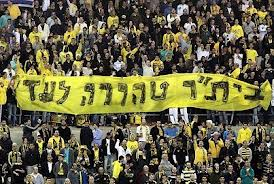
What do you do about situations we’ve been reading about recently? I’m talking about the reports of fan racism in soccer in Israel. Israel has suffered a few difficult instances in the last few years with respect to violence against Arabs and Palestinians. But the sports context seems to exacerbate the problem and provide a context for a poison cocktail of attitudes, energized competition, and ignorance that produces a combustible mixture of racism.
Recently, plans by Beitar Jerusalem soccer club to add its first Muslim players prompted violent and racist incidents in Israel. During a recent match between Beitar and a team from Umm El Fahm hundreds of police had to be deployed. Beitar Jerusalem fans held up the banner above(which reads “Beitar will remain pure forever”) which connotes very unpleasant references to “group purity” an attitude that Jews – at least most Jews – would like to forget. Beitar gets its name from the youth movement, linked to Herut the forerunner of Likud, which opposes Israel’s Arab neighbors. The team name symbolizes a position of honor in Israeli youth movements. Some Beitar fans lead chants calling the Arabs offensive names, which prompts the Arab teams to call out “Allahu akbar.” Some Israeli teams do include Arabs but not Beitar.
The sports environment activates group level perceptions that cause fans and players to identify even more strongly with their national and ethnic group. Sports is a team activity and it is thus easier to foreground a collective group identity. The “individual” versus “group” level of perception is exaggerated in the sports context. People can feel threatened or vulnerable and they can feel this on an individual basis or a group basis, and the two levels of perception can be quite distinct with some situations, such as during heated competition, causing greater distance between the two. For example, if a Jew were asked whether or not he feels vulnerable or threatened he might say “no.” He personally feels secure and not threatened. But if you ask that same person whether or not his group (Jews) is vulnerable or threatened he might say “yes” my group the Jews are vulnerable and threatened. Some studies show that the more one feels his or her group is vulnerable or threatened the more conservative they are with respect to social policies and security.
It’s clear that Israel is expressing its insecurities and hardening its own political stances because it increasingly feels threatened and vulnerable at the group level. The sports context and public displays of demands for “purity” (meaning no Arabs) are troubling examples of the increased polarization in the Israeli-Palestinian conflict. Nothing is separated from politics in Israel because conflicts of such intractability permeate the entire society. The whole culture participates in the conflict ethos. Ultimately the goal is to play soccer without charging ethnic tensions. Talk will not solve the problem at the moment but it will one day.
Israeli Elections and the Move to Moderation
The “guide to parties” link is a clear guide to Israeili political parties and their position in Israeli politics. Click on Guide to parties. It is possible to see how Israel has moved to the center a little and the public is not as right wing as the world thinks. The “guide to parties” is a good and clear introduction to the political parties in Israel. It is also reproduced on my Facebook page. Of course, the surprising winner in the 2013 Israeli elections was the political party termed “yesh atid” (there is a future) headed by a newcomer to the Israeli politics Yair Lapid. Some background on Lapid is here: Yair Lapid background here. His victory was surprising to everyone and it will be interesting to watch him develop, or not, into a political leader. Lapid is considered a lightweight by many and as you can see from the background story he is currently fairly unprepared for serious national leadership.
The graph below shows the political blocs in Israel and their relative power in the new 19 Knesset. Netanyahu did not do as well as people expected and in general the Knesset moved to the center. Israelis have spoken and they are concerned with the right wing’s recalcitrant positions with respect to the peace process and settlers. One should not overstate Netanyahu’s loss. He will remain the most powerful person in the government and holds a slim majority of seats. But there will be more moderate voices and Netanyahu will now have to include and deal with political pressures from the center. The answer to Israel’s most basic problem, their relationship with the Palestinians, does not lie in the discourse of the far right. For the last few years the confidence and even arrogance of the settlers has been bolstered. But this election took them down a notch. Here are a few insights and suspicions I have about what will happen after the gritty work of forming a coalition is complete:

First, Netanyahu will try to form a stable coalition that will not fall apart if one group leaves the governing coalition. Pressure to do something about illegal settlements would cause Bayit Yehudi and its leader Naftali Bennett to bolt the coalition under such circumstances. The entire right wing bloc (see chart )is weaker than in the past and will not get its way very easily. Some of the power of the right-wing blocs will be redeployed to left of center Yesh Atid.
Second, the success of Lapid and Yesh Atid will be fascinating to watch and potentially important. Lapid has been clever so far and avoided alliances that might have hurt him. I spoke with some Israeli friends who think that Lapid will sell out to Netanyahu quickly and easily , and others who think he will remain more independent. In either case, he is in a position to form a powerful center bloc that can mediate some of the more conservative successes of the past. Lapid truly appeals to the Israeli center and is in a position to be very influential.
Third, the Arab parties continued to be a puzzle. Their turnout is low and their influence is less than it should be. If they were more engaged in the political process and had some increased respect for Israel’s democracy they would get more from their government. Of course, the Israeli right concludes that they are oppositional for a reason, which is to contribute to the failure of the political system and Israel in general.
Still, actual change will be slight. Netanyahu will form his third government and the coalition will be reasonably close to what it already is. We will have to keep our eye on Netanyahu to see whether he pivots toward the center or keeps his conservative coalition and moderates some of his positions. My guess is that there will not be much new under the sun.
Just in Final Results here.
Top 10 Anti-Semitic Slurs: Anti-Semitism or Legitimate Criticism of Israel
Below is the list of top 10 anti-Semitic slurs for 2012 from the Simon Wiesenthal Center. All but one of these contributions for the year concerns me. I always look at the statements and spend a moment chagrined and admittedly a little shaken that such discourse actually characterizes the consciousness of certain individuals and groups. But that aside, the slurs bring up the tension between legitimate criticism of Israel and anti-Semitism. This is a fine interpretive line that speaks to the issue of Israel as a legitimate target of political criticism, and the use of such criticism as an anti-Semitic tool. Moreover, it’s an excellent example of the distinction I like to make for students between perspective and bias. Top 10 Anti-Semitic Slurs.
Look at #9 by Jakob Augstein who is a contributor to Spiegel online. There is currently a bit of a fury in Germany over the decision by the Wiesenthal Center to list Augstein here. Augstein is a respected journalist and surely doesn’t belong in the same categories as the Muslim Brotherhood, Hamas, the Golden Path, and Farrakhan. Moreover the issues of Israel’s nuclear arsenal, powerful political lobbying, and conservative trends in the society are legitimate issues worthy of discussion and argumentation.
One can be a respected journalist raising legitimate issues and still be quite misleading, exaggerated, and uninformed. I do not think these comments by Augstein rise to the level of anti-Semitism and do not think he should have been lumped in with the likes of the other 9 contributors. His words and style are inflammatory and certainly lacked nuance. Comparing traditional observant Jews to the sort of “Islamism” that is triumphalist in nature and promotes violence is a silly comparison based more on exaggerated rhetorical strategies rather than fact. An unfair and unjustified moral equivalency is typically the rhetorical strategy used by those characterized more by bias than perspective. The same sort of exaggeration applies to the claims about the undue influence of the Jewish lobby. It is true that the Jewish lobby in the United States is effective and strong but it does little more than successfully defend its interests in a democratic manner. There is a Saudi lobby and a Pakistani lobby and on and on. The Jewish lobby engages in the democratic process and does so successfully. But the argument that Jewish influence distorts foreign-policy is based on the assumption that there is a “correct” foreign-policy that is being subverted. If a group wants to counter the influences of the Jewish lobby then organize and come up with better arguments.
Again, I think Mr. Augstein is critical of Israel and does not do a particularly good job of defending such a position – and there is plenty to disagree with – but the charge that the statement in #9 is anti-Semitic is unjustified. Jews and Israelis who are overly sensitive to the potentialities of anti-Semitism must also work to make the distinction between a perspective based on legitimate issues critical of Israel and anti-Semitism. Staining someone with the charge of anti-Semitism, when it is only a knee-jerk response and not clearly justified, shuts down legitimate debate about Israel as a political entity and strangles the communication process.
We have to do the hard work and make the distinction between anti-Semitism and criticism of Israel on the basis of argument and substantive issues. Sure, some critics of Israel are blatant anti-Semites. Showing movies of the Protocols of the Elders of Zion is clearly anti-Semitic; the vacant eyed whack job surrounded by guns holed up in a mountain cabin somewhere who blames the Jews for the world’s problems is anti-Semitic; comparing Israel to Nazi Germany is anti-Semitic. Even the apartheid comparison is problematic. A careful and considerate comparison between Israel and South Africa, on the basis of the best political theory and history, does not justify in any way such a comparison even though there are issues of difficult population concentration.
But making civil rights and political arguments about occupancy of the land, the status of Palestinians after their dispersal in 1948, refugees, borders, settlements, and security considerations is not anti-Semitic. These issues are not treated seriously when they are viewed as manifestations of racism and anti-Semitism. And sometimes anti-Semites attach themselves, like barnacles on the bottom of the boat, to those making legitimate criticisms of Israel. They attempt to move the discussion from quality argumentative confrontation to “delegitimization” of Isreal. Sometimes the difference between anti-Semitic intentions and fair criticism is difficult but it is a difficulty we must continue to grapple with.
Also posted in:
The “Business” of Peace
Establishing new relationships between adversaries is always a primary goal of the peace process. There is much in the research literature that talks about transforming relationships and typically this discussion focuses on changing attitudes, stereotype reduction, and humanizing the other. But one relationship change that receives relatively little attention but is quite effective is the process of what I call “rationalizing” relationships. Rationalized relationships are based less on personal intimacy and more on instrumental and pragmatic interdependencies. “Business relationships” are the best examples of a rationalized relationship where the two parties benefit and interact on a regular basis but do not have to be personal. Of course, an ideal goal rooted in theories such as the contact hypothesis would be to improve the quality and personal nature of the relationship since this mitigates various tensions. But this more personalized relationship is not the primary goal.
These “business relationships” are slightly different from the political relationships I wrote about on October 29th because they are less oriented toward problem-solving. Still, emotional attachment to the other is less important than the realization of interdependence and the need for practical coordination. This form of a communicative relationship serves as a useful starting point for conflict resolution, and allows minority groups in multicultural societies to establish mature relationships with the dominant group. Business relationships treat others as respectful partners that have common interests in problem resolution as much as anything else. The experience of rationalized relationships is quite compatible with the ability to sustain “reasonable disagreement.”
Business relationships recognize self-interest but develop a relationship that rests on equitable self-interest; that is, a relationship where each attends to the utilitarian and practical needs of the other. These rationalized business relationships entail, above all else and as in friendship a habit of attention by which participants in a conflict are attuned to the balances and imbalances in what they are giving up for each other. Business relationships are less concerned with intimacy because intimacy is reserved for relatively few relationships that are more absorbing and based on sacrifice and strong identity with the other. But utilitarian business relationships can apply to large numbers of people and is focused on the pragmatics of resource gratification. Parent-child, ruler and ruled, or superior- subordinate relationships are not business relationships because they limit the autonomy and agency of one person (the child, ruled, or subordinate) and are based on maximization of differences. In short, the business relationship is central to the problems associated with multicultural contact and the ability of groups to develop their capacities for trust and communication.
Recently, a United States Institute of Peace special report (special report 315) outlined the ways in which the business sector could foster peace and assist with the conflict resolution process. The relationship between business and peace is certainly complex and potentially fraught with problems of ownership, ethics, corruption, tribalism, and preoccupation with narrow market interests. And there is a line of research that points to how business exacerbates problems and can be a source of strife and tension. For example, the routine operations of a company can have negative effects on the local community, degrade the environment, and engage in unfair labor practices. But business can also sustain peace because it is based in nonviolence and consensus ethical relationships. The USIP report describes five main areas in which business relationships can be promoted of peace.
The first is economic activity which helps alleviate the relationship between poverty and violence. Jobs and a vibrant business environment creates a context for people of different religious and ethnic backgrounds to work on common goals. Cisco Systems, for example, connects Palestinians and Israelis through a $10 million investment in Palestinian technology development.
Secondly, there are benefits that accrue by respect of the rule of law associated with international labor standards. Businesses with strong ethical commitments are powerful models for the value of respecting the rule of law and clearly an avenue of peace.
A commitment to good organizational citizenship, which includes attention to local community and culture, stimulates a positive social environment and teaches the lessons of responsibility. Moreover, these relationships develop outside the company and establish an organizational-cultural relationship that engenders trust and promotes the habits of democracy.
The interaction between track one and track two diplomacy is a fourth feature of business relationships that helps lessen tensions. Business leaders can partner with government leaders to address political challenges. Finally, businesses can engage in assessment of practices that are particularly suited to the political environment. By paying attention to the unique concerns of employees, customers, and suppliers business relationships continue to rationalize the political culture.
USIP report 315 outlines these issues in more detail and extend the discussion of the relationship between business prosperity, the relationships that business engenders, and political stability and conflict prone environments.
Israel, Islam, and the Muscular Left
Hezbollah rockets often have sayings written on them such as “Remember the Khaybar, the armies of Mohammed will return.” Or it is not uncommon in a moment of victorious joy to hear a Muslim call out “Remember the Khaybar.” Khaybar was a battle in 629 where the prophet Mohammed defeated Jewish tribes. This victory is typically recalled in the chants and sayings expressing military victory and the defeat of the Jews.
The old European left, forged in the fires of Nazism and Fascism, identified with Jews and the struggling State of Israel. The left understood Jewish suffering and supported the State of Israel as a justifiable political collective deserving of national and political identity. Israel was understood to be emerging in the tradition of freedom and the struggle against oppression of all types. This was a time in the history of the left when they made distinctions and substantive decisions. It was a time when oppression and terrorism were clearly unacceptable and could not be justified by any argument. Historically, leftist and progressive political ideology was responsible for the defeat of Nazism, Fascism, and the development of human rights.
But in the last couple of decades the intellectual left has lost its moral compass and has now never met a minority group that did not consider oppressed. The European and American left are getting weaker and less able to defend themselves as a voice of moral legitimacy and progress. Israel is a very good case in point. Once, Israel was the darling child of the left because they had suffered so much discrimination, betrayal, and extermination. 50 years ago the State of Israel was bathed in the celestial glow of growing political strength and national identity. A longtime oppressed people were reconstituting themselves in their ancient homeland.
I grant you the changing conditions on the ground – settlements, checkpoints, and Israel’s military strength. But this is part of what I mean when referring to the left’s inability to make distinctions and decisions. They seem to be unable to distinguish between the peaceful and democratic trends in Israel and a discriminatory religious state. The left’s ideology has circled around and flanked itself. They now see everything filtered through a colonialism lens and robotically take the side of the smaller minority group. This is true in Vietnam, Rhodesia, Israel, and other causes such as Hugo Chavez in Venezuela. The rigid blindness caused by this colonialism lens is evidenced by the number of political regimes that are thoroughly authoritarian and repressive but still receive the sympathy of the left, especially the European left. And they have occasionally made the distinction between vulnerable European Jews and Israel as a modern-day Sparta, but this distinction between Israel and Jews is indefensible. The left’s ideological criticism of Israel coupled with Islam’s blatant anti-Semitism makes for a combustible situation. Even Christopher Hitchens, who later in life gravitated toward the muscular left in his support of the Iraq war, maintained his criticism of Israel right up until his end.
A Muscular Left
I would encourage you to read a statement on muscular liberalism called the Euston Manifesto. It is a document that tries to reinvigorate progressive politics by focusing on egalitarian liberalism and democratic commitments that are true to authentic liberal values in the actual tradition of the term and not so flexible so as to include defending all sorts of anti-liberal causes such as extremist Islam. Muscular liberalism makes no apology for tyranny; there are no excuses to “understand” violence and repressive regimes that harm their own people and stifle political progress. The muscular left does not countenance apologies and drawn out explanations designed to justify violence and repression.
Egalitarian politics has always been a staple of the liberal tradition especially between ethnic communities because even after peace treaties are signed it is interpersonal and cultural equality and respect that makes for lasting peace. A muscular liberal tradition accepts differences of opinion and perspective as normal and requires contentious issues to be solved through the communication process. The only legitimate battles are rhetorical and argumentative designed to manage conflict.
The left must remember that it once apologized for Stalinism and Maoism. The modern version of these apologetics is making excuses for suicide terrorism and religious extremism. Muscular liberalism challenges anti-democratic forces wherever it sees them – even if they emerge from historically oppressed groups.
How to Respond to Radical Islam
The post below was originally published in HartfordFAVS. You can access it here.
There are two ways to begin to approach the problem of radical Islam. The first is political and sees radical Islam as a problem of political will and development. The first question to ask here is, “what are the goals of an Islamist group?” Is the goal one of military takeover of the geographic area, or the spread of ideological and religious Islam? Take the case of the Gaza Strip and Hamas. Much of Hamas is militaristic and seeks political control of the Gaza Strip. Other elements, mostly smaller elements, want to impose religious law and work with offshoot groups that are Salafi-Jihad groups.
Hamas in Gaza receives international attention for its conflict with Israel but they also compete with other groups that are more radically Islamist in nature – even though the numbers are small and they are poorly organized. The competition is between principles of political Islam and not so much about military strength. There are more than a few members of the Hamas leadership who have little interest in debating political Islam and find these Salafi-Jihad groups to be annoying at the moment. Most Hamas leadership prefers to spend their time threatening Israel and organizing the Gaza Strip rather than finding new ways to express political Islam. In fact, there are times when Hamas has quite an oppositional and antagonistic relationship with these religiously-based groups. One leader of a radical Islamist group a couple of years ago challenged Hamas and declared in Islamic emirate in Palestine and demanded that Sharia law be imposed. At present, Hamas resists these groups and prefers to keep them at a distance while they maintain their more contentious relationship with the PLA and Israel.
So what is the best way to challenge and perhaps overcome radical Islam? These groups are very extreme, wishing to reestablish the Caliphate and bring all Muslims under a single rule, and removing anyone (especially Israelis) from what they considered to be Islamic holy land. And they usually classify declared Islamic states such as Saudi Arabia and Iran as illegitimate because they are not Islamic enough. This leads to infighting among Islamist groups and is troubling and destabilizing for governments. Governments in Central Asia and other places have contributed to the problem by engaging in strong repression. This radicalizes the group and forces them to respond even more aggressively. Worse yet, these groups can give governments a license to carry out violent retaliation that usually exacerbates the problem. Below are some suggestions for dealing with groups with a dangerous agenda and a threatening form of political Islam. All of these suggestions are based on the assumption that authoritarian political systems, which are economically undeveloped and lack legitimate democratic outlets for conflict resolution, contribute to the popularity of these groups and encourage citizens to turn toward them.
- Governments confronting extremist Islamic groups must establish conditions for these groups to operate within legal confines of democracy. In other words, the government should allow Islamist groups to organize and express themselves on the basis of free symbolic behavior. This allows citizens to begin the habits of listening to alternatives. Imposing repressive sanctions on these grou I ps drives them underground and radicalizes them.
- Begin a program to work with young people explaining the consequences of political Islam. People in a community in general should develop more knowledge about religious issues and various leaders. What will it mean for the state to adopt or Islamic principle and its governance? Include in these discussions secular political groups as well.
- Allow democratically defended opportunities for criticism and complaints. This must be done within the confines of the law and proper modes of political expression. The press of course can be a good platform for the presentation of issues and ideas.
- Use the language of Islam to understand the language of extremist Islam. That is, the best way to challenge the political ideology of extremist Islam is within the discourse of Islam itself. This will require using imams and scholars to engage in such debate.
- Maintain proper control of police and security forces. They should be used mainly to control and manage criminal behavior and not to stifle political activity.
Steps in this direction will prevent Salafi-jihad groups from radicalizing and going underground which makes them only more secretive and difficult to manage. By eliminating the conditions under which these groups thrive, it becomes possible to control them. The process is difficult and slow but more open political systems, economic development, and freedom of expression will keep these groups exposed and under more control.
Palestinian Labor Pains
The vote in the United Nations to grant the Palestinians nonmember observer status was certainly as expected. Those supporting the move were overwhelming with 138 countries voting in favor, 9 against, and 41 abstentions. The vote was testimony to the international public relations campaign that has evolved over the decades to establish the Palestinians as a political and legal entity. But I do not mean that cynically. There is no simple state agency or decision-making mechanism that determines precisely when a collection of people have cohered enough to be considered a particular ethnopolitically identified group. There are rules of thumb and good practices such as a history of cultural continuity, recognizable borders, established political institutions, and a desire for statehood, but conclusions about when these things have been sufficiently achieved remain at least somewhat subjective. That’s why there’s always a little bit of “persuasion” or as I referred to it above “public relations” involved in convincing the world that official recognition is justified.
In earlier posts on this blog (April 17, June 5, September 19, and September 25) I argued against the Palestinian effort to achieve recognition by the United Nations. See those posts for details, but I essentially signed on to a series of disadvantages such as (1) making it more difficult to negotiate with Israel, (2) damaging or even voiding the Oslo accords, (3) confusing security arrangements, (4) failing to make progress on unity between Hamas and the PLA, (5) annoying Israel and the United States who oppose UN recognition, and others.
Yet, it is pretty difficult to be in favor of the two-state solution and be overly critical of this latest development. In one sense, Netanyahu got what was coming to him. He has been sufficiently difficult and intransient such that the Palestinians were forced to entertain alternatives. Part of the hue and cry by supporters of Israel is little more than the painful recognition that a Palestinian state, in the real sense of the term, might actually happen. The phrase “two-state solution” has become a cliché, a shibboleth that rolls easily off the tongue but doesn’t really taste very good.
I would still argue that the best solution is for direct negotiations between the Palestinians and the Israelis. But I have softened my position a little and believe that the new United Nations status for Palestinians might be early labor pains that will one day give birth to a state. I would reiterate that a two-state solution is best for the maintenance of Israeli identity and Israel’s democracy. No other political solution to the relationship between Israelis and Palestinians guarantees the unity of the State of Israel based on Jewish particularity. Netanyahu can claim to be amenable to a Palestinian state one day all that he wants, but he is simply incapable – to use an unfortunate metaphor – of pulling the trigger. You could never convince me that a Palestinian state will be established on Netanyahu’s watch.
This is a first step and a baby step to be sure. Of course, being designated an observer state is mostly symbolic but not completely. The Palestinians will improve their international standing, call greater attention to themselves, and have an internationally legitimate body from which they can express themselves. It will also give them access to the International Criminal Court as well as participation in certain UN agencies. It is not full membership or recognition, but it is not unimportant.
Not much will change, however. Mahmoud Abbas even in his formal UN speech was graceless enough to refer to Israel as racist and colonialist. Netanyahu announced that the UN action “will not change anything on the ground.” He strongly asserted that Israel will not compromise its security and that “peace can only be achieved through negotiation between the sides…” Abbas asked the United Nations to issue Palestinians a birth certificate and that is fair enough. But the Israelis have to prepare for the new arrival by controlling settlers, negotiating in good faith, and recognizing at least certain aspects of the Palestinian narrative. The PLA must find some way to control Hamas and continue their recognition of Israel. Nothing really has changed on the ground, but the Palestinians do have a new toy.
Photo Manipulation by Hamas in Gaza
Photo manipulation has been with us a long time. There are two types of manipulations: the first is to alter the image and the second is to simply deceive the viewer about the content or story behind the image. Lesser artists tried to copy the great masters and pass them off as originals. In later years images were touched up with ink, double exposure, and airbrushing. But the possibilities for manipulation of photographic images with the advent of the digital age increased exponentially. It also has become easier to copy and send images such that they circulate and take on a reality of their own. An image can be false or deceptive but millions of people have been exposed to it before discovering the deception. Take the example below:

This is the sort of disinformation that can be easily spread by manipulating images. The picture of the dead child spread quickly across the Internet and was described as a dead girl in the arms of the Palestinian Prime Minister Ismail Haniyeh. The child was killed during the Gaza war in December 2012 and, as reported by Palestinian sources, was killed by an Israeli rocket. But according to Honest Reporting, a website that tracks deception and manipulation, the child was not killed by Israel but rather an errant rocket fired by Hamas. This image spread through Twitter and Facebook and imprinted itself in the minds of many before the correction.
The picture below is of an Israeli child wounded by Palestinian rockets. You can see the Hebrew lettering on the jacket of the man holding the child and, as the picture points out, the coat of arms in the upper left is of the city in southern Israel Kiryat Malakhi.

In a very real sense, everything about a photographic image has the potential for manipulation and untruths. Beginning with the choice of lens, available light, and how close or far to stand from the subject a photographer makes ethical decisions. And it is certainly possible to manipulate an image in the interest of increasing accuracy or improving the emotional impact for artistic reasons. But these composition decisions are more controllable and subject to standard considerations than blatant lies about the content of a photograph.
The press has a particularly important relationship between photographic images and their publication. There is a fiduciary relationship between the press and the public. And the press should not be in the position of corrupting this relationship. Granted, simply uploading an image to the Internet and making a false claim about it is easier because the individual and the Internet audience have no fiduciary relationship. This does not make the act of lying about an image any less despicable but the perpetrator gets away with it because he’s not turning a sound relationship into an impure one.
One consequence of this easy deception is a loss of faith in the photojournalistic profession and the power of the visual image. Since the goal of political photographs or journalistic photography is to reproduce accurately some social or political reality a powerful source of truth and emotion is lost as confidence in the accuracy of images diminishes.
To extend the Churchillian metaphor from the photograph above, truth has to get its pants on faster. This is an issue of the distribution of images rather than their compositional manipulation. Visual processing is powerfully analogic and impressionistic and only takes a few seconds. The old refrain of “a picture being worth 1000 words” is true enough. The deadening cynicism that results from exposure to too many manipulated, exaggerated, and false visual images makes it even more difficult for quality images to do the work for which they are intended. These visual “lies”, perpetrated mostly by Hamas detract from the peace process and exacerbate the conflict rather than mediate it. Agreement on disallowing these practices must be part of a final peace process, otherwise truth will not only be slow to get its pants on it will trip over itself.



 Peace and Conflict Politics