Blog Archives
The Palestinians are the New Cubans: The Emerging Red-Green Alliance
Karagiannis and McCauley have written an excellent article on the interesting alliance between the left and political Islam. It can be found here. A summary is below.
By Emmanuel Karagiannis, Ph.D. and Clark McCauley, Ph.D
It seems that the end of Cold War has brought an end to the enmity between communism and Islamism. Indeed, there are growing signs that an informal alliance is forming between political Islam and the radical Left, both at the state level and the level of groups and movements. Tehran has reached out to left-leaning regimes in Bolivia, Nicaragua and Ecuador, offering energy and trade. Europe’s Islamists and leftists have also joined forces. In March 2012, British firebrand socialist Galloway and his pro-Hamas Respect Party scored a sensational victory in Bradford West (a heavily Muslim-populated district) by-election, gaining 55,9 percent of the vote. Although this emerging alliance may appear as a tactical marriage of convenience between two fundamentally different political philosophies opposing the West, Reds and Greens have more in common than they dare to admit.
First, Islam and communism emphasize group goals over individual interests. Both seek to establish a society based on sacred texts: the Quran for the Islamists and the works of Marx and Lenin for leftists. Furthermore, they offer a vision of a just society that can be created on earth: the Marxist utopia of a classless communist society parallels the utopian vision of a restored Caliphate. Both claim to represent an absolute truth that would lead to the salvation of mankind. Both have an eschatological view of history that includes the inevitability of a final battle between good (socialist progress / Dar al-Islam) and evil (capitalist reaction / Dar al-Harb), and both can justify violence to achieve this goal.
Islamists and leftists have been keen to present themselves as part of the wider anti-globalization movement. A common denominator of the anti-globalization movement is its claim that big capitalism is inherently unjust in serving the interests of Western elites to the detriment of (working and Muslim) masses around the world. It is hardly a coincidence that Hezbollah’s new manifesto, published in December 2009, spends a great deal of time attacking “an economic system that only views the world as markets that have to abide by America’s own view”. Also, leftist groups have championed the cause of anti-globalization as the preferred form of anti-imperialism. The rationale has changed but leftists’ enemies are the same.
Moreover, both Islamists and leftists have portrayed the United States as the foremost imperialist power. This kind of framing resonates well for both, but for different reasons. For leftists, the U.S. involvement in the greater Middle East is outright imperialism the way Lenin described it. For the Islamists, American wars in the Middle East are just another episode in a long line of Western interventions to grab resources and land from the ummah. It is not rare to see pro-Hezbollah banners and posters of Nasrallah in leftist demonstrations in European cities.
Opposition to Israel has been another common obsession for Islamists and leftists. What brings together Islamists and leftists is deep hate for what, in their eyes, Israel represents. From the Islamist point of view, the establishment of the Jewish State was orchestrated by the Christian West to steal Muslim land in a repetition of the Crusades. For leftists, Israel must be fought as Washington’s colonialist ally in the Middle East. Recognizing Israel as the keystone of the Red-Green alliance, Iran’s President Ahmadinejaz has made the Palestinian issue his ideological core. He knows that for the radical Left, from Latin America to Europe and North Korea, the Palestinians are the new Cubans—the new Vietnamese who need international solidarity. By extension, befriending Iran is a logical thing to do for anyone who supports the Palestinian cause. Much to Tehran’s delight, Venezuela and Bolivia suspended diplomatic ties with Israel following the Gaza crisis in 2009, as did Nicaragua in response to the Gaza flotilla raid in June 2010.
No matter how unlikely it may seem, leftists and Islamists have come closer in recent years. Despite a long history of animosity and conflict, the two sides have joined efforts to confront the United States, Israel, and the West. Antiglobalization, anti-American and anti-Israel sentiments have provided a common framework justifying joint action for the sake of working and Muslim masses.
Group Level Perceptions and Racism in the Israeli-Palestinian Conflict
When grappling with the difficult issues of intractable conflicts and how to moderate them one always encounters the “contact” solution; in other words, the two competing groups must get together and begin the process of communicating in such a way that the differences dissipate. There is sound research supporting such a suggestion and my own work, along with many others, is deeply focused on the processes of difficult conversations – or, as some term, dialogue.
There is always then a chorus of people who chuckle and say “this won’t work”. The depth and intensity of the conflict between the two parties, so the claim goes, is so great that talk is a waste of time. Well, this is true sometimes. I know of no serious scholar who believes that talk is magic, but I also know of no serious scholar who doesn’t recognize the centrality of interaction, contact, and some properly controlled form of dialogue.
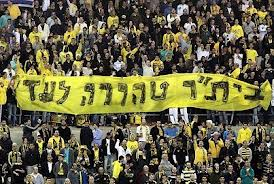
What do you do about situations we’ve been reading about recently? I’m talking about the reports of fan racism in soccer in Israel. Israel has suffered a few difficult instances in the last few years with respect to violence against Arabs and Palestinians. But the sports context seems to exacerbate the problem and provide a context for a poison cocktail of attitudes, energized competition, and ignorance that produces a combustible mixture of racism.
Recently, plans by Beitar Jerusalem soccer club to add its first Muslim players prompted violent and racist incidents in Israel. During a recent match between Beitar and a team from Umm El Fahm hundreds of police had to be deployed. Beitar Jerusalem fans held up the banner above(which reads “Beitar will remain pure forever”) which connotes very unpleasant references to “group purity” an attitude that Jews – at least most Jews – would like to forget. Beitar gets its name from the youth movement, linked to Herut the forerunner of Likud, which opposes Israel’s Arab neighbors. The team name symbolizes a position of honor in Israeli youth movements. Some Beitar fans lead chants calling the Arabs offensive names, which prompts the Arab teams to call out “Allahu akbar.” Some Israeli teams do include Arabs but not Beitar.
The sports environment activates group level perceptions that cause fans and players to identify even more strongly with their national and ethnic group. Sports is a team activity and it is thus easier to foreground a collective group identity. The “individual” versus “group” level of perception is exaggerated in the sports context. People can feel threatened or vulnerable and they can feel this on an individual basis or a group basis, and the two levels of perception can be quite distinct with some situations, such as during heated competition, causing greater distance between the two. For example, if a Jew were asked whether or not he feels vulnerable or threatened he might say “no.” He personally feels secure and not threatened. But if you ask that same person whether or not his group (Jews) is vulnerable or threatened he might say “yes” my group the Jews are vulnerable and threatened. Some studies show that the more one feels his or her group is vulnerable or threatened the more conservative they are with respect to social policies and security.
It’s clear that Israel is expressing its insecurities and hardening its own political stances because it increasingly feels threatened and vulnerable at the group level. The sports context and public displays of demands for “purity” (meaning no Arabs) are troubling examples of the increased polarization in the Israeli-Palestinian conflict. Nothing is separated from politics in Israel because conflicts of such intractability permeate the entire society. The whole culture participates in the conflict ethos. Ultimately the goal is to play soccer without charging ethnic tensions. Talk will not solve the problem at the moment but it will one day.
Palestinian Labor Pains
The vote in the United Nations to grant the Palestinians nonmember observer status was certainly as expected. Those supporting the move were overwhelming with 138 countries voting in favor, 9 against, and 41 abstentions. The vote was testimony to the international public relations campaign that has evolved over the decades to establish the Palestinians as a political and legal entity. But I do not mean that cynically. There is no simple state agency or decision-making mechanism that determines precisely when a collection of people have cohered enough to be considered a particular ethnopolitically identified group. There are rules of thumb and good practices such as a history of cultural continuity, recognizable borders, established political institutions, and a desire for statehood, but conclusions about when these things have been sufficiently achieved remain at least somewhat subjective. That’s why there’s always a little bit of “persuasion” or as I referred to it above “public relations” involved in convincing the world that official recognition is justified.
In earlier posts on this blog (April 17, June 5, September 19, and September 25) I argued against the Palestinian effort to achieve recognition by the United Nations. See those posts for details, but I essentially signed on to a series of disadvantages such as (1) making it more difficult to negotiate with Israel, (2) damaging or even voiding the Oslo accords, (3) confusing security arrangements, (4) failing to make progress on unity between Hamas and the PLA, (5) annoying Israel and the United States who oppose UN recognition, and others.
Yet, it is pretty difficult to be in favor of the two-state solution and be overly critical of this latest development. In one sense, Netanyahu got what was coming to him. He has been sufficiently difficult and intransient such that the Palestinians were forced to entertain alternatives. Part of the hue and cry by supporters of Israel is little more than the painful recognition that a Palestinian state, in the real sense of the term, might actually happen. The phrase “two-state solution” has become a cliché, a shibboleth that rolls easily off the tongue but doesn’t really taste very good.
I would still argue that the best solution is for direct negotiations between the Palestinians and the Israelis. But I have softened my position a little and believe that the new United Nations status for Palestinians might be early labor pains that will one day give birth to a state. I would reiterate that a two-state solution is best for the maintenance of Israeli identity and Israel’s democracy. No other political solution to the relationship between Israelis and Palestinians guarantees the unity of the State of Israel based on Jewish particularity. Netanyahu can claim to be amenable to a Palestinian state one day all that he wants, but he is simply incapable – to use an unfortunate metaphor – of pulling the trigger. You could never convince me that a Palestinian state will be established on Netanyahu’s watch.
This is a first step and a baby step to be sure. Of course, being designated an observer state is mostly symbolic but not completely. The Palestinians will improve their international standing, call greater attention to themselves, and have an internationally legitimate body from which they can express themselves. It will also give them access to the International Criminal Court as well as participation in certain UN agencies. It is not full membership or recognition, but it is not unimportant.
Not much will change, however. Mahmoud Abbas even in his formal UN speech was graceless enough to refer to Israel as racist and colonialist. Netanyahu announced that the UN action “will not change anything on the ground.” He strongly asserted that Israel will not compromise its security and that “peace can only be achieved through negotiation between the sides…” Abbas asked the United Nations to issue Palestinians a birth certificate and that is fair enough. But the Israelis have to prepare for the new arrival by controlling settlers, negotiating in good faith, and recognizing at least certain aspects of the Palestinian narrative. The PLA must find some way to control Hamas and continue their recognition of Israel. Nothing really has changed on the ground, but the Palestinians do have a new toy.
Photo Manipulation by Hamas in Gaza
Photo manipulation has been with us a long time. There are two types of manipulations: the first is to alter the image and the second is to simply deceive the viewer about the content or story behind the image. Lesser artists tried to copy the great masters and pass them off as originals. In later years images were touched up with ink, double exposure, and airbrushing. But the possibilities for manipulation of photographic images with the advent of the digital age increased exponentially. It also has become easier to copy and send images such that they circulate and take on a reality of their own. An image can be false or deceptive but millions of people have been exposed to it before discovering the deception. Take the example below:

This is the sort of disinformation that can be easily spread by manipulating images. The picture of the dead child spread quickly across the Internet and was described as a dead girl in the arms of the Palestinian Prime Minister Ismail Haniyeh. The child was killed during the Gaza war in December 2012 and, as reported by Palestinian sources, was killed by an Israeli rocket. But according to Honest Reporting, a website that tracks deception and manipulation, the child was not killed by Israel but rather an errant rocket fired by Hamas. This image spread through Twitter and Facebook and imprinted itself in the minds of many before the correction.
The picture below is of an Israeli child wounded by Palestinian rockets. You can see the Hebrew lettering on the jacket of the man holding the child and, as the picture points out, the coat of arms in the upper left is of the city in southern Israel Kiryat Malakhi.

In a very real sense, everything about a photographic image has the potential for manipulation and untruths. Beginning with the choice of lens, available light, and how close or far to stand from the subject a photographer makes ethical decisions. And it is certainly possible to manipulate an image in the interest of increasing accuracy or improving the emotional impact for artistic reasons. But these composition decisions are more controllable and subject to standard considerations than blatant lies about the content of a photograph.
The press has a particularly important relationship between photographic images and their publication. There is a fiduciary relationship between the press and the public. And the press should not be in the position of corrupting this relationship. Granted, simply uploading an image to the Internet and making a false claim about it is easier because the individual and the Internet audience have no fiduciary relationship. This does not make the act of lying about an image any less despicable but the perpetrator gets away with it because he’s not turning a sound relationship into an impure one.
One consequence of this easy deception is a loss of faith in the photojournalistic profession and the power of the visual image. Since the goal of political photographs or journalistic photography is to reproduce accurately some social or political reality a powerful source of truth and emotion is lost as confidence in the accuracy of images diminishes.
To extend the Churchillian metaphor from the photograph above, truth has to get its pants on faster. This is an issue of the distribution of images rather than their compositional manipulation. Visual processing is powerfully analogic and impressionistic and only takes a few seconds. The old refrain of “a picture being worth 1000 words” is true enough. The deadening cynicism that results from exposure to too many manipulated, exaggerated, and false visual images makes it even more difficult for quality images to do the work for which they are intended. These visual “lies”, perpetrated mostly by Hamas detract from the peace process and exacerbate the conflict rather than mediate it. Agreement on disallowing these practices must be part of a final peace process, otherwise truth will not only be slow to get its pants on it will trip over itself.
Obama’s Last Term and the Middle East: What’s Next?
It is common political wisdom that things change when a president is elected to a second term because he is no longer constrained by the need to be reelected. He can govern in a more freewheeling manner consistent with his most deeply held convictions and the next election be damned. This is a slight simplification since presidents have other obligations and limits on their behavior, but it remains true that a second term in office makes it more possible to legislate for one’s legacy. So how will Obama’s second term in office change his approach to the Middle East and Israel in particular? I think there are three changes we might see during Obama’s second term.
First, Obama and Netanyahu need to start over or at least recalibrate their relationship. During his first term Obama was not particularly energized by the Israeli-Palestinian conflict. Of course, he would like to be remembered as the president that achieved the elusive goal of peace but probably realizes that this is unlikely. Still, Obama will not forget that Israel is a true friend and he will continue to support it through good times and bad. Obama and Netanyahu will move closer together and work to achieve common goals and manage common threats. Obama mentioned Israel many times during the campaign and this was more than simple campaign rhetoric. It represented the importance of the Israel-US relationship.
Israel and the US have a long and strong relationship that has changed somewhat but remains a strategic advantage to both. Israel assists the US with security threats and increasingly influences US military research and development. The two countries not only cooperate economically but have strong cultural resonances. Despite the fact that the US jeopardizes its relationships with the Arab world because of its close relationship with Israel, the US continues to balance these relationships. For example the US still relies on stable but nondemocratic countries such as Saudi Arabia to influence interests in the area. This represents US pragmatism as well as fundamental foreign policy convictions. All of this is consistent with Netanyahu’s primary concern for Israel’s safety and security. The relationship between the US and Israel as well as the importance of cooperation (on issues such as a nuclear Iran, terrorist intelligence, foreign aid, and military readiness) will be the foundation for a renewed relationship between Obama and Netanyahu.
Secondly, Obama has other issues in the Middle East he must attend to. Syria is coming apart, a nuclear Iran is coming together, and the politicization of Islam is on the rise. Netanyahu and Israel will certainly be helpful with these matters but, ironically, Israel must be kept at bay otherwise their presence will inflame the situation. But there are limits to what Obama can do to resolve these conflicts. In the cases of Syria and Iran Obama must diplomatically pull strings from the background and this is always slower and more difficult. But one thing is for sure: Obama will be better in managing this than Romney. Obama is more interested in helping Israel with less violence and more compromise and this is important. This is a different perspective than the one from those who supported Romney for president because they thought Obama lacked a clear commitment to Israel.
Obama represents a more diplomatic and a slower foreign-policy hand than either Romney or Bush before him. A second term will ensure that he will be better able to express this agenda. I think Obama will spend more time working with moderate regional states to achieve interests on their own rather than waiting for the United States. For example, the US does not have a taste for supplying Syrian rebels with weapons; thus, Obama will work to triangulate interests of others to form blocks and coalitions that might be better able to achieve goals. Again, this is slower and more frustrating – and leads those with more macho foreign-policy tendencies to be critical – but is closer to an approach that will be successful. International alliances based on common interests of preventing terrorism and stopping those who would intimidate their own citizens are most able to build successes.
A third trend for Obama’s second term should be increased attention to human rights, especially with respect to foreign policy. Obama was actually not very vulnerable to attack from the right during the campaign with respect to strength in foreign policy. His killing of Osama bin Laden, the “surge” of troops in Afghanistan, and his rather casual acceptance of questionable security practices (under the guise of security and strength) have been roundly criticized. Obama has been lax with respect to the promise to close Guantanamo, warrantless wiretapping, and drone attacks. I am convinced that he continued these policies for fear of appearing to be a weak liberal and now that he has no more elections to condition his behavior, Obama will turn his attention to the recognition of human rights. Drone attacks have essentially replaced the interrogation room and courtroom. They deliver a death sentence without confronting the knotty legal questions about interrogation or innocence.
The campaign is over but not the resonances in the deserts of the Middle East. After the world is finished congratulating him on his election victory, they will look to the United States for assistance and guidance. Obama will be more puppetmaster than puppet.
The Two State Solution and the Next Four Years
The cynics among us will believe that nothing much will change in the next four years in the Middle East but that is a particularly narrow view. There have been important changes in the Israeli-Palestinian conflict along with the relationship between the US and Israel. The Bush administration was aggressive in their efforts to reshape the region and trapped in a narrow ideological position that always seemed to favor the military. Obama’s first four years were characterized mostly by patience and changes in certain political conditions such as the Palestinian economy, settlement construction, and security. But Obama did not foreground the Israeli-Palestinian conflict; he did not stake his presidency on it or claim that he had new ideas or directions.
The problem now, and Obama’s most prominent obstacle should he be reelected, is resuscitating the peace process and getting back to discussions about the political viability of the Palestinians. Benjamin Netanyahu’s coalition with the right wing parties is necessary for him to govern but brings about a mix of partners that is thoroughly incapable of making the necessary adjustments that will improve the situation. The tensions between Hamas and Fatah continue and keep the conflict inflamed such that Hamas can interfere with any progress on the part of Fatah. But if Obama gets another four years he might be able to play a more significant role in a two state solution because the main parties – the Israelis and Palestinians – are incapable of reaching an accord on their own.
Things have been quiet of late. There have been few efforts toward settlement and many believe it’s a calm before the storm. Of course the Israeli leadership has been waiting until after the elections (which will be just a few days from now) to see who they will be doing business with. But whomever is elected president must engage in a workable two state solution that addresses the history and aspirations of both sides. Romney, at present anyway, is thoroughly incapable of doing this. A significant campaign plank for Obama has been that a vote for Romney is a vote to return to a way of doing things more characteristic of the Bush administration. This will be equally true in foreign policy as in economic policy. And although Romney is probably more moderate than the campaign represents, I have still seen nothing in his policy or speeches to indicate the sympathy or nuance necessary for genuine settlement of this dispute. At present, the task of solving the conflict is made more complicated by a loss of confidence in the two state solution. The Israeli-Palestinian conflict has become even more dangerous and unsolvable because the most viable and politically legitimate option (the two state solution) is losing credibility.
In the earlier days of the conflict the Palestinians expressed little interest in the two state solution because they saw it as artificial and, more importantly, were clearly not inclined to offering the Israelis a parallel right to a state. Later they came to accept a two state solution but not with full enthusiasm. But a second Obama administration will be in a much better position to inaugurate a state even though conditions are more difficult. Interestingly, there is more enthusiasm for building a Palestinian state among global leaders and Europeans than from the Palestinians themselves. A Palestinian state in the future will provide one barrier against extremism and help with forging coalitions with Iran and other Islamists.
The next president will have to approach the Israeli-Palestinian conflict with skill and sensitivity. There’s a danger that a two state solution is an American solution or, even worse, an Israeli one rather than a mulilateral solution. Many Palestinians feel that the idea of statehood has been distorted and that anything they agree upon would be something other than their own.
There is a real chance that statehood could dissolve into the background as a Palestinian achievement. There’s so much cynicism and lack of confidence in the process that both sides see statehood is an impossible achievement. But Obama is actually in a better position than any previous president to resuscitate the two state solution because of his ability to speak to diverse audiences and thereby improve America’s standing. If Obama actually became engaged in the Middle East peace process and deployed all of his powers of diplomacy he just might succeed.
The world is growing weary of the endless repetition of issues such as security, refugees, Jerusalem, and borders. The entire peace process is filled with slogans and clichés about peace that does not get anyone any closer to goals. Obama is in a position to find a new language to reconnect both sides to their national aspirations and do it in such a way that all sides are strengthened. All of this of course is assuming he is reelected.
Pro/Con One State or Two States
|
The below represents the two general reaction statements to the two state solution. They lack details and represent the general reactive position. It is from: Procon I invite reactions and comments. PRO Israel and/or CON Palestine Statements |
PRO Palestine and/or CON Israel Statements |
| PRO:“Well, there has emerged, over the course of the past ten years at least, a sense that the only way out of the situation in the Middle East is to establish a State of Palestine alongside Israel so that there will be an end of conflict. There is no other solution to end the conflict in reality.There is an international consensus about it as reflected by the so-called Road Map Quartet [the United States, the European Union, Russia and the United Nations], which is after all the whole world. You have the United States, you have Europe, you have the Russians and the United Nations, which is the whole world, and then there is the Arab League, which is twenty-two different states, and there is the previous Palestinian administration, and the Israeli administration, all of them committed to the two-state solution.”
— Ziad J. Asali, MD |
CON:“The paradigm of the Two States will not bring about stability. No! . . . (The Two-State solution) is not relevant. Not relevant . . . (The Palestinian state) will undermine the State of Israel. From there, the confrontation will go on.The State of Israel is ready to give the Palestinians an independent Palestinian state, but the Palestinians are not ready to give us an independent Jewish state . . . Every agreement you make will be the starting point of the next irredenta. The next conflict. The next war.The establishment of a Palestinian state will lead at some stage to war. Such a war can be dangerous to the State of Israel. The idea that it is possible to set up a Palestinian state by 2008 and to achieve stability is disconnected from reality and dangerous.”
— Moshe Yaalon |
| PRO: “The next diplomatic formula that will replace the ‘two states for two peoples’ will be a civilian formula. All the people between the Jordan and the sea have the same right to equality, justice and freedom.. [T]here is a very reasonable chance that there will be only one state between the Jordan and the sea – neither ours nor theirs but a mutual one. It is likely to be a country with nationalist, racist and religious discrimination and one that is patently not democratic… But it could be something entirely different. An entity with a common basis for at least three players: an ideological right that is prepared to examine its feasibility; a left, part of which is starting to free itself of the illusions of ‘Jewish and democratic’; and a not inconsiderable part of the Palestinian intelligentsia.The conceptual framework will be agreed upon – a democratic state that belongs to all of its citizens. The practicable substance could be fertile ground for arguments and creativity. This is an opportunity worth taking, despite our grand experience of missing every opportunity and accusing everyone else except ourselves.” | CON: “Although the one-state approach proposes a united entity between the Jordan and the sea, in fact it represents King Solomon’s original proposal to cut the baby in half. In reality, one state means that Israelis and Palestinians each receive a mutilated and unsustainable version of its national dream. The Palestinians will never get the national self-determination they seek in a Jewish-dominated single state. Jews will achieve neither the democracy and inner harmony they seek (or ought to), nor legitimacy from the world, as long as they obstruct Palestinian rights to national self-expression in their single state – even before Jews become a minority.Finally, this conflict is tragically likely to ignite again over ‘some damn foolish thing in the settlements’ (with apologies to Bismark). A one-state solution not only fails to prevent settlements from ripping into Palestinian land and courting violence, it legitimizes expansion – since there is no border. Sadly, we all need one.” |
Obama Support for Israel Is Strong
One of the least defensible arguments levied against Barack Obama is that he is weak on Israel and does not properly support the security of Israel. This is simply an indefensible position. Essentially the Republican attack machine has made it its business to distort Obama’s record with respect to Israel in an effort to capture Jewish voters. As usual, the strategy has been to take Obama’s recognition of complexity, diplomacy, and slightly more complete understanding of the issues and turn it into a weakness. I grant you that Obama talks about Israel and the Middle East with greater nuance and understanding of what it will really take to solve problems but this does not detract from his support for Israel. He recognizes that Israel is essentially a mirror of the United States and, of course, the importance of security issues for Israel. Those who question Obama simply have to look at the record. Some months ago Obama said that “the United States will always have Israel’s back” and he meant it. I cite just some of the evidence below for how Obama has operationalized his support for Israel.
Apparently, those questioning Obama support for Israel missed the signing ceremony last week of the United States-Israel Enhanced Security Cooperation Act. This was a bill reaffirming the special relationship between United States and Israel and, more importantly, ensuring that Israel has all the necessary weapons and assistance to protect itself. The Enhanced Security Cooperation Act extends loan guarantees to Israel, boosts Israel’s credit rating, and authorizes the sale of $1.6 billion in US weapons available whenever needed. Moreover the law requires that Israel maintain its military superiority in the region and affirms US commitment to defend Israel in the United Nations Security Council.
Obama’s support for a two state solution, consistent with comments made by Netanyahu, is in line with the most prevalent thinking about how to resolve the problem with the Palestinians and maintain the Jewish nature of the State of Israel. The two state solution is increasingly problematic and difficult to impose but it represents strong support for the ethnoreligious core of the Israeli state.
The debilitating sanctions against Iran, who at this time represents the most direct threat to the State of Israel, are mostly the work of President Obama. Iran is now cut off from financial markets, cannot land in many airports around the world, and has oil sales that are a trickle compared to the previous flows. Obama has built an international coalition and stood on the world stage in defense of Israel’s security needs.
Obama’s presidential leadership and staff challenged the international community and prevented the statehood move by the Palestinians in the United Nations. This represented the correct argument that Palestinian statehood should be the result of negotiations between Israel and Palestine, that the establishment of the state through procedures separate from the political realities in which it is embedded would not be recognized by the other nor considered legitimate.
The Obama administration challenged the discredited Goldstone Report which was noteworthy in its biases against Israel and partially responsible for its author distancing himself from his own report. Obama stated clearly that Israel had a right to defend itself when Israel was criticized for its defensive actions off its coast.
It took tremendous courage for Obama to confront the Arab League in Cairo in 2009 and unabashedly declare US support for Israel. Obama told them our support for Israel was steadfast. Expressing some well-placed defensible criticism of Israel (e.g. with respect to the West Bank) should be viewed as part of our support for Israel and its future state; it is certainly no sign of weakness.
A variety of strong Israel supporters, Zionists, and political leaders, from Edgar Bronfman to Ehud Barack call Obama a friend and the leader who has deepened and strengthened the relationship between United States and Israel.
Israel is constantly plagued and harassed by terrorist groups such as Hamas and Hezbollah and Obama supported Israel’s refusal to negotiate with such groups by announcing that “no country can be expected to negotiate with a terrorist organization sworn to its destruction.” Israel’s Dome Missile-Defense System was developed in cooperation with United States and is effective for intercepting Hamas and Hezbollah rockets. It is a security system received during the presidency of Barack Obama.
Obama is a thoughtful and decisive leader who recognizes the importance and cultural resonance of Israel. The argument that he insufficiently supports Israel simply does not hold water. The State of Israel is stronger and more secure today because of Barack Obama.
Thank You Bob Costas for Remembering the Tragic Munich Olympics
Bob Costas asked the International Olympic Committee to have a moment of silence in memory of the slain Israeli athletes in the 1972 Munich Olympics. The IOC rejected the request offering the usual argument about not wanting to politicize the games, a standard they do not always hold themselves to. Costas, who should be commended for his courage and dignity, told the IOC that he was going to remember the moment anyway and is planning something for the opening ceremony.
I think this issue is important and worthy of some commentary. One of the problems with the Israeli-Palestinian conflict is that nothing seems to transcend the rank politics of the conflict. If I wrote a high-minded defense of Costas and thought that this tragedy deserved cultural and historical recognition most would simply dismiss it and categorize me as “another Israel supporter.” And the converse is true for those who might deny the request for recognition. They would be cavalierly cast as anti-Israel and pro-Palestinian. The consequence of this constant simplistic bifurcation of the conflict is that it becomes impossible to talk about anything else. This is certainly true of any notion of “truth.” One cannot even report in a straightforward descriptive manner what actually occurred during some political event. Everything is steeped in interpretive implications, and combine this with facile notions of the “social construction of reality” and nothing is what it seems. This is essentially the situation with contemporary American politics and the Tea Party. They are so concerned with ideological and political purity that any other form of talk resulting in true deliberation – the kind of deliberation where one side might actually learn something and adjust their opinions – is impossible.
But isn’t it possible to ask what sort of political act is actually deserving of memory and recognition. Isn’t it possible, regardless of what side of the political spectrum you occupy, to condemn group specific murder as unacceptable? Isn’t it possible for the Olympic Games, with its long history of fellowship and cultural cooperation to stand up for something as clearly odious as targeted murder of an ethnopolitical group within the context of the games? The killing of the Israeli athletes was not a disembodied violent act but one that was wrapped in Olympic significance.
The tragedy of the Munich Olympics, along with its enduring images, is truly a cultural collective memory that endures because of the kinship that surrounds participation in the Olympics. It is true enough that we construct our pasts with contemporary culture in mind but that is what simply keeps a historical occurrence alive with fresh meaning and relevant meaning.
There is a relationship between tragedy and historical meaning. A tragedy always connects culture, the social, and the visual physiological environment. And, perhaps more importantly, tragedy binds individuals to groups and community. Consequently, the events of the Munich Olympics have bound individual and groups and infused their membership in these groups with significance, a significance that sweeps through time and becomes part of history.
It’s important to commemorate and remember the horrific violence of the 1972 Munich Olympics because it has become a collective memory signifying the full sweep of political consciousness and conflict. Collective memories define group identities and signal people as to their individual identities. Remembering the Munich tragedy should prompt people to ask themselves who they are and what they will accept.
We should remember that there is competition for what is recalled and remembered in the past. Disagreements about remembering events are always hotly contested and one version of the story “wins out” over another and thus becomes a more dominant theme along with changing the historical story. Historical events that were once considered objectively, or as objectively as possible, become pawns in a game designed to manage the perception of reality. Memories and proper understanding of events are most contested and manipulated during periods of confusion and uncertainty. We are currently struggling with understanding political conflicts, anti-Semitism, nationalist struggles, and how to reconcile history with contemporary circumstances. This is especially true for the prototypical intractable conflict that is the Israeli-Palestinian conflict.
It is sometimes said that the past is manipulated in order to fashion the present. If that were true, why wouldn’t we want to recognize the horrific events of the 1972 Olympics in order to inform and sensitize the present?
“The West Bank is not Occupied” says Levy Committee
The established nature and routine life of the settlements was interesting to me during the 2 1/2 months I recently spent in Israel living and conducting some research in the settlements. The notion that some of these large settlements such as Ariel will ever be moved defies imagination. Construction in the town of Ariel continues along with new additions to the University Center and upgrades of city services. Even though settlements have questionable legal status the state continues to provide necessary infrastructure for the maintenance of the settlements. Inside Israel proper are road signs, mileage markers, and general information facilitating travel as well as the provision of necessary services.
A couple of weeks ago Prime Minister Netanyahu organized a panel about the status of the West Bank. The panel was headed by Justice Levy, and the panel’s primary conclusion was that Israel cannot be seen as “occupying” the West Bank. The original report is available here. The Levy committee concluded that the concept of occupation did not apply on the basis of international law. The main argument is that there was no established sovereign state on what is now called the West Bank and therefore Israel cannot be accused of occupying this land. The report goes on to explain how Israel has a right to the land and this includes the right to transfer populations if necessary. The report continues with a long list of laws that should be annulled in order to encourage settlement in the West Bank, followed by a list of suggestions and procedures that will facilitate Jewish settlement in Judea and Samaria.
The “left” in Israel maintains that Judea and Samaria are occupied on the basis of international law ever since they were captured in 1967. But the panel accepted the argument from the “right” by explaining that the idea of “occupation” relates to short periods of time in which one state captures or makes incursions into another until their differences are resolved. Judea and Samaria, according to the argument from the right, has been under Israeli control for a long time and there seems to be no timetable for dispute resolution or expectation that Israel will simply withdraw. Essentially, the report concluded that Israel can treat the West Bank as if it were part of the internationally recognized state of Israel. Take note of a few problems:
If the West Bank and its settlements are part of Israel proper then the people currently living in the West Bank would be Israeli citizens with full political rights – regardless of religion or ethnicity. The slippery slope here is that the Palestinians of the West Bank would overwhelm the Jewish majority democracy and pose almost insurmountable political problems. The presence of the Palestinians in the West Bank, regardless of what one thinks of their political and cultural rights, will be a very difficult problem, a management and political problem, for the Israelis. Israel simply must get out of the business of lording over large numbers of people who are not Israelis. Again political nuances do not even matter much because the reality of managing large numbers of noncitizens is always a loser for the dominant culture.
It should be noted that there is nothing particularly new about this legal argument. Israeli legal scholars have attempted to justify Israel’s presence in the West Bank by arguing that it is not subject to the conditions of international law. Their arguments have not been accepted by most other legal scholars or the international community in general.
Third, trying to do something about occupation on the basis of international law is pretty futile. The Israeli Supreme Court has consistently ruled on the side of security arguments with respect to the West Bank. Those arguments have been tempered, and always subject to conditions, but have remained supportive of Israel’s presence. The court has, for example, allowed settlements but not on privately owned land; it has allowed targeted assassinations but only under specific conditions; it has even allowed Israel to use and sell natural resources in the West Bank.
Attitudes about the green line (see the Michael Freund article on the “articles of interest” tab on the top of this blog page) and the settlements are beginning to change in Israel. There is creeping support and sympathy for settlers. And a more casual and optimistic attitude about ownership of the West Bank is a byproduct of the diminished interest in the two state solution. If there is no genuine two state solution, then Israel might as well appropriate the land. As Israelis grow tired of dealing with the Palestinians their attitude about the West Bank becomes more predatory.



 Peace and Conflict Politics