Blog Archives
Trump is the Result of Our Weakening Democracy-An Early Warning

Well, some patterns are pretty clear: there is an ever-growing collection of small time nationalists who are angry and threatening the quality of democracy around the world. Even though the 20th century is characterized as an era of expanding inclusiveness, and a century that witnessed more democratic change than any other, it all seems to be dissipating as citizens interestingly and strangely become more comfortable with authoritarian leadership.
And it gets worse! Foa and Mounk, writing in the Journal of Democracy in both 2016 and 2017, report that American citizens are not only unhappy with their governments but increasingly critical of liberal democracy. 24% of young Americans polled in 2011 stated that democracy was either a “bad” or a “very bad” way to run a country. This is a sharp increase from previous measures and especially associated with the young. And consistent with these findings, there was an increase in the number of Americans expressing approval for “army rule.”
This is a shocking state of affairs and at first glance it seems impossible. But the data on Americans is consistent with the larger global patterns. Continuing to cite from Foa and Mounk in the Journal of Democracy (volume 28, 2017), 72% of those born before World War II thought that democracy was essential. Only 30% of Millennials said the same thing. And across long-standing democracies in Great Britain, the Netherlands, Sweden, Australia, and New Zealand the proportion of young people who believe that democracy is essential has drifted away.
And, of course, the rise of people like Trump, Le Pen in France, Chávez in Venezuela, Brexit, Duterte in the Philippines, Orbán in Hungry, and Putin are all consistent with the decline in democracy because they blame an allegedly politically corrupt establishment (note Trump’s inauguration speech and reference to a nefarious Washington elite) but still want to concentrate power in an executive.
A narrow vision of groups and polities is the essence of the populist appeal and fundamentally antidemocratic because populism foregrounds and privileges the perspective of a particular group. Democracy is pluralistically oriented and committed to solving problems through dialogue and discourse.
What Explains All This?
For starters, it is not explained by isolated geographic aberrations. The decline in the respect for democracy is apparent in Europe as well as South America. But what does seem to be a key issue is the strength or durability of democracy. I would underscore the observation that democracies are a continuum. The country and political system is not either democratic or not in a binary sense. Measurements of the extent to which elections are free and fair, and citizens have rights of speech, movement, and assembly etc. result in a democracy rating but less so the strength or commitment to democracy. When democracies are weak they are more easily overcome. Moreover, the rise of citizen skepticism and disenfranchisement promote populist and antisystem parties.
It’s fair to say that Trump is like no candidate in American history. His victory caused so much pain and angst for large portions of the electorate because he fit no model of presidential preparation or decorum. His blatant political disrespect and sexism were like nothing the American public has seen in a presidential aspirant. Trump’s victory could have only taken place in the context of declining faith in democracy as well as a persistent history of delegitimizing the press, political parties, and the system they represent. It’s no accident that someone like Trump was elected during a historical period where the two political parties are so polarized, and so incapable of engaging each other to solve problems, that citizens look for alternatives, presumably “correct” alternatives, that don’t require them to consider the diversity of opinions democracies are so good at managing.
Trump Has the Keys to the Candy Store: Suicide is Painless

Sung to the theme of M*A*S*H
Through early morning fog I see
visions of the things to be
the pains that are withheld for me
I realize and I can see…
[REFRAIN]:
that suicide is painless
it brings on many changes
and I can take or leave it if I please.
What madman or anguished society would give the keys to the candy store we call the United States to Donald Trump? No candidate in history has been less prepared and, moreover, does not seem to be bothered by it. His cabinet and advisor appointees make for a ghoulish monster’s ball of Wall Street billionaires who have no experience in government, business executives who think running the government is the same thing as running a business, and ideologues with an agenda that is ironically counter to the mission of the office they are running.
Trump’s election has been regularly compared to populist movements in history and currently around the world. It is in line with populist and nationalistic parliaments in Hungry, Poland, Greece, and the rise of the right in France. And the rhetoric of populism is consistent across cultures. Such rhetoric is often an early indicator of unstable and vulnerable democracies. Truly consolidated democracies are the most resistant and stable forms of government and most likely to be immune to the siren call of nationalism and populism. But less established democratic political cultures, especially those with charismatic strongmen as leaders, are more susceptible to the political discourse that constitutes populism.
That is, the modern populist praises tough and decisive leadership, belittles and distrusts elites and specialists in an effort to alienate the average person from the truly competent, and is critical of institutions. Trump, interestingly, has some new wrinkles for this pattern because although his rhetoric strikes a chord with the struggling and downscale demographics, he has successfully convinced them that he will improve their lives. Curiously, Trump traffics in elitism. And he will soon go about the business of using his own appointees as loyalists who will compromise the media, silence the opposition, and create a threatening discursive environment. He has already begun to undermine trusted institutions such as the CIA (taking the unprecedented position that the CIA is wrong about Russian cyberhacking), the media (a regular flow of criticism and delegitimization that cast even more doubt on quality sources of information), the legislative history of conflict of interest policy (refusal to release tax forms, challenges to his own business interests), and foreign policy traditions (a more volatile and aggressive foreign policy such as breaking the nuclear treaty with Iran, harsh challenges to China, and name-calling).
The United States’ record of promoting liberalism and generally making the right decisions is strong enough. We commit our military when necessary; typically pass legislation that protects the rights of individuals (whether it be guns or abortions); we continue to make progress on due process and equal protection under the law; and we have a decent history of widening the circle of citizen inclusion with respect to rights and opportunities.
But we momentarily lost our minds when we voted for Trump. It was a reckless mistake that requires a “do over.” Clinical research explains that for successful suicide victims there is only a few seconds in which they will actually pull the trigger or jump. The rest of the time they are holding back but there remains some moment – some brief period when the window is open – in which all of their stress, pressures, and cognitive distortions conflate and they actually step off the ledge or pull the trigger.
So we have the United States and Trump. The American citizenry momentarily lost its mind and pulled the trigger. It’s going to be a crazy few years riddled with mistakes resulting from Trump’s lack of preparation, his long and embarrassing record of bad behavior and misogyny, his refusal to listen to security briefings because he can lone wolf-it, his knee-jerk congenital lying (his loss of the popular vote by almost 3 million was from people casting illegal votes; Russia had nothing to do with hacking or influencing the American election), and his naïveté about world leaders.
I fully expect Trump to expand his control and throw the population a bone or two on occasion, all the while converting the presidency into a postmodern spectacle designed to continue Trump brand recognition.
Trump and the American Media Landscape

There is a correlation between the American media landscape and the change in public discourse, especially presidential discourse. Trump represents a different type of person to occupy the office and that is especially true of his language, digital media use, and discursive practices. As more than a few people have noted, we are in a historical period were authority is disrespected and challenged on all sides. Facts just don’t seem to matter. And when we become disconnected from facts it is possible to believe anything. So science is rejected and challenged on the basis of arguments and reasons outside the boundaries of science. Global warming, climate change, the value of vaccinations, etc. are all subjected to a set of criteria and justifications incompatible with proper scientific standards of reasoning.
Trump is a frightening extreme when it comes to ignoring facts and simply making it up or saying whatever he pleases. And the situation is even more egregious when you combine his temperament with a personality disorder. That is, he is so incapable of accepting criticism or recognizing defeat that he digs in his heels and lashes back even more aggressively. The truth be damned. When you combine this disposition with the fact that he actually knows very little and is unschooled in diplomatic, political, and intellectual conversations you have a problem. The mix can be combustible. Remember he said most of his knowledge is based on the Sunday news shows so his political knowledge is about equivalent to whatever information comes in a headline service.
The Media and the Formation of Trump’s Consciousness
What kind of mediascape does Trump live in? His vocabulary, short assertions, egocentrism, and incomplete grasp of the issues have been fashioned as a result of his emergence from a network of communication patterns and exposure to issues situated within the particular media environment. In a word, Trump talks like and processes information like those in his dominant mediascape. Let me be more precise.
Rodney Benson in a paper for Goldsmiths describes “The New American Media Landscape.” Benson essentially posits three segments of the US journalism field. The first is a vast infotainment field that is populated by well-maintained websites such as Yahoo and the Huffington Post. Local commercial television and the innovative websites Vice and Vox are included in this category. These sites produce news in an appealing fashion intended to attract audiences; they do some interesting things but are designed more to attract attention then quality information. A second segment of the mediascape is the partisan media represented by Fox (conservative) and MSNBC (liberal). The political blogosphere is also pertinent here. This is the terrain of biases and shouting matches where slavishly clinging to a political perspective, even if it’s an indefensible perspective, in order to bring down the other side is the primary motivation. And the third territory is the mainstream quality media such as The New York Times and Wall Street Journal. Specialty magazines and academic papers are also part of the quality media landscape.
Trump is always critical of the mainstream quality media because they are issue and data based in an effort to treat issues according to their quality and allowing good solutions to emerge rather than insisting on a political perspective that is forced on everyone else. The mainstream quality media is more critical and analytical and seeks to attract an audience on that basis. Trump’s discourse and primary influences clearly match the second level partisan terrain of the media characterized by distortions and misinformation. His name calling and bombastic style are contrary to what a functioning democracy requires which is a public narrative that recognizes differences.
The image of Trump as a populist nationalist (I will reserve judgment on using the word fascist for now) is increasingly defensible as he continues to appeal to an angry population by stoking the fires of their resentment. His 3 o’clock in the morning tweets make him an active participant in the partisan landscape. Apparently, a couple of nights ago Trump was watching a program on flag burning as symbolic speech. Consistent with his unreflective style he tweeted his immediate emotions which were to assert that burning the American flag should result in either jail time or loss of citizenship. He used new social media (Twitter) to blurt out an unconstitutional and indefensible gut reaction exerting a sense of power. His behavior from the partisan landscape was responded to by the quality media with a lecture for Mr. Trump on the Constitution and the extent to which it protects symbolic speech, of which the Supreme Court has established. This is one thing – maybe even to be expected – from a private citizen but a little scary and disappointing from the President of the United States. I suspect we will see more media territorial framework tensions as Trump’s partisan media style clashes with other segments of the media landscape.
Trump and Israel – He’s Confused

The problem with trying to understand Trump’s relationship to Israel and the Middle East in general is that he knows nothing about either, and has no foreign policy record. His positions are confused and contradictory especially with respect to Iran and Saudi Arabia. He seems to care very little about most places except Iran in which he has threatened to pull out of the US-Iran nuclear agreement. And this is particularly dangerous if Trump surrounds himself with a Secretary of State such as Bolton or Giuliani both of whom are bellicose and more capable of inflaming differences then cooling them. Trump is sufficiently confused such that he is publicly critical of Iran but supportive of Bashar al Assad in Syria. Soon it should occur to him or his advisors that supporting the Syrian governing regime bolsters Iran, not to mention being on the wrong side of the ideological spectrum.
Israel primarily wants two things from the United States – its regular military aid, and the support and recognition that comes with our cultural and democratic affinities. Both of these can be in potential danger depending on which planks of Trump’s tangled platform end up emerging as the strongest. Trump has, on the one hand, signaled a lack of interest in the Middle East and an almost isolationist sensibility. In his businessman’s language, he does not see it as a “good investment.” On the other hand, Trump is committed to defeating ISIS and does not seem to fully realize the central role Israel must play with respect to intelligence and support. Moreover, continuing his confusion, he has taken highly inflammatory and unrealistic positions by expressing support for the settlements and moving the US embassy to Jerusalem. At other times he just wants to remain distant from the issues. The Forward has suggested that Trump will probably reduce America’s involvement in the Middle East. This is generally not good news.
His conservatism is not yet fully honed because Trump sometimes appears to be the isolationist who does not want to be the world’s policeman, and at other times he seems to resonate with neoconservatives who want to assert American political and military power. Trump has a lot to learn and it is the type of learning that requires some development and maturation. He cannot see the Israeli-Palestinian conflict as just one negotiation trick away from resolution. He is more comfortable with business deals and negotiations which are subject to more rational marketplace considerations. “The art of the deal” is governed by a logic that requires one to maximize benefits and minimize losses and the deal is done when both sides can accept their gains and losses. This is not the governing logic of asymmetrical ethnopolitical conflicts that are intractable; in other words, the issues of sanctity, identity, fractured history, violence, and deep emotions are not part of the rational model of the “art of the deal.”
I suspect Trump’s limited experience in international affairs blinds him to the type of communication necessary to solve problems such as the Israeli-Palestinian conflict which does not profit much by seeing it only through a prism of rational exchange. I fear that when he becomes fiercely entangled with the knotty issues that characterize the Israeli-Palestinian conflict he will see it through a narrow American prism rather than a broader global and cultural one. And the tools that enabled him to succeed in business will not serve him so well in the arena of international conflict.
The Republican Party is generally more blindly supportive of Israel but for now all we know about Trump is the blind part.
The Problem of False Equivalencies
But, please, tell me again how “both candidates are the same” and they’re “equally as flawed.” Because if that’s what you really believe, then you’re choosing to ignore reality and believing whatever the hell you want to believe.
Read more here
How the Trump Monster Slouched toward the Republicans
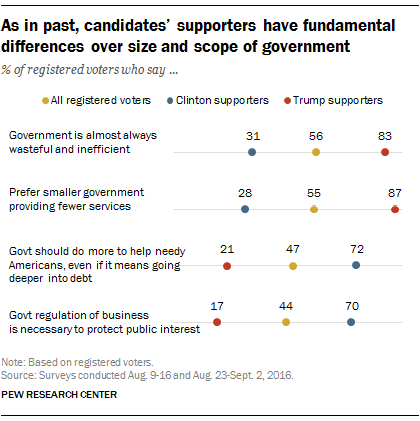
Note the data in the table below from the Pew Foundation. There have been more than a few stories written about how Trump is a monster created by the Republican Party. Let’s take a closer look at just what the Republican Party has created and why. There are lots of reasons but let’s focus on two. First, the Republicans have simply failed to appeal to Hispanics and minorities even though their after action report from the 2012 election recognized this problem. They did little or nothing about it. 86% of Republicans or those leaning that way are White where only 57% of Democrats are White. Curiously, the Republicans should be able to appeal to Latinos who are family oriented, religious, and patriotic to the extent that they oppose leftist regimes. There are two prominent Republicans in Ted Cruz and Marco Rubio who could be electable if conditions were right. The Democrats have begun to include minorities more into the family tent and these minorities recognize their own progress – Donald Trump’s claims that their schools and inner cities are a mess notwithstanding.
Moreover, the Republicans began to run more on moral and social (guns, God, and gays) issues then on economic ones. The angry less educated white male strand of Republican has countered any genuine Republican attempts to include minorities because of their racism and general rejection of the argument that immigration is good for America rather than bad. The foreign-policy hawks in the Republican Party are an attractive appeal for many Americans, and can resonate with American strength, but this group has essentially been co-opted by Hillary Clinton.
Bill Clinton moved to the party to the center and brought in more professionals leaving working-class whites to find a place in the Republican Party. These working-class whites have been frustrated by the Republicans who promised to look after their interests but haven’t done so very successfully. So this group had one more reason to radicalize and movements such as a Tea Party began to emerge and differences between minorities and whites and Republicans and Democrats began to polarize even further.

The table below strongly illustrates this polarization. The blue dots represent Clinton supporters and the red dots Trump supporters. Look at the differences between the two on a few key issues that are ideological in nature. Statements about how wasteful government is and should be smaller are dramatically associated with Republicans (83% and 87% agree). And statements about how government should help the needy and regulate business (most associated with Democrats) are strongly supported by Democrats over Republicans (72% and 70%). These patterns in the electorate are the reason Donald Trump was so successful in the primaries. Moreover, rather than finding a candidate who genuinely coalesced around cultural and economic issues Trump represents fear and nationalism. How is a political party supposed to get anything done when they express such disdain for government?
Trump’s populist nationalism makes us particularly vulnerable because the public currently has so little confidence in many American institutions such as the courts, the presidency, public schools, and banks. When the golden haired man comes on TV and tells you that nothing is your fault – it’s all the fault of immigrants, elites, and the media – there’s plenty of people who will listen.
Trump and “Muted Eloquence”

In the classical literature on rhetoric there is a concept called “muted eloquence.” The term is attributable to Rousseau and is part of the common distinction between reason and emotion or appeals to rationality versus attempts to arouse interests and stir passions in order to induce conformity. There’s always been this argument between those who champion the unadorned use of reason – as if humans were all mind – and persuasion that induces change through baser and more primitive appeals to passions. We can see this distinction borne out between Hillary Clinton and Donald Trump with Hillary more oriented toward (although not completely) defensible reason and Trump who was almost completely consumed by stirring tribal emotions as opposed to reason-based policy analysis.
The distinction is also one made between “persuading” and “convincing.” Again, persuasion is affecting change through typical appeals to emotions, passions, and the like; and convincing is the act of completely reconstituting the psyche and will of the other by giving them new content and reconstituting their consciousness. Classical scholars argue this point because they were deeply divided with respect to the primary avenue of change that citizens were capable of. Some argued that the highest form of reason was convincing which led to the purest and most accurate formation of preferences and opinions. Others challenge the ability of humans to be reasonable in the purest sense and argued that legislators and leaders needed to find a way to “persuade without convincing” because the only way to effect change was through appeals to the passions on an equal level with reason. Most people were deeply flawed, as the argument went, with respect to their ability and receptiveness to “pure” reason. Persuasion could be musical and non-rational even at the risk of potential fanaticism. Charismatic leaders aroused deeper and more immediate passions in listeners, and their oratory was musical in the same way that chanting could be prophetic of charismatic religious figures. They did not use rationality to convince but persuasion to move. Mohammed and Moses are examples of the link between reason and passion and illustrations of how stirring the passions can lead to fanaticism.
I certainly would not call the oratory of Donald Trump musical but it does function the same way in that it is processed holistically and produces a gut pre-rational passion. “Muted eloquence” is when a visual sign has a sense of immediacy and impact. It is when some physical object or image communicates with a powerful effect. So, for example, The King cuts down the tallest flowers in the garden as a message to kill his enemies. In the movie “the Godfather” when a smelly fish wrapped in newsprint arrives at the door the character Tessio explains “it means Luca Brasi sleeps with the fishes.” The message that Luca Brasi is dead and his body dumped in the ocean is semantically ratified by the dead fish. It is a mute wisdom that speaks clearer and more powerfully than a long discourse. These visual signs are a form of persuasion that differs from the ideal of reasoned discourse.
We pivot to Donald Trump surrounded by three women who have accused Bill Clinton of sexual assault. They were then seated in the audience for the debate. The presence of these women was supposed to attenuate Trump’s behavior and signify sexual malpractice in Hillary’s case in addition to Trump. And even though these women are accusing Bill Clinton not Hillary just the image of sexual impropriety is supposed to be a form of muted eloquence designed to associate blame and shame with Hillary, and as a piece of evidence that Trump is no different than anyone else. Even though Trump is the sexist perpetrator here he sought to bathe himself in the victimhood of other woman.
The alleged rapist of one of the women, Kathy Shelton, was defended by Hillary and acquitted. Hillary was little more than the court-appointed attorney and she was fulfilling his constitutional right to legal counsel. But such argument seeks conviction rather than persuasion. Her innocence in the Kathy Shelton case is logically and rationally undeniable, but the muted eloquence of Trump’s debate has closed off appeals to conviction.
The brazen and stunning stunt struck at the core of our unhinged national consciousness, a consciousness increasingly reason-free.
What You Saw in the Debate

Most pundits figured if Trump could tie his shoes then he would have the most to gain from the debate. He really did have a lot to gain by appearing presidential and in control but the issue is of course whether or not he actually maintained any sense of presidential decorum. He didn’t.
Presidential debates are mostly spectacle and this one was no different. Sure, Hillary won especially if you keep score according to a debate coach’s tally sheet of arguments and counter arguments. Presidential debates such as these are not interested in who comes up with a better argument but rather who can make the other look bad.
But the public anticipates debates with a certain amount of enthusiasm. It’s a contest between democracy’s formidable gladiators; there is an underdog challenger doing battle with a superior opponent and we talk about debates with all the war metaphors we can muster. There are “attacks,” and “aggression,” along with “victors and the vanquished.” We would be better off viewing the debates as platforms to make judgments about individuals leading to a decision about which candidate is best. The “winner-loser” frame extends the war metaphor but also causes us to watch it like a horse race constantly attending to who is ahead and who is behind rather than learning something about the issues.
But still, debates contribute to voter knowledge and the acquisition of information. It is true enough that journalism rarely these days considers itself to be a platform for issues and deliberative consideration. So debates have slightly appropriated this role. The debates give us an opportunity for a raw look at the candidates including how they appear on TV, how they handle themselves spontaneously, and general issues of charisma and attraction. This is an important and satisfying counterpoint to political ads which are strategically constructed and designed to be manipulative and the voters know it. It is quite easy to dismiss candidate commercials but less so for debates because of their increased perception of authenticity.
So what did we see the other night and how does it fit in with some of the research on debates?
Even though debates are known to reinforce partisan preferences, the first Clinton-Trump debate transcended that conclusion because Hillary sliced and diced Trump. She set traps (the coming Miss Universe interview), behaved more politely, had very few fact checking problems, appeared composed and in control, unhinged him a few times as was the debate plan, and spent more time on policy.
Dorothy Rabinowitz – of the conservative Wall Street Journal of all places – wrote that Hillary is the only thing that stands between the United States and the “reign of the most unstable, proudly uninformed, psychologically unfit president ever to enter the White House.” Since in one study almost 30% of the viewing audience considers the presidential debates more helpful than talk shows or advertising spots, this means that a lot of people witnessed the Hillary performance in the debate. And given that the viewership was the biggest in history (over 80 million viewers) she was in a position to reintroduce herself to many people.
Presidential debates also produce multiplier effects. This means that post debate citizen communication about political issues is stimulated. The debate induces communication. And this post debate communication is one way that partisan preferences are mediated. In other words, debates because of information processing and selection biases are strongly implicated in reinforcing existing partisan biases. But these effects are mediated by post debate conversation. As citizens engage others, especially if this engagement represents some sense of substantive exchange, then partisan positions are challenged. From my own experience anyway, the Clinton-Trump post debate interactions were robust. This of course has something to do with Trump’s media presence and inimitable personality along with the uniquely personal and conflict oriented nature of the campaign. Nevertheless, it prompted post debate conversation relative to the issues people are thinking about.
One might continue to think, in naïve rationality, that Trump will make the necessary adjustments but it’s getting late and first debates are the most watched as the audience trails off for the next two. But we will tune in waiting for some sort of catastrophe that we can talk about after the debate.
The Flowering of the Post-Truth Era of Politics

It is fashionable – especially for liberal academics – to decry the current state of politics crouching in fear as the beast Donald Trump slouches toward Bethlehem. The center is no longer holding. But just because it’s “fashionable” doesn’t make it any less true. Trump is a unique candidate who represents the accumulated intellectual and linguistic decline that has been fomenting in the background for a few decades.
This undercurrent has been creeping up on the culture but hiding itself in the small interactions of people, commercial culture, and media that structure and reproduce the nature of society. For example, a few of what we thought were ongoing debates or genuine contentions in our political culture that require critical analysis and defensible conclusions have now been either settled or are leaning so far in one direction as to constitute a tide. So, there was once a debate between “bias” and “objectivity” the goal of which was to clarify objectivity or move toward it as much as possible. But we woke up one morning and the tables were turned telling us that objectivity didn’t exist and everything was biased. The only issue was whose bias was going to overwhelm the other. Argument, the foundation of democratic processes and quality decision-making, has been enervated because when everything is considered “just your opinion” or “just the way you see things” then even quality evidence-based argument loses its standing. The best thinking is easy to ignore because there are no standards of objectivity only degrees of bias.
There also used to be a boundary between entertainment and civic life. Even the most insightful political operative did not assume that Trump’s television show “The Apprentice” would be a launching pad for his presidential run. But when exposure and recognition become equivalent to knowledge of history, politics, and policy then appearing on television is just as good. The increasing ease with which exposure is conflated with competence is one of those undercurrents that has finally bubbled to the surface as commercial media, and the logic of its presentation structure, has become the dominant form of information processing and organization.
Additionally, it is remarkable how the public has been separated into fact universes. People live in their own information enclave that includes a collection of their own facts and interpretations – or at least conclusions they believe to be facts. Somehow we got to the point where rather than observing and gathering facts and information and then interpreting upwards toward a conclusion, we start with conclusions and reason downward looking for confirming facts and ideas. We criticize politicians who change their mind rather than respecting them for learning something and adjusting accordingly. It is all part of the post-truth society.
Finally, and by way of one more example, the quality of public discourse (e.g. presidential speeches and advertisements) has shifted shapes so that now it looks more like bloated rhetoric then considered analysis. Trump is of course a good example of a speaker who is so befuddled that he has little left to do but lash out and call names. He reflects a specialized strand of reality, one in which when you are wrong you blame reality rather than yourself. It is the ultimate in the common characterization of Trump as a narcissist.
How Trump Misunderstands Islam

Trump continues to use fear appeals and scare tactics when it comes to Muslims and terror. And while he is minimally effective – and getting less so every day – his supporters are sympathetic others who are increasingly misinformed about terror and Islam. A piece of video footage showing Trump supporters at a rally had one fellow screaming at another that Islam was an “ideology.” The point was that Islam is a nefarious set of beliefs and practices designed to manipulate you into its belief system.
The dilemma here is that defining Islam as violent justifies an armed response when, in fact, the only response that will be effective is a long-term war of ideas pitting *Islamist extremism against liberal democracies. As Gutmann and Thompson have claimed in their highly recommended book Democracy and Disagreement,“of the challenges that American democracy faces today, none is more formidable than the problem of moral disagreement.” In other words, those who have sacred values and are what Scott Atran calls “devoted actors” rather than “rational actors” pose the biggest challenge to liberal democracies because conflicts over fundamental values are so resistant to resolution. You cannot simply subject the moral disagreement to the rational calculations of the marketplace.
But if wanton murder of men, women, and children is so fundamental to Islam why is it such a recent phenomenon on the world stage? Why doesn’t “jihadism” as it has come to be known have long history? Typically, Islamist terror is first associated with the 1979 Iranian revolution. But even the Iranian revolution can be analyzed as a clash of political ideologies where Islamists attach themselves to religious sounding terminology (“infidels,” “holy wars,” “party of God”) in order to give themselves religious justification.
It is true enough that Islamism is really a totalitarian movement that has hijacked some religious terminology in an effort to alter traditional Islam and challenge Western democracies. But Boroumand and Boroumand writing in the Journal of Democracy make the following emphatic statement and I quote in full:
“There is in the history of Islam no precedent for the utterly unrestrained violence of Al Qaeda or Hezbollah… To kill oneself while wantonly murdering women, children, and people of all religions and descriptions… has nothing to do with Islam and one does not have to be a learned theologian to see this… The truth is that contemporary Islamist terror is an eminently modern practice thoroughly at odds with Islamic traditions and ethics” (p.6).
I don’t mean to imply that traditional Islamic religious teachings hold an inclusive democratic vision for the world or that it resonates with contemporary ideas about liberal democracies and human rights. But the long view of any religious evolution has it moving toward a widening circle of inclusion and dignity for others. As of now, there are more than a few Islamic countries that are pluralistic but have no political concept of “pluralism.” For this reason they define rigid group boundaries and more nascent forms of control.
But as with most of the issues in this election, Trump is not the answer to anything.
*Terminology note: I use “Islamist” or “Islamism” to refer to those extreme groups or ideologies that justify violence and cherry pick the Koran to give their ideology a religious sounding façade. The term “Islamic” refers to the long political, religious, and scholarly tradition of institutional Islam.




 Peace and Conflict Politics