Category Archives: Communication and Conflict Resolution

The Media’s Distorted Relationship with Israel

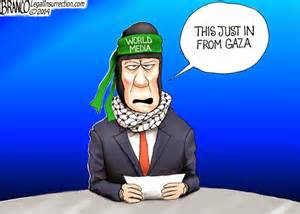
Media Bias and IsraelMatti Friedman writing in The Atlantic wrote a trenchant article about what the media gets wrong with Israel. Friedman makes the point that the press is failing the public when it comes to its duty to inform and provide a platform for issues and debate. In a number of publications Friedman has pointed out stories that are purely ideological, an overemphasis on stories with a certain perspective, and a disproportionate amount of media attention on the conflict without being particularly informative. You can read The Atlantic article here.

His analysis is important because it recognizes the banality of news gathering (the pressure of deadlines, journalist fatigue, financial constraints, distractions) and how it influences news gathering and results in mistakes and minor distortions. But Friedman claims that the true explanation lies elsewhere and that the flow of information is intentionally manipulated. Here’s his explanation.

First, international journalists in Israel live in the same social context and have a certain uniformity of attitude and behavior. The people in these groups know one another and that’s why four or five stories written by different people sound alike. There is a uniformity to the stories because this group of people share information and talk on a regular basis. Journalists also tend to be liberal and that’s one reason that the Israeli story, according to Matti Friedman, is less known and understood then the Palestinian story.

The same is true for NGOs and humanitarian organizations. Journalists view them through a positive humanitarian filter and consequently write about them in the language of public relations puff pieces. The truth is that these NGOs and humanitarian organizations have political agendas, plenty of funding from international sources, and are happy to buy drinks in the American Colony Courtyard.

A disdain for Israel is almost a prerequisite for admission to this journalist social club. The conscientious new reporter arriving in Israel will spend time educating himself or herself about the conflict including its history, religion, and cultural implications. But many new journalist arrivals to Israel cling to their colleagues who already have a framework and a “story” about who’s a good guy who’s a bad guy. Many of the standard criticisms have already been described and producing a story is little more than coordinating and repackaging stories that have already been written. The Middle East is full of failed governments that are authoritarian and corrupt, but there is more likely to be a story critical of Israel than anyone else.

Friedman bluntly indicts the Associated Press for having moved from a journalistic tradition of careful description to one of advocacy. Moreover, there has developed a narrative, or a story with standard plot lines and characteristics, that is increasingly consistent and coherent for both Palestinians and Israelis. But the Israeli narrative is fueled more by ideology than facts. The standard script for Israel has more bad guys (settlers, far right politicians, IDF, Netanyahu), but the only Palestinian “bad guys” are abstract groups (e.g. Jihadists).

There has always been a gap between what journalists write and what is actually going on, but in the case of the Israel-Palestine conflict the gap is too large and the distortions too intentional. The Israeli narrative, in addition to its long list of bad guys, portrays the Palestinians as weak and innocent victims and the Israelis as oppressors. Groups like Hamas choose journalists to talk to carefully and use them to magnify messages.

There is a cynical attitude about truth in the modern world which denies its existence and claims that any agreed-upon truths are social constructions anyway. Such an argument might be defensible on the basis of philosophical discourse but less so on the basis of political discourse. Much of what is written about Israel fits that narrative constructed by others and is either completely untrue or “untrue enough.” Ferreting out and reviewing as much truth as possible is a continuing journalist challenge.

A Very Impressive and Important Opportunity

Summer Fellowship all expenses paid. You really need to seriously consider Brandeis University’s summer travel and study. Stimulating academic and intellectual preparation for teaching and scholarship–at no cost to you. More information from below.

Keren Goodblatt
Communications Specialist
Schusterman Center for Israel Studies
Brandeis University
781-736-7310
www.brandeis.edu/israelcenter
Faculty: Just a few places left for Summer Institute for Israel Studies. Apply now!

“I Make No Effort to Indulgently Understand Tyranny. I Am Charlie”

Free speech In the wake of the attack in France on the satirical newspaper Charlie Hebdo, I call on all news and publication outlets to reprint satirical articles from the magazine and publish images that Jihadis object to. This should be done in the name of freedom, symbolic expression, and solidarity with those killed in France. I consider myself a pretty decent democrat committed to liberal values that includes such qualities as tolerance, diversity, compromise, pursuit of the best argument, deliberative processes, and respect. But these Islamic extremists who kill people because of some flimsy insult push the boundaries of all of these.

They consider nothing to be outside the realm of their own decisions about what is deserving of violence, and represent the type of political sensibilities the world has been evolving away from for 200 years. They care about nothing except their own ideological purity, always a dangerous condition. And we certainly have not seen the last of these. The communities that ring the city of Paris have become infested with radicalized extremists who advocate mass murder and even genocide in certain cases. These are the kinds of extremes that call for restrictions on liberty and that’s always a dangerous moment. But what can you do? Can we make it easy to blowup soccer fields, performing arts centers, kosher grocery stores, and schools just because we object to inspections and security profiling?

And this sort of extremism in the name of religion is not the result of weak economies or abstract political theories objecting to US foreign policy. It increasingly looks like an ideological system bent on imposing its doctrines on others.

I turn at these times to the Euston manifesto with respect to democracies which advocates a muscular democracy. That is, it clearly defends the limits of tolerance and acceptability. I quote two paragraphs below but it is the very last sentence of paragraph 2 that is the most muscular. In other words, democracy is not about that spectrum of the left that knows no group that is not oppressed and gives all sorts of groups a free pass with respect to responsibility being associated with individual volition rather than abstract social forces.

1 For democracy.
We are committed to democratic norms, procedures and structures — freedom of opinion and assembly, free elections, the separation of legislative, executive and judicial powers, and the separation of state and religion. We value the traditions and institutions, the legacy of good governance, of those countries in which liberal, pluralist democracies have taken hold.

2 No apology for tyranny.
We decline to make excuses for, to indulgently “understand”, reactionary regimes and movements for which democracy is a hated enemy — regimes that oppress their own peoples and movements that aspire to do so. We draw a firm line between ourselves and those left-liberal voices today quick to offer an apologetic explanation for such political forces.

Two groups of leaders need to denounce these attacks and speak up in defense of liberal values. Muslim leaders are one of these groups and they need to go beyond simply objecting to violence. They must begin a program of explanation and clarification about Islam making clear that the God of Islam does not endorse such behavior. And secondly the leaders of Western countries must systematically explain, clarify, and defend the liberal state. Many immigrants as well as citizens of a country – whether it be in the outskirts of Paris or to the United States – need to understand more clearly and sharply what it means to live in a democracy and the boundaries of diversity and tolerance. This will include proper forms of protest. I might make the argument that a news outlet should be aware of too much satire and criticism of one group and respect in a diverse society requires limiting such copy. But this sort of criticism or humor still exists in the realm of symbolic behavior and is protected speech. The only way to object to what someone writes is more writing and the power of the better argument.


Do You Want to Stop Extremist Groups? Don’t Change Messages, Change the Receivers for These Messages

terrorist and capitalistCommunication perspectives have a long history of trying to teach people which particular message produces which affects, as if the message were a bullet traveling through space that simply needed to be aimed properly. I’m just as guilty as anyone else of thinking about communication as an instrumentality that is constantly looking to push the right button to achieve a predetermined desired effect. So, for example, my own work in dialogue and deliberation still often – not always – reads as if success is simply finding the optimal input conditions that lead to some output.

But there is another way of thinking about how to achieve particular effects. Rather than thinking of the receiver of a message as a passive mechanism with an absorptive sponge for a brain, and then spending your time trying to find the right message that will be absorbed as you designate, change the receiver rather than the message. Make new receivers that will be more or less poised to receive particular messages. Let me explain.

The U. S. is currently struggling to defeat extremist groups such as the Islamic State, Hezbollah, Hamas, Al Qaeda, and a host of other radical groups. Most of the news about our efforts to degrade these extremist groups is pretty bad. Terrorist and violent groups are successfully recruiting new members, winning their share of battles, raising money, and generally prospering. Our military, mighty as it is, will not defeat the Islamic State and no informed counselor to the president believes military force is the only answer – important as it is. So what are we to do?

One answer is to change the terrorists and make them less interested in violence. A more traditional approach consistent with the silver bullet metaphor above is to “lecture” terrorists on democracy, and pluralism, and liberalism, and all those good things and assume that if we can only find the right words with the right pedagogical strategy then these ideas will “take” and we will turn them all into liberal democrats. Well as a popular quip goes, “good luck with that.”

But a second way to approach the problem is to change social structures and business arrangements such that they foster capitalist enterprises and market economies. Don’t try to change people, change social systems and the people will follow. Hernando De Soto wrote about this some months ago in the Wall Street Journal. The idea is to raise living standards and inject the cultures with some imagination and capital especially for the poor. And interestingly, turns out that the poor in many cultures, both Latin American and Middle Eastern, are not poor because of simple unemployment as conventional wisdom would hold. Rather, they are small businessmen and women operating “off the books” in an underground and informal economy.

If economic leaders and advisers in Middle Eastern states would eliminate regulation, and bureaucratic extremes including recognizing the importance of property rights, they would create customers for businesses and leave extremist groups with fewer customers. This is consistent with the goal of leaving groups like ISIS without constituencies, which is currently the goal in Iraq after the deposition of Malaki. On the political front of the strategy is to bring Sunnis into the political system including official bodies of governance on the assumption that they will not turn their attention to outside extremist groups. The same logic can work on an economic basis. The perceptions of these communities must change so they are seen as future vibrant markets rather than training grounds for violence. There is some history, according to De Soto, of these capitalist strategies working in Peru, China, Botswana, and others. And finally, it’s fairly well established that businesses rationalize human relationships. Former intergroup enemies can be interdependent on the basis of a commercial exchange. And if you change the relationship you can change attitudes and values.

I’m naïve you say? Maybe.


Some Serious Solution Proposals to the Israel-Palestine Conflict – Pay Attention!

Two states on one land It’s just unconscionable how much time is spent analyzing and criticizing the Israeli-Palestinian conflict, and how little time is spent working on positive and productive solution possibilities. There are, of course, lots of solution proposals and options but the force of communicative energy is directed toward critique and justifications for why something cannot be done rather than the hard work of grinding out durable solutions that take into account the “facts on the ground.” True enough, many elements from both sides don’t actually want to work on solutions because their identities are wrapped up in the conflict but this is one of the stages in the conflict process the two sides must overcome. Listen to the sound file here from the “Voice of Israel” and their shallow criticism of the New York Times. They fail to make the distinction between bias and perspective and have slipped into a series of minor perspective differences informed more by defensiveness than serious engagement.

An animated video that you can watch here is a better and more productive presentation of the conflict because it presents the pragmatic issues that must be addressed rather than small matters that do not carry any traction. Here’s an alternative from IPCRI – a serious solution that clearly requires additional difficult conversation but seems “rational” to the extent that it addresses the needs of everyone.

IPCRI (the Israeli-Palestinian Center for Research and Information) is a welcome alternative. IPCRI has been working on detailed solutions designed to create “Two States in One Space.” You can access the “Two States in One Space Research Paper” here. The paper tries to balance a separation mentality with a cooperation one that requires somewhat less sacrifice and ameliorates potential trauma. The core idea of the paper is to avoid evacuation of hundreds of thousands of Jews and Palestinians by creating different categories of political participation. For example, on that portion of the land that will be Israel one group will be citizens (Israeli Jews) with all the privileges of voting, decision-making, and shaping the national identity. The minority group will be residents, not citizens, but who will have certain guaranteed liberal rights just not the same as citizens. The same will hold for the Palestinian state where Jews (many of them now are settlers) will be a resident minority but not citizens.

This model mitigates demographic fears, responds somewhat to the right of return issues, prevents massive population movement which is rarely easy or successful, and allows for independent nation building. Individuals can move to their own nation state or remain a resident granting the fact that population movement and control will be demanding.

But Most Important!

But most importantly the model sets up the conditions for the development of integrated cooperation and interdependence. The current asymmetrical relationship between Israelis and Palestinians will be softened as the two sides cooperate on security, regional and local governance, and the establishment of necessary shared institutions of government. Israeli Jewish needs for a democratic state devoted to Jewish particularity will be met and there will be no political possibility for the Jewish nature of the state to be challenged. And, Palestinians will have their own state devoted to cultural, political, artistic, and religious matters all in the service of a Palestinian political identity.

Of course, these things remain difficult with lots of work ahead but both sides have to assume that they are not going to get everything they want. This proposal is a matter of entering into a voluntary union that requires a certain amount of cooperation and allows for less sacrifice. And finally, it represents a sensible integration model rather than the separation mentality that characterizes most political solutions. Spend some time reading the documents at IPCRI.


How Group Level Conflict Is Changed by Interaction Rituals

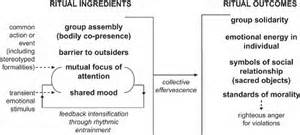
interaction ritualsEthnopolitical conflicts are pervasive in a culture and involve a relationship between locally situated parties and larger groups. The conflict is perceived as both an interpersonal problem and a group level problem. Attempts to resolve these conflicts are significantly at the interpersonal level in the form of communicative contact experiences that seek to change relationships in the hope that such changes will find their way to group levels. If intergroup contact of any sort (problem-solving groups, dialogue groups, civil society) is going to claim efficacy then there must be some principled relationship between interpersonal interactions and the larger world of social structure. This calls to mind work by Giddens on the relationship between communicative interactions and the pre-existing structural world (e.g. “culture,” “ethnicity”). Sociologists refer to this as the micro-macro link and the connections between the real-time world of individuals and the larger world of social structure. Conflict resolution experiences rely on interdependence between forms of interpersonal communication and broader group goals. For example, communicative contact between conflicting groups can have multiple goals. One goal can be immediate and concern change or attitude adjustment on the part of those participating in the communicative encounter, while a broader goal is concerned with the relationship between the communicative encounter and the conflict as a whole. Israeli and Palestinian high school students, for example, might interact in order to appreciate each other’s values and culture, and then have mechanisms to return to their home communities to transfer their experiences and widen the impact. A macro category such as “Israeli” or “Palestinian” serves as a shorthand for numerous micro communication and cultural behaviors. This leaves room for definition and change of meaning.

The term interaction ritual from Goffman refers to the motivations, resources, and messages of language users who are parties to conflicts to produce histories, cultural content, and stored memories. Ethnopolitically divided groups distort these processes on the basis of attribution errors, incompatible narratives, interpretive disjunctions, incomplete scripts, biased indexicality, and perceptual biases thereby producing dangerous, damaging, and inaccurate macro categories. Some interaction ritual chains (e.g. mutual victimization claims) are counterproductive and circulate in the larger community thereby perpetuating the conflict. Controlled encounters designed for positive change have new interaction rituals as a goal. A category for the other group such as “violent,” “backward,” “manipulative,” “deceptive,” or “rigid” contain the reality that lives in the network of communicative relationships. By changing the interaction rituals and activating the network of communicative relationships it’s possible to alter the group’s reality and alter the categories of meaning that sustain the intensity of the conflict. Macro categories of meaning (gender, ethnicity, group identification) are enfolded into individuals and displayed in communicative practices. Biased meanings are thus easily foregrounded in the context of ethnopolitical conflicts.

For example, one of the macro meaning categories for intractable conflicts in general, and the Israelis and Palestinians in particular, is “victimhood.” (See Eidelson and Eidelson for more on victimhood.) Victimhood is that state where groups feel a loss or sense of insecurity and diminished self-worth because of aggressive outsiders. Each group feels as though victimhood correctly characterizes their condition. Third person affects and group level perceptions supports the notion that even when individuals do not feel victimized, they believe that victimization characterizes their group. Typically, ethnopolitically divided groups argue about who has suffered more and “compete” for the most victimized status. The macro category “victim” serves as a short hand for a compilation of micro-experiences. Talk in localized contexts produces interaction ritual chains that circulate like capital between micro-and macro levels of reality. By changing the interaction rituals group members can change the nature of the circulating symbolic capital. Just as the label describing someone’s personality (e.g., friendly, aggressive, authoritarian) is an encapsulation of interaction encounters, so too are macro descriptive terms of group experiences. Conflict resolution is about changing communicative relationships in micro-contexts so that the phenomenological reality of the concept changes at the macro level.


A Third Narrative for Israel-Palestine


The Third Narrative


Anyone interested in the Middle East these days will be subjected to a relentless barrage of accusations against Israel on the Web, on campus and in other settings. Some of these attacks come from the far left, from activists trying to appeal to Jews and non-Jews who are committed to human rights and social justice.

Often, these critics are not just attacking specific, objectionable Israeli policies and behavior. They treat Israel as the epitome of evil. They portray the entire Zionist enterprise, from the 19th century to the present, as nothing more than a racist, colonialist and immoral land theft. Many are active in the movement of Boycotts, Divestments and Sanctions (BDS) against Israel, calling Israel an Apartheid state.

At Ameinu, a North American Jewish organization that supports progressive causes in Israel, the U.S. and Canada, we have often criticized Israeli policies and behavior, including settlement expansion, racism against Arabs and crony capitalism. But we believe too many of Israel’s left-wing critics cross the line that separates legitimate, productive criticism from polemical, inaccurate and unfair attacks.

At the same time, too many voices of those who reflexively support –or passively accept—the Israeli occupation and the morally indefensible status quo in the Palestinian territories are going unanswered.

The Third Narrative initiative is our response to this situation. We hope to engage people on the left who suspect that it is wrong to lay all blame for the Arab-Israeli conflict at the feet of Israeli Jews…but aren’t sure how to respond to Israel’s most vitriolic critics. Some of what these critics say is true, some of their accusations are justified. Some of what Israel’s traditional defenders say is also accurate. When it comes to this conflict, the truth is rarely black or white; it resides in a gray area where advocates on either side typically don’t like to venture. That is where we try to go with The Third Narrative.

We feel a deep connection to the Jewish state and the Jewish people. We are also committed to social justice and human rights for everyone. Some say those commitments are contradictory, that particularist attachments to a state or a people can’t be reconciled with universal values. Our response is that belonging to a people, a community larger than ourselves, is a basic human need –indeed, it is our right. And balancing our communal attachments with a commitment to humanity as a whole is our responsibility.

In fact, our ties to Israel might make us even more disturbed by its current direction than those that have no ties to it. But we are alarmed by the increasingly widespread rhetoric that refuses to recognize any justification whatsoever for Israeli positions or the Jewish state. And we think the American left –Jewish and non-Jewish—could use a third narrative, one that neither reflexively attacks nor reflexively justifies Israeli policies and actions.

For more information, please contact us.


Strategies for Hate Applied To Islam

imagesMuslims, for a lot of obvious reasons, have been the recipients of hate crimes and this is quite unfortunate. In addition to old-fashioned violent hate fueled by fierce emotions there is the more benign form of hate that simply tries to dispute Islam’s status as a religion. This is usually the territory of the more educated who are able and patient enough to do close analyses that they consider to be insightful with respect to the “true” nature of the religion. One example of this is Bill Warner who has written about Islam and lays out a rather thorough analysis about how Islam is not really a religion but a political system based in force. Warner thoroughly rejects Islam as a religion and describes it as “warlike,” and concerned predominantly with “annihilating civilizations.” You can watch an interesting video of Warner explaining his position here. Warner masks his extreme hostility to Islam in academic images of critical analysis. He refers to Islam as not coming from the tradition of critical thinking but one of authoritative thinking. He states clearly that Islam is nondemocratic the supply and its alien stance toward the West.

Warner’s analysis is really quite skilled in that he denies the concept of the “golden rule” in Islam because Muslims, according to Warner, do not believe in equality for all. Rather, they believe in equality only for a few and how you are treated depends on what groups and social class you belong to. His “golden rule” example is an appealing comparison that the average reader can relate to. Warner goes on to state emphatically that Islam is primarily interested in destroying civilizations and conquering the world. His arguments play nicely into the hands of those prepared to receive them.

Another hate strategy for anti-Muslim groups is to portray them as strange and alien. Prayer and worship are fundamentally different than the Judeo-Christian tradition and are typically associated with negative traits. Muslims are portrayed as aggressive, irrational, and unsympathetic to violence, child marriage, and the roles of women. Clearly Islam is associated with terrorism and understood as a justification for terrorism. A study on the relationship between hate crimes and terrorism found that a crimes or violence against a group like Muslims do not necessarily lead to or predict terrorist activities. Still, anti-Muslim groups believe that Islam is a danger to the United States and typically think of Muslims as a fifth column waiting in the wings to damage American democracy and Western civilization. Their fears are accompanied by paranoia about population growth that will one day overwhelm majorities.

Finally, Muslim hate groups characterize Islam is an evil religion capable of great violence and hate itself. They presume that Islam has no core human values and is inferior to the West. The Southern Poverty Law Center produces the hate map which identifies various hate groups in different states in the United States. The hate map is an important source of information because people can be easily misled by the skilled rhetoric of those who speak for these groups. Additional Muslim hate groups have been identified and had their rhetoric and strategies exposed.

Hate is an extreme emotion capable of great violence. Yet, I recognize that Islam is currently in the grip of a violent force in terms of Jihadis who do have a violent doctrine with vicious capabilities. But clichéish as it sounds this strand of Jihadi violence is not the essence of Islam. We are not in the midst of a battle for the soul of Islam, but perhaps for the influence of a particular path. Anti-Muslim hate groups must not win undue influence.

Three Dilemmas for Israeli Settlers


Given that the territories are defined as a “frontier land”—neither sovereign nor part of the Israeli official map—their definition is open to construction. Israeli settlers frame three discursive dilemmas they must solve. These three dilemmas are (1) the construction of authenticity, (2) the discourse of marginality including the confrontation with the Palestinians or the “native others”, and (3) the use of rituals and collective memory to normalize life and established cultural and religious authority. Settlers must engage in various sense making patterns in order to facilitate the appropriation of the land.

The Authenticity Dilemma

Ethnoreligious communities are mostly constituted by narratives about their origins. These narratives are composed of bits of history and group identity that are consolidated into a narrative or “imagined community.” Such narratives must be complete and coherent enough to include discourses about belonging, citizenship, culture, as well as position people in relation to one another. These narratives are particularly potent because they clothe power with legitimacy, which is just the discursive puzzle that requires resolution.

The most important settler element of recorded time is the sanctity of the past. The insistence on the divine promise of the land to the Jewish people negates any legal arguments about property rights in the present. The relationship between the land and the Jews is transhistorical and therefore not subject to secular considerations. The land is a heavenly bequest to the Jewish people and their rights can never be relinquished. Moreover, the Jewish people are not “born of the soil” but arrived in the land on the basis of the covenantial relationship with God. In other words, the claim on the land is stronger than mere historical rights. Just as the American Indian cannot claim rights to the land, a Jew could not claim rights to the land of Israel on the basis of historical inhabitants; rather, the Jewish people claim their unique covenantial history and the fact that they created this history.

The solution to the discursive dilemma – the one most fundamentally associated with Jewish authenticity for settlers – about how to reconcile redemption with the institutions of the state lay in pragmatism. Religious settlers would not turn away from the commandment to settle the land, but find a more practical way of fulfilling it. This would be accomplished by the invocation of the security frame.

The Marginality Dilemma

The discourse of marginality is about the relationship between the center and the periphery and how the concept of the periphery, or margin, is essential to the concept of the center. The Palestinians live at the periphery of the environment and this increasingly informs their identity, albeit an undesirable one. The margins of a landscape contain what one is but not what they should be, and the conflict comes from the individual’s struggle against being socialized by the margins. The discourse of marginality depends on comparisons of the center to the margins.

We can borrow some from Gramsci here by pointing out that the marginal or disadvantaged group is in a binary relationship with the dominant group, cut off from most avenues of legitimate participatory politics, especially in the dominant sphere. The discourses that emerge from the authoritative center overwhelm local specificities and place the marginal group in a position that is enervated and without agency.

The Authority Dilemma

Settlers marginalize Palestinians by appealing to authority, but it is an authority that resonates with the settler community and deep elements of the Jewish historical consciousness. In other words, they are unconcerned with the general international community or the public at large and seek a form of self justification based on internal community authority standards. Traditional social movements are more successful when they use frames that are pragmatic for the intended audience. Hence, the appeal to the biblical right to the land or Jewish ethnoreligious roots creates arguments that resonate and converge with the interests of the target settler community.

The dominant settler discourse is built on the premise of biblical promise. It stresses the authority of the Bible and the word of God and projects an unassailable morality and inevitability. The invocation of the Bible and the word of God frames the narrative in language sealed from criticism and scrutiny. By definition, any questioning or challenge is viewed in moral terms and considered unacceptable. In contrast, the Palestinian narrative is less grounded in religious terminology but no less hardened by claims of historical rights.


The Problem with the Concept of “Peace” in Islam

Islam and Peace

Given the contemporary image of Islam as violent, and the current grip that extremist Islam has on the image of Islam, it’s a little difficult to explain that Islam has a preference for nonviolence and forgiveness. But Islam has a long history of reestablishing harmony and solving problems through genuine reformation including the moral courage to sincerely forgive others.

The interpenetration of Islam as a religion and the resolution of secular problems is a core theme in the Islamic definition of peace. Peace in the Islamic tradition is related to God and reflects a higher reality. In the Koran peace is affirmed in many aspects of the language and as a condition of paradise. It is something the innermost person yearns for and it is related to wholeness attained through the relationship with the divine. Now, peace in Judaic or Christian traditions is also a higher-order reality and integral to the primary religious precepts of these religions. But the contemporary problem with conflict resolution in Islam is just such a notion of the divine because the most recalcitrant tension is that peace has been defined as Islamic peace. And making relationships and having a sense of community is based on sharing Islamic principles. Thus there is an inconsistency between theory and practice where both sides, Islam and the West, have arguments between principles and practice and conflict is rooted in these disagreements between how to express and practice the divine. So in extremist Islam jihad is an effort aimed at the more abstract religious principles of the Islamic community and its maintenance (according to the practitioners of this strand of Islam) but it is a practice that justifies violence. Hence, the Muslim extremist and the religious Christian or Jew – or even the secular person – holds the same sense of peace as being integrated into the community but the conflict results from the practice of violence which is justified in one case but certainly not in the other. The jihadist “practice” is not considered acceptable as an expression of the holy Koran by either some other Muslims or group.

There is considerable overlap between the Western conception of peace and the Islamic one but the overlap is not complete. Even the role of acceptable legal precepts and wisdom is valued in Islam above the capricious decisions of dictators or force of the military. Islam has always held its military and check and rejected abuses of power. There is a tradition of positive peace based on the actual practice of justice and not only the absence of arbitrary rule. There has been a long tradition of Islamic scholarship and wisdom, even wisdom in the Western tradition, but the relationship between reason and religion has maintained which is one difference between Islam and the West. This leads to an important difference between Islam and the West which is that reason in the West has been elevated to a more “correct” way of thinking. Passion in Western conflict management is considered disruptive and in need of control. A fundamental difference that accounts for the difficulty and intractability of conflicts between Islam and the West is the thorough integration and wholeness of the concept of peace with religious precepts. Peace is not only the domain of secular social science but peace begins with God and his attained as God calls everyone to the “house of peace.” Peace in Islam is patterned on harmony and religion based integration. The word jihad means to strive for the divine, but from a contemporary Western Islamist perspective has been corrupted by the inclusion of justifiable violence.

Islam also has a tradition of cooperation and coexistence with groups that were either divergent or even antagonistic toward Islamic precepts. There is a discursive tradition in Islam which refers to the “house of peace or truce” and includes issues concerning limits on war, truce with non-Muslims, and general concerns about managing conflicts. But the more dichotomous thinking of fundamentalists currently holds sway because military ideas about jihad have moved to the forefront. It remains true that a conception of peace and conflict management cannot be separated from Muslim discourse. Even the idea of individual freedom in Islam is based on the attainment of freedom as a result of being at peace with and integrated into the broader religious community. Individual freedom clearly is not synonymous with “doing whatever you like.” Rather, individual dignity emerges from the maintenance of harmony between individuals and God. There is in contemporary Islam a tension between using religion to justify violence and actual conflict dynamics. Conflicts are typically rooted in political and economic grievances, but religion is used to intensify attitudes and rally support. Nuance and issue complexity are lost as the discourse gets simpler and adherents become more radicalized. Currently Islamic fundamentalist leaders have made the claim that Muslims are occupied by non-Muslims in foreign lands and oppressed by various transnational governments. Casting such a wide transnational net is unusual and is typically interpreted as exceptional religious vocabulary used to justify violence. But from a dialogue and conflict management perspective using such religious discourse is not unusual. Moreover, the West must approach Islam with respect to pragmatic conflict dynamics (economic, political, and social issues) – including exploring the relationship between the conflict and Islamic principles – in an effort to meet group secular needs while maintaining harmonious relationships within the community. The West after a long period of engagement can turn this tradition to its advantage and the advantage of all.