Category Archives: Communication and Conflict Resolution
Educating for Free and Deliberative Speech
Hearing criticisms of your own convictions and learning the beliefs of others are training for life in the multi-faith society. Preventing open debate means that all believers, including atheists, remain in the prison of unconsidered opinion. The right to be offended, which is the other side of free speech, is therefore a genuine right. True belief and honest doubt are both impossible without it. John O’Sullivan
 I have been a pretty standard liberal Democrat all my life, but recently I have been more critical of the left’s retreat from First Amendment protections. I’m talking about the left’s willingness to restrict symbolic expression that is critical of an ethnopolitical group or identity group of any kind. A recent article by John O’Sullivan in the Wall Street Journal takes up the issue of the new limits on free expression in the name of protecting religious and ethnopolitical group sensitivities. The article is an excellent treatment of these issues and I highly recommend it.
The harsh and anti-democratic strand of jihadist Islam has successfully scared enough people into restraining free expression in the form of restricting criticism of religion and political culture. Earlier in the history of free expression, O’Sullivan explains, the predominant restrictions on speech were with respect to obscenity, pornography, and language that was sexually explicit. The purveyors of these restrictions were moralistic and believed themselves to be defending proper standards of society. Political speech was strongly protected. But now, the calls for restrictions are designed to limit the political speech of others and consider off-limits the entire array of topics surrounding religion and politics. Obscene and pornographic speech was limited on the basis of protecting the broad moral foundation of the culture, limiting speech that is critical of religion is justified on the basis of particular groups with each making their own demands.
Burning an American flag is considered political speech and symbolic expression that is protected. I can legally burn the American flag in the center of the town square as a symbolic statement of opposition to some aspect of American foreign policy. But if I burn the Koran, which would still be legal in the United States as politically protected expression, it will cause a different reaction. There is a suggestion that the US endorse an international blasphemy law that would define the Koran as so special that burning it constitutes a particular offense, rather than simply protected symbolic expression.
The traditional approach to protected speech is to ignore the content of speech but simply disallow symbolic expression that will cause imminent danger (yelling “fire” in a crowded theater).Yet feeling free to limit speech because words are supposedly so powerful and dangerous is a slippery slope that will slowly erode freedom.
The Answer: Education
One does not come into the world with established political ideology and sensitivities to managing group differences. Democracy and freedom of speech is advanced citizenship in a democracy and must be taught. Free and open societies, where citizen participation is rich and required, necessitate learning the habits of pluralism and democratic processes. The legal environment surrounding freedom of expression has drifted toward an oversensitivity to categorize speech is injurious and in constant need of management. We should not be in the business of restricting all sorts of pure symbolic behavior. Living amongst one’s fellows in a pluralistic, multi-faith, diverse environment requires living in a world that is not of one’s own making and is constituted by differences. These differences must be managed through the deliberative communication process which is by definition “contestatory.”
The lines and distinctions implied here are difficult. For example, do we allow street gangs to deface public buildings with racist slogans and call it “freedom of expression”? I presume it would be possible to define such activities as sufficiently harmful and capable of producing imminent danger, but it will depend on many factors. Slow and long term as it is democratic cultures must continue civic education that includes democratic values.
If You Were Born in Jerusalem Were You Born in Israel? Maybe not

There is currently a court case in the United States about to be heard by the Supreme Court pertaining to Menachem Zivotofsky who was born in Shaare Zedek hospital in Jerusalem – Western Jerusalem. As reported in the Wall Street Journal on October 31, 2014 Menachem’s parents are US citizens but when they went to the US Embassy in Tel Aviv to apply for his passport they listed his place of birth as “Israel.” The consular officials said no. The case is currently under consideration and interestingly is a major issue in foreign policy. Let’s explain with a little background first.
Some Background
Jerusalem from 1517 was part of the Ottoman Empire up until the First World War. It was an international city mostly of interest because of its religious sites traced to the Abrahamic religions. After World War I Jerusalem was part of the British mandate and in 1948 the United Nations partitioned Palestine and Jerusalem was declared a “separate body” with special political status. After the establishment of the State of Israel Jordan controlled East Jerusalem and Israel maintained control in West Jerusalem. Jerusalem was divided for 19 years and after the 1967 war, Israel retook the old city and declared Jerusalem united.
Status of International Law
UN resolution 181 in 1947 declared Jerusalem a “separate entity,” and would be managed on the bases outlined in the United Nations Proposal 181 which concerned the partition of Palestine. Israel has always considered the partition proposal null and void because the Arabs rejected the UN resolution and attacked the new state of Israel. Consequently, separating Jerusalem out as a separate entity was unjustified. Israel was again attacked in 1967 and as result of their victory in the Six-Day War Jerusalem was reunified, or reclaimed by Israelis, as a Jewish city. Since 1967 all residents including Arabs were offered Israeli citizenship, although most of them declined. The Palestinians argue that in violation of United Nations principles Israel acquired land by military means and the unification of Jerusalem was illegal.
Israel in 1980 declared Jerusalem as its eternal capital and made the argument that such claims are rooted in 3000 years of history citing King David, biblical events, the structure of Jewish prayer which turns toward Jerusalem three times a day, as well as the foregrounding of Jerusalem in the thoughts and liturgies of Jews everywhere.
Still, the Palestinian Authority claims all of East Jerusalem including the Temple Mount and maintains that West Jerusalem and its final status can only result from negotiated agreements between the two sides.
So What Is to Become of young Menachem Zivotofsky?
The United States prefers Jerusalem to remain an international city with final status to be the result of negotiations. It does not recognize Jerusalem as the capital of Israel according to international law. The United States position is specific in that it supported the partition plan but not UN control of Jerusalem. The US also objected to all unilateral action, including moving its embassy to Jerusalem from Tel Aviv, that made decisions for Jerusalem outside the boundaries of negotiated agreements.
US foreign policy became entangled in this issue when Congress passed a law in 2002 that directed the State Department to allow US citizens born in Jerusalem to identify “Israel” as their place of birth. This allowed people like Mr. Zivotofsky to self identify. But the Bush and Obama administrations have refused to implement the rule claiming their exclusive powers in foreign policy and avoiding antagonizing the Arab world by maintaining the international standing definition of Jerusalem.
As of now, Jerusalem remains a potentially contentious definitional issue with much of the world automatically associating it with Israel and other parts of the world refusing. It has found its way into a political battle between Congress and the presidency with respect to who is most authoritative when it comes to directing the nation’s foreign affairs. Can the executive branch just ignore Congress, and can Congress direct legislation over the head of the President. These are the matters influencing the Supreme Court decision while Menachem Zivotofsky waits to see where he was born.
“Pluralism:” Another Powerful Theoretical Political Term Wrapped up As a Sweet Nicety
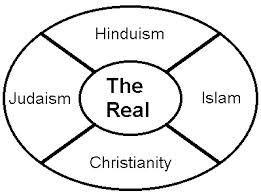 Lately, Thomas Friedman and a few others have been talking about pluralism and pointing out how extremist groups like ISIS live in a pluralistic world but have no concept of “pluralism”. They have no concept of the many viable approaches to life and knowledge and that these differences can coexist and thrive in non-rancorous competition. Liberal democracy is the political and communication condition most conducive to achieving pluralistic relations. I don’t mean to imply that Western democracy must be forced on Islam in some triumphalist sense, but it remains true that a diverse and respectful peace will not be achieved if one or both sides of the conflict hold a single overarching philosophical idea they consider unassailable and necessary to force on the other. A pluralistic mentality stresses the beneficial consequences of cultural differences and works to guard differences with legislation and accommodate all groups and centers of power as much as possible. This accommodation is steeped in argument and communication processes designed to incorporate minority views, respect differences, and work out solutions to competing demands.
Pluralism as a political and communication theory emerges from the philosophical tradition of liberalism which challenged monism and dominant ideologies in favor of individual rights and especially the right to association and speech. Such rights are considered in the Western tradition “inalienable” since they cannot be given away. And pluralism requires a vigorous and healthy regard for discussion and communication to solve problems. Pluralism remains a complex theoretical concept not in principle but in practice. The recognition of other sources of knowledge and power, and the argument for their advantages, even between Muslims and Westerners, is not that controversial. But the practice of pluralism is difficult and more controversial. And it is not the case that pluralism is simply the imposition of American liberalism. The logic of intercultural contact designed to solve or control conflict by definition requires the conditions of pluralism. Terms like compromise, mutual respect, accommodation, dialogue and deliberation, and other relational terms are all definitionally tied to the foundations of pluralism. Countries such as Germany, Italy, and Japan established the conditions of a pluralistic society after World War II and became increasingly stable. If politics is about the management of differences, then pluralism is the highest expression of the management of differences.
Once you get past its noble expression of basic principles pluralism produces a messy and difficult system of working out problems and trying to achieve stability and morally balance interests. Then pluralism gets us to communication. Its basic principles may be foundational and quickly recognized, even if one selfishly ignores those principles, as the only acceptable moral philosophy. But after that, after the statements about respect for differences, the real lived world, the life-world of human beings, is subject to the communication process. The differences and divides that separate people can only be closed or moderated by the process of interaction. Hence, intercultural contact and all those activities designed to achieve peace or manage conflicts are discursive in nature. Participants in conflicts, carrying their arsenal of plurality assumptions, begin with incommensurability and cultural divides and move toward communication in its full expression. It is the communication process that reaches across the divides and the gaps that define differences between groups. Certainly communication is more contestatory in the beginning of the conflict management process but must proceed to dialogue and deliberation as conditions dictate.
Some authors are clear with respect to the strong peace building and dialogue traditions of Islam. Muslim politics is not predetermined by a rigid category of religion that prevents them from inclusiveness, plurality, and dialogue for problem-solving. There is no way Islam can confront peace building without responding to issues in pluralism, secularism, and civil society. But too few people are aware of the work that has already taken place in this arena. Scholars have explained how there is no necessary contradiction between Islam and the embrace of pluralism and democratic processes. In fact, many Muslims admire Western engagement with secular knowledge and pluralism. Islamic principles of unity, mercy, subjugation of passion, and accountability emerge from the Koranic concept of nurturing alliances with other groups. And these groups are typically non-Muslims including Jews, Christians, and others. It is easy to make the argument that pluralism is a major issue for peace building in Islam. The discourse of pluralism and nonviolence is the cornerstone of interreligious dialogue and mediation of East-West differences.
Time to Stop the Abstract Reference to “New Media”
In their USIP report on “New Media and Contentious Politics” Aday and associates identified five levels of analysis in which new media and political conflict intersect. The five levels are pretty straightforward but useful. Still, I find two things most interesting about the evolution of new media: they are the fact that new media is not so “new” anymore, and secondly that new media relies on old media more than we thought. There is an interdependence and dependency on the two media (new and old) that organizes itself according to bridging structures. Quickly, the five levels are individual such that individual attitudes and behaviors are changed. The society is a second-level evidenced by things like polarization, protests, and participatory events. Collective action is a third level of analysis which points to the ability to organize and catalyze political activity. Regimes are also affected by new media because information and stories, accurate or not, can circulate in the society and stimulate regimes to respond impressively. And new media brings international attention which was especially potent during the Arab uprisings.
Again, Aday and colleagues in another Blogs and Bullets report explained in more detail the functioning of new media during contentious politics. When the audience is local new media such as Facebook serve mostly an information function. And of course it is increasingly important for mobilizing protests and organizing the community. But when the audience is more global new media plays a megaphone role in that it attracts international attention to local issues.
It remains interesting that new media are not so central to the news process as some people were beginning to think because it turns out that their relationship with traditional media is more complementary. Sometimes traditional media cannot cover a story because they are restrained or simply organizationally unable to manage coverage. Consequently, new media which are smaller and more mobile can cover a story and then make it available to traditional media and their often superior resources. And if new media and traditional media are both available then they make up a more complex media ecosystem that enriches the information value available.
The location of click data, reported in the Blogs and Bullets report, indicates that the majority of them came from outside the country thus reinforcing the notion of new media as an international megaphone. But the international community has a short attention span and they turn away from the story rather quickly. The Blogs and Bullets report suggests that counter to the popular conclusions about the local organizational role of new media (Facebook, Twitter, various webpages), they actually had more effect outside the region and internationally. Moreover the report underscores the fact that disentangling traditional media effects from new media effects is difficult if not impossible. The two media systems if you will have mutually influential effects on one another and are not quite so distinct as some believe.
Generalities about “new media” or “social media” have to give way to more precise questions and relationships. Thus, Facebook seemed to have some definite effects in Egypt but it did not another places. Why would that be? What are the lines that connect new media with traditional media? In other words, how do they work together to create an effect and can we parse out these effects?
The term “new media” continues to be a convenient shorthand and is communicative to the extent that it refers consistently to network-based asymmetrical forms of communication made possible by digital technology. But more work needs to be done on just how preferences and concepts are formed and spread, and which medium (new or old) is responsible for which affect.
The Media Literate Terrorist
 The media in general, and new media in particular, are increasingly effective tools used by extremist in Syria or ISIS. Even their extraordinary brutality is no match for the skill in which they are using new media to attract new recruits, send propaganda messages, scare the enemy, and promote their goals of a single Muslim state. ISIS is now one of the more sophisticated users of technology and they are intent on strutting their stuff to show the world what they can do. You can read more by Gabriel Wiemann on new technology and terrorism here and here.
First, ISIS begins with a historical frame or a brand if you will that marks them as epochal and steeped in the language of historic Islam and religious triumphalism. This brand frame is consistent and deftly designed for particular audiences. Hence, they refer to the current organization of states in the Arab world as “colonial” or “Crusader” partitions. They use video messages to challenge the arrangement of states and call for a single Muslim nation under the protective covering umbrella of Islam. Like all ethnopolitical groups, they claim to have been oppressed, mistreated, and brutalized such that they are justified in righting an ancient wrong. They frame messages designed for young recruits on the basis of ancient injustices and deep threats to their primordial claims of truth and geography. These messages must be working well enough because recruitment is up along with supplies and weapons.
You have to give ISIS their due with respect to rhetorical sensitivity and their ability to adapt to technology and message strategy. With just about the same skill as any Hollywood producer, ISIS creates a sense of importance, urgency, and participation in something greater than yourself. Messages are crafted differently for Westerners then Arabs (the Westerners get a softer less violent sell). Long boring speeches by Osama bin Laden on video sent to Al Jazeera were replaced by jihadists who were familiar with colloquial English and could speak to American youth about liking their next-door neighbor because you borrow their lawnmower, but how that neighbor was really an enemy of Islam. Now ISIS has mastered twitter, Facebook, and has many messages translated into various languages. They send images through Instagram and travel with a camera person who takes video of battles and dramatic moments to be used later in the other images.
The website ask.fm (you need to logon and get an account) has a section where you can ask questions about how to travel to a particular location and join ISIS including suggestions on what to bring. There are instant messaging programs designed for communication that can be kept secret and are not made public.
Terrorist and extremist groups have been using social media for some time now but the effectiveness of these media will only grow. These new communication technologies are cheap, accessible, and highly interactive. They promote more individualized contact as well as coherent yet dispersed communities. Combating these new forms of connectivity is increasingly more interesting and challenging than understanding how ISIS are other groups use them.
Managing Extremism and Dealing with ISIS
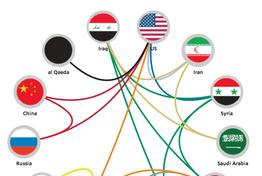
Maybe some of you saw the article from the Wall Street Journal on August 30, 2014. It graphically depicted (see the accompanying screenshot) all the various relationships among political actors in the Middle East and how they changed from enemies to friends or discovered common interests. So, historically Iran and the United States have been at loggerheads but Iran is a Shiite country and ISIS is a Sunni movement therefore Iran and the United States are in league with one another against the common Sunni enemy. Shiite Iran and Sunni Saudi Arabia have been fierce competitors but both parties now have the same enemy in the radical Islamic movement. It’s the old story that “the enemy of my enemy is my friend.” You can read more about it at the link above.
The various combinatorial factors of allegiance can be actually quite humorous if we carry out this “enemy of my enemy is my friend” shibboleth far enough. ISIS is a threat to Al Qaeda therefore Al Qaeda and the United States can form common cause. Syria has no love loss for ISIS so we can coordinate with them. Even Israel, who almost nobody chooses as a dance partner, shares interests with Egypt in opposing Hamas.
While these political associations have some element of truth to them, they are highly temporary, ad hoc, and abstract. They might cooperate for a couple of minutes behind the scenes but don’t count on the development of quality new relationships. There are too many problems and inconsistencies to forge much of a relationship. Moreover, if the United States does cooperate with one group they antagonize another. Can you imagine the US actually getting closer to Iran and the implications of that for our relationship with Israel and Saudi Arabia? That would be a complex dance indeed. Actually, the potential alliances are quite confusing and our judgments about the various alliances are probably distorted by media images and their general lack of information about ISIS.
Still, they do represent examples of commonalities that we are always calling for. We are surrounded by media messages pertaining to violence when it comes to news and information about ISIS. The availability heuristic would predict that we use and overemphasize information that is easily available to us. Since we can imagine images of violence easier than ones of peace and reconciliation, simply because these images are more available, we tend to think that such images and relationships are more characteristic of the conflict. And certainly the same is true of the negativity bias, which holds that negative information is more easily attended to and brought to mind than positive information. So when we think of the Israeli-Palestinian conflict we think of negative things such as violence, religious differences, and a whole host of tragedies that cause us to remember those more than anything else. These heuristics of negativity and availability can fundamentally define an intergroup conflict and contribute significantly to its intractability.
There is no escaping the requirement that any genuine and diligent effort to resolve Islam-West differences must confront extremism and violence. The first step, and this will be difficult for many, is to view extremism as a genuine relational term that is a reaction to economic and cultural issues. Hence, the issue is a problem that requires efforts from both sides. Defining a problem relationally implies a similarity dialectic; it forces the two parties to interpret differences as similarities or at least the recognition of mutuality of the problem. These common enemy situations can play a part. If there is going to be a compatibility perspective rather than a rivalry perspective, which is an initial crucial step toward ameliorating conflicts, then extremism must be confronted. These temporary relationships are opportunities for contact and defining problems more relationally. They at least provide entrées into the issues.
The current conflict represents simplistic belief systems that reduce the other side to essentialist practices and end up rendering everyone uninformed. For Muslims the fundamentalism gravitates toward puritanical religious ideology that defines offenses and outsiders. For Westerners fundamentalism equates liberal democracies with the natural flow of history and market economies as beyond criticism.
Real security is not a private good but one that is achieved by developing consensus, and cooperation, and interdependence – all relational terms. Justice cannot be imposed by one side but must be a concept that binds the two sides into a just relationship. They need a bigger story, another narrative that continues to develop the narrative of complementarity and compatibility. These temporary interdependencies formed against common enemies allow at least a toe if not a foot in the door.
The Agony of Contentious Language in the Israeli-Palestinian Conflict
 There is a tendency, even for those who know better, to think of language as a simple carrier of meaning. That is, language is the mechanism that packages up meaning and does the work of transferring it from one person to another. So we refer to the “war” in the Middle East and this term “war” carries the vast and complex array of images and meanings that attend to the concept of war. But language is a symbol system that connects a sound or visual image with meaning and this connection is tenuous and changeable. It is not stable and simple. Language not only reflects cultural differences and nuances of meaning but also” constitutes” and creates meanings. Calling the Israel Palestine conflict a “war” implies images of purposeful behavior on the part of both parties to engage in violence, identify territory that one side is defending, and images of clashes between the two sides. But this does not describe the Israel Palestine conflict very accurately.
There are two qualities of language that are pertinent here: the first is this constitutive quality of language where if I refer to something in a particular way I can influence your perception of it and “constitute” a version of reality. This is a relatively simple notion. If I use a racial or ethnic epithet to describe someone or their group I am creating an image of them. I can manipulate the importance of an issue by changing the way I refer to it. During the Vietnam War there used to be “search and destroy missions” but this made the image of the American soldier to aggressive and violent so the term was changed to “reconnaissance in force.” Labeling the unintended killing of innocents as “collateral damage” is a well-known example of constituting desired meaning. These sorts of things are not simple verbal trickery but attempts to alter how you understand an action. A recent article in the Forward noted how the situation in Gaza changed Hebrew and the Hebrew adapted to the conflict. In the beginning the Israelis referred to the fighting in Gaza as mivtza or an “operation” and not as milhama which is the everyday term for “war” in Hebrew.
So is Israel engaged in an “operation” or a “war?” The implications for word choice are clear enough. War implies a greater commitment of effort and resources along with potential existential threats and of course the legal right to benefits for soldiers of various types. This is all less true of a simple “operation.” A culture, especially the military dimension of the culture, tends to build a linguistic structure and vocabulary around its own narrative and political interests. This is fine and understandable but remains an obstacle to peace and changing the language into a structure of peace and conflict management that is necessary for resolution.
The second maddening quality of language is the obverse of its power to parse reality and define it. It is the fact that language is never sufficiently precise to describe the reality you desire; it never quite captures or always falls a little short of just what you want to express. For example, we have the words “tall” and “short.” We use these words easily and regularly and describe people who are tall” or “short.” We are comfortable with these two terms and they easily describe the realities of “tall” and “short.” But what about all those places between “tall” and “short?” What about all those portions of reality that don’t fit into “tall” or “short?” We are stuck with clumsy modifiers such as “sort of tall,” or “a little bit short.” Is the conflict in Gaza an “operation” or “a war?” And if it is something in between or “sort of” both then what language do we use to describe it? It is an asymmetrical conflict but what all is exactly included in that semantic category?
Language is powerful enough and has the ability to either stimulate or constrain conversations. Perhaps one day the structure of language around the conflict between the Israelis and the Palestinians will include some of the following: “dialogue” (the search for mutuality), “pluralism” (a recognition and respect for differences), “kiyum mishutaf” (a true shared in common experience), “Sulha” (Arab conflict resolution).
The noted political theorists Charles Tilly and Sidney Tarrow have recognized how culture laden language is. They have demonstrated how examining changes in language help understand long-term changes in behavior. In particular these two theorists have studied the language of contention and demonstrated how it can be creative and facilitative of a transformation from one state of contention to something else – namely, something less contentious.
Power to the People! A Call for Citizen Engagement in Israel Palestine

I’ve got an idea that is not really so bold as much as it is ignored. My idea responds to what I consider to be a weakness in the political considerations that characterize the Israeli-Palestinian conflict. And that weakness is the failure of sufficient input from the general populace. I mean meaningful input taken seriously. Polls in both Israel and Palestine indicate that upwards of 60% of the population wants peace and find the two state solution to be sensible. It is true, according to a new poll of Palestinians, that the two state solution is falling away in popularity. But it can be reinvigorated and it does represent something the Palestinians support. A few people (e.g. Hamas, settlers, elites) cause a lot of problems and their messages are sometimes confused with consensus. Moreover, political elites cannot always be trusted and are subject to their own strategic manipulations. We’ve seen nothing but failure in the Israeli-Palestinian conflict even though it has been characterized by diplomatic influences.
In spite of all the political contact between the two sides the Israeli-Palestinian conflict is mired in complexity partially because the approach to peace building is not sufficiently multifaceted or inclusive of popular consciousness. Any sort of “people-to-people communication” can improve grassroots contact between the two sides, build coalitions, and engage ordinary citizens. But these forms of contact must also bubble up to influence political leaders.
I’m calling for groups of Palestinians and Israeli Jews to organize themselves into participatory groups characterized by democratic mechanisms that parallel the spread of recent nondemocratic dynamics. There are five other qualities that should be descriptive of these groups: first, these groups should be deeply integrated into the various communities; participants should be representative of the population, not elites. Two, these groups must be interdependent such that what happens in one group influences another group. Borders, population characteristics, and security matters are examples. Three, these groups have to be repeated often enough to discover consistent patterns that represent defensible conclusions. Four, they must be governed by principles of deliberation – some of which are discussed below – and democratic and public sphere criteria are expected. Finally, these groups must produce some sort of product and make it available to the public, which should be following the discussions anyway.
I do not intend for these groups to be revolutionary. They are grassroots movements designed to achieve a sustained message that typifies as much as possible population sentiments. The gap between public opinion and the perspective of the elected elites should be closed or constrained. The goal is to drive a reform agenda that improves the relationship between the populace and the government. These discussions should be as open and public as possible with the media performing their best function as a megaphone that reaches broad populations. The meetings should perform a legitimizing function and help find a path leading to some productive solutions.
Participatory Democracy
There are more models and procedures for citizen participation then we can respond to here (click here for a description six models of citizen participation), but a standard model of participatory democracy is best. This is a general term that refers to democratic procedures and representative decision-making. That is, nonelected citizens have decision-making power and the communication within these groups empowers individuals and promotes their cooperation. Participatory democracy is a model for social justice and the relationship between civil society and the macro political system.
It is true that participatory democratic discussions are historically idealistic and can be abstract but there are a number of success stories and advantages under certain circumstances. Organizing such groups is not easy and requires political will but it remains a relatively unexplored avenue. Finding a pathway to peace is a social construction that must include public debate and discussion. If these proposed participatory groups can establish themselves and maintain consistency they will be less vulnerable to the destructive influences of extremists on both sides. And managing these extremists – these few people who cause a lot of trouble – is particularly important in the Israeli-Palestinian conflict because these extremists will do anything to prevent productive solutions. Deep and widespread citizen engagement is probably necessary to build a foundation for a new political order that will be necessary if this conflict is going to be at least managed if not resolved.
There will be more on how to develop, organize, and structure these proposed public discussion in future posts.
Why Israel Wins the Military War but Loses the Narrative


Israel supporters are struck dumb by what they consider to be the great moral inversion. In fact, as Jeffrey Goldberg writing in The Atlantic states, “Hamas is a theocratic fascist cult committed to the obliteration of Israel.” It is an organization committed to genocide. Hamas represents nothing of modern democratic political theory– religious tolerance, political participation, association rights, liberal values, etc. But to the chagrin of many Hamas is treated as if it were a legitimate political party committed to the interests of Gazans rather than itself. Hamas is fighting a war in which they are trying to kill as many of their enemy as possible (Israelis); Israel is fighting a war in which they are trying to avoid killing as many people as possible. The moral inversion continues.
John Kerry is currently struggling with a cease-fire agreement because he insists on granting Hamas various rights rather than treating it according to his own State Department’s designation as a terrorist group. Kerry’s defense is that Hamas is a reality that must be dealt with and I agree with that, but one does not cave in to a terrorist group’s demand for their own security, funding, and freedom of movement in order to secure a cease-fire. On the contrary, that would be a reward for the group’s behavior and will probably encourage future violence if such rewards are available.
So what explains this? Why is this violent anti-Semitic group being treated seriously while Israel takes a perceptual and public relations beating? Why do the Palestinians, who are equally as blameworthy for the failure of conflict management, win the narrative? Why are they the sympathetic underdog? Here are a few suggestions:
Imagine some tough guy big kids in your neighborhood who are teased and taunted by a bunch of little kids. The little kids throw rocks, break the windows at houses, and spread false or distorted stories about these big kids to others in the neighborhood. The big kids defend their houses and respond to the rock throwing with fistfights they easily win, and throwing back bigger and harder rocks. The big kids do more damage and bloody the noses of the little kids and are “blamed” for inflicting damage even though they were defending themselves and the little kids initiated the aggression. And so it is with the Israelis and Palestinians. It doesn’t seem to matter how the Palestinians or Hamas behave, the Israelis get blamed because they are capable of inflicting more damage. The big kids and the Israelis lose if they defend themselves and if they do not defend themselves. So Hamas wins the narrative battle every time they manipulate Israel into killing Palestinians. Israel cannot escape the paradox.
Secondly, the Palestinians have mastered the underdog narrative. During pre-state Israel, and even in the early days of the state, Jews were the underdog and the center of world attention and sympathy. But now the left has switched its allegiance to the newest minority group. There is a spectrum of the left that never met a minority group it did not consider oppressed and the Palestinians are a perfect example.
And third, the second point above is informed by the context of anti-Semitism. I dislike and reject the notion that anti-Semitism is everywhere and always the explanation for criticism of Israel. Surely Israel can be criticized without it being anti-Semitic. But sometimes the criticism of Israel is so bizarre, so morally inverted, that only anti-Semitism explains it. And new media has brought violent and vitriolic anti-Semitism to the forefront. Anti-Semitism was of hallucinogenic proportions during the Holocaust, completely unjustified by reality, and there are moments when I feel the same conditions returning.
Finally, everyone has to do more. Israel has to make its case better to the world. They need spokespersons and better public relations to be sure. But that’s only a small part of the problem. It is not a public relations problem but an argument one. It is incumbent on Israel to do a better job of explaining to the world who they are and what they are fighting against. Moreover, Israel has to begin addressing those issues where change is inevitable. Settlements, for example, are just not going to be there in the end – at least in their present form. The only way Israel remains a nation of Jews, for Jews, and defined as a Jewish state devoted to some sense of Jewish particularity is by allowing the Palestinians to do the same for themselves in their own state. Israel must make more aggressive progress toward this goal.
Until then, Israel will continue to win military battles and kill more of the other side (which is never a very good measure of anything), but lose the narrative battle.
This will not stop if we don’t talk
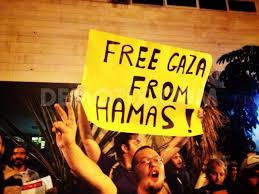

ze lo y’gamer im lo n’daber
This won’t stop if we don’t talk
It is probably unimaginable to think of Hamas and Israel actually talking civilly but getting to the negotiating table is the only answer. Here are some thoughts on doing that.
The above phrase in transliterated Hebrew is going around Israel. It means “this will not stop if we don’t talk” and it appears on protest signs, news stories, and casual conversation. It rhymes in Hebrew. Truer words have never been spoken. The issue is not how to talk to each other or what form those talks should take, the issue is getting to the table. All of our knowledge and skill at communication, dialogue and deliberation, is wasted and unavailable if you cannot get the two parties to the table. If Hamas or Israel insists that the other side must be destroyed or their incompatibilities are irreversible and there’s nothing to talk about, then the violence and conflict will simply continue.
At the moment I’m concerned about getting to the table. Essentially, this is the issue of “ripeness” which you can read more about here. Ripeness refers to the right time or the belief that the conditions are best for talking and solving problems. Right now no one would consider the time “ripe” for conflict management between Israel and Hamas for example. The time might be necessary or the most urgent given the violence but the situation is not ripe. “Ripeness” is a delicate matter because it is a little subjective and difficult to know when exactly is the “right time.” One can move too early, too late, too fast, or misjudge the other. Moreover, conflicts usually have more than one ripe time.
But I do not advocate sitting around waiting for the ripe moment. Participants in a conflict sometimes avoid ripe situations because they get more out of prolonging the conflict. Hamas always says it has “time on its side” because the status attributions it receives from war with Israel outweigh any benefits of negotiation and talk. One question becomes then how you create ripeness, how do you construct conditions that will increase the chances of bringing two sides to the table? Here are some strategies:
1. Third parties are always good sources of incentives. The Middle East has been most calm and in control when there is a significant international polity (the Ottoman Empire, the British Mandate, the United States,) that can provide incentives for talks. Actually, anytime a third-party is willing to intervene and try to mediate the conflict it is a good indication of ripeness.
2. The second strategy for getting people to the table, although a less pleasant one, is waiting until things are so bad that negotiation becomes attractive. As the saying goes, “sometimes things have to get worse before they can get better.”
3. Sometimes it’s possible to get people to the negotiating table by promising them more than they expect. Perhaps some symbolic recognition that was earlier denied, or a tangible resource.
4. New ways to be interdependent that benefit both sides are always strong strategies. Interdependence creates common interest and overlapping concerns and the two parties will talk if the reward possibilities are sufficient.
5. Pre-negotiations or “talking about talk.” Finally, it is sometimes useful to get the two parties to talk about how they would organize and develop dialogue or deliberation. Don’t engage in actual discussion and deliberation and do not term the conversation as official negotiation or discussion. But get the two parties together and have them imagine what the process would look like. This should move them closer to the actual experience of problem-solving deliberation.
Persuading the two parties to talk and find a way to negotiate a settlement – to get them to the table – is typically more difficult than constructing an actual settlement package. There are lots of solutions and proposals to end and contain the Israeli-Palestinian conflict. Many of them are understood and accepted by both parties and not very controversial. But none of this matters if the two parties do not talk.



 Peace and Conflict Politics