Category Archives: Communication and Conflict Resolution
I Don’t Want to Debate. I Want to Talk about My Pain. How the Democrats Got It Wrong

It is quite interesting how just a few short months ago we were burying the Republican Party. They were in a state of disarray with a crowd of presidential contenders each of which seem to be more flawed than the next. And Trump was the worst of the bunch. As his momentum grew there were more and more articles and analyses decrying the state of the Republican Party explaining how Trump was going to destroy it. The reliable sensible old guard (Romney, McCain, Bush) were not only abandoning candidates but actively working against them. Romney’s pointed and vitriolic attacks on Trump were shocking coming from the cool businessmen Republican. So what happened? How did one of the worst candidates who is the least prepared and lacks the basic manners for the job get elected?
It turns out that the Republicans can’t take credit for getting Trump elected, but the Democrats can take some blame. And it wasn’t Hillary’s fault either. Her campaign made mistakes but it was not the technical and strategic components of the campaign that made the difference; it was the smug identity politics of the left; it was that sense that if you disagree with me (a good liberal) you must be some simplistic uneducated fool who is racist and sexist. And I am equally guilty.
Liberalism is a political ideology fundamentally concerned with inclusion, rights, and individual freedom. In recent years it has become associated with sharp group identities demanding recognition and a tension between “celebrating differences” and seeking the commonalities that bind us together as a nation. Our history of privatizing ethnicity and religion, and using the overarching American national ideals (democracy, individual rights, etc.) as common factors has served us well. It has meant over the years that our personal identities are not wrapped up in religion and ethnicity but in political philosophy designed to treat each other equally. But as those “rights” became increasingly group identification rights such that groups were clamoring for distinction and difference rather than commonality the differences and cleavages amongst us became the focal point. Consequently, as the title of this essay indicates, public argument and deliberation to solve problems receded into the background as individuals foregrounded their personal identities and private pain.
Liberal activism in the service of identity politics – to the exclusion of other issues – has been making progress along with a smoldering grassroots reaction and intensifying disdain for the other side. Finally, we ran into Trump who was equally as skilled at a self-righteous and aggressive style of discourse and thereby became the voice of the disenchanted. It’s important to underscore that the liberal group agenda is responsible for improving group political rights and battling the racism and discrimination it is so recognized for. The “group rights” agenda is responsible for reshaping civic life and addressing inequities burdening minorities as well as other segments of society. But the evolution of those rights into an arrogant identity politics rather than a unifying political agenda has left us with the contentious group distinctions we are experiencing and its accompanying polarization.
The recent presidential campaign was a despicable display of politics that was almost free of discussion of issues, uncivil, tacky, shallow, and polarizing. It failed its responsibility to our foremost political requirement, which is to use democratic means to shape a society into a fair and governable unit. This of course includes respect for individual group identities but in the future might require more emphasis on those things we need to do together rather than separately.
Right Wing Media Bias
This video makes some very strong points and is worth watching. I suggest you click on it now and watch. The video is sponsored by “Media Matters” which is a liberal organization but one that has the interests of our democracy in mind. It is possible to make the case that systematic and consciously perpetrated bias by Fox News governs their organizational identity and has quantifiable effects on voting patterns and political knowledge. The claims of news bias are so pervasive and so self-contradictory that it’s damaging any remnants of news credibility. Everybody believes the news is biased right up until the point the news says something they agree with. And, moreover, people are absolutely convinced that their perceptions are correct and their understanding of the issues and whatever source they came from is accurate. The public is shockingly naive about the frequency and forms of information processing distortions.
Let’s pay attention for a moment to this issue of news bias and try for some rigor and conclusions that result from data and controlled studies. I’ve grown weary of everyone complaining about the news and biases especially when all the complaints are simply self-serving. It borders on fascinating how few people see their own distortions and biases. Every Trump supporter is convinced the New York Times and the television media – minus Fox News – favored the other side and was critical of Trump while being charitable toward Hillary. And Hillary supporters (although in much smaller numbers) lamented the fascination with Trump that brought him so much free media time.
I would call your attention to a study directly confronting this issue of Fox News and its impact in the news sphere. The authors examine the impact of media bias, the persuasiveness of a particular media, the likelihood of voting, and mobility rates. Moreover, and something most citizens don’t think about, the review of the studies includes conditions of the receivers. In other words, the same news programming does not have the same effect on everyone. So, on the basis of survey research the authors found that 22% of the population believed that Saddam Hussein had weapons of mass destruction, but 33% of Fox News viewers believed he had weapons of mass destruction. The findings hold even after controlling for party identification.
Additionally, exposure to conservative media has an effect on voter choice including being responsible for switching some Republicans to Democratic voters. The results are slightly conditioned by the psychological state of receivers. Those watching Fox news for the first time were more persuadable than viewers who watched consistently. This particular study focused on Fox News and conservative media but I would presume that the pattern of results apply to liberal media as well even if the effects are stronger or weaker.
My concern here is not to repeat the pernicious effects of Fox News or biased media but to sound the alarm for increasing pressure to both find quality outlets of information, as well as “educate” the public a little more about the nature and exposure to bias and what to do with it. Fox News is responsible for taking partisan positions and making some extreme even outrageous claims; these then get repeated and spread throughout the population thus multiplying the distorted effects.
Turning more toward public media rather than commercial media is one response to this situation. Public media presents more in-depth and critical news about domestic and international affairs and is capable of increasing citizen engagement as well as quality information.
One Final Attempt at Quality Information before Voting
Dear blog follower:
During this election, more than any other, trying to get some facts right is difficult. The below is from ProCon.org a nonpartisan educational organization, that helps everyone to make informed decisions regardless of how or for whom you vote. The degradation of the political process, the volume of ignorance floating around, polarization, and the incivility and impertinence of the candidates is of historic proportions. Most of us never imagined Trump as a Republican candidate and we certainly didn’t imagine the debates – which were supposed to be an informed and intelligent portrayal of the candidates – as a showcase for marital and sexual indiscretions paraded in front of the opponent and the world.
So, I offer the below as the clearest and most objective side-by-side comparison of the candidates and their stance on issues. You may have made up your mind already but at least check your thinking against the information presented.
Presidential Election
2. 2016 Presidential Election Candidate Quiz – Find Your Match!
Abortion
4. Top Pro & Con Quotes on Abortion
Felon Voting
5. Should Felons Who Have Completed Their Sentence (Incarceration, Probation, and Parole) Be Allowed to Vote?
6. State Felon Voting Laws
7. Number of People by State Who Cannot Vote Due to a Felony Conviction
Gun Control
8. Should More Gun Control Laws Be Enacted?
9. Top Pro & Con Quotes on Gun Control
Immigration
11. Should the Government Allow Immigrants Who Are Here Illegally to Become US Citizens?
12. Illegal Immigration, Population Estimates in the United States, 1969-2014
13. Demographics of Immigrants in the United States Illegally
Marijuana
14. Should Marijuana Be a Medical Option?
15. 25 Legal Medical Marijuana States and DC
16. Ranking 20 Drugs and Alcohol by Overall Harm
Minimum Wage
17. Should the Federal Minimum Wage Be Increased?
18. Top Pro & Con Quotes on the Federal Minimum Wage
19. State-by-State Minimum Wage Levels
20. And, just for fun, Top 10 Most Surprising Things in the 2016 Presidential Candidates’ Online Stores
The Problem of False Equivalencies
But, please, tell me again how “both candidates are the same” and they’re “equally as flawed.” Because if that’s what you really believe, then you’re choosing to ignore reality and believing whatever the hell you want to believe.
Read more here
How the Trump Monster Slouched toward the Republicans
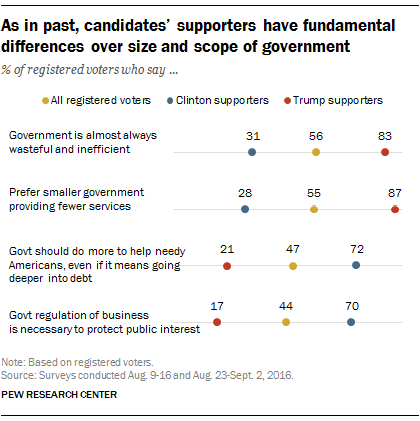
Note the data in the table below from the Pew Foundation. There have been more than a few stories written about how Trump is a monster created by the Republican Party. Let’s take a closer look at just what the Republican Party has created and why. There are lots of reasons but let’s focus on two. First, the Republicans have simply failed to appeal to Hispanics and minorities even though their after action report from the 2012 election recognized this problem. They did little or nothing about it. 86% of Republicans or those leaning that way are White where only 57% of Democrats are White. Curiously, the Republicans should be able to appeal to Latinos who are family oriented, religious, and patriotic to the extent that they oppose leftist regimes. There are two prominent Republicans in Ted Cruz and Marco Rubio who could be electable if conditions were right. The Democrats have begun to include minorities more into the family tent and these minorities recognize their own progress – Donald Trump’s claims that their schools and inner cities are a mess notwithstanding.
Moreover, the Republicans began to run more on moral and social (guns, God, and gays) issues then on economic ones. The angry less educated white male strand of Republican has countered any genuine Republican attempts to include minorities because of their racism and general rejection of the argument that immigration is good for America rather than bad. The foreign-policy hawks in the Republican Party are an attractive appeal for many Americans, and can resonate with American strength, but this group has essentially been co-opted by Hillary Clinton.
Bill Clinton moved to the party to the center and brought in more professionals leaving working-class whites to find a place in the Republican Party. These working-class whites have been frustrated by the Republicans who promised to look after their interests but haven’t done so very successfully. So this group had one more reason to radicalize and movements such as a Tea Party began to emerge and differences between minorities and whites and Republicans and Democrats began to polarize even further.

The table below strongly illustrates this polarization. The blue dots represent Clinton supporters and the red dots Trump supporters. Look at the differences between the two on a few key issues that are ideological in nature. Statements about how wasteful government is and should be smaller are dramatically associated with Republicans (83% and 87% agree). And statements about how government should help the needy and regulate business (most associated with Democrats) are strongly supported by Democrats over Republicans (72% and 70%). These patterns in the electorate are the reason Donald Trump was so successful in the primaries. Moreover, rather than finding a candidate who genuinely coalesced around cultural and economic issues Trump represents fear and nationalism. How is a political party supposed to get anything done when they express such disdain for government?
Trump’s populist nationalism makes us particularly vulnerable because the public currently has so little confidence in many American institutions such as the courts, the presidency, public schools, and banks. When the golden haired man comes on TV and tells you that nothing is your fault – it’s all the fault of immigrants, elites, and the media – there’s plenty of people who will listen.
What You Saw in the Debate

Most pundits figured if Trump could tie his shoes then he would have the most to gain from the debate. He really did have a lot to gain by appearing presidential and in control but the issue is of course whether or not he actually maintained any sense of presidential decorum. He didn’t.
Presidential debates are mostly spectacle and this one was no different. Sure, Hillary won especially if you keep score according to a debate coach’s tally sheet of arguments and counter arguments. Presidential debates such as these are not interested in who comes up with a better argument but rather who can make the other look bad.
But the public anticipates debates with a certain amount of enthusiasm. It’s a contest between democracy’s formidable gladiators; there is an underdog challenger doing battle with a superior opponent and we talk about debates with all the war metaphors we can muster. There are “attacks,” and “aggression,” along with “victors and the vanquished.” We would be better off viewing the debates as platforms to make judgments about individuals leading to a decision about which candidate is best. The “winner-loser” frame extends the war metaphor but also causes us to watch it like a horse race constantly attending to who is ahead and who is behind rather than learning something about the issues.
But still, debates contribute to voter knowledge and the acquisition of information. It is true enough that journalism rarely these days considers itself to be a platform for issues and deliberative consideration. So debates have slightly appropriated this role. The debates give us an opportunity for a raw look at the candidates including how they appear on TV, how they handle themselves spontaneously, and general issues of charisma and attraction. This is an important and satisfying counterpoint to political ads which are strategically constructed and designed to be manipulative and the voters know it. It is quite easy to dismiss candidate commercials but less so for debates because of their increased perception of authenticity.
So what did we see the other night and how does it fit in with some of the research on debates?
Even though debates are known to reinforce partisan preferences, the first Clinton-Trump debate transcended that conclusion because Hillary sliced and diced Trump. She set traps (the coming Miss Universe interview), behaved more politely, had very few fact checking problems, appeared composed and in control, unhinged him a few times as was the debate plan, and spent more time on policy.
Dorothy Rabinowitz – of the conservative Wall Street Journal of all places – wrote that Hillary is the only thing that stands between the United States and the “reign of the most unstable, proudly uninformed, psychologically unfit president ever to enter the White House.” Since in one study almost 30% of the viewing audience considers the presidential debates more helpful than talk shows or advertising spots, this means that a lot of people witnessed the Hillary performance in the debate. And given that the viewership was the biggest in history (over 80 million viewers) she was in a position to reintroduce herself to many people.
Presidential debates also produce multiplier effects. This means that post debate citizen communication about political issues is stimulated. The debate induces communication. And this post debate communication is one way that partisan preferences are mediated. In other words, debates because of information processing and selection biases are strongly implicated in reinforcing existing partisan biases. But these effects are mediated by post debate conversation. As citizens engage others, especially if this engagement represents some sense of substantive exchange, then partisan positions are challenged. From my own experience anyway, the Clinton-Trump post debate interactions were robust. This of course has something to do with Trump’s media presence and inimitable personality along with the uniquely personal and conflict oriented nature of the campaign. Nevertheless, it prompted post debate conversation relative to the issues people are thinking about.
One might continue to think, in naïve rationality, that Trump will make the necessary adjustments but it’s getting late and first debates are the most watched as the audience trails off for the next two. But we will tune in waiting for some sort of catastrophe that we can talk about after the debate.
What To Watch for Monday Night in the Clinton – Trump Debate
Word around the campfire is that the debate between Hillary Clinton and Donald Trump this Monday night the 26th might be the most watched television program in history. Both candidates have an appeal to the various audiences that make up the United States (not to mention the world) beginning with Trump’s narcissistic populism and rank self-aggrandizement, and including Hillary’s “bitch persona” as Andi Zeisler explains in the New York Times.
The debate will devolve into two general strategic thrusts. One, we will at least fantasize about meeting our expectations on policy and issue stances. There will be some attempts to win debate points by a rather straightforward exchange of a few facts and arguments. But don’t expect this to last long and while this clearly favors Hillary it could work against her. Hillary Clinton is soaked in policy issues and Donald Trump doesn’t stand a chance. She is the grown up version of the high school debater carrying around a large suitcase of information and just waiting to pull out a little 3 x 5 fact card. I’m sure, bless her heart, she still thinks this form of discourse matters much. Somewhere in her soul she still believes that if she has one better fact than Trump, or makes the slightly better argument then she will “win.”
The problem is people don’t pay much attention to this form of communication any longer. Most of the population is incapable of taking part in such argument and, more to the point, don’t want to. Paradoxically, Hillary’s superior control of the substantive issues will do little more than classify her as “boring” or a “Washington policy wonk” who doesn’t understand the needs of real people. Moreover, Trump can escape this aspect of the debates unscathed because the expectations for him on these matters are so low. Even when it turns out he doesn’t know the difference between Turkey and his Thanksgiving meal he will emerge undamaged.
I suppose it is possible that Trump will pull an all-nighter and study for his big exams but I doubt it. This would be too against character. In fact, it might not serve him well because it would be contrary to his authenticity image which is based on a lack of fancy knowledge. Trump will do well if he just maintains some sense of equanimity. Then again, this too is against character.
But the name calling, personal attacks, and bullying will be the real fun. Both candidates have been wounded often enough that they take the shots pretty well. Trump will clearly try to bully Hillary but she’s also capable of being tough. This worked for Trump in the primaries and I’m sure he will continue to do “what got him here.” Trump will be at some disadvantage because of the moderator system rather me rabble rousing crowds. This is likely to subdue him which does not work to his advantage.
Hillary has to continue to drive home the theme that Trump lacks the manners and temperament to be president. Following the convention when she unleashed an aggressive series of ads around this theme was the time in which she had 10 point leads in the polls. These leads began to dissipate as soon as she scaled back that message. If Trump is calm on Monday night and even slightly appears presidential then that will be the best argument against Hillary’s claim that he is unfit for the job.
Unfortunately, the only way for Hillary Clinton to gain ground during the debate is to cause Trump to lose his temper or say something so outrageous that it reinforces Hillary’s claim that he is unfit for the job. Considered policy analysis and reasonable arguments that take place in the shiny and clean debating halls of justice are Hillary’s strength, but she’ll have to play outside in the dirt to beat Trump.
The Flowering of the Post-Truth Era of Politics

It is fashionable – especially for liberal academics – to decry the current state of politics crouching in fear as the beast Donald Trump slouches toward Bethlehem. The center is no longer holding. But just because it’s “fashionable” doesn’t make it any less true. Trump is a unique candidate who represents the accumulated intellectual and linguistic decline that has been fomenting in the background for a few decades.
This undercurrent has been creeping up on the culture but hiding itself in the small interactions of people, commercial culture, and media that structure and reproduce the nature of society. For example, a few of what we thought were ongoing debates or genuine contentions in our political culture that require critical analysis and defensible conclusions have now been either settled or are leaning so far in one direction as to constitute a tide. So, there was once a debate between “bias” and “objectivity” the goal of which was to clarify objectivity or move toward it as much as possible. But we woke up one morning and the tables were turned telling us that objectivity didn’t exist and everything was biased. The only issue was whose bias was going to overwhelm the other. Argument, the foundation of democratic processes and quality decision-making, has been enervated because when everything is considered “just your opinion” or “just the way you see things” then even quality evidence-based argument loses its standing. The best thinking is easy to ignore because there are no standards of objectivity only degrees of bias.
There also used to be a boundary between entertainment and civic life. Even the most insightful political operative did not assume that Trump’s television show “The Apprentice” would be a launching pad for his presidential run. But when exposure and recognition become equivalent to knowledge of history, politics, and policy then appearing on television is just as good. The increasing ease with which exposure is conflated with competence is one of those undercurrents that has finally bubbled to the surface as commercial media, and the logic of its presentation structure, has become the dominant form of information processing and organization.
Additionally, it is remarkable how the public has been separated into fact universes. People live in their own information enclave that includes a collection of their own facts and interpretations – or at least conclusions they believe to be facts. Somehow we got to the point where rather than observing and gathering facts and information and then interpreting upwards toward a conclusion, we start with conclusions and reason downward looking for confirming facts and ideas. We criticize politicians who change their mind rather than respecting them for learning something and adjusting accordingly. It is all part of the post-truth society.
Finally, and by way of one more example, the quality of public discourse (e.g. presidential speeches and advertisements) has shifted shapes so that now it looks more like bloated rhetoric then considered analysis. Trump is of course a good example of a speaker who is so befuddled that he has little left to do but lash out and call names. He reflects a specialized strand of reality, one in which when you are wrong you blame reality rather than yourself. It is the ultimate in the common characterization of Trump as a narcissist.
How Trump Misunderstands Islam

Trump continues to use fear appeals and scare tactics when it comes to Muslims and terror. And while he is minimally effective – and getting less so every day – his supporters are sympathetic others who are increasingly misinformed about terror and Islam. A piece of video footage showing Trump supporters at a rally had one fellow screaming at another that Islam was an “ideology.” The point was that Islam is a nefarious set of beliefs and practices designed to manipulate you into its belief system.
The dilemma here is that defining Islam as violent justifies an armed response when, in fact, the only response that will be effective is a long-term war of ideas pitting *Islamist extremism against liberal democracies. As Gutmann and Thompson have claimed in their highly recommended book Democracy and Disagreement,“of the challenges that American democracy faces today, none is more formidable than the problem of moral disagreement.” In other words, those who have sacred values and are what Scott Atran calls “devoted actors” rather than “rational actors” pose the biggest challenge to liberal democracies because conflicts over fundamental values are so resistant to resolution. You cannot simply subject the moral disagreement to the rational calculations of the marketplace.
But if wanton murder of men, women, and children is so fundamental to Islam why is it such a recent phenomenon on the world stage? Why doesn’t “jihadism” as it has come to be known have long history? Typically, Islamist terror is first associated with the 1979 Iranian revolution. But even the Iranian revolution can be analyzed as a clash of political ideologies where Islamists attach themselves to religious sounding terminology (“infidels,” “holy wars,” “party of God”) in order to give themselves religious justification.
It is true enough that Islamism is really a totalitarian movement that has hijacked some religious terminology in an effort to alter traditional Islam and challenge Western democracies. But Boroumand and Boroumand writing in the Journal of Democracy make the following emphatic statement and I quote in full:
“There is in the history of Islam no precedent for the utterly unrestrained violence of Al Qaeda or Hezbollah… To kill oneself while wantonly murdering women, children, and people of all religions and descriptions… has nothing to do with Islam and one does not have to be a learned theologian to see this… The truth is that contemporary Islamist terror is an eminently modern practice thoroughly at odds with Islamic traditions and ethics” (p.6).
I don’t mean to imply that traditional Islamic religious teachings hold an inclusive democratic vision for the world or that it resonates with contemporary ideas about liberal democracies and human rights. But the long view of any religious evolution has it moving toward a widening circle of inclusion and dignity for others. As of now, there are more than a few Islamic countries that are pluralistic but have no political concept of “pluralism.” For this reason they define rigid group boundaries and more nascent forms of control.
But as with most of the issues in this election, Trump is not the answer to anything.
*Terminology note: I use “Islamist” or “Islamism” to refer to those extreme groups or ideologies that justify violence and cherry pick the Koran to give their ideology a religious sounding façade. The term “Islamic” refers to the long political, religious, and scholarly tradition of institutional Islam.
Change Hillary’s Campaign Slogan from “I’m with Her” to “She’s with Me.”

The results of the most recent Washington Post-ABC News Poll are in and the news is certainly good for Hillary. She leads Trump by double digits and he seems to be declining precipitously. In a head-to-head matchup Clinton leads Trump 51% to 39% among registered voters.The results are informative and the poll also shows some interesting data that should be useful for Hillary.
If you are a Republican hoping to defeat Hillary Clinton in the fall you must be pretty dispirited. I mean Hillary is beatable – or at least it appears she was beatable. Her high negatives coupled with all the people who dislike her for reasons justified or not seemed at one point insurmountable. But then along comes the Republican Party and they behave the way the Democrats usually do. That is, when they want to form a firing squad they get into a circle. No political party choice has been so tin-eared about the temperament and qualifications of a candidate since McCain chose Sarah Palin as his vice presidential running mate. Let’s take a closer look at the numbers and what they probably or potentially mean.
The most troubling data in the survey for Hillary is the net “new direction” data which indicate that 56% of those polled would like to set the nation on a new direction. This makes it difficult for Hillary to identify herself with the President and as a candidate that will continue Obama’s policies. But on the other hand, President Obama’s approval ratings at 56% are higher than since the killing of Osama bin Laden in 2011. Obama is more popular than Bush was during the last days of his presidency. So using the President during the campaign – dependent of course on audiences and context – will generally be a safe bet for Hillary.
Just about two thirds of Americans think Trump is unqualified to be President. They believe his temperament is insufficiently stable and his comments about ethnic groups and women are unacceptable. It doesn’t matter if such comments are defined as racist or “politically incorrect” because his comments are considered inappropriate. The intensity of criticism for an opponent does not have to rise to racism; inappropriate is good enough. It marks the user as insensitive at best and incompetent at worst with no facility for basic civility or contextual awareness.
The majority of the populace considers Trump unqualified and astounding 64% do not believe he has the credentials to be President. Still, there’s a group of people who consider Trump unqualified for the job and disapprove of his comments about women, minorities, and Muslims but they plan to vote for him anyway. These are the people composed of two characteristics: extreme Obama hate which means they’ll vote for anybody who isn’t Obama or is associated politically with Obama, and those who want the country to move in a new direction. Hillary can probably safely pay little mind to one of these groups. The Obama haters are probably tinged with a little racism (at best) and it would be difficult to make progress with them.
But she has to convince the electorate that things are going to change for the better and new directions are in the offing. Hillary is the establishment candidate and easily defined as just “more of the same.” She shares an elite form of discourse with Obama and those of her politically competent generation which stands in contrast to Trump’s populism. Then again, she has Trump’s bumbling verbosity working to her advantage; that is, Trump could capitalize on the populist message if he knew how to communicate it. But my guess is Trump will continue to fail his party and his supporters by refusing to understand the difference between himself and his message. He will substitute authenticity for communicative effectiveness. And for Hillary to move toward stronger identification with supporters she should convince them that “she is with them” rather than “they are with her.”




 Peace and Conflict Politics