Authoritarian States Are Not so Stable

I tend to be an unapologetic democracy advocate who is confident in the premise that elevates the essence of democracy (consent of the governed) to the most moral and ultimately stable form of government. Holding such a position can certainly get you in trouble if you convert it into neoconservative foreign policy and start meddling in the affairs of others under the justification of “democracy promotion.” Moreover, there are more than a few people who make the counterargument that democracy is destabilizing for cultures unprepared for it (many in the Middle East and Arab world), and authoritarian regimes may be on the wrong side of human rights but they are stabilizing. Beyond all the opinion on these matters, there is the problem of sufficient cases and empirical demonstration, namely, what are the instances where democracy promotion and advocacy actually work to undermine authoritarianism and can be credited with “democratic regime change.”
Gregory Gause has initiated excellent steps in this direction in a recent article in Foreign Affairs. You can find it here. Gause takes up the task of explaining the “myth of authoritarian stability.” The “Arab world” as he terms it sports a long list of authoritarian leaders – Qaddafi in Libya, the Assad family in Syria, Mubarak in Egypt, the al Saud family in Saudi Arabia, Ben Ali in Tunisia and others. And even though there are complex differences amongst these cases there seems to be, according to Gause, two issues that align themselves in such a way as to predict either the likelihood of authoritarian stability or democratic liberalization.
First, you’ll rarely find, if ever, an explanation that accounts for Arab regime stability in terms of culture. Most attribute stability to the relationship between the state and the military. Still, the assumption that there is no daylight between the military and rulers is not necessarily correct. There are cases where the military was protective of protesters and this was true of Egypt in particular. When societies are homogeneous and the military is not subduing an ethnoreligious minority they are more sympathetic to types of resistance. When the military is professionalized and mature they tend to be less implicated in automatic obedience to the regime.
Gause offers a second assumption about authoritarian stability which is the state control of the economy. Oil wealth, for example, built systems of patronage and provided social services that appeased the population. Salaries, subsidies, state created jobs, and various other social welfare programs are assumed to maintain authoritarian positions. But it turns out that attempts to modernize the economy have been more successful at enriching a few and creating opportunities and privileges for the upper classes composed mostly of the super wealthy and ruling families. Some authoritarian regimes are then quick to provide salary increases and other benefits for citizens, but have often been surprised at the extent to which groups are politicized and willing to foment rebellion.
Turns out, as Gause concludes, that authoritarian regimes are not so stable after all and many have underestimated the pressures for change lurking beneath the surface. These conditions make it tempting to interfere and try to manipulate the dynamics of change in authoritarian societies. But it’s important to remember that most basic dynamics are indigenous and outside states should tread cautiously.
The Twisted Logic of Cultural Differences

One of the most pressing and distressing cultural and communication problems is how you talk to the “other.” Group and cultural polarization is no longer an interesting insight posed by an academic or intellectual. No, it is common knowledge and easy enough to see even for the most disengaged citizen. It is the problem of perceived incommensurability when the belief that two cultures – especially cultures in conflict – are irreconcilably different. These differences cause distortions in the communication process resulting from the cognitive and political consequences of intergroup contact and the absence of bridging discourse that closes or shrinks cultural gaps. These distortions are apparent in discourses and interactions between the two groups that sustain violence. Although this results in damages and injustices to both sides there are ways to mitigate effects and work to transform the conflict into morally acceptable democratic argument.
The term incommensurability was introduced to refer to scientific values that were so different that they lacked any common unit by which they could be measured. Aristotelian versus Newtonian mechanics is an example. But over time incommensurability became associated with other ideas including concepts related to the humanities and social sciences. Cultures have been termed incommensurable and cultural incommensurability has been associated with diversity and other social agendas. Strong diversity advocates cherish incommensurability as a sign of cultural uniqueness and claim that all group and cultural differences lack some common units by which they can be compared. So, the difference between Palestinians and Israelis, for example, is equivalent to the differences between Aristotelian and Newtonian mechanics. There is no bridging language.
Thomas Kuhn explained that incommensurability referred to “irreconcilable differences” because two or more paradigms involve different sets of problems, definitions, and standards. It is possible to “interpret” the two incommensurable paradigms in a language other than the paradigm, which is what conflict resolution specialists do, but this will always be limited.
Cultures and groups polarize because they engage in a process of increasing differentiation. They develop negative identities such that part of the definition of group or cultural membership involves the rejection of the other. This produces extremes: being Israeli is defined as not being Palestinian, or being a Republican is defined as not being a Democrat.
Increasing differentiation explains how the discourse of difficult conflicts can devolve into contradiction, paradox, and double binds. The natural consequences of differentiation is to gravitate around binaries including binaries of ethnicity (Arab-Jewish), gender (male-female) religion (sacred-secular), history (war of independence-nakba), cultural narratives (victimization-displacement), politics (Republican-Democrat), and so on. Even when groups engage in communicative contact the result can be communication that dissolves into debates, arguments, and blame. These then harden into fixed positions and the sort of interest-based thinking that is not able to deal with identity-based conflicts. The doubly bound messages of conflict groups continue to stimulate the process of differentiation; that is, these groups reify incommensurability through the differentiation described above which results in a type of deformed communication where individuals are trapped by the accusations of the other. Each side of the conflict interprets the other as being responsible for its own oppression and the act of denying such a claim is understood as simply providing additional evidence of the claim in the first place. Thus, you have the twisted logic of group differences.
Attempts to win arguments such as “who started it” or what historical event is responsible for the current situation are typically futile and mostly damage the possibilities for dialogue. These binaries and double binds are so exhausting that the communication resources of both sides are depleted and continuing conflict differences becomes the accepted reality.
Blaming the United States for ISIS and Al Qaeda – Unjustified

It is already the case that it will have taken the US longer to defeat Al Qaeda and ISIS than it did Germany and Japan. There are two reasons for this. The first is the tendency to blame the United States for these problems, and the second is the role of religion in foreign policy.
Blaming the US
I find the argument that the US is responsible for ISIS and we are reaping what we sow to be indefensible and a rather weak argument. Here’s how the current litany of arguments blaming the US goes: ISIS is George Bush’s fault because of Iran. The Taliban are Ronald Reagan’s fault because we armed them to fight the Soviets. The splinter groups in Syria and Yemen are offshoots of Al Qaeda. The PLO, Hezbollah and Hamas are Israeli creations all because of the occupied territories. The jihadists in Libya are our fault because we supported the overthrow of the vicious dictator Qaddafi. I suppose I haven’t heard an explanation for how we are responsible for Boko Haram but I’m sure someone can construct one. We seem to be engaging in “post hoc ergo propter hoc” fallacious reasoning such that the existence of a terrorist group is looking for a cause and pointing to some prior act of United States.
America apparently has more influence than Islam even though jihad has a long history and every Middle Eastern slight gets easily interpreted as caused by Europe or the West. There are more than a few motivations that have their basis in religious imperatives that existed before the United States did. I accept that there are two sides to the argument about the legitimacy of the war in Iraq and related terrorist activity, but there’s a difference between justification for the war in Iraq and its prosecution.
WMDs (nuclear weapons) are one day going to be responsible for catastrophic destruction. The US is going to have to remain diligent and aggressive to prevent a mushroom cloud over New York City. And this is not hyperbole. The most likely political entities to make them available to terrorists are Iraq, Iran, North Korea, Pakistan. Stopping their potentialities in Iraq or anyplace else before they’re able to be used elsewhere is sensible policy. The levels of violence, organizational structure, and ideology associated with Al Qaeda or ISIS is beyond the capabilities of the United States. Even if United States is implicated in the creation of a few of these groups claiming that we are directly responsible seems to be quite a stretch.
And if Bruce Hoffman’s predictions are correct then ISIS and Al Qaeda will merge and the US will be the only “answer” to the problem rather than its cause.
Religion and Foreign Policy
The second reason Al Qaeda and ISIS are so difficult to defeat is the role of religion. This is, of course, a large issue and we can address it more fully at another time. But Jacob Olidort explains how soft power and attempts at democratic and rational conflict management are no match for the pull of theology and religion for ISIS and Al Qaeda followers. Salafism and other tenets of Islam provide a theological basis for jihad and other relationships between religion and politics. The United States is in no position to challenge the theology of ISIS or Al Qaeda when in fact this is exactly what must be done. Foreign policy rooted in religion make problems more recalcitrant and difficult to manage. Religion makes the actors on both sides more “devoted” than “rational” as Scott Atran explains. This makes them less subject to a shared an intersubjective reality that one day can provide the basis for common ground.
The Sunni-Shia Divide and Modern Consequences
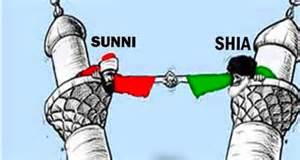
Mohammed revealed his new faith in 610 and it was known as Islam or submission to God. He gathered followers quickly and by the time of his death in 632 had set the stage for the building of an empire. But the Sunni-Shia divide was the result of disagreement over future leadership. The disagreement was simple. The Shia believe that only the descendents of Mohammed could rule, and the Sunni believe that being part of Mohammed’s bloodline was not necessary. The Sunni were more powerful and have a long history of persecuting Shia.
There were further splits within the Shia (e.g. “the Twelvers”), the details of which are not of concern here, but the result is the modern-day distribution of majority Shia in Iran, Iraq, Azerbaijan, and Bahrain and about 40 countries are Sunni.
This modern ethnoreligious conflict
The current sectarian and political differences between the two are due in no small part to the Ayatollah Khomeini in Iran who instituted an Islamic government based on Shia religious principles. Organizations like Hamas and the Muslim Brotherhood are Sunni and do not accept such a version of Islam. Saudi Arabia, a Sunni country, recently sent troops into Yemen (a key strategic concern to the United States) to repel Iranian supported agitators as well as the Houthis. Yemen shares a border with Saudi Arabia. And some scholars have argued that the Sunni puritanical sect known as Wahhbism was in response to Shia Iran. The tensions in Yemen, the Iran-Iraq war in 1980-1988, and the organization of militants in Afghanistan to fight the Soviet Union are all the result of Sunni-Shia tensions. And you might recall that Saddam Hussein was a Sunni ruling over a majority of Shia. Iran supports Bashar al-Assad even though he is an Alawite and a member of the Shia minority sect.
Sunni and Shia governments constantly worry about their grip on power, especially in the wake of protest movements in places like Tunisia and Egypt. The Arab awakening has spread along the sectarian divide especially when minority sects are the ruling power. This is true in Bahrain where Shia are the majority but there is a Sunni ruling family, and of course the Alawite in Syria rule over a Sunni majority. The Civil War in Syria is a classic sectarian tension and a proxy war between Sunni and Shia powers.
These authoritarian regimes, especially where a minority religious group rules over a majority, rely on authoritarian governments closely aligned with their military to maintain the order. These authoritarian governments are sometimes preferred because they result in stability. Sometimes leading scholars even suggest that these cultures are not going to be receptive to American reforms especially with respect to democracy creation. Consequently, they argue for the desirability of authoritarian regimes as illiberal as they are. But the Arab Awakening must be explained. Surely cultural, technological, and economic factors can be a combustible mixture. The Sunni and the Shia provide the spark for this mixture and bubble underneath most political change in the Arab world.
Cultural Differences and Conflict

I know, I know. Dichotomies like the ones below are typically exaggerations and overly simplistic. But such distinctions also represent the real world of how people think. And even if differences such as the ones below are not perfect, they are the sorts of differences that must find their way into solutions. These distinctions also necessarily simplify issues and make them more manageable. Besides, they are better than the cartoonish “Clash of Civilizations.”It is simply true that two cultures such as Islam and the West do not share universal standards of argument and reasoning. It is not that they are incommensurate, but they are sufficiently different such that certain points of articulation must be discovered and addressed. Moreover, the religious versus the pragmatic traditions of the East and West respectively make for numerous points of disagreement.
A Islam-West conflict will be considerably different than other international relations conflicts, which might be more subject to rational negotiation and decision-making. But any conflict between an Islamic and Western tradition will be filtered through identity and made more difficult and sensitive by identity. A conflict will always have to recognize the centrality of identity issues and find ways to manage them.
Differences between Islam and the West with Respect to Conflict Resolution
Islam The West
| 1. Believe an image of violent Islam is predominant in the West.
2. Peace is defined by the presence of Islamic values.
3. Issues of “face” and “honor” are particularly important.
4. Discourse of peace is the exception.
5. Modern social science is not very relevant.
|
1. Islam and the West are incompatible and Islam is a threat
2. Peace is the absence of war and found in pragmatism.
3. These issues are important but somewhat less so.
4. Discourse of peace is normal.
5. Importance of the social sciences and managing conflict.
|
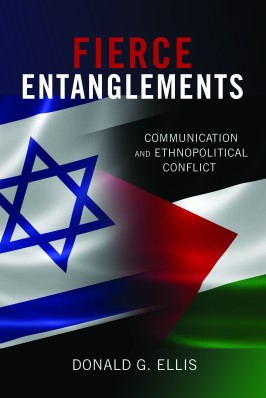
In my book “Fierce Entanglements” I cite 20 of these dichotomies but have only a few here for the sake of brevity and space. I think issues such as these deserve attention and I find that they get relatively little. One of our conundrums is that we currently live in an age of tremendous cultural difference recognition. Subgroups in a society demand recognition of their distinctiveness and the right to practice their culture even though it is at odds with the dominant culture. As a society, we increasingly take great pleasure in pointing to cultural differences.
But we’re much more hesitant when it comes to actually recognizing those differences legally and morally. When we generalize or categorize another culture we are quickly reprimanded and reminded of exceptions and variations. So, I do not know if all the distinctions referred to in the table above are justified, but they do represent a common template and for starters are worthy of discussion.
What do you think?
Obama’s Communication Problems: His Strengths Get Defined as His Weaknesses

President Obama continues to make steady progress on foreign policy issues but, of course, gets no credit for it. Part of it is his own fault because he is always been better at policy than communicating about it. Although his campaigns for the presidency were brilliantly executed and finely crafted with respect to statistical models and winning pathways to the office, he falters when it comes to explaining himself and flooding the media environment with meaningful images and language that “sell” a policy. True enough, we are currently trapped in a maze of Republican attacks and the message environment is full of critical commentary designed to fulfill campaign needs more than anything else. If you did nothing more than follow the Republican primary debates you would think the President was a pathetic bumbling fool. But that is certainly not the case.
For starters, and this is one of the more egregious failures of the president’s team, those critical of the President have been able to control the meaning of his foreign policy by taking the President’s qualities of patience, diplomacy, and thoughtfulness and turning them into weaknesses. It’s a perfect foil for a candidate like Trump (and Rubio and Cruz) all who take macho stances and believe they must come off as “tough guys” who are not going to take any guff from anyone. While the president is solving problems and stimulating relationships, the Republican presidential candidates are making statements that are irresponsible and indicative of their ignorance of foreign policy. I realize this is campaign rhetoric but it does influence the message environment and the White House and Hillary should recognize that a steady diet of these messages is debilitating to the health of Obama’s legacy and Hillary’s campaign.
President Obama is skillfully resetting relationships with Iran and Cuba but the President’s enemies remain in control of the message and its interpretation.
The nuclear deal with Iran was a historic piece of talented negotiation between two religious and political cultures that could not be more distant and separate from one another. You could not find two cultures – the US and Iran – more recalcitrant when it comes to talking to one another; yet, the deal was made and even the carnival barker Donald Trump using the principles of his shallow and simplistic book “The Art of the Deal” could not have done better, his bluster about his own experience making deals notwithstanding. If the future of the treaty with Iran is fragile then it is only because Congress is so hostile to Iran.
And President Obama’s trip to Cuba on March 21 will make him the first sitting U. S. president to visit Cuba since Calvin Coolidge. This normalization of relations with Cuba is long overdue and certainly will not happen during a Rubio or Cruz presidency as they continue with their counterproductive and stereotypic categories for Cuba as a Castro controlled communist state that can never redefine itself.
The power of regular communicative contact has been apparent in the relationship between Secretary of State John Kerry and the Iranian Foreign Minister. They have been talking recurrently and rumor has it they have formed a strong personal relationship during the negotiations. Tyler Cullis writing in Foreign Affairs (March 7, 2016) explains that the US sailors who accidentally drifted into Iranian waters would not have been released so quickly and easily had it not been for the relationship between Kerry and Minister Zarif. This is a success for the Obama administration and should be understood as such. But instead the administration allowed its Republican opposition to characterize it as an embarrassment and an example of disrespect for the United States.
Obama has taken important historic steps to form long-term relations with Iran, Cuba, and other countries, and must be praised for his patient and persistent diplomacy.
Trump and Post-Truth Discourse
[I am republishing this because it was an early warning about Trump and violence. The video tells the story of how Trump does not understand what he is responsible for.]
Trump is dangerous and worse yet he’s unaware of how dangerous he is or doesn’t care. Even at the risk of a little hyperbole we are seeing the consequences of a “post-truth” society where information is distorted, low quality, and attached to a cultish individual full of shibboleths rather than data or reasoning. The post-truth society no longer observes and gathers data in the service of a defensible conclusion; rather, one’s established beliefs and group identity seek confirmation and discourse becomes characterized by a series of cognitive shortcuts designed to confirm what you already believe. Below are three qualities of Trump’s discourse.
But first listen to Trump tell an audience that a heckler from the audience should be “punched in the face.” This is a man running for President of the United States encouraging the audience to start a fistfight. Trump does not even have a rudimentary understanding of his own behavior and the likelihood he could start a riot and hurt someone. His own social and political development is so stunted that he does not understand the tinderbox nature of the situation.
Here is Trump telling us he must be smart because he knows a lot of words.
Then again, this is the same presidential candidate who said the only way to defeat ISIS is to kill their family members. This is a candidate for president who is advocating for a war crime and instructing the military to break the law.
Trump is an essentialist. His rhetoric is filled with references to groups of people and their “essential” qualities. He refers to those who are “stupid” and “not the best.” He regularly makes references to a family member who is a professor at an elite university and to his own elite university attendance. He believes himself and his family are of superior descent. In the video Trump embarrassingly tries to perpetrate this myth by referring to how many words he knows.
Trump demonizes the other side. He refers to Hillary Clinton in extreme terms including name-calling, polarizing language, and blame. By creating the opposition as the “devil” incarnate then it becomes easier to scapegoat them and attach blame. He also has no qualms about dehumanizing others also referring to his opposition as “criminal” or “the most incompetent.” This demonization is simply a substitute for his own inadequacies. Trump essentially knows nothing about policy and hasn’t even taken the time to prepare. Moreover, his followers don’t want to hear policy they just want to hear tough talk and demonization.
Third, and more characteristic of Trump than any other candidate, is a strategy that says attack, blame, and accuse and don’t worry about accuracy or justification because the blame and the accusation is what will be remembered and not the explanation or the truth. Hillary Clinton is bombarded with accusations regarding Benghazi, or emails, or accusations about trustworthiness none of which have much merit but are all designed to do damage first and not worry about the truth. These are all tactics associated with authoritarians trying to damage in opposition rather than engage them argumentatively.
A more shocking and deeper question concerns the explanation for why so many people support Trump. He is not so difficult to explain but the collective delusion of the populace is far more troubling.
The Joys of Hate

The noted cognitive scientist and Nobel Prize winner Daniel Kahneman introduced the concepts of System 1 and System 2 or fast and slow thinking. System 1 is fast, instinctive, and emotional. System 2 is slower, logical, and deliberative. System 2 came later in our evolutionary development. System 1 thinking is intuitive and uses quick judgments that we rely on for most decisions. It is also the process that leads to far greater biases in judgment. System 2, our more deliberative thought processes, can be used to dampen the negative effects of our intuitive judgments. System 1 or fast thinking is reptilian and automatic. It has evolved from deep in our evolutionary history. So we respond quickly and easily to sexual associations and danger. System 2 is thoughtful and cognitive. It requires slower thinking and patience.
The experience of hate is I think a System 1 cognitive process but we often try to treat it with System 2 solutions. In other words, the bigot, anti-Semite, and the racist are typically confronted with System 2 rational thinking as if the person is simply experiencing unjustifiable beliefs and misinformation. We try to change the person or educate him by presenting facts, correcting errors, and revealing logical inconsistencies. Curiously, we are dumbfounded and dismayed when this doesn’t work. When our attempt to reason the other person into correct thinking is useless we are chagrined.
The truth is that bigots and racists and anti-Semite’s don’t want to hear it. They are immune to the closed fist of logic that characterizes reasoning. Also, even though it’s a little bit counterintuitive, these people enjoy the experience of hating. It’s a powerful biologically-based experience of information that doesn’t require much from them and is sensually pleasing psychologically. The System 1 experience of emotional engagement for the racist and anti-Semite is fun! The quick and automatic conclusions of System 1 thinking are enjoyable and require little of the hater.
The person’s beliefs are firmly established and foundational to the experience of hating. There’s no questioning or insecurity. Anti-Semites stand sure in their beliefs and the power and pleasures of self-righteousness, condemnation of others, and sense of intense kinship with those who think like them is climactic in its joy.
Just look at the joys of hating:
- That anti-Semite gets to compare Jews to Nazis. What an orgiastic pleasure it is to take the group you hate most (Jews) and compare them to the great symbol of evil Nazis. Hatred is a purifying experience and perhaps the height of its titillating pleasure is the sense of superiority it confers on one. The bully (think Trump), the self-righteous, the judgmental, and the ignorant are all soldiers in this army of those who feel superior. The expressions of their beliefs are immediate and instinctual. And since they have little cognitive analytic sensibility and are incapable of genuine information processing, they don’t even see themselves as anti-Semitic.
- The racist who feels his group is superior transcends the pleasures of superiority and can think of himself as “morally” purified. Everywhere he looks he sees evidence – the confirmation hypothesis at work a System 1 heuristic – of his group’s moral clarity. The history and traditions of the outgroup are the subject of propaganda and deceit as any “good” in the outgroup is automatically attributed to the environment rather than the group thus maintaining the racist’s own sense of purity.
- The instinctual and exaggerated language of the hater quickly categorizes the other and relieves him of the burden of real moral scrupulousness. So one can accuse Israel of violation of human rights or colonialism without doing the hard analytical work of defining and understanding these ideas. These pleasures extend to the Westerner who hates Islam as well. His sense of political supremacy and rectitude produces the same gut feeling that Islam is backward and tribal, thus reproducing his own moral superiority.
Deliberative and thoughtful exchange about others is slow and plodding. It requires correction and revisiting of attitudes and beliefs that must be modified or discarded. The scrupulous attention to cognitive errors and misinformation is evolutionarily new and we are not yet so good at it, especially when deliberation has to compete with the reptilian joys of hate.
First posted 2/24/2014
The Discourse of the Republican Jihad
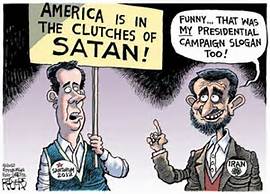
There is a hadith, or saying of the prophet, that goes: “Know that paradise lies under the shade of swords.” Increasingly, this saying makes me think of American party politics as much as an ISIS credo.
I have spent a good part of my professional life studying group conflict that is informed by ethnicity, religion, and ideology. And of all the ugly and murderous strands of conflict the world is subject to those where religion and fundamentalism prevail are the most troubling and recalcitrant. American political discourse, especially inside the conservative wing of the Republican Party, is beginning to sound more like arguing with those who believe they know the mind of God. The unseemly nature of the Republican campaign and the existence of core values that are not subject to adjustment or moderation by democratic discourse, is a communicative expression of these incommensurate conflicts.
There has been no shortage of criticism of the quality and temperament of the leading Republican candidates so I will not elaborate on that except to add my voice to the chorus of those who are dismayed at how vapid Donald Trump is, and how Cruz is a fear-provoking evangelical who believes in using the state to bring about an apocalyptic vision of the end of the world. Rubio is a Roman Catholic but also attends a Southern Baptist Church in Florida probably for pure political expediency. They both have unforgiving religious boundaries and there isn’t much of a difference between them.
For a good and clear summary of evangelicals including their Protestant foundation and politics read an article in Foreign Affairs by Walter Russell Mead.
Turns out that candidates like Cruz and jihadist organizations like ISIS engage in the same rhetoric that is part of the logic of the discourse that characterizes incommensurable realities. (Those competing incommensurate realities are this group of Republican candidates and their liberal opposition). Cruz, who is immovable with respect to walls preventing immigration, the elimination of social safety nets, wiping out the IRS and making taxes unavailable for the public good, and wild and dangerous statements about carpet bombing ISIS, engages in the same rhetorical strategies as the Islamic state does with the West. Here are a few discursive patterns that underscore both groups.
Islam and the West tell different stories and have rival narratives. The language of the stories is constitutive of the meaning and embedded in the psychological, sociological, and political life of each group. Each group is trapped inside a story and there are no points of convergence between them. This is equally true of the Republican candidates exemplified mostly by Cruz. President Obama is not someone to disagree with but must be completely delegitimized; the Supreme Court becoming more liberal is so horrifying that it requires violating the Constitution and stopping the President from making an appointment; our country has been in decline and only the acceptance of Cruz’s God and family values will stay the decline.
Uncontrollable ingroup-outgroup mentalities that distort communication such that contrast effects create a reproducing cycle of perceived differences. Just as the West perceives differences that favor its own group history and culture, so too does the conservative-liberal intergroup mentality maintain a constant sense of differences with positive attributions made to the ingroup and negative attributions made to the outgroup. That’s why “name-calling” is so common and even effective because just labeling someone as a member of an outgroup is sufficiently damaging. There is no place for nuance. Calling someone “right-wing” or “liberal” categorizes them with all the implications.
The political parties (sorry, the Republicans more than the Democrats these days anyway) easily fall victim to the belief that language is dead – as exemplified by the Supreme Court and Scalia’s notion of strict constructionism – and any term or concept has a specifically decided upon meaning whose intent is clear and well understood and cannot be changed. This “dead” notion of language forces a contest between two or more groups for control of the meaning. It directs attention away from trying to find solutions or points of meaningful articulation and more toward self-justification. Meaning, while not completely free, is a living entity that is subject to new insights and discoveries. This mentality has escaped the current campaign as the candidates seem more intent on overwhelming their opponent then actually engaging the public.
Current Thinking about Israel and the Two-State solution

Most people who are considered “rational” resonate with the two-state solution to the Israeli-Palestinian conflict. In other words, there seems to be something coherent and right about both sides having their own state including cultural, religious, artistic, historical, and political traditions that define the nature of the state. In this nice rational world the two sides have clear borders and tolerate one another even if it means little more than going about their business. They would share business interests to each others mutual benefit and perhaps one day even find themselves in a certain amount of cultural convergence – just enough to appreciate the other side.
I continue to support and argue to keep the two-state solution alive. There are a variety of reasons for this but most important is the maintenance of Israel as a “Jewish” and “democratic” state, not to mention what would be an act of justice for the Palestinians. There is just no way Israel can maintain its democratic traditions and its Jewish identity if it has to oversee an angry and disenfranchised ethnopolitical group. The conflict with Palestinians has been damaging to Judaism as well as Zionism. And, it has been damaging to the Palestinians. Again there are many arguments about the history and nature of Palestinian identity and national culture but what matters most is the future and the reality of Palestinian national consciousness. A national consciousness that is inevitable.
A binational (one state for two nationalities) solution is a nonstarter and barely justifies consideration. It is opposed by the majority of Israelis and even plenty of Palestinians. In fact, it would be counterproductive with respect to the goal of securing a Jewish and democratic state living in peace. The two-state solution is the only path to avoiding a binational state. If handled correctly it could result in the dignity and cultural development of both groups allowing each to flourish. But alas settlers and Netanyahu are infuriatingly intent on preventing a Palestinian state.
The current thinking
Among many who see the demise of the two-state solution, along with the right wing who reject the two-state solution, the current thinking is summed up in the phrase “manage the conflict.” In other words, leave things just as they are. There will be no binational state and no state for the Palestinians. Things will stay just as they are and occasional tension and even violence is just the price you pay for normal political reality. “Managing the conflict” makes two foundational arguments.
The first is that Israel is doing just fine. It is a wealthy and prosperous country with a rich economy and a per capita income about 15 times the Palestinians. Israel maintains a strong relationship with the United States – Netanyahu’s insults to Obama notwithstanding – and continues to collect about 4 billion a year in foreign aid. Israel is a world leader in research, high-technology, and medicine. Typically, you hear the argument that these successes will not be improved by the creation of a Palestinian state.
The second point concerns the conscious settlement and geographical control of the West Bank. The Netanyahu government continues to support settlement expansion (under the guise of “natural” expansion) and the annexation of certain areas. This includes a recent announcement that about 100,000 Jews will be settled in the Golan Heights taking advantage of Syria’s inability to respond because of its civil war. Palestinians in areas A and B will not be citizens or have voting rights in Israel itself thus making employment difficult and increasing the possibilities for immigration. Netanyahu and Naftali Bennett, therefore, see no need for a Palestinian state. Just “manage the conflict” and issues will settle themselves over time.



 Peace and Conflict Politics