The Death of the Worthy Adversary

Good dialogical discourse conflates the distinctions between enemies and adversaries; that is, as a combination or fusion of the distinctions such that the two are not so different from one another. Certainly, our polarized culture makes a sharp distinction between an “enemy” and an “adversary.” Part of the discourse of dialogue and deliberation involves maintaining the distinction between the two and treating the other as the “worthy opponent.” Again, this is an important principle of deliberative democracy and deliberative communication. In other words, the two sides of a conflict must work to treat the other as adversaries and a “worthy” one such that your adversary holds a defensible position that is deserving of consideration.
Michael Ignatieff made this point cogently when he explained the distinctions between adversaries and enemies in the New York Times and called for respect between the two. Ignatieff explained that an adversary was someone you want to defeat but an enemy is someone you want to destroy. The current environment which has Republicans wanting to “destroy” Democrats is a good example. Once you define your enemy as the opposition between your own social category and the category of the other, then “enemy” takes on a variety of obstructions and distortions. Trust, for example, is possible for adversaries and does not need to lead to issues related to capitulation, appeasement, or giving in. But trust is not possible between enemies. When you define the other as an enemy trust is an early casualty that can never rise again.
The table below displays some distinctions between treating the other as an enemy or an adversary. An enemy is unwavering in his defensible position where an adversary might be amenable to adjustments. Treating the other as an adversary necessitates a respect for the other position and its grounded nature. Without such respect the two sides talk to each other out of rank disrespect. The use of the language of war and violence exacerbates problems, and makes cooperation impossible.
Obama was seen by the Republican Congress as an enemy rather than an adversary to be confronted. For that reason Obama employed more presidential decrees in order to circumvent a Congress that viewed him as the enemy and was interested only in his failure. Heated rhetoric, such as claims that Obamacare was “an assault on freedom,” were all contributions to the increasing perception of the other as the “enemy.” And although he was reflecting differences in society Obama was also exaggerating these differences.
There is any number of reasons for a gravitational pull toward defining the other as an enemy. But this is just one more example of the corrosive nature of our public discourse that does not even recognize the damage. The ultimate goal is to turn enemies into friends but that is an entirely different interactional category
Enemies versus Adversaries
| ENEMY | ADVERSARY |
| To be destroyed. | To be defeated. |
| Strong negative emotions such as hate and disgust. | The possibility for positive emotions such as respect. |
| No trust. | Trust is possible. |
| Zero-sum game. | Non-zero-sum game. |
| Warfare metaphors. | Possibilities for cooperation. |
| Differences between the two sides are maximized. | Differences can be constructive and are to be integrated. |
| Unwavering commitment to a perspective. | Opportunity for change and altering perspectives |
| The goal it is to refute the other position. Destroy it. | Goal is to understand the other position and argue it. |
| Statements are predictable and offer little new information. | New information surfaces and can be addressed. |
| Success requires simple impassioned statements. | Success requires exploration of the complexities of the issue being discussed. |
Trump Has the Keys to the Candy Store: Suicide is Painless

Sung to the theme of M*A*S*H
Through early morning fog I see
visions of the things to be
the pains that are withheld for me
I realize and I can see…
[REFRAIN]:
that suicide is painless
it brings on many changes
and I can take or leave it if I please.
What madman or anguished society would give the keys to the candy store we call the United States to Donald Trump? No candidate in history has been less prepared and, moreover, does not seem to be bothered by it. His cabinet and advisor appointees make for a ghoulish monster’s ball of Wall Street billionaires who have no experience in government, business executives who think running the government is the same thing as running a business, and ideologues with an agenda that is ironically counter to the mission of the office they are running.
Trump’s election has been regularly compared to populist movements in history and currently around the world. It is in line with populist and nationalistic parliaments in Hungry, Poland, Greece, and the rise of the right in France. And the rhetoric of populism is consistent across cultures. Such rhetoric is often an early indicator of unstable and vulnerable democracies. Truly consolidated democracies are the most resistant and stable forms of government and most likely to be immune to the siren call of nationalism and populism. But less established democratic political cultures, especially those with charismatic strongmen as leaders, are more susceptible to the political discourse that constitutes populism.
That is, the modern populist praises tough and decisive leadership, belittles and distrusts elites and specialists in an effort to alienate the average person from the truly competent, and is critical of institutions. Trump, interestingly, has some new wrinkles for this pattern because although his rhetoric strikes a chord with the struggling and downscale demographics, he has successfully convinced them that he will improve their lives. Curiously, Trump traffics in elitism. And he will soon go about the business of using his own appointees as loyalists who will compromise the media, silence the opposition, and create a threatening discursive environment. He has already begun to undermine trusted institutions such as the CIA (taking the unprecedented position that the CIA is wrong about Russian cyberhacking), the media (a regular flow of criticism and delegitimization that cast even more doubt on quality sources of information), the legislative history of conflict of interest policy (refusal to release tax forms, challenges to his own business interests), and foreign policy traditions (a more volatile and aggressive foreign policy such as breaking the nuclear treaty with Iran, harsh challenges to China, and name-calling).
The United States’ record of promoting liberalism and generally making the right decisions is strong enough. We commit our military when necessary; typically pass legislation that protects the rights of individuals (whether it be guns or abortions); we continue to make progress on due process and equal protection under the law; and we have a decent history of widening the circle of citizen inclusion with respect to rights and opportunities.
But we momentarily lost our minds when we voted for Trump. It was a reckless mistake that requires a “do over.” Clinical research explains that for successful suicide victims there is only a few seconds in which they will actually pull the trigger or jump. The rest of the time they are holding back but there remains some moment – some brief period when the window is open – in which all of their stress, pressures, and cognitive distortions conflate and they actually step off the ledge or pull the trigger.
So we have the United States and Trump. The American citizenry momentarily lost its mind and pulled the trigger. It’s going to be a crazy few years riddled with mistakes resulting from Trump’s lack of preparation, his long and embarrassing record of bad behavior and misogyny, his refusal to listen to security briefings because he can lone wolf-it, his knee-jerk congenital lying (his loss of the popular vote by almost 3 million was from people casting illegal votes; Russia had nothing to do with hacking or influencing the American election), and his naïveté about world leaders.
I fully expect Trump to expand his control and throw the population a bone or two on occasion, all the while converting the presidency into a postmodern spectacle designed to continue Trump brand recognition.
I Don’t Want to Debate. I Want to Talk about My Pain. How the Democrats Got It Wrong

It is quite interesting how just a few short months ago we were burying the Republican Party. They were in a state of disarray with a crowd of presidential contenders each of which seem to be more flawed than the next. And Trump was the worst of the bunch. As his momentum grew there were more and more articles and analyses decrying the state of the Republican Party explaining how Trump was going to destroy it. The reliable sensible old guard (Romney, McCain, Bush) were not only abandoning candidates but actively working against them. Romney’s pointed and vitriolic attacks on Trump were shocking coming from the cool businessmen Republican. So what happened? How did one of the worst candidates who is the least prepared and lacks the basic manners for the job get elected?
It turns out that the Republicans can’t take credit for getting Trump elected, but the Democrats can take some blame. And it wasn’t Hillary’s fault either. Her campaign made mistakes but it was not the technical and strategic components of the campaign that made the difference; it was the smug identity politics of the left; it was that sense that if you disagree with me (a good liberal) you must be some simplistic uneducated fool who is racist and sexist. And I am equally guilty.
Liberalism is a political ideology fundamentally concerned with inclusion, rights, and individual freedom. In recent years it has become associated with sharp group identities demanding recognition and a tension between “celebrating differences” and seeking the commonalities that bind us together as a nation. Our history of privatizing ethnicity and religion, and using the overarching American national ideals (democracy, individual rights, etc.) as common factors has served us well. It has meant over the years that our personal identities are not wrapped up in religion and ethnicity but in political philosophy designed to treat each other equally. But as those “rights” became increasingly group identification rights such that groups were clamoring for distinction and difference rather than commonality the differences and cleavages amongst us became the focal point. Consequently, as the title of this essay indicates, public argument and deliberation to solve problems receded into the background as individuals foregrounded their personal identities and private pain.
Liberal activism in the service of identity politics – to the exclusion of other issues – has been making progress along with a smoldering grassroots reaction and intensifying disdain for the other side. Finally, we ran into Trump who was equally as skilled at a self-righteous and aggressive style of discourse and thereby became the voice of the disenchanted. It’s important to underscore that the liberal group agenda is responsible for improving group political rights and battling the racism and discrimination it is so recognized for. The “group rights” agenda is responsible for reshaping civic life and addressing inequities burdening minorities as well as other segments of society. But the evolution of those rights into an arrogant identity politics rather than a unifying political agenda has left us with the contentious group distinctions we are experiencing and its accompanying polarization.
The recent presidential campaign was a despicable display of politics that was almost free of discussion of issues, uncivil, tacky, shallow, and polarizing. It failed its responsibility to our foremost political requirement, which is to use democratic means to shape a society into a fair and governable unit. This of course includes respect for individual group identities but in the future might require more emphasis on those things we need to do together rather than separately.
Trump and the American Media Landscape

There is a correlation between the American media landscape and the change in public discourse, especially presidential discourse. Trump represents a different type of person to occupy the office and that is especially true of his language, digital media use, and discursive practices. As more than a few people have noted, we are in a historical period were authority is disrespected and challenged on all sides. Facts just don’t seem to matter. And when we become disconnected from facts it is possible to believe anything. So science is rejected and challenged on the basis of arguments and reasons outside the boundaries of science. Global warming, climate change, the value of vaccinations, etc. are all subjected to a set of criteria and justifications incompatible with proper scientific standards of reasoning.
Trump is a frightening extreme when it comes to ignoring facts and simply making it up or saying whatever he pleases. And the situation is even more egregious when you combine his temperament with a personality disorder. That is, he is so incapable of accepting criticism or recognizing defeat that he digs in his heels and lashes back even more aggressively. The truth be damned. When you combine this disposition with the fact that he actually knows very little and is unschooled in diplomatic, political, and intellectual conversations you have a problem. The mix can be combustible. Remember he said most of his knowledge is based on the Sunday news shows so his political knowledge is about equivalent to whatever information comes in a headline service.
The Media and the Formation of Trump’s Consciousness
What kind of mediascape does Trump live in? His vocabulary, short assertions, egocentrism, and incomplete grasp of the issues have been fashioned as a result of his emergence from a network of communication patterns and exposure to issues situated within the particular media environment. In a word, Trump talks like and processes information like those in his dominant mediascape. Let me be more precise.
Rodney Benson in a paper for Goldsmiths describes “The New American Media Landscape.” Benson essentially posits three segments of the US journalism field. The first is a vast infotainment field that is populated by well-maintained websites such as Yahoo and the Huffington Post. Local commercial television and the innovative websites Vice and Vox are included in this category. These sites produce news in an appealing fashion intended to attract audiences; they do some interesting things but are designed more to attract attention then quality information. A second segment of the mediascape is the partisan media represented by Fox (conservative) and MSNBC (liberal). The political blogosphere is also pertinent here. This is the terrain of biases and shouting matches where slavishly clinging to a political perspective, even if it’s an indefensible perspective, in order to bring down the other side is the primary motivation. And the third territory is the mainstream quality media such as The New York Times and Wall Street Journal. Specialty magazines and academic papers are also part of the quality media landscape.
Trump is always critical of the mainstream quality media because they are issue and data based in an effort to treat issues according to their quality and allowing good solutions to emerge rather than insisting on a political perspective that is forced on everyone else. The mainstream quality media is more critical and analytical and seeks to attract an audience on that basis. Trump’s discourse and primary influences clearly match the second level partisan terrain of the media characterized by distortions and misinformation. His name calling and bombastic style are contrary to what a functioning democracy requires which is a public narrative that recognizes differences.
The image of Trump as a populist nationalist (I will reserve judgment on using the word fascist for now) is increasingly defensible as he continues to appeal to an angry population by stoking the fires of their resentment. His 3 o’clock in the morning tweets make him an active participant in the partisan landscape. Apparently, a couple of nights ago Trump was watching a program on flag burning as symbolic speech. Consistent with his unreflective style he tweeted his immediate emotions which were to assert that burning the American flag should result in either jail time or loss of citizenship. He used new social media (Twitter) to blurt out an unconstitutional and indefensible gut reaction exerting a sense of power. His behavior from the partisan landscape was responded to by the quality media with a lecture for Mr. Trump on the Constitution and the extent to which it protects symbolic speech, of which the Supreme Court has established. This is one thing – maybe even to be expected – from a private citizen but a little scary and disappointing from the President of the United States. I suspect we will see more media territorial framework tensions as Trump’s partisan media style clashes with other segments of the media landscape.
Right Wing Media Bias
This video makes some very strong points and is worth watching. I suggest you click on it now and watch. The video is sponsored by “Media Matters” which is a liberal organization but one that has the interests of our democracy in mind. It is possible to make the case that systematic and consciously perpetrated bias by Fox News governs their organizational identity and has quantifiable effects on voting patterns and political knowledge. The claims of news bias are so pervasive and so self-contradictory that it’s damaging any remnants of news credibility. Everybody believes the news is biased right up until the point the news says something they agree with. And, moreover, people are absolutely convinced that their perceptions are correct and their understanding of the issues and whatever source they came from is accurate. The public is shockingly naive about the frequency and forms of information processing distortions.
Let’s pay attention for a moment to this issue of news bias and try for some rigor and conclusions that result from data and controlled studies. I’ve grown weary of everyone complaining about the news and biases especially when all the complaints are simply self-serving. It borders on fascinating how few people see their own distortions and biases. Every Trump supporter is convinced the New York Times and the television media – minus Fox News – favored the other side and was critical of Trump while being charitable toward Hillary. And Hillary supporters (although in much smaller numbers) lamented the fascination with Trump that brought him so much free media time.
I would call your attention to a study directly confronting this issue of Fox News and its impact in the news sphere. The authors examine the impact of media bias, the persuasiveness of a particular media, the likelihood of voting, and mobility rates. Moreover, and something most citizens don’t think about, the review of the studies includes conditions of the receivers. In other words, the same news programming does not have the same effect on everyone. So, on the basis of survey research the authors found that 22% of the population believed that Saddam Hussein had weapons of mass destruction, but 33% of Fox News viewers believed he had weapons of mass destruction. The findings hold even after controlling for party identification.
Additionally, exposure to conservative media has an effect on voter choice including being responsible for switching some Republicans to Democratic voters. The results are slightly conditioned by the psychological state of receivers. Those watching Fox news for the first time were more persuadable than viewers who watched consistently. This particular study focused on Fox News and conservative media but I would presume that the pattern of results apply to liberal media as well even if the effects are stronger or weaker.
My concern here is not to repeat the pernicious effects of Fox News or biased media but to sound the alarm for increasing pressure to both find quality outlets of information, as well as “educate” the public a little more about the nature and exposure to bias and what to do with it. Fox News is responsible for taking partisan positions and making some extreme even outrageous claims; these then get repeated and spread throughout the population thus multiplying the distorted effects.
Turning more toward public media rather than commercial media is one response to this situation. Public media presents more in-depth and critical news about domestic and international affairs and is capable of increasing citizen engagement as well as quality information.
Trump and Israel – He’s Confused

The problem with trying to understand Trump’s relationship to Israel and the Middle East in general is that he knows nothing about either, and has no foreign policy record. His positions are confused and contradictory especially with respect to Iran and Saudi Arabia. He seems to care very little about most places except Iran in which he has threatened to pull out of the US-Iran nuclear agreement. And this is particularly dangerous if Trump surrounds himself with a Secretary of State such as Bolton or Giuliani both of whom are bellicose and more capable of inflaming differences then cooling them. Trump is sufficiently confused such that he is publicly critical of Iran but supportive of Bashar al Assad in Syria. Soon it should occur to him or his advisors that supporting the Syrian governing regime bolsters Iran, not to mention being on the wrong side of the ideological spectrum.
Israel primarily wants two things from the United States – its regular military aid, and the support and recognition that comes with our cultural and democratic affinities. Both of these can be in potential danger depending on which planks of Trump’s tangled platform end up emerging as the strongest. Trump has, on the one hand, signaled a lack of interest in the Middle East and an almost isolationist sensibility. In his businessman’s language, he does not see it as a “good investment.” On the other hand, Trump is committed to defeating ISIS and does not seem to fully realize the central role Israel must play with respect to intelligence and support. Moreover, continuing his confusion, he has taken highly inflammatory and unrealistic positions by expressing support for the settlements and moving the US embassy to Jerusalem. At other times he just wants to remain distant from the issues. The Forward has suggested that Trump will probably reduce America’s involvement in the Middle East. This is generally not good news.
His conservatism is not yet fully honed because Trump sometimes appears to be the isolationist who does not want to be the world’s policeman, and at other times he seems to resonate with neoconservatives who want to assert American political and military power. Trump has a lot to learn and it is the type of learning that requires some development and maturation. He cannot see the Israeli-Palestinian conflict as just one negotiation trick away from resolution. He is more comfortable with business deals and negotiations which are subject to more rational marketplace considerations. “The art of the deal” is governed by a logic that requires one to maximize benefits and minimize losses and the deal is done when both sides can accept their gains and losses. This is not the governing logic of asymmetrical ethnopolitical conflicts that are intractable; in other words, the issues of sanctity, identity, fractured history, violence, and deep emotions are not part of the rational model of the “art of the deal.”
I suspect Trump’s limited experience in international affairs blinds him to the type of communication necessary to solve problems such as the Israeli-Palestinian conflict which does not profit much by seeing it only through a prism of rational exchange. I fear that when he becomes fiercely entangled with the knotty issues that characterize the Israeli-Palestinian conflict he will see it through a narrow American prism rather than a broader global and cultural one. And the tools that enabled him to succeed in business will not serve him so well in the arena of international conflict.
The Republican Party is generally more blindly supportive of Israel but for now all we know about Trump is the blind part.
The Right Is the New Left
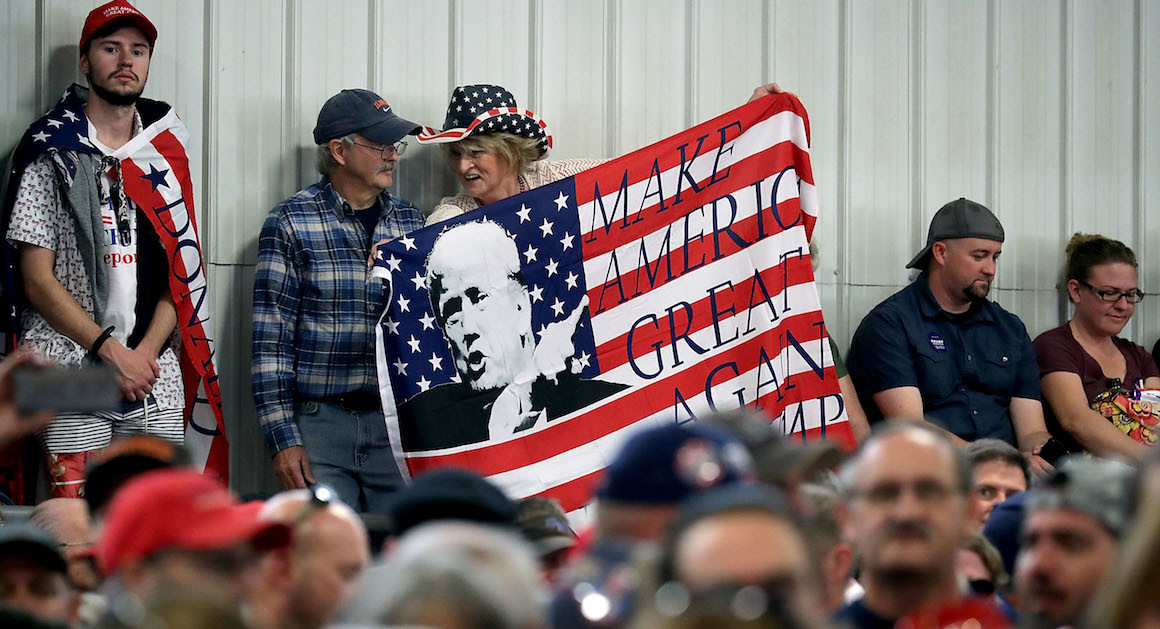
Have you noticed that it’s the left end of the political spectrum that is now defending the status quo. Obama and Hillary supporters are the establishment and described as a continuation of the past and the mainstream of politics. It’s the Trump supporters and those on the right who are the critical outsiders. They are the ones who want to take down the “establishment” and remove the government. It used to be that the left had an oppositional relationship with society, and the right was mainstream conservatism and the defender of national values; it used to be the left that engaged in cultural terrorism, and the right was associated with maintaining American values and traditions. So, what happened?
I will tell you what happened. The left has made serious progress on its goal of creating the “culturally correct” man. This was accomplished methodologically by the process of criticism of society with the goal of transforming the historical power structure of American society. The angry, violent, and revolutionary voices come more from the Trump camp than the Hillary camp. Even Bernie Sanders’ liberal constituencies quietly and obediently returned to their lives rather than organize and revolutionize. What is this methodological process that creates the “culturally correct” man? It is commonly known as political correctness. The angry American (of which angry white males are the most typical) feels oppressed by political correctness such that he or she is now in a more radicalized oppositional relationship with the political process. It’s the right that is intensely and more violently critical of American society.
Political correctness has its roots in Marxist social theory and the goal of revolutionary transformation. Detailed examination of Marxist criticism is beyond our concerns here but suffice it to say that a whole line of destructive criticism – emanating mainly from the Frankfurt School – challenged the fundamental elements of American society such as patriarchy, capitalism, patriotism, morality, family, gender, and religion. The transformations of the economy and the changing nature of work and manufacturing have combined with cultural criticisms to position a significant segment of the right into a revolutionary stance.
Working class white males, exemplified by what has become known as the typical Trump supporter, have suffered the most from pressures to upset the patriarchal order (e.g. intense demands to change gender reference language; acceptance of same-sex marriage), change the Christianity-capitalism authoritarian structure (ordination of women; the misguided belief in the efficacy of their own individualism), and the steady substitution of white males by women, immigrants, and the government.
The pressure on middle-class white males has been relentless. The culture increasingly speaks a new language that has been stripped of its traditional power and substituted by a neutral and more inclusive vocabulary that clearly does serve the goal of diversity but at the expense of the traditional institutions of authority.
Even though more inclusive culturally sensitive language is a laudable goal, it resonates more with the cosmopolitan liberal than the traditional conservative. Multiculturalism is the true enemy of this group on the right and can be seen as breaking up traditional cultural values, taking jobs, and dismantling American society. Interestingly, this group values rugged individualism and small government but still expect government to provide social safety nets. Many of these working-class white males have roots in the Democratic Party and still retain some party identification but most of them fit into the Pew Research Center political identity category termed “hard-pressed skeptics.” They are low income and express negative attitudes toward immigrants and are distrustful of government. The combination of factors has resulted in a communal rather than ascribed identity makes them a politically critical outside group.
One Final Attempt at Quality Information before Voting
Dear blog follower:
During this election, more than any other, trying to get some facts right is difficult. The below is from ProCon.org a nonpartisan educational organization, that helps everyone to make informed decisions regardless of how or for whom you vote. The degradation of the political process, the volume of ignorance floating around, polarization, and the incivility and impertinence of the candidates is of historic proportions. Most of us never imagined Trump as a Republican candidate and we certainly didn’t imagine the debates – which were supposed to be an informed and intelligent portrayal of the candidates – as a showcase for marital and sexual indiscretions paraded in front of the opponent and the world.
So, I offer the below as the clearest and most objective side-by-side comparison of the candidates and their stance on issues. You may have made up your mind already but at least check your thinking against the information presented.
Presidential Election
2. 2016 Presidential Election Candidate Quiz – Find Your Match!
Abortion
4. Top Pro & Con Quotes on Abortion
Felon Voting
5. Should Felons Who Have Completed Their Sentence (Incarceration, Probation, and Parole) Be Allowed to Vote?
6. State Felon Voting Laws
7. Number of People by State Who Cannot Vote Due to a Felony Conviction
Gun Control
8. Should More Gun Control Laws Be Enacted?
9. Top Pro & Con Quotes on Gun Control
Immigration
11. Should the Government Allow Immigrants Who Are Here Illegally to Become US Citizens?
12. Illegal Immigration, Population Estimates in the United States, 1969-2014
13. Demographics of Immigrants in the United States Illegally
Marijuana
14. Should Marijuana Be a Medical Option?
15. 25 Legal Medical Marijuana States and DC
16. Ranking 20 Drugs and Alcohol by Overall Harm
Minimum Wage
17. Should the Federal Minimum Wage Be Increased?
18. Top Pro & Con Quotes on the Federal Minimum Wage
19. State-by-State Minimum Wage Levels
20. And, just for fun, Top 10 Most Surprising Things in the 2016 Presidential Candidates’ Online Stores
The Problem of False Equivalencies
But, please, tell me again how “both candidates are the same” and they’re “equally as flawed.” Because if that’s what you really believe, then you’re choosing to ignore reality and believing whatever the hell you want to believe.
Read more here
How the Trump Monster Slouched toward the Republicans
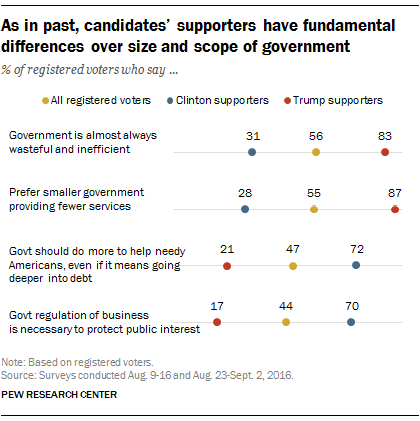
Note the data in the table below from the Pew Foundation. There have been more than a few stories written about how Trump is a monster created by the Republican Party. Let’s take a closer look at just what the Republican Party has created and why. There are lots of reasons but let’s focus on two. First, the Republicans have simply failed to appeal to Hispanics and minorities even though their after action report from the 2012 election recognized this problem. They did little or nothing about it. 86% of Republicans or those leaning that way are White where only 57% of Democrats are White. Curiously, the Republicans should be able to appeal to Latinos who are family oriented, religious, and patriotic to the extent that they oppose leftist regimes. There are two prominent Republicans in Ted Cruz and Marco Rubio who could be electable if conditions were right. The Democrats have begun to include minorities more into the family tent and these minorities recognize their own progress – Donald Trump’s claims that their schools and inner cities are a mess notwithstanding.
Moreover, the Republicans began to run more on moral and social (guns, God, and gays) issues then on economic ones. The angry less educated white male strand of Republican has countered any genuine Republican attempts to include minorities because of their racism and general rejection of the argument that immigration is good for America rather than bad. The foreign-policy hawks in the Republican Party are an attractive appeal for many Americans, and can resonate with American strength, but this group has essentially been co-opted by Hillary Clinton.
Bill Clinton moved to the party to the center and brought in more professionals leaving working-class whites to find a place in the Republican Party. These working-class whites have been frustrated by the Republicans who promised to look after their interests but haven’t done so very successfully. So this group had one more reason to radicalize and movements such as a Tea Party began to emerge and differences between minorities and whites and Republicans and Democrats began to polarize even further.

The table below strongly illustrates this polarization. The blue dots represent Clinton supporters and the red dots Trump supporters. Look at the differences between the two on a few key issues that are ideological in nature. Statements about how wasteful government is and should be smaller are dramatically associated with Republicans (83% and 87% agree). And statements about how government should help the needy and regulate business (most associated with Democrats) are strongly supported by Democrats over Republicans (72% and 70%). These patterns in the electorate are the reason Donald Trump was so successful in the primaries. Moreover, rather than finding a candidate who genuinely coalesced around cultural and economic issues Trump represents fear and nationalism. How is a political party supposed to get anything done when they express such disdain for government?
Trump’s populist nationalism makes us particularly vulnerable because the public currently has so little confidence in many American institutions such as the courts, the presidency, public schools, and banks. When the golden haired man comes on TV and tells you that nothing is your fault – it’s all the fault of immigrants, elites, and the media – there’s plenty of people who will listen.




 Peace and Conflict Politics